One-Day Sale | October 14th, 2026
It's here! Our One-Day Sale this month is on October 14th, 2026.
For 24 hours only, save 50% on over 700 titles from Naxos!
Explore an incredible selection of box sets, CDs, DVDs, and more, featuring best-selling recordings of music by Dvořák, Strauss, Janáček, Vivaldi, and many more.
Whether you're filling gaps in your collection or discovering something new, this is your chance to shop hundreds of Naxos favorites at half price!
Over 700 titles. 50% off. 24 hours only. Don't miss out!
Shop now through Thursday, October 15th, 2026 at 9:00AM CT!
738 products
-
-
-
-
-
SaleBolcom: Trio for Horn, Violin and Piano - Suite No. 2 for Solo Violin
Naxos · Nov 2021CD$19.99$9.99 -
-
-
-
-
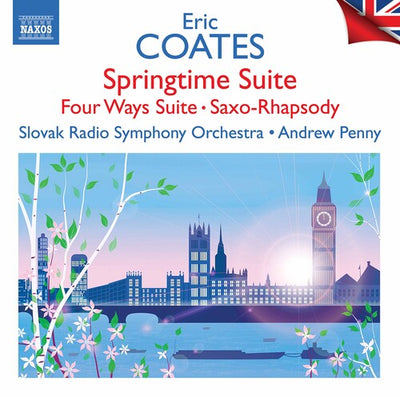
SaleCoates: Springtime Suite / Edge, Penny, Slovak Radio Symphony Orchestra
Naxos · Jan 2022CD$19.99$9.99 -
SaleTchaikovsky: None But The Lonely Heart / Nishizaki, Breiner, Queensland SO
Naxos · Nov 2001CD$19.99$9.99 -
SaleAmerican in Paris (An) / Porgy and Bess Suite / Gershwin in Hollywood
Naxos · May 2002CD$19.99$9.99 -
-
-
-
-
-
-
-
-
-
-
SaleWOLF-FERRARI, E.: Vedova scaltra (La) (La Fenice, 2007) (NTS
Naxos AudioVisual · Jun 2008DVD$37.99$18.99 -
-
-
-
-
-
-
-
-
SaleTavener: Ex Maria Virgine, Angels, Etc / Brown, Berkieta, Jacobs, Clare College Choir, Et Al
Naxos · Nov 2008CD$19.99$9.99
Pierné: Ballet Suites
Composer, conductor and organist Gabriel Pierné wrote in a wide variety of genres, from operator pieces for solo piano. His orchestral music for the stage shows the utmost refinement and clarity as well as wit and charm in the finest French tradition. His colorful and evocative score for Ramuntcho is rich in Basque flavor with zortzico dance rhythms and village dances, all beautifully textured. Set in the 18th century, the ballet Cydalise et le Chèvre-pied reveals the full range of his inventive scoring, which remains chamber music-like in its finesse.
Bolcom: Trio for Horn, Violin and Piano - Suite No. 2 for Solo Violin
Recipient of the National Medal of Arts, Pulitzer Prize, and a GRAMMY Award, William Bolcom is one of America’s most senior and internationally acclaimed composers. Commissioned to expand upon the under-represented horn trio repertoire, Bolcom has written a modern counterpart to Brahms’ Trio for Horn, Violin and Piano, Op. 40, in which he incorporates multiple styles into a substantial composition. The Suite No. 2 for Solo Violin is by turns frenzied, melancholic and light-hearted. Bolcom states, “Both works are performed beautifully and well recorded. Bravi tutti!”
Liszt: Complete Piano Music, Vol. 59 - Schubert Transcriptions
As a boy during the years 1822–23 Liszt studied in Vienna with Czerny and Salieri, at the same time as Schubert was winning his reputation as a leading composer in the city. Many years later Liszt did much to introduce Schubert’s music to a wider audience, not least through his prodigious transcriptions. In the case of the Three Marches and Mélodies hongroises, Liszt selected music originally written for piano duet, but in Soirées de Vienne, a set of nine pieces of which some were to remain prominent in Liszt’s concert repertoire, he fashioned a sequence of truly memorable valse-caprices.
Coates: Springtime Suite / Edge, Penny, Slovak Radio Symphony Orchestra
American Classics - Sowerby: Organ Works /Craighead, Mulbury
Sowerby was fascinated by traditional forms, and his 'Classic Concerto' explores many of these structures. Within its three brief movements, it gives an excellent introduction to Sowerby's playful sense of harmony. 'Medieval Poem' and 'Pageant,' both written earlier, also delve into traditional themes.
'Festival Musick' is an audience favorite, bright and playful. Its sense of humor is evident to occasional listeners as well as those more intimately versed in organ music. Composed during a single week in summer, it is one of Sowerby's last compositions.
Both organists involved with this album have the remarkable technical skill and performing panache to bring Sowerby to life. The rich sound of the organ at St. Bartholomew's Church in New York City and accompaniment of the Fairfield Orchestra have been captured masterfully. WORKS FOR ORGAN AND ORCHESTRA is a well-performed and expertly engineered recording.
American Classics - Foote: Piano Quintet, Quartets /Da Vinci
Foote's chamber music is strongly influenced by Mendelssohn and Brahms, neoclassical in outlook, graceful and lyrical with little hint of storm or stress. This disc, featuring the Piano Quintet along with the Op. 32 and Op. 70 string quartets, is one of two of all-Foote releases which are part of Naxos' admirable American Classics series. The recordings feature the Da Vinci Quartet, a very good Colorado-based ensemble which has undertaken the performance of all of this composer's chamber works.
American Classics - MacDowell: Piano Music Vol 2 /Barbagallo
- American Record Guide
Meredith Willson: Symphony No. 1 and 2 / Stromberg, Moscow SO
The First Symphony was written as a commemorative piece for the 30th anniversary of the San Francisco earthquake of 1916. But rather than recall the horror of that event, the piece is more of a tone poem celebrating the city. The second movement, however, is poignant in its evocation of a city rebuilding itself. The rising opening violin line, emulating a rebirth out of the ashes, is particularly effective.
The Second Symphony, another work celebrating the glory of California, has a vague Spanish character to it as it pays homage to Father Junipero Serra, a "padre-pioneer" in the words of Willson. As with the First Symphony, the outstanding movement is the Andante with its veiled references to Gregorian chant and its Spanish motives as an allusion to the Spanish mission founded by Serra.
William Stromberg, a conductor who has an affinity for performing film music, is to be commended for bringing to light these once forgotten works with sterling performances from the Moscow Symphony Orchestra.
Lully: Grand Motets Vol 3 / Hervé Niquet, Concert Spirituel
The three Grands Motets are interspersed with Lully's settings of O dulcissime Domine and Laudate pueri Dominum. The two women's voices in O dulcissime Domine interweave magically over a continuo accompaniment. The highlight, however, is the first motet, Exaudiat te Dominus. The opening is lively and joyous, contrasting with the sad, heart-felt setting of Domine salvum fac. Le Concert Spirituel bring out the contrasts in the Dormierunt section of Notus in Judaea Deus well, and respond to the grandiose passages in the Benedictus. It is only in this latter piece that the generally crisp and rhythmic articulation flags.
The curious should not hesitate. The recording is in general good, although the harpsichord sounds dull. Full texts and translations are included.
-- Colin Clarke, MusicWeb International
American Classics - A Sampler
When complete, this series will consist of over 200 titles, exploring the full spectrum of American concert music. All the familiar names are there: Copland, Ives, Grofé, Barber, and Sousa but so are many others such as: Bennett, Dédé, Foote, McKay, and Siegmeister all of whom have contributed to the rich musical tapestry that is American.
All of us at Naxos invite you to journey with us as we set out to discover America.
Click Here for the complete Naxos American Classic Series
Tchaikovsky: None But The Lonely Heart / Nishizaki, Breiner, Queensland SO
But overall Takako Nishizaki's beautiful singing tone and sweetly-wrought phrasing, partnered with Breiner's affectionate conducting, make these transcriptions pleasing and satisfying musical experiences, even without the love poems that were Tchaikovsky's main impetus. My only caveat concerns the disc's tracking order: placing so many slow and similar-key selections together unavoidably engenders feelings of monotony. But since this easily can be remedied with the CD's programmability, there's no reason for you to hesitate about obtaining this serene, relaxing disc. Naxos' atmospheric recording balances Nishizaki's violin significantly forward relative to the orchestra.
--Victor Carr Jr., ClassicsToday.com
American in Paris (An) / Porgy and Bess Suite / Gershwin in Hollywood
Bernstein: Symphony No 2, Etc / Judd
"The opening "Candide" Overture is particularly poignant, for it reveals a band full of life and spirit eagerly responding to Mr. Judd's forward-leaning and even accelerating tempo. But perhaps the most valuable item here is Bernstein's Symphony No. 2, "The Age of Anxiety," a strong work -- alternately atmospheric and excitable, and ultimately carefree -- that is not overrecorded. Jean Louis Steuerman is a deft piano soloist, and the orchestra again does itself proud under Mr. Judd's steady hand." - James Oestreich, NEW YORK TIMES
American Classics - Carter: Symphony No 1, Etc / Wait, Et Al
It’s very good news that Naxos has added Elliott Carter to its American Classics series, beginning with a strong programme of rarely heard pieces, and juxtaposing Carter in early populist vein with Carter the 1960s’ avant-gardist in full cry.
The wartime muscularity of the Symphony No 1 (completed in 1942 but heard here in its 1954 revision) is clearest in passages which echo, or anticipate, Copland’s more extrovert orchestral scores of the same period. But that triumphalist spirit is most productively on show in Carter’s splendidly brash Holiday Overture (1944). The Symphony as a whole is less straightforward, more varied in style and character, and the slow movement in particular moves from hymnic meditation into more ambiguous regions of expression in a manner that might not be completely convincing. It is certainly distinctive, however, and fits well with the balance between restraint and exuberance that typifies the work as a whole.
By the mid-1960s, when the Piano Concerto was composed, Carter’s language had shed its tonal roots, and his forms were far more distant from those traditions that are still traceable in the Symphony. Textures are immensely elaborate, yet the music is uninhibitedly dramatic, depicting all kinds of conflicts and attempted reconciliations while subjecting the basic concept of the concerto to penetrating critical scrutiny.
The power of the drama emerging from the constantly fluctuating confrontations between soloist, main orchestra, and a mediating concertino-group of seven players is rather muted in this recording, which (I suspect) is not the result of a preparatory series of public performances. Ursula Oppens, with Michael Gielen, managed to convey rather more of the music’s inherent fire and tumult. But Mark Wait shows a finely gauged technical command, and although Kenneth Schermerhorn and his Nashville players are occasionally underpowered and inclined to play safe, the jubilant conclusion of the Holiday Overture sweeps any interpretative reservations aside. With the symphony not otherwise available, this disc is a thoroughly recommendable addition to the Naxos American canon.
-- Arnold Whittall, Gramophone [3/2004]
Tavener: Lament For Jerusalem / Summerly, Et Al
Liszt: Symphonic Poems / Michael Halász, New Zealand So
Ce qu'on entend sur la montagne also goes very well. The natural sonics capture the atmospheric opening (with its then-novel bass drum rolls) very effectively. If you know your Sibelius, you will recognize these first few minutes as the conceptual forebear of the Finnish composer's En Saga. Yes, the work's various sections tend to lie side by side rather than flow inevitably into one another, but it's a lovely piece that doesn't deserve its current neglect in the concert hall. Hunnenschlacht is just plain fun: a noisy battle followed by an organ-led apotheosis. Once again Halász and company deliver the goods, with fine playing and a vivid sense of drama. Also, to their credit, they don't linger over the less-interesting music representing the "good guys". In short, these are intelligent and effective performances that deliver maximum bang for your buck. Give them a shot.
--David Hurwitz, ClassicsToday.com
Bernstein: Dybbuk, Fancy Free / Mogrelia, Nashville Symphony
Fancy Free of course is delightful, and often recorded, but this performance holds its own with the best--and I frankly prefer Andrew Mogrelia to the composer in Dybbuk. He's just that much livelier, and the Nashville Symphony sounds as inside the idiom as the New York Philharmonic of several decades' past. This newcomer also is better recorded than Bernstein's performances either on Sony or DG, and the excellent version of "Hot Stuff" that opens Fancy Free also is a plus. If you're a Bernstein fan, you will certainly want this.
--David Hurwitz, ClassicsToday.com
Rossini - Complete Piano Music Vol 1 / Alessandro Marangoni
More private were the creations which became collected as the Péchés de vieillesse or ‘Sins of Old Age’, which are contained in fourteen volumes. Some of these are for voice and piano, others, such as volume IX, include pieces with strings, harmonium and horn, the solo piano works from which appear at the end of this programme. Album de Chaumière or ‘The Cottage Album’ is the no doubt ironically twee title given to volume VII, the first of the albums for solo piano. This consists of 12 pieces ranging from titles such as Petite polka chinoise to works of a grander scale such as Une pensée à Florence. Rossini’s attitude with these works is frequently ironic and often deceptive. Confronted with a title such as Prélude inoffensif, one might expect something other than the extended lyrical aria which in fact appears. The generally light character of many of the pieces is interspersed with more searching, funereal atmospheres such as that in Un profound sommeil, and Un cauchemar – literally ‘A Nightmare’. In these pieces we are not so very far removed from the symbolic cries of the owl in Leoš Janá?ek’s ‘On a Overgrown Path.’ On the complete opposite there are parody-like pieces such as the bombastic Marche which closes Vol. VII.
Alessandro Marangoni is a young pianist and a rising star whose reputation will in no way be harmed with these recordings. Whatever one thinks of these ‘Sins of Old Age’ they are certainly a fascinatingly enigmatic and eclectic mixture of Rossini in all moods. Fans of the Petit messe solenelle must certainly investigate these pieces, as the thick piano chords and bouncy bass lines which crop up in that work are certainly not absent here. Fans of Rossini’s operas are also kept well fed with rich melodic invention, if performed instrumentally rather than vocally. This Naxos recording is very good, with a rich, deep piano sound, if captured in a rather dry and tubby acoustic. The impression is one of a front room soirée rather than a concert hall performance, which isn’t such a bad thing for these pieces. I do however feel that a slightly more sympathetic space might have helped Alessandro Marangoni when trying to give a more legato feel, or in varying the colour and mood. The pieces come across a little on the lumpy side sometimes, and the contrast between some of the works is less startling than might otherwise have been the case.
This new series will have to compete with the recordings by Stefan Irmer on MDG, and although there is no information on the instrument used in the Naxos recording – other than that it is a Steinway & Sons from the Angelo Fabbrini collection, it gives the impression of being an older instrument, a quality it would then share with the MDG recordings. The bass has a pleasant rounded quality, and the usual Steinway brightness only really shines through in the upper registers at higher volume. Any reservations I may have can be accounted for as a matter of personal taste, so nothing I say should stop anyone from dropping into their local retailer and bagging this remarkable release forthwith. This is going to turn into another of Naxos’s eminently collectable sets, and on this showing will prove to be worth it at almost any price.
-- Dominy Clements, MusicWeb International
WOLF-FERRARI, E.: Vedova scaltra (La) (La Fenice, 2007) (NTS
Kuhlau: Piano Sonatinas Op 55 & 88 / Jeno Jandó
This release marks another disc in the lengthening series of Kuhlau’s compositions on Naxos.
Kuhlau, born in 1786 to a musician with the German Army, began his musical education in Lüneburg with piano, and also began to compose at that time. Around 1800 he studied with C. F. G. Schwenke, the man who succeeded C. P. E. Bach in the position as Hamburg Stadtkantor. By 1804, Kuhlau was in the process of launching his career as a pianist in earnest. Blind in one eye since childhood, Kuhlau fled to Copenhagen under an alias to avoid mandatory military service; his half-blindness evidently did not compel the authorities to exempt him. He eventually became a naturalised citizen of Denmark and established his base there for the rest of his life.
Known to this reviewer primarily for his compositions for flute — various discs have been released recently of his flute sonatas and trios on Naxos and other labels. Kuhlau also produced a number of other pieces, primarily for chamber ensembles.
The works on offer on the present disc are short and charming, with most movements lasting no longer than three minutes. Jandó does right, I think, in keeping the performances simple and straightforward. The object of these pieces is not to impress or give a listener a good deal of food for thought. These are meant primarily to entertain. They are likely to be familiar to piano students worldwide. There isn’t much here that would surprise the listener, but there are a few moments of particular interest, such as the unexpected similarity of the opening movement of the Sonatina in A minor, Op. 88 No. 3 to Beethoven’s 1810 Für Elise. Another standout is the opening Allegro maestoso of the Op. 55 No. 6 Sonatina in C which, with its length of just over seven minutes, allows for a bit more mulling over of its thematic material.
The recording aesthetic for this disc is just what one would expect from Naxos: warm ambience without losing presence or definition. Jandó gives these pieces a clean and clear performance. Quite a pleasant disc for casual listening.
-- David Blomenberg, MusicWeb International
Schoenberg: Pelleas Und Melisande, Erwartung / Craft, Silja
Mussorgsky: Pictures At An Exhibition; Liszt: Piano Concerto No 1
Mussorgsky’s Pictures were originally composed for the piano. In that form he created a spacious canvas necessitating something of a symphonic sound from the piano. This proved exquisitely demanding and only a few brave pianists, including Prokofiev, dared to scale its fearsome crags. Maurice Ravel, to whom we owe its renown, was paid 10,000 francs to orchestrate it for Serge Koussevitzky. But as one might look at and interpret a picture in many different ways so then different sonic paint brushes might offer alternative views and insights? Thus Leonard Slatkin’s notion to bring together an eclectic selection of arrangements, some quite outlandish, might seem fresh and appealing?
D. Wilson-Ochoa is the Nashville Symphony’s Principal Music Librarian and former horn player. His neat opening ‘Promenade’ [1] was arranged, using woodwinds, at first, then pizzicato strings. This walking bass/cello line leads into the orchestral build-up, to give the impression of the visitor arriving at the gallery with mounting excitement and anticipation of seeing its treasures. Sergey Gorchakov’s portrait of Gnomus [2] is simpler, more sober and menacing than Ravel’s; his colours darker. Walter Goehr’s ‘Promenade’ [3] is calmly introspective as the visitor passes thoughtfully on; it features sensitive use of solo strings, double woodwind and muted brass. Emile Naoumoff’s entrancing arrangement of Il vecchio castello [4] has, at its heart, a glistening piano solo with woodwinds and cellos sounding the lilting Italian Sicilienne – absolutely gorgeous. Van Keulen’s ‘Promenade’ [5] is a much grander walk while his Tuileries [6] is a perky arrangement full of childish mischief and high spirits. Wind and brass are delicately mixed - woodwinds supported by muted trombones and trumpet – to create an appealing pastel. Conductor/pianist Vladimir Ashkenazy makes an impact with four horns in unison. Low strings and heavy percussion are used to underline the heaviness of Bydlo his picture of the Polish cart on enormous wheels [7].
Carl Simpson’s ‘Promenade’ [8] is brief and straightforward but with an unexpected cheeky cheep anticipating – Ballet of the unhatched chicks [9]. Lucien Cailliet was a student of Vincent D’Indy, His arrangement exerts his imaginative faculties to the full, out Ravel-ing Ravel. He makes exuberant use of wood-block, rattle and a flutter-tonguing blast from the trumpet. Sir Henry Wood’s vision of the Two Jews … [10] markedly underlines the differences between the two: the rich one glowering and overwhelming and the cowering pauper. The next ‘Promenade’ [11] (and the one that Ravel left out) is by Lawrence Leonard. It’s grand too , in terms of its rich harmonies and orchestrations; carrying on the self-regarded magnificence - one might say - of the rich Jew. Leo Funtek’s picture of French women arguing around a market square in Limoges, Le marché [12] makes for a snappy riot of colour. Funtek surmounts its challenges of articulation through its brief 1:26 of presto writing. The Catacombae [13] of John Boyd, demonstrates his experience with wind, brass and percussion. It is a haunted subterranean vision and is more menacing than Ravel’s portrait. It leads seamlessly into Ravel’s own arrangement of Con mortuis in lingua mortua [14]. As David Nice says, “the French master’s subtle halos and shadows remain uniquely evocative.’ That wonderful orchestrator, Leopold Stokowski, adds his characteristically vivid colouring to The hut on fowl’s legs (Baba-Yaga) [15]. This is a satanic portrait using four trumpets and eight horns supported by shrill whistling upper woods, to evoke Baba-Yaga’s terror-filling flight.
The concluding The Bogatyr Gate at Kiev [16] is the most substantial picture. Douglas Gamley paints this massive gate in resplendent colours using to fine effect the chorus of the Nashville Symphony and an organ. What magnificence - magnificence to rival 1812!
Liszt’s first surviving piano concerto was sketched out in 1832, when the composer was 21. It was only orchestrated 17 years later, with the help of the young composer Joachim Raff. Its first performance in 1853 at Weimar was conducted by Berlioz. Revisions followed in 1857. Its three movements are cyclically connected. This striking live recording of Peng Peng’s articulate and polished reading is sturdy in the portentous episodes and sensitively shaded in the quieter and more introspective passages. Slatkin gives sterling support.
Rob Mathes’s arrangement of The Star Spangled Banner was commissioned by the National Symphony Orchestra under its conductor Leonard Slatkin. It was conceived as a eulogy on the tragedy of 9/11. This performance - part grandiloquent, part restrained - is affecting.
Instead of the familiar Ravel orchestrations of Mussorgsky’s Pictures here is an eclectic collection of alternatives, always colourful and often arresting.
-- Ian Lace, MusicWeb International
Tavener: Ex Maria Virgine, Angels, Etc / Brown, Berkieta, Jacobs, Clare College Choir, Et Al
TAVENER Ex Maria virgine. Birthday Sleep. O Do Not Move. A Nativity. Marienhymne. O Thou Gentle Light. Angels • Timothy Brown, dir; Clare College Cambridge Ch • NAXOS 8.572168 (63:46 Text and Translation)
Two of the selections are first recordings: Ex Maria virgine , the major work at 38 minutes, and Marienhymne . The other works are not widely available, for Birthday Sleep was recorded by Stephen Layton (28:4), A Nativity by Matthew Greenall (not issued over here), and Angels by David Hill (23: 2). I cannot find the first recordings of the other two pieces.
Marienhymne is sung in German, while O Thou Gentle Light is sung in Greek (the ancient hymn Phos hiláron , which Dom Lucien David also set as a neo-Gregorian chant). The earliest work on the program, Angels , dates from 1985.
The major work is a setting of nine age-old texts in Latin or English separated by a refrain, “Ex Maria virgine,” the first movement being repeated at the end. One movement has a Greek refrain, the original of “hail, Mary,” but the first word is pronounced “kay-ray” rather than “ky-ruh.” The composer has a devoted following, so these accomplished performances will delight them.
FANFARE: J. F. Weber