One-Day Sale | October 14th, 2026
It's here! Our One-Day Sale this month is on October 14th, 2026.
For 24 hours only, save 50% on over 700 titles from Naxos!
Explore an incredible selection of box sets, CDs, DVDs, and more, featuring best-selling recordings of music by Dvořák, Strauss, Janáček, Vivaldi, and many more.
Whether you're filling gaps in your collection or discovering something new, this is your chance to shop hundreds of Naxos favorites at half price!
Over 700 titles. 50% off. 24 hours only. Don't miss out!
Shop now through Thursday, October 15th, 2026 at 9:00AM CT!
738 products
-
-
-
SaleKozeluch: Cantata for the Coronation of Leopold II / Stilec, Prague Symphony
Naxos · Apr 2018CD$19.99$9.99 -
-
-
-
-
-
-
SaleMozart: Piano Concertos Nos. 23 & 24 / Goldstein, Fine Arts Quartet
Naxos · Sep 2018CD$19.99$9.99 -
-
-
-
-
SaleHakenberger: 55 Motets from the Pelplin Tableture / Lukaszewski, Musica Fiorita, Kameralny Polish Choir
Naxos · Oct 2018CD$29.99$14.99 -
-
-
-
-
SaleHaydn: Die Schopfung / Equilbey, Accentus, Insula Orchestra [Blu-ray]
Naxos AudioVisual · Nov 2018Blu-Ray$34.99$17.49 -
-
-
-
-
-
-
-
-
-
-
-
-
-
-
SaleRossini: Il Barbiere di Siviglia / Rhorer, Le Cercle de l'Harmonie
Naxos AudioVisual · Sep 2019DVD$30.99$15.49 -
-
-
-
-
-
-
-
-
SaleBeethoven: Symphonies vol. 1 - nos. 1 & 3 (for piano trio & flute) / Grodd, Gould Trio
Naxos · Nov 2019CD$19.99$9.99 -
-
-
-
-
-
-
-
-
-
-
SaleGlass: Violin Concerto No. 2 & Violin Sonata / Plawner, Berne Chamber Orchestra
Naxos · Jan 2020CD$19.99$9.99 -
-
-
-
-
-
-
SaleHandsome Harpsichord: Best Loved Classical Harpsichord Music / Various
Naxos · Feb 2020CD$19.99$9.99 -
-
-
-
Kozeluch: Cantata for the Coronation of Leopold II / Stilec, Prague Symphony
This album is the second release in the Naxos Czech Music Masters from Vienna series, and features the world premiere recording of Kozeluch’s magnificent coronation cantata. The coronation of Leopold II in Prague in 1791 came at a difficult time for European monarchs, although Leopold himself enjoyed a reputation as an enlightened ruler. Two musical works were commissioned for the occasion: Mozart’s opera ‘La clemenza di Tito’ and Kozeluch’s cantata ‘Heil dem Monarchen.’ The cantata, by turns celebratory, serene and darkly dramatic, was well-received and enhanced Kozeluch’s reputation in royal circles. It almost certainly played a part in his appointment in 1792 to the court of Leopold’s son and successor, the last Holy Roman Emperor Franz II.
Mayuzumi: Samsara, Phonologie symphonique & Bacchanale
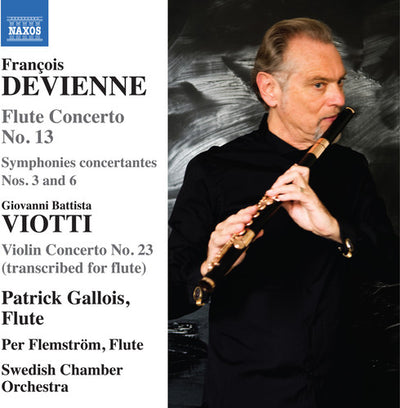
Devienne: Flute Concertos, Vol. 4
Mozart: Piano Concertos Nos. 23 & 24 / Goldstein, Fine Arts Quartet
Mozart himself saw the advantages of creating more accessible versions of his concertos in reduced instrumentation. Ignaz Lachner followed common 19th-century practice by leaving the piano parts of these concertos intact and making splendid transcriptions of the orchestra parts using only a string quartet with added bass. K. 488 and K. 491 are two of Mozart’s greatest and most popular piano concertos. These chamber versions throw an intense and intimate new light on familiar music. Alon Goldstein is one of the most original and sensitive pianists of his generation, admired for his musical intelligence and dynamic personality. His career as a soloist has taken him all over the world, working with leading orchestras and conductors. The Fine Arts Quartet ranks among the most distinguished ensembles in chamber music today, with an illustrious history of performing success and an extensive legacy of over 200 recorded works.
Bach: Christmas Oratorio / Otto, Mainz Bach Orchestra and Choir
J.S. Bach’s Christmas Oratorio was written for the Christmas season of 1734, and although it incorporates music from earlier works it belongs firmly among his timeless large-scale compositions. The development of the oratorio, which was to become a new musical form in Protestant church services at that time, was stimulated by Bach’s compositions, particularly by the unusual form of his six-part Christmas Oratorio. From its famously joyful opening ‘Jauchzet frohlocket’ to the arrival of the Wise Men from the East, this work’s enduring popularity has long proven its status as a choral ‘evergreen.’ For the conductor Ralf Otto, flexibility, diversity and transparency of sound have always been essential to his work with choirs and orchestras. The conductor’s reputation is based on his gift for interpreting different musical styles, from the Renaissance through the music of today. This recording follows the April 2018 release of Bach’s St. John Passion with the Bach Choir and Orchestra of Mainz conducted by Ralf Otto. MusicWeb International wrote: “the Bachchor Mainz is a fine ensemble: it shows great flexibility in those turbae which are performed at a high speed, and produces a surprisingly transparent sound, also thanks to the good acoustic of the Christuskirche in Mainz.”
Hakenberger: 55 Motets from the Pelplin Tableture / Lukaszewski, Musica Fiorita, Kameralny Polish Choir
Andreas Hakenberger spent his entire professional career within the territory of the Crown of the Kingdom of Poland, remaining for 20 years as chapel-master at the Lutheran Church of St. mary’s in Gdansk. Here he wrote his most outstanding works, a sequence of important motets written in cori spezzati, or polychoral technique. The rich tonal coloring obtained through the combinations of vocal parts is enhanced by the variety of the accompanying instrumentation. With astute use of imitation and rhetorical pauses, Hakenberger’s music emerges as richly colorful, graceful and vibrant. There have been very few recordings of the music of Andreas Hakenberger. This release offers by far the most of his music yet to be issued, and contains all of the 55 motets preserved in the Pelplin Tablature.
Verdi: Macbeth
Haydn: Die Schopfung / Equilbey, Accentus, Insula Orchestra [Blu-ray]
Also available on standard DVD
Haydn’s oratorio ‘The Creation’ is one of the greatest masterpieces in the repertoire. Its libretto was constructed by Gottfried von Swieten who took texts from the Book of Genesis, the Psalms, and who employed his own original poetry. In this radical and compelling staging by the ground-breaking Catalan theatre collective, La Fura dels Baus, and internationally acclaimed stage director Carlus Padrissa, the oratorio is seen through the prism of a stream of refugees expelled from Paradise. Stunning light projections encapsulate the stage space and incorporated philosophical and scientific perspectives make this truly an oratorio for our time.
-----
REVIEW:
Many productions these days use video as part of the design but this is the first I can recall which is so wonderfully—often breathtakingly—effective.
– Lark Reviews
Berlioz: Roméo et Juliette, Op. 17, H 79
Guitar Double Concertos / Trapaga, Folgueira
Romero Asenjo: Cello Concerto - Concerto for 2 Violins - Str
Keeley: Chamber Music / Samek, Brannick, Aquinas Trio
Rob Keeley considers chamber music to be the most direct and expressive medium for him as a composer. The spirits of Haydn and Chopin can be heard in the Second Piano Trio, and there is a wink towards Mozart in the wonderful blend and agility to be found in the Clarinet Quartet. All of these works are the result of musical friendships, the faith and commitment of the players an integral part of each performance, with the remarkable sonorities of Distil as its still center.
New Orchestral Hits 4 Kids
The Guerra Manuscript, Vol. 5
Rossini: Il Barbiere di Siviglia / Rhorer, Le Cercle de l'Harmonie
Rossini’s comic masterpiece The Barber of Seville was based on Pierre-Augustin Caron de Beaumarchais’s French play Le Barbier de Séville and is the ultimate opera buffa. The score is a compendium of the composer’s wittiest and most brilliant writing, and includes the famous entrance aria Largo al factotum and a raft of superbly dynamic ensembles. This vibrant and youthful production features Florian Sempey, one of the world’s best Figaros, the ‘Rossini tenor’ Michele Angelini, vivacious and critically admired Catherine Trottmann, and the award-winning team of acclaimed director Laurent Pelly and conductor Jérémie Rhorer who directs his spirited period ensemble Le Cercle de l’Harmonie.
-----
REVIEW:
The cast are in modern dress but the interaction of characters is so forceful as to sweep away any lurking objections. Add to this some very fine singing, particularly from Michele Angelini’s glorious high tenor as Almaviva, and there is a great deal here to admire and enjoy.
– Lark Reviews
Reger: Orchestral Works / Levin, Brandenburg State Orchestra
-----
REVIEW:
That this is a welcome release scarcely needs to be said: too often Reger is considered a significant composer for organ, but significant within that niche: a master of fugal writing, perhaps on the heavy teutonic side. But, of course, there has always been more to him than this. This Naxos release allows wider access to his works in commendable performances by a conductor evidently deeply sympathetic to his cause.
The Variations and Fugue on a Theme by J.S.Bach, Op.81 (1904) are an arrangement by Ira Levin of Reger’s work for piano. In 1904, Reger considered it his finest work to date, and it was enthusiastically greeted on first public performance. The theme comes from the aria ‘Seine Allmacht zu ergründen, wird sich kein Mensche finden’, originally a duet for tenor and contralto, with oboe, viola d’amore and continuo, from Cantata No. 128, Auf Christi Himmelfahrt allein. Reger had insisted that the pianist treat the theme ‘sweetly and always very legato—that is to say, like an oboe solo’. Levin’s arrangement catches that very well.
It should be noted that Levin does not merely rearrange for different instruments: he reconstructs the work in a valuable reimagining – tempo is slower, preferring 6/4 time to Reger’s more general 6/8. He omits four variations (6,7,11 and 12), and uses a broad variety of instrumentation, notably in percussion, though no instruments not found elsewhere in his works. The result has revealing clarity and a taut architecture, very enjoyable in its own terms. Orchestration brings out very sharply the relationship to the organ, especially in the opening variations, and perhaps even more to Reger’s reverence for Brahms: sonorities are frequently Brahmsian. Levin is absolutely true to the spirit of Reger and his special emotional world. If the letter is Reger is an issue, some will prefer the piano version: but there is more than enough room for both.
Four Tone Poems after Arnold Böcklin, Op.128 (1913) is Reger’s best-known orchestral work, inspired by the paintings of Böcklin, the 19th Century Swiss artist. These were symbolist pictures, with some abrupt changes of mood. Reger marks these shifts with subtlety. The overall mood is serious, but with many charms, notably in Der geigende Eremit (‘The Hermit Fiddler’) with its lovely violin solo, wonderfully captured by Klaudyna Schulze-Broniewska, the leader of the Brandenburgisches Staatsorchester.
Add the slightly romantic arrangement by Reger of O Mensch, bewein’ dein’ Sünde gross, BWV 622 to the mix, and we have a CD whose appeal should move far beyond Reger enthusiasts. This is a splendid introduction for those who have thought of Reger as too heavy for their tastes, and packed with insights for those who have come to love him.
– MusicWeb International (Michael Wilkinson)
Beethoven: Piano Concertos Nos. 3 & 4
Beethoven On Guitar
Beethoven: Symphonies vol. 1 - nos. 1 & 3 (for piano trio & flute) / Grodd, Gould Trio
Beethoven and Hummel’s relationship was one of fractious beginnings, but ultimately true friendship. Between 1825 and 1835 Hummel arranged his contemporary’s Symphonies Nos. 1-7 and Septet, Op. 20 for his favored combination of pianoforte, flute, violin, and violoncello. Beethoven would surely not have objected- arrangements were, after all, a perfectly normal part of the 19th-century musical landscape. To audiences today his symphonies need little introduction but, thanks to the musical sensitivity and sheer brilliance of Hummel’s arrangements, it is possible to experience the thrill of hearing these extraordinary pieces afresh.
Koželuch: Joseph der Menschheit Segen
Moravec: Sanctuary Road / Tritle, Oratorio Society of New York
A 2020 GRAMMY nominee for Best Choral Performance!
After the success of his opera The Shining, Pulitzer Prize-winning composer Paul Moravec has once again collaborated with librettist Mark Campbell to create the second of his “American historical oratorios.” Sanctuary Road draws on the astonishing stories to be found in William Still’s book The Underground Railroad, which documents the network of secret routes and safe houses used by African American slaves to escape into free states and Canada during the early to mid- 1800s. The epic nature of these stories of courage, perseverance and sacrifice is transformed into an enthralling saga, heard here at its world premiere performance at Carnegie Hall- a performance acclaimed by BroadwayWorld for its “riveting, pulsating wall of sound and stellar soloists.”
REVIEWS:
Paul Moravec’s Sanctuary Road is unique. Moravec terms it an oratorio, and indeed; yet there’s plenty of dramatic action of an operatic sort. The soloists, all African American, are an able group, but bass-baritone Dashon Burton, as Still, has an especially compelling, authoritative quality. The performance was recorded live at the work’s 2018 premiere at Carnegie Hall in New York, and the Oratorio Society of New York Chorus under Kent Tritle is both precise and energetic in the pressure-packed situation of a single recorded performance.
– AllMusicGuide.com (J. Manheim)
Santuary Road's eminent singability, colorful scoring, and uplifting messages would seem to guarantee its future success. Moravec’s setting of the material makes it unquestionably an oratorio in the full quasi-operatic sense, rich in character, action, and vocal display, and also cinematic in rhythm, cutting from intimate moments to breathless chase scenes and back.
The performance largely belonged to the five soloists, four portraying various fugitives plus the clear-voiced bass-baritone Dashon Burton in a sturdy turn as William Still himself.
Mezzo-soprano Raehann Bryce-Davis had the showstopper aria as the appropriately named Ellen Craft. Strong in the lower register, her voice blossomed on top, bringing loud applause at the close.
In recurring segments titled “Run,” Joshua Blue depicted the lone fugitive’s terror and grit in his powerful tenor. With clear diction and dry humor, baritone Malcolm J. Merriweather as Henry “Box” Brown told of his 26 hours traveling in a shipping crate to Philadelphia.
Soprano Laquita Mitchell’s solo came late but was worth waiting for. By the aria’s climax, she was in full-throated dramatic mode, to marvelous effect.
Between Moravec’s sensitive scoring and conductor Tritle’s astute management of balances, all the solos came across clearly, even though not all the voices were extra large. In fact, all the sonic and dramatic elements of the piece came together smoothly in a well-paced performance whose final crescendo on the word “Free” brought a tear to the eye and the audience to its feet.
– New York Classical Review by David Wright
It is extremely well crafted in musical terms and it sets off the text so that the experience is commemorative, rightly honoring, remembering but of course still providing a history-as-art experience. I come away with a feeling of satisfaction, of approval. You should hear this.
– Gapplegate Classical-Modern Music Review
All the soloists, including the lovely soprano Laquita Mitchell, the sonorous bass-baritone Dashon Burton and the heavy-lifting narrator, the superb baritone Malcolm J. Merriweather do sterling work with the unstinting support of maestro Tritle and his orchestra and chorus.
– Rafael's Music Notes
Rossini: Zelmira
Tansman: Complete Works for Solo Guitar, Vol. 2 / De Vitis
Alexandre Tansman’s guitar music was almost exclusively created as the result of his friendship with the legendary Spanish guitarist Andres Segovia. The true extent of this catalogue has only recently become apparent, with unknown works emerging from archive sources. Performed after careful research into the original manuscripts, Andrea De Vitis’s programme brings together pieces that reference Tansman’s favorite musicians from history, in particular Bach and Chopin- masterfully intertwining personal affections with sophisticated techniques to create some of the most important guitar repertoire of the 20th century.
Glass: Violin Concerto No. 2 & Violin Sonata / Plawner, Berne Chamber Orchestra
Philip Glass has become an iconic figure in American music. His works are often inspired by collaborations with other leading musicians, and the proposal of an “American Four Seasons” by the violinist Robert McDuffie to reflect Vivaldi’s famous masterpiece resulted in a concerto which evokes the Baroque spirit of early 18th-century violin tradition. With the Concerto’s range of moods, listeners are invited to decide for themselves which season the music evokes. The Violin Sonata sees Glass’s melodic and harmonic language haunted by the ghosts of Brahms, Faure and Franck, “the meditative-ness of this piece bringing a unique energy” for award-winning violinist Piotr Plawner.
Bach: The Well-Tempered Clavier, Book 2
Beethoven: Piano Pieces & Fragments / Gallo
Including premiere recordings, this programme provides us with a privileged opportunity to engage with 36 of Ludwig van Beethoven’s rarely heard sketches, variations and briefest of compositions, even the earliest of which have much to teach us about the emergence of his unique voice and style. The range of Beethoven’s musical experimentation reveals a lasting interest in counterpoint, as well as practical pages such as cadenzas for a Mozart concerto, an incomplete sonata and a second version of the famous bagatelle Fur Elise. A significant supplement to his greatest works, these miniatures bring the full arc of Beethoven’s singular genius into ever clearer focus.
Heavy Weather: Wind Concertos / Adsit, Hartt Wind Ensemble
The Hartt School Wind Ensemble presents recent concertante works by three contemporary American composers- demonstrating once more the versatility of the ensemble, heard here in conjunction with soloists. Susan Botti’s sull’ala is inspired by flight, expressed in rhythm, harmony and texture, while Jess Langston Turner describes powerful meteorological phenomena in Heavy Weather. In Guignol, Stephen Michael Grye conjures witty banter and frenetic action from his puppet hero.
Handsome Harpsichord: Best Loved Classical Harpsichord Music / Various
Jolivet: Complete Works for Flute, Vol. 2 / Boulegue
In this second volume of Andre Jolivet’s complete works for flute, Kobe International Flute Competition winner Helene Boulegue explores further examples of some of the most individual and important of all 20th-century works for the instrument. The Flute Concerto No. 1 exemplifies Jolivet’s genius for liquid melodic lines and frenetic bravura. The intricately scored Suite en concert for flute and four percussionists is one of the most fascinating in the repertoire, whilst the Sonatine is both trance-like and rhapsodic.