One-Day Sale | October 14th, 2026
It's here! Our One-Day Sale this month is on October 14th, 2026.
For 24 hours only, save 50% on over 700 titles from Naxos!
Explore an incredible selection of box sets, CDs, DVDs, and more, featuring best-selling recordings of music by Dvořák, Strauss, Janáček, Vivaldi, and many more.
Whether you're filling gaps in your collection or discovering something new, this is your chance to shop hundreds of Naxos favorites at half price!
Over 700 titles. 50% off. 24 hours only. Don't miss out!
Shop now through Thursday, October 15th, 2026 at 9:00AM CT!
738 products
-
-
-
-
-
-
-
-
-
SaleSinigaglia: Complete Works for String Quartet, Vol. 1 / Archos Quartet
Naxos · May 2020CD$19.99$9.99 -
-
-
SaleSierra: Cantares, Loiza & Triple Concerto / Trio Arbos, Marcelletti
Naxos · May 2020CD$19.99$9.99 -
-
-
-
-
-
-
-
-
SaleGuarnieri: Choros, Vol. 1 - Seresta / Karabtchevsky, São Paulo Symphony
Naxos · Aug 2020CD$19.99$9.99 -
-
-
SaleBeethoven: Missa Solemnis (Documentary And Performance) / Bernius, Kammerchor Stuttgart [Blu-Ray]
Naxos AudioVisual · Sep 2020Blu-Ray$30.99$15.49 -
-
-
SaleLiszt: Transcriptions - Complete Piano Music Vol. 55 / Andrey Ivanov
Naxos · Sep 2020CD$19.99$9.99 -
-
-
-
-
-
-
-
-
-
-
SaleRahbari: My Mother Persia - Symphonic Poems, Vol. 3 / Prague Metropolitan Orchestra
Naxos · Oct 2020CD$19.99$9.99 -
-
-
SalePer la Notte di Natale - Italian Christmas Concertos / Mortensen, Concerto Copenhagen
Naxos · Nov 2020CD$19.99$9.99 -
-
-
-
-
SaleM. Haydn: Missa Sancti Nicolai Tolentini / Winpenny, Lawes Baroque Players
Naxos · Dec 2020CD$19.99$9.99 -
-
-
-
-
-
-
SaleChaya Czernowin: Heart Chamber / Kalitzke, Ensemble Nikel, SWR Experimentalstudio, Deutsche Oper Berlin
Naxos AudioVisual · Mar 2021Blu-Ray$34.99$17.49 -
-
-
-
-
SaleKorngold: Songs, Vol. 2 / Stallmeister, Fischer, Schenker-Primus, Simon
Naxos · Jun 2021CD$19.99$9.99 -
-
-
SaleArensky: Egyptian Nights / Yablonsky, Moscow Philharmonic Orchestra
Naxos · Aug 2021CD$19.99$9.99 -
-
-
SalePaderewski: Songs and Mélodies - Suite in G Major / Smolij, Adamski, Schmidt, Capella Bydgostiensis
Naxos · Sep 2021CD$19.99$9.99
Esenvalds: Translations / Sperry, Portland State Chamber Choir

The multi-award-winning Latvian composer Eriks Esenvalds’ 21st-century choral sound is both exquisite and angular, and in this album he explores ideas of ‘translation,’ legend and the divine. With his expanded tonality and employment of shimmering singing hand bells in ‘Translation,’ and the angelic use of the viola and cello in ‘In paradisum’ he creates music of ravishing refinement. In ‘Legend of the Walled-In Woman’ Esenvalds transcribes and employs an authentic Albanian folk song.
-----
REVIEW:
Ethan Sperry’s immaculate Portland State Chamber Choir clearly relish the luscious choral textures, which often expand into 16 parts. The engineering captures with great clarity both this sense of spaciousness and the extreme dynamic range. All the solo vocal contributions are magnificent...A stunning, timely triumph, therefore, full of ravishing, transformative and deeply touching music.
– Gramophone
Zador: Sinfonia Technica / Smolij, Budapest Symphony Orchestra MAV
Mozart: 30 of the Best
Sinigaglia: Complete Works for String Quartet, Vol. 1 / Archos Quartet
The renowned Italian composer and mountaineer Leone Sinigaglia wrote a fascinating series of pieces for string quartet that reflect his powers of characterization and elegance. Flowing melodies can be heard throughout, not least in the Concert-Etude, Op. 5, while the more substantial Variations on a Theme of Brahms, Op. 22 display his technical skill and expressive variety, whether reflective, somber or exuberant. His String Quartet in D major, Op. 27 exemplifies his dual inheritance: a commanding central European facility, combined with a natural Italian lyricism.
Zemlinsky: Der Zwerg / Runnicles, Deutsche Oper Berlin
A 2020 Grammy nominee for best opera recording!
Also available on Blu-ray
Based on Oscar Wilde’s story The Birthday of the Infanta, Zemlinsky’s single-act opera Der Zwerg is the tragic tale of a dwarf who is presented at court, falls in love with the beautiful Donna Clara, but is ultimately forced to see himself as others see him and to die of a broken heart. Preceded by Schoenberg’s Accompaniment to a Cinematographic Scene, Op. 34 (1930), Zemlinsky’s Romantic score is full of psychological intrigue. Is Der Zwerg a critique of society’s superficiality? Is it the composer’s self-portrait in his doomed affair with Alma Schindler? Director Tobias Kratzer’s stunning, transparent production creates a space in which each character is thrown into sharp relief in this ‘fine, noble and melancholy work’. (Bachtrack.com)
Sierra: Cantares, Loiza & Triple Concerto / Trio Arbos, Marcelletti
Cantares, commissioned by the Cornell University Chorus and Glee Club to celebrate the university’s sesquicentennial anniversary, evokes ancient Peruvian, Aztec and Afro Caribbean voices lost in time. The virtuoso Triple Concierto transforms the popular Caribbean rhythms of salsa, bolero and merengue into complex contemporary expressions, while the polyrhythmic layers of Loíza conjure a Puerto Rican town known for its strong African traditions.
Puerto Rico-born composer Roberto Sierra is internationally recognized and renowned for his integration of Caribbean music with the Western idioms he acquired during studies in Europe, and this release of recent works follows a whole series of much-admired and highly popular recordings of his music on the Naxos label. The most recent of these, Kandinsky (8.559849), was described as ‘a real find’ by Gramophone, and as presenting ‘mouth-dropping renditions of this music of supreme virtuosity’ by Fanfare. Sinfonía No. 3 ‘La Salsa’ (8.559817) was admired by ClassicsToday.com for ‘three highly entertaining orchestral works saturated with Latin rhythms and melodic motives’, and the Missa Latina (8.559624) was a GRAMMY nominee and summed up as ‘a powerful and individual major work performed with exemplary skill and commitment in superb sound’ by MusicWeb International. In other words, new recordings of works by Roberto Sierra are always a welcome and much in demand addition to the catalogue.
-----
REVIEW:
Cantares is performed atmospherically and with a thoroughly mystical character. In Loiza, the Afro-Caribbean dance Bomba is the starting point for polyrhythmic variations that are enchantingly dancing. It is an original and rousing work. Sierra has dedicated his Triple Concerto to the Arbós Trio. It is based on Caribbean music and popular rhythms. This work too is presented in an enthralling interpretation, so that this distinctive CD and the exemplary performances can only be strongly recommended.
– Pizzicato
Clementi: Piano Music / Rimmer
Muzio Clementi’s legacy to pianists lies not only in his teaching studies and in his exploration of new levels of virtuosity, but in compositions that were widely admired by contemporaries such as Beethoven. This album explores a variety of pieces, a number of which focus on variations. ‘The Black Joke’ was a popular English tune garnished by Clementi with 21 successive variations. Musical Characteristics captures the styles of leading figures of the time, including Mozart, Haydn and Koželuch, while the Variations on ‘Batti, batti’ is a virtuoso transcription. Nicholas Rimmer plays on an original fortepiano made in Clementi’s own workshop around 1806. A pianist with a keen interest in chamber music, Lied, as well as in historical keyboard instruments, Nicholas Rimmer has appeared in many major concert venues in Germany and the UK, among others. His collaborative partnerships have resulted in acclaimed recordings of Brahms and Wolfgang Rihm; the latter (8.572730) received a Diapason d’Or, a Pizzicato Supersonic Award and an International Record Review ‘Outstanding’ Award.
Bach: Cello Suites, Vol. 1 (Arranged for Guitar) / McFadden
-----
REVIEW:
McFadden avoids the result coming too close to a version for harpsichord, though the guitar can never equate to the range of tonal colours available from a solo cello, nor, for that matter the dynamic range of the instrument. Though we do hear fingers moving around the fret, let me conclude this short review by admiring the clean-cut playing of this world famous Canadian guitarist. We can now look forward to the second disc.
– David's Review Corner (David Denton)
Busoni: Works for 2 Pianos / Ciccolini, Orvieto, Rapetti
Ferruccio Busoni composed a significant number of works for two pianos throughout his life. While Bach’s pervasive influence is already evident in some of his early compositions including the Preludio e Fuga and Capriccio, it reaches its most complex and glorious expression in the definitive 1921 version of his Fantasia contrappuntistica. In the case of Schumann’s Op. 134 for piano and orchestra, Busoni simply reduced the orchestral part for a second piano. However, his skill as a master transcriber and composer is revealed in his brilliant arrangements of Mozart’s works, which also highlight the subtlety and originality of his style. Aldo Orvieto has recorded extensively, releasing more than 70 albums dedicated to composers of the 20th century on a wide variety of labels, many receiving critical acclaim. Aldo Ciccolini appeared on the Naxos release of Achille Longo’s PianoQuintet (Ciccolini’s teacher) with the Circolo Artistico Ensemble (8.572628), which was nominated for an International Classical Music Award (ICMA).Classical Lost and Found wrote that: ‘Considering Ciccolini’s intimate association with his mentor’s quintet, this would have to be considered a definitive performance.’ Marco Rapetti received his Diploma cum laude at the Accademia Perosi in Biella. Rapetti has been awarded many prizes in national and international competitions, and has released several recordings, including the complete piano works of Borodin, Liadov, Dukas and Debussy.
Guarnieri: Choros, Vol. 1 - Seresta / Karabtchevsky, São Paulo Symphony
Camargo Guarnieri’s catalogue of works represents a legacy of incalculable worth for Brazilian culture, as has his influence as a teacher on several generations of younger composers. His association with the poet and musicologist Mario de Andrade led to the birth of the Brazilian Nationalist School and the ideals of using traditional Brazilian music in classical forms. The series of seven Choros and the Seresta for Piano and Orchestra represent Guarnieri’s personal approach to the concerto form, with striking contrasts between potent rhythm and dense, emotionally charged soundscapes and melodies full of Brazilian inspiration. This volume forms part of the first complete recording of the Choros.
Artistic director and conductor of the Orquestra Petrobras Sinfonica, Isaac Karabtchevsky is also artistic director of the Baccarelli Institute and the Heliopolis Symphony Orchestra. He was awarded the Premio da Musica Brasileira four times for his recordings of the complete symphonies of Villa-Lobos with the Sao Paulo Symphony Orchestra on Naxos. He has served as the musical director of the Teatro La Fenice, the Orchestre National des Pays de la Loire and the Tonkunstler Orchestra.
REVIEW:
Each of the four short works on this disc proves to be thoroughly entertaining. Rhythmically they bounce along in the allegros, often driven by Brazilian syncopation, while the slow movements are heartfelt and tender without being over-Romanticized. The performances are excellent. The soloists are members of the São Paulo orchestra—Davi Graton is also a renowned teacher—and Isaac Karabtchevsky boasts a long pedigree in conducting Brazilian music. (He led the same orchestra in Naxos’s first-rate series of the complete Villa-Lobos symphonies.) This initiative to record lesser-known Brazilian repertoire got off to a great start, and the new disc promises even more.
-- Fanfare
Beethoven: Missa Solemnis (Documentary And Performance) / Bernius, Kammerchor Stuttgart [Blu-Ray]
Beethoven’s Missa solemnis is the one work the composer admired above all his compositions. It was written for his great patron and friend Archduke Rudolf of Austria at around the same time that he embarked on his Ninth Symphony and as the writer Donald Tovey noted, ‘there is no choral and no orchestral writing, earlier or later, that shows a more thrilling sense of the individual colour of every chord.’ This insightful documentary follows Frieder Bernius on a journey of discovery as he immerses himself in Beethoven’s monumental masterpiece in preparation for a recording.
Liszt: Transcriptions - Complete Piano Music Vol. 55 / Andrey Ivanov
Volume 55 in the critically acclaimed Liszt Complete Piano Works series features transcriptions of pieces by his contemporary Eduard Lassen, performed here by award-winning pianist Andrey Ivanov in his recording debut. Andrey gave his first concerto performance at the age of nine. In 2006, he was selected to study at the Central School of Music in Minsk, graduating to the Moscow Conservatoire. He won first prize at the Belgrade and Minsk International Piano Competitions and went on to perform in Moscow, St Petersburg, Belgrade, Brussels and Amsterdam. He is currently studying at the Birmingham Conservatoire with Pascal Nemirovski.
Widor: Organ Symphonies, Vol. 3 / Christian Von Blohn
Charles-Marie Widor’s ten organ symphonies sit at the heart of his extensive oeuvre. They reveal Widor’s mastery of the form with their profundity, technical difficulty and sonorous color. Symphony No. 7, Op. 42, No. 3 inaugurated a new, orchestral approach to the genre and encompasses dreamlike sonorities, Chopinesque melancholy and majestic bravura. The Symphonie gothique, Op. 70 makes explicit reference to Gregorian chant, developing a kind of theological ‘programme music’ that is both austere and consolatory.
Rutter: Anthems, Hymns and Gloria for Brass Band
-----
REVIEWS:
Rutter’s particular brand of polyphony, bright and optimistic yet surprisingly dense, offers many possibilities, and it is likely that even listeners not particularly enamored of Rutter will appreciate the artistry here. The lion’s share of that artistry comes from the Black Dyke Band, the preeminent member of the shrinking group of British brass bands. There are plenty of popular Rutter pieces here, including This Is the Day, composed for the wedding of Prince William and Kate Middleton in 2011. The Black Dyke Band ends with a collaboration on Rutter’s first big hit, the Gloria (1974), deploying the ideal Sheffield Philharmonic Chorus.
– AllMusicGuide.com (James Manheim)
Two musical pillars of Christmas in the UK are John Rutter and Salvation Army silver bands. While, with one exception, there are neither John Rutter carols here nor a Salvation Army silver band, we do have a disc devoted to the music of Rutter most of which is performed by one of Britain’s most famous (and finest) bands in arrangements by Luc Vertommen. And, as such, it seems to ooze Christmas, even there is only one item—What Sweeter Music—which has a direct Christmas connection.
The Black Dyke Band under their conductor, Nicholas Childs, plays everything with supreme polish and sensitivity, and exudes a silky smooth warmth and affection. Of particular beauty is their take on The Lord Bless You and Keep You, which has such a velvety softness that it seems almost to breathe with a human voice. Also exuding a truly almost vocal style of delivery is the delightfully creamy cornet of Richard Marshall, in the Pie Jesu. I am not so sure otherwise about this arrangement, with a tinkling glockenspiel adding a slight whiff of the fairground. Indeed, on the whole, Luc Vertommen’s arrangements have a slightly over-orchestrated feel, with his version of All Things Bright and Beautiful really far too fussy and action-packed to match the simple beauty of Rutter’s original. I suspect that without a band of such superlative control to play them, these arrangements would not work anything like as effectively as they do. However, they do work magnificently in this context, and while they hardly stretch the band and have, inevitably, a certain samey quality, the luxury of the playing ensures that the novelty of Rutter on brass never wears too thin. The one exception is Distant Land (A Prayer for Freedom) which takes on a decidedly Copland-esque feel in this instrumental-only arrangement.
Scored for choir, organ, brass and percussion, the Gloria of 1974 is so strongly redolent of Walton that it is sometimes difficult to spot anything distinctive in the music, especially given this performance in which Darius Battiwala is so keen to convey the mood of celebration and festivity that the moments of repose are largely swept away by the sheer exuberance of the music-making. One senses that the church in which this recording was made was possibly a little too small to accommodate such musical enthusiasm, and certainly the men of the Sheffield Philharmonic Choir seem to have pretty much tired themselves out by the time we reach the final Amen. But what the choral singing lacks in polish, is more than amply compensated for by the sheer joie-de-vivre of the performance and the sparkling majesty of the Black Dyke Band.
– MusicWeb International
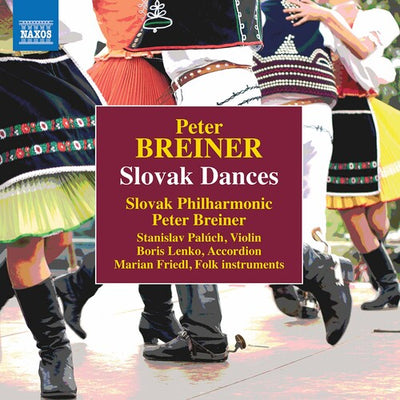
Breiner: Slovak Dances, Naughty and Sad / Slovak Philharmonic
-----
REVIEW:
The basis of Breiner’s suite is native folksong and one might easily suppose, therefore, that its themes might be catchy and easily remembered. Slovak listeners, certainly, will be humming happily along as they recognise such traditional ditties as My father is but one big headache, My mother told me not to sit in the dark, I must have been crazy and Oh, mother dear, it itches (Slovakian peasant life was clearly no bed of roses).
Anyone born west of Bratislava or east of Humenné is, however, unlikely to be familiar with the original melodies and, bereft of that anchor, may well find that the dances come and go without making that much of a memorable impression. Moreover, I’d imagine that the composer’s distinctly contemporary musical palette risks disconcerting or even alienating a few tradionally-minded listeners who prefer their music delivered in an orchestration more characteristic of the late 19th century.
In spite of any such potential issues, the suite certainly offers plenty of pleasurable moments. Many of them occur, as already suggested, during the dances featuring the “domestic ethno-traditional” solo instrumentalists whose contributions deliver frequent titillation to ears unfamiliar with the sound of fujaras or jew’s harps. Thus, no. 3, the jaunty You enchanting girl, you…, is marked by effective and attractive contributions from the violinist, the accordionist and Ms Friedl’s whistles, as too is no. 9 My little whistle – ititi, ititi. Meanwhile, no. 11 I must have been crazy exhibits an engaging and sinuously oriental atmosphere that perhaps reflects the influence of intermittent Mongol and Ottoman invasions of Slovakia over the centuries. The final dance You little gate with bars is the shortest of the whole set but brings the suite to a close with an appropriate burst of vitality.
– MusicWeb International
Shor: Images from the Great Siege - Verdiana
Rahbari: My Mother Persia - Symphonic Poems, Vol. 3 / Prague Metropolitan Orchestra
Alexander Rahbari’s My Mother Persia is a cycle of symphonic poems suffused with the rich melodies, rhythms and improvisations of Persian traditional music in which he is profoundly versed both as composer and conductor. Originally written as a violin concerto, Symphonic Poem No. 9 ‘Nohe Khan’ – the name relates to a singer at religious ceremonies – was recast for baritone saxophone in 2018. Symphonic Poem No. 10 ‘Morshed’ vividly explores ritualized song in the context of ‘ancient sport’. Volume 1 is on 8.574064 and Volume 2 on 8.574065. Alexander Rahbari is a remarkable figure in the music world, taking a leading position in the cultural development of his country from a young age, winning numerous awards as a conductor and becoming closely associated with the Berlin Philharmonic orchestra as assistant to Herbert von Karajan. Rahbari has conducted numerous successful Naxos recordings, but this is the world premiere release of his cycle of symphonic poems My Mother Persia.
Heroic Horn - Best Loved Classical Horn Music / Various Artists
For those who are new to an instrument, the first question is often: where to start? The ‘Best Loved’ series offers an easy answer to that question and a perfect introduction to the wonderful, varied world of classical music. Spotlighting individual instruments in some of the best-loved pieces ever written, and with a mix of solo, chamber and orchestral works, the series provides a convenient introduction to classical music’s infinite variety of instrumental sounds and styles. The focus in these releases is a light and relaxed approach, rather than academic and theoretical: a joyful exploration and celebration of individual instrumental sounds. The present release is a showcase of the horn.
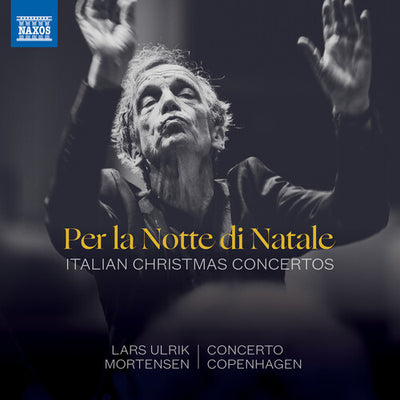
Per la Notte di Natale - Italian Christmas Concertos / Mortensen, Concerto Copenhagen
Christmas celebrations are thought to go all the way back to the formidable feasting of the Vikings at midwinter, when in true Nordic fashion yuletide was ‘toasted in’. The celebration of the birth in Bethlehem is more subdued and spiritual, but it is of a far more recent date. We do not know if the Vikings celebrated yuletide with music, but music at Christmas has been a popular tradition since the Middle Ages. Today, practically all peoples around the world celebrate midwinter with special religious and cultural rituals; the precise times vary, but gifts, decorations, festivities, candles, bells and special Christmas music are apparently always part of this. In the 17th and 18th centuries, Christmas was the busiest time of the year for church composers. The congregation expected to hear new Christmas music in church which often involved instruments, choirs and soloists. Here you'll hear the Concerto Grosso - starting with A. Corellis version becoming template for the composers G.Torelli, A.Vivaldi, F. Manfredini and P. Locatelli following the trend of music concertos for Christmas Celebrations.
Cello Concerto / Double Bass Concerto / Moonburst
Widor: Organ Symphonies, Vol. 4 / Christian Von Blohn
M. Haydn: Missa Sancti Nicolai Tolentini / Winpenny, Lawes Baroque Players
Michael Haydn’s colorful and inventive music is uplifting and expressive in equal measure, but his music has been eclipsed by that of his elder brother Joseph, and by Mozart. Sacred music is central to Michael Haydn’s oeuvre and was considered by some contemporary critics as superior to Joseph’s. Encompassing a broad range of textures and styles, parts of the Missa Sancti Nicolai Tolentini demonstrate Haydn’s music at its most exhilarating and energetic, and his supreme gift for empfindsames (‘sensitive’) lyrical writing is also to be heard in the Vespers.
The Art Of Agony / Viney-Grinberg Piano Duo
This diverse programme features eight premiere recordings of Australian music for two pianists, including seven works recently commissioned by the acclaimed Viney-Grinberg duo. Demonstrating the innovative potential of this medium, these pieces range from duets on a single piano to Mill Life in which 22 pianos are overdubbed and piled on top of each other. Other highlights include Visible Weapon, pairing virtuoso velocity with electronics, and The Art of Agony – a musical picture frame for Percy Grainger’s spoken voice.
Lassus: Le Nozze In Baviera / Rice, Ensemble Origo
The wedding in 1568 of Renate of Lorraine to Wilhelm V, heir to the throne of the Duke of Bavaria, was a sumptuous, 18-day spectacular designed to rival those of the Italian courts. Orlande de Lassus had been the court’s maestro di cappella since 1556. Using an eye-witness account of the event, Ensemble Origo presents a hypothetical reconstruction of some of his musical contributions – a Te Deum, the moresca (a genre related to the villanella), and an improvised comedy – thereby shedding light on some of the various meanings that the music had for its 16th-century listeners. Ensemble Origo is an early music ensemble founded in 2010 and directed by Connecticut-based musicologist and conductor Eric Rice. Its aim is to present vibrant performances and recordings of early music – from the Middle Ages through to the Baroque – that reflect the context in which the repertory was originally produced and heard; ‘Origo’ is Latin for ‘earliest beginning’, ‘lineage’, or ‘origin’. The ensemble draws on a roster of musicians from Connecticut, Boston, and New York.
From Eric Rice, Director of Ensemble Origo: "This recording originated from my curiosity about the moresca, an Italian musical genre that caricatured Black Africans. I wanted to know where, how, and for whom these pieces were performed; this recording of four vignettes from a 16th-century wedding is the result."
"Like most scholars and performers of early European music, I am a white person of privilege, and among the many things such privilege has afforded me is the opportunity to study and perform this music. While I do not claim any first-hand knowledge of exclusion due to my race, my gender, or the traditional beliefs of my ancestors, I am fervently interested in understanding racism, oppression, and their manifestations in cultures past and present. Oppression in music of the past is often simple erasure on the part of music historians and performers: the tacit denial that people of other races even existed in a particular time and place, either through neglect or refusal to bring their documented presence to light. Such erasure, in turn, has resulted in a lack of understanding of how music was used to perpetuate the myth of white European superiority."
"In this recording, I aim to show the presence of Black Africans in several 16th-century European musical works, to demonstrate how these works were used, and to invite our listeners to consider their various purposes, including the perpetuation of the white superiority myth. While I could have demonstrated such uses solely in the context of scholarly articles, these have less currency and immediacy than the act of listening – of bearing witness with the ears – to this music, which must first be performed by modern musicians. Indeed, many of these representations have to be heard in order to gain a robust understanding of how they function. This performance of Lassus’s moresche in something like their original context does not constitute an endorsement of the views expressed in them, nor does it represent unambiguous advocacy for them as works of art. Though these pieces have been recorded before, little regard has been paid to the original context in which they were created and performed. This recording seeks to address that."
Le Nozze In Baviera: Sung Text
REVIEW:
In the early spring of 1568 the wedding took place in Bavaria of Renate of Lorraine to Wilhelm V, heir to that Southern German dukedom. Lassus had by then travelled extensively (there are claims that he also visited England and France) from his native Mons at least to Germany and Italy. He was Duke Albrecht V’s (Wilhelm’s father) maestro di cappella and so provided the music for a celebration which Albrecht was determined to make an occasion to be remembered. The following year Massimo Troiano wrote a description of the event(s) in a form sufficiently detailed and vivid to allow Rice to attempt a hypothetical reconstruction of how the music may have sounded.
There its humour (Lucia, celu [tr.6], for instance), piety (the Te Deum [tr.1]), uninhibited celebration (Cathalina, apra finestra [tr.8]), parody and Burlesque (Álla la pia calia [tr.3]), bawdy (O Lucia, miau [tr.7]), ceremony (Chi chilichi [tr.9]), and pathos (Chi passa per 'sta strada [tr.12]). This last is actually by a contemporary of Lassus, Filippo Azzaiolo, who was born between 1530 and 1540 and lived until after 1570 and gets just that one track on the CD.
In fact there is all the fun, frolicking and abandon of a wedding—especially one lasting as long as this one did… at least a fortnight. So the guests (here the performers of Ensemble Origo) realise that they had better behave themselves and hold their drink, and temper their abandon with lucidity and a measure of decorum which mustn’t sound too reluctant. The performers here get this just right.
For many new to Lassus, Le nozze in Baviera will give a slice of his non-sacred works that ought to delight and invite further exploration. For those who value this—yes—still much underrated composer, the CD may show something new. In all cases, it is one to revel in.
– MusicWeb International
Bright Sheng: Let Fly - Zodiac Tales - Suzhou Overture
Inspired by the image of a violin melody ‘flying off’, Chinese-American composer Bright Sheng’s virtuosic three-movement concerto Let Fly interweaves Chinese and Western classical elements. Vivid legends of astrological animals inform Zodiac Tales, a tour de force concerto for orchestra. Reflecting the city of Suzhou’s ancient, continuous cultural heritage, traditional nostalgia fuses with contemporary rhythms in the exciting Suzhou Overture. These works are featured here in their world premiere recordings.
Chaya Czernowin: Heart Chamber / Kalitzke, Ensemble Nikel, SWR Experimentalstudio, Deutsche Oper Berlin
This Blu-ray Disc is only playable on Blu-ray Disc players and not compatible with standard DVD players.
Also available on standard DVD
The works of award-winning composer Chaya Czernowin have been performed worldwide at significant new music festivals and prestigious venues, and she is the first woman to be appointed composition professor at Harvard University. Commissioned by Deutsche Oper Berlin and widely acclaimed in the critical press, ‘Heart Chamber’ uses voice and stage as internalized sonic and visual landscapes to create a genuine multi-sensory musical experience. With only two characters and a hint of a narrative, this is a grand opera on the smallest of transformations, focusing on the intense beauty and vulnerabilities of falling in love. ‘It is seldom that audiences at the Deutsche Oper Berlin have listened with such rapture to a new commission’ (Online Merker). Director Uli Aumüller’s feature film ‘I did not rehearse to say I love you’ is also included and takes a behind-the-scenes look at the creation of the opera.
Music for Brass Septet, Vol. 7 / Septura
In this seventh volume of Music for Brass Septet, Septura survey two of America’s greatest and most representative composers. Gershwin’s An American in Paris charts a visitor’s stroll around the French capital, absorbing the city’s atmosphere and charm, whereas the synergy of classical form and jazz animates Gershwin’s unique Preludes. Copland’s Quiet City depicts a contrasting and more understated cityscape, while the suite from the ballet Appalachian Spring displays Septura’s luminous virtuosity.
REVIEW:
This disc is a quite remarkable achievement of adaptation. The recording, made in 2019, is of outstanding quality, and is a ‘must have’ for all lovers of brass music.
– David's Review Corner (David Denton)
Korngold: Songs, Vol. 2 / Stallmeister, Fischer, Schenker-Primus, Simon
In his song settings, Korngold pursued the Romantic ideal and lavished considerable care and inventiveness on their composition. His seemingly effortless gift for melody is everywhere ap-parent in this second volume (Vol.1 is on 8.572027), whether in the early works or the songs from the 1940s, which would not sound out of place in an operetta or a Broadway musical. Also present, notably in the Drei Gesänge, Op.18, is an exciting, experimental approach to harmony that reflects the music of his most radical opera, Das Wunderder Heliane (8.660410-12).
REVIEW:
Already in the 1920s, as a young man, Korngold was composing in a powerfully vocal idiom, as can be heard in the four Lieder des Abschieds (Songs of Farewell). He did not become a prolific art song composer, but there are lieder dotted among his long list of compositions This second volume of his complete songs include Sonett fur Wien from 1953, just four years before his death. The mezzo, Sibylle Fischer, has the task of expressing so much sadness in the four Lieder des Abschieds, a mood she passes to the baritone, Uwe Schenker-Primus, in the Drei Gesange. He also has the task to hark on sorrow in the Lieder aus dem Nachlass, and we hear him to better effect in the forthright Five Songs. That Korngold wrote songs for the cinema surfaces with Morgen from the film The Constant Nymph, here recreated with a piano trio accompaniment, and sung with a smooth elegance by Britta Stallmeister. Together with the pianist, Klaus Simon, the vocal trio give us a rare chance to hear forgotten Korngold.
– David's Review Corner (SDavid Dento)
Arensky: Egyptian Nights / Yablonsky, Moscow Philharmonic Orchestra
A student of Rimsky-Korsakov and the teacher of Rachmaninov and Scriabin, Anton Arensky holds a distinguished place in the history of Russian music as both an academic and a composer. For his 1900 ballet Egyptian Nights, based on Pushkin, he chose an exotic theme – the dangerous love of the handsome Amoun for Queen Cleopatra – and sought authentic melodic material in scholarly texts. With his gift for orchestration and color, Arensky fashioned a sensuous and vivid score, featuring a brilliantly conceived series of dances. This was a world premiere recording on its initial release on Marco Polo 8.225028, recorded in1996. Gramophone wrote: ‘The playing is suitably colorful, the recording responsive to that’, as did Fanfare: ‘The Moscow Symphony Orchestra clearly revels in this repertoire, and it plays with spirit and enjoyment.’
REVIEW:
The present disc is one of many recordings originally on Marco Polo that have been re-released on Naxos. Acoustically, Egyptian Nights could use an up-to-date recording, but one cannot cavil about Dmitri Yablonsky’s powerful performance, which derives the maximum excitement from the score. The Moscow Symphony Orchestra plays equally well and the whole production is a feast for any fan of Russian music of the time.
– MusicWeb International
Paderewski: Songs and Mélodies - Suite in G Major / Smolij, Adamski, Schmidt, Capella Bydgostiensis
Although Paderewski is more readily associated with his career as a legendary virtuoso pianist, his modest output of 70 orchestral, instrumental and vocal works deserves to be more widely known. Prominent among his vocal output is a series of early songs that reveal natural flowing patterns while exploring both melancholy and folk idioms. The Douze Mélodies, written at the end of his compositional career, is the most original and striking Polish set of songs of the period, notable for dissonance, chromaticism and a palette of rich and unusual musical colors, to which this orchestral arrangement adds a whole new dimension. Little known, the early Suite in G major offers youthful warmth and brio.