Outlet CDs
3357 products
Webern: Vocal & Chamber Works
Arensky: Egyptian Nights / Yablonsky, Moscow Philharmonic Orchestra
A student of Rimsky-Korsakov and the teacher of Rachmaninov and Scriabin, Anton Arensky holds a distinguished place in the history of Russian music as both an academic and a composer. For his 1900 ballet Egyptian Nights, based on Pushkin, he chose an exotic theme – the dangerous love of the handsome Amoun for Queen Cleopatra – and sought authentic melodic material in scholarly texts. With his gift for orchestration and color, Arensky fashioned a sensuous and vivid score, featuring a brilliantly conceived series of dances. This was a world premiere recording on its initial release on Marco Polo 8.225028, recorded in1996. Gramophone wrote: ‘The playing is suitably colorful, the recording responsive to that’, as did Fanfare: ‘The Moscow Symphony Orchestra clearly revels in this repertoire, and it plays with spirit and enjoyment.’
REVIEW:
The present disc is one of many recordings originally on Marco Polo that have been re-released on Naxos. Acoustically, Egyptian Nights could use an up-to-date recording, but one cannot cavil about Dmitri Yablonsky’s powerful performance, which derives the maximum excitement from the score. The Moscow Symphony Orchestra plays equally well and the whole production is a feast for any fan of Russian music of the time.
– MusicWeb International
Santoro: Symphony No. 8; Cello Concerto / Thomson, Goiás Philharmonic
This recording focuses on Claudio Santoro’s output from the 1960s – a significant decade in the composer’s ever-eventful life. It features world premiere recordings of his charged Cello Concerto, fuelled by his experiences in East Berlin, the dramatic Eighth Symphony and the encore piece One Minute Play, alongside Três Abstrações and Interações Assintóticas, Santoro’s only work to use quarter-tone tuning.
Learn more about this title on the Naxos Classical Spotlight podcast!
REVIEW:
I knew nothing of Santoro’s music until I began listening to these releases in the Naxos Music of Brazil series. Recently a number of his Symphonies and other works have been released and here No 8, from 1963, is placed alongside the slightly earlier Cello Concerto and three other works from the same decade. Another informative and enjoyable production.
-- Lark Reviews
Bartók: Piano Music, Vol. 8 / Ránki
Agócs, Harrison & Rodriguez: Works for Violin & Percussion Orchestra
The unique instrumentation of the three works in this album was pioneered by the innovative Lou Harrison, whose 1959 concerto encapsulates his culturally wide-ranging aesthetic. More conventional instruments work alongside calibrated extras such as wash tubs and flowerpots in a work of color, languorous elegance and kinetic energy. The companion works were composed in its honor: Robert Xavier Rodríguez’s Xochiquetzal evokes the ancient Mayan world in imaginary folk music to form a synthesis of time periods and cultures, while the economical serenity of Kati Agócs’s concerto also includes bitonal effects and zesty syncopation.
Mozart: Complete Masses, Vol. 1 / Poppen, Kölner Kammerorchester, WDR Rundfunkchor Köln
The occasion for the composition of Mozart’s Missa longa is still a matter of speculation, but the Mass remains an exceptional work with its elaborate choral writing, extended orchestration and dramatic changes. The symphonic qualities of the Coronation Mass reveal influences from Mozart’s travels in Paris and Mannheim, as well as a move towards a more operatic style – the memorable soprano solo of the Agnus Dei clearly anticipates the aria ‘Dove sono’ from Le nozze di Figaro. The richness and variety of this work ensures that it has deservedly remained one of Mozart’s most frequently performed Masses. Working with many top orchestras throughout Europe, North America, South America, and Asia, Christoph Poppen is currently principal conductor of the Cologne Chamber Orchestra and principal guest conductor of Hong Kong Sinfonietta. He is former artistic director of the Munich Chamber Orchestra, and former music director of the Deutsche Radio Philharmonie Saarbrücken Kaiserslautern. Greatly sought-after as a pedagogue, he has been Professor of Violin and Chamber Music at the Hochschule für Musik und Theater in Munich since 2003 and was also appointed Professor of Violin Chair at the Escuela Superior de Música Reina Sofía Madrid in 2021.
Hero For Today / United States Army Band And Chorus
Includes work(s) by various composers. Ensembles: United States Army Band, United States Army Chorus.
Handsome Harpsichord: Best Loved Classical Harpsichord Music / Various
Always Ready / Buckley, United States Coast Guard Band
Gardens of Stone
Music from the Land of Hope and Glory / "President's Own" United States Marine Band
20th Century Foxtrots, Vol. 5 - Switzerland / Wallisch
This acclaimed edition covering the early 20th century’s fashionable wave of hot dance music from America into Europe now takes us to Switzerland. 20th Century Foxtrots - 5 presents more evocative piano rarities from this decadent era, performed with panache and grace by Gottlieb Wallisch, and features numerous world premiere recordings and a plethora of rarely heard pieces. Volunes 1–4 can be heard on GP813, 814, 854 and 855.
Fiorini: In the Midst of Things - Piano & Chamber Music
Maltese composer Karl Fiorini is a European without frontiers – the compositions in this album reflect his early detachment from a Mediterranean identity towards a more varied and intense sound world. Trio Lamina features elements of Bartók’s ‘night music’ in its complex sub-sections, whereas Fiorini’s two piano studies, which predate his move to Paris, already exude a Gallic ambience. Influenced by North African folk music, the Piano Trio expands his global reach, and the Piano Sonata, a gritty virtuoso concert piece, shifts geographical influence towards Eastern Europe to powerful effect. All of these world première recordings were recorded in the presence of the composer.
REVIEWS:
This program is a shining example of a 21st-century composer who has stepped back from the extremist styles of the mid-late 20th century to re-embrace communication with an audience, but has taken elements from those styles into his own armory.
Karl Fiorini (b. 1979) references Minimalism alongside Lisztian bravura in the first of his Piano Études (2007–08), Middle Eastern syncopation in his 2017 Piano Sonata, and Neoclassical momentum plus Webernian fragmentation in the Trio Lamina (2002).
He draws on the characteristics of recent schools without adhering to their strict rules or specific aims. He knows his instruments, and his chamber music on this showing is bracingly virtuosic. Like other contemporary composers such as Francisco Coll, he has created a strong voice by synthesizing disparate elements so they emerge as subtle flavors, to use a cooking metaphor. (Much 21st-century music resembles modern fusion cuisine.)
The latest work on this program is a quartet, In the Midst of Things (2019), utilizing the same instrumental combination as Messiaen’s Quartet for the End of Time. I think Fiorini deliberately echoes that seminal work in the first movement, which begins with a languorous cello melody accompanied by full, stately chords from the piano, but he soon turns away from it. By the time we reach the closing Presto movement we are in a bustling world of earthy joie de vivre of a type Messiaen never attempted. Again, Eastern rhythms feature.
I greatly enjoyed these examples of Fiorini’s work. He may be an instinctive composer as he claims, but his instinct is clearly based in a solid grounding of acquired knowledge and continual exploration. The sound and performances are excellent. For those interested in new music, this disc is an exciting and not overly demanding example.
-- Fanfare
The early Trio Lamina (2002) for violin, clarinet, and piano sports an arch form and a spooky atmosphere reminiscent of Bartok. The Two Piano Etudes (2008) have a Gallic neo-Impressionism; and the Piano Trio (2005) has echoes of North African folk music in the use of hexachords and modes in retrograde and inversion. The Piano Sonata (2017) is a dense and demanding concert piece inspired by the music of Eastern Europe.
In the Midst of Things (2019) is a four-movement work for clarinet and piano trio that takes a Beethoven-like approach to structure, balancing intricate theory with carefully timed emotion. The performers bring out the best in the scores, rendering them all with marvelous skill, vigor, transparency, and commitment[.]
-- American Record Guide
Keeley: Chamber Music / Samek, Brannick, Aquinas Trio
Rob Keeley considers chamber music to be the most direct and expressive medium for him as a composer. The spirits of Haydn and Chopin can be heard in the Second Piano Trio, and there is a wink towards Mozart in the wonderful blend and agility to be found in the Clarinet Quartet. All of these works are the result of musical friendships, the faith and commitment of the players an integral part of each performance, with the remarkable sonorities of Distil as its still center.
Heroic Horn - Best Loved Classical Horn Music / Various Artists
For those who are new to an instrument, the first question is often: where to start? The ‘Best Loved’ series offers an easy answer to that question and a perfect introduction to the wonderful, varied world of classical music. Spotlighting individual instruments in some of the best-loved pieces ever written, and with a mix of solo, chamber and orchestral works, the series provides a convenient introduction to classical music’s infinite variety of instrumental sounds and styles. The focus in these releases is a light and relaxed approach, rather than academic and theoretical: a joyful exploration and celebration of individual instrumental sounds. The present release is a showcase of the horn.
Voyage Exotique / Christoph Croisé
Christoph Croisé channels his prowess as a cellist – “he’s got it all – technical chops, impeccable musicianship and imaginative daring” (Gramophone) – into compositional ingenuity on the first album devoted entirely to his own works. Christoph draws inspiration from a variety of musical role models, including contemporary and centuries past, paying homage to the time-honoured evolution of classical music that has melded current conventions with popular styles. Traditional forms, such as sonata and concerto, are imbued with jazz, blues, bossa nova and improv to create, as Christoph puts it, “a musical and cultural melting pot.”
Christoph’s compositional urge was spurred by the pandemic and lockdown. The four works on Voyage Exotique were written between 2020 and 2022. He also cites current world events as a motivating influence. His first cello concerto, imbued with high-wire virtuosity that makes full use of the cello’s – and Christoph’s – capabilities, opens a programme that also includes an imaginary intergalactic journey in the form of a clarinet trio, and a sonata for cello and piano that is by turns pensive, agitated and longing, yet ultimately hopeful. The title track, a “Grand duo” for two cellos is, in the truest sense of the word, an “exotic journey” through foreign sound cultures and myriad cello effects.
REVIEW:
It is a bit difficult to categorize this release by cellist Christoph Croisé. The music borrows heavily from popular traditions, bossa nova and other tropical sounds, lots of jazz, and, in the finale of the grim, Ukraine-inspired Cello Sonata No. 1, Op. 9, Eastern European folk rhythms. Several pieces, most of all the Cello Concerto No. 1, are quite virtuosic, and this fits with the general concept; Croisé is adept at writing lines that show off his abilities on the cello, but he is also an alert chamber player who interacts well with the other musicians in the chamber pieces. A genuinely fresh album.
-- AllMusic.com (James Manheim)
The Harmonious Thuringian
Handel's Recorder
A Violin's Life, Vol. 3
Frank Almond’s life is intertwined with that of his violin, the “Lipin´ski” Strad, an exceptional instrument named for the famed 19th-century Polish violinist Karol Lipin´ski and first owned by legendary 18th-century Italian composer-violinist Giuseppe Tartini, represented on A Violin’s Life, Volume 3 by his Sonata Prima in D, Op. 2, a trio sonata in all but name. The masterful Piano Trio in E flat by 19th-century Swedish virtuosa Amanda Meier connects with the instrument that had passed on to her future father-in-law Engelbert Ro¨ntgen. Another great Nordic composer, Edvard Grieg, opens the album with his great Sonata No. 3 in C minor.
The legend of the Lipin´ski Strad went viral in 2014 when, following a concert, walking towards his car, Frank Almond was tasered by an assailant and the prized instrument was stolen. An FBI pursuit resulted in the recovery of the instrument within weeks. International media ensued on the BBC, NPR, and a feature in Vanity Fair. An award-winning documentary film “Plucked” premiered at the 2019 Tribeca Film Festival. Frank Almond’s critically acclaimed and chart-topping recordings of A Violin’s Life are now a trilogy. The “Lipin´ski” Strad lives on.
Bach: St. John Passion / McGegan, Cantata Collective
Cantata Collective, an ensemble “of San Francisco early music luminaries” (San Francisco Chronicle) inaugurates a major series of J. S. Bach’s choral works with a live recording of the composer’s St. John Passion. With celebrated conductor Nicholas McGegan, the toast of today’s new generation of vocal soloists and a three-to-a-part chamber choir, the Cantata Collective conveys the emotional intimacy and dramatic power of this monumental passion in a highly polished performance that led Early Music America to implore: “To the excellent musicians of Cantata Collective: More Bach Please!”
Haydn: Armida / Bartoli, Pregardien, Harnoncourt, Concentus Musicus Wien
REVIEW:
Armida brings out the best in Cecilia Bartoli as a performer. Her tone is ravishingly beautiful when it needs to be - you need go no further than her first aria, a gorgeous prayer for Rinaldo, to find evidence of that - but when she is required to turn on the vocal fireworks, as for Armida’s great aria of fury in Act 2, she does so with thrilling precision and passion. She is at her finest in the final act when Armida’s power is on the wane, heartbreaking in the great aria Ah, non ferir, then spitting fury as she goes off to exact her revenge.
Patricia Petibon gives Bartoli a real run for her money as the second lady. The voice is of a very different quality to Bartoli’s - sweeter and more innocent, less knowing - but it is every bit as delicious, from the gently winsome quality of her first aria to the intentionally strident and very impressive hysterics of her aria at the beginning of Act 2. She also makes a most beguiling nymph in the third act.
When Bartoli and Prégardien come together, however, things improve enormously, and their Act 1 duet, when he tries to convince her of his faithfulness, is a real treat, both beautiful in its opening section and then exhilarating in its coloratura. Markus Schäfer gives a very attractive turn as Clotarco and Scot Weir’s Ubaldo is fine. Oliver Widmer’s Idreno is not pleasant, though, sounding disagreeably unfocused in his opening aria with little improvement later.
I’m not normally a fan of Harnoncourt in music of this period - I find his Mozart infuriating - and generally I find Concentus Musicus Wien to be so abrasive as to be devoid of pleasure in much of their playing. However, I actually found their style to be pretty effective here. It is a martial opera, after all, and the harsh edge on the brass, as well as in some of the other orchestral tuttis, helps to evoke the atmosphere of war. The string playing doesn’t always sound thin and pinched, either, and they are the finest thing about the scene in Act 2 where Rinaldo’s indecision is invested with the intensity of a mad scene.
Harnoncourt does occasionally pull the tempo around a bit, as though he can’t quite help himself, but he still shapes the work with conviction, and it’s worth remembering that this was a rather neglected opera when this performance took place, so he probably felt the need to inject a certain something into his interpretation so as to make contemporary audiences sit up and take notice that little bit more. I can turn a blind eye to most of it if it means being reacquainted with Haydn’s music in such a successful way. The corking Trio that ends the second act is completely thrilling, bringing out the finest dramatic instincts of the singers, orchestra and conductor.
Both CDs are ingeniously packaged in a single case and the booklet contains an interesting essay by David Wyn Jones. At a price like this there is no need to hesitate.
– MusicWeb International (Simon Thompson)
Bruch, Bridge, Sibelius, Shostakovich: Works for 2 Violas / Hertenstein, Peijun Xu, Ahn
Peijun Xu, born in Shanghai, is one of the leading violists of her generation. As a soloist, Peijun Xu has performed in renowned venues such as the Shanghai Concert Hall, the Laeiszhalle Hamburg or the Alte Oper Frankfurt. Her chamber music partners include Paul Rivinius, Evgenia Rubinova, Alexander Sitkovetsky and Veit Hertenstein. German violist Veit Hertenstein plays with “brigthly ringing, luminous and finly finessed sound (The Strad Magazine 2022).
Veit Hertenstein is Professor for Viola at the Musikhochschule Detmold, Germany since 2015.
Vittorio Grigolo - The Italian Tenor
"He's got everything the role demands - a voice that flows, terrific looks, an instinctive sense of theatre. He's entirely credible as a 20 year old uncontrollably in love and everything he does seems natural, from his impetuous first appearance in the Aimens courtyard, to his chilling shriek of despair at Manon's death." - The Guardian
"In his Covent Garden debut, rising star Vittorio Grigolo wins the audience's hearts with his good looks, ardent singing and an eager demeanour that takes on the full tragic dimension of Chevalier des Grieux's predicament." - The Stage
"More than matching Netrebko for passion and control was the Des Grieux of the young Italian tenor Vittorio Grigolo, making his debut at Covent Garden. The thunderous ovation he received at curtain call suggested that the audience sensed the birth of a star." - The Evening Standard
"Vittorio Grigolo's dashing and thrillingly sung Chevalier des Grieux, his seductive middle voice covered to beautiful effect in the many subito shadings in mezza voce." - The Independent
"The voice was ablaze, mobile in dynamics like Des Grieux's heart, able to soar and sob alike without the slightest strain. The house loved him." - The Times
Kurek: Symphony No. 2 - Tales from the Realm of Faerie and Other Works
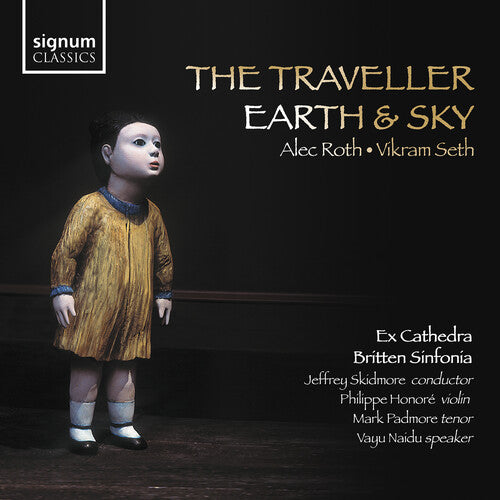
Roth: The Traveller; Seth: Earth & Sky / Ex Cathedra, Britten Sinfonia
THE TRAVELLER for choir, children’s choir, orchestra, tenor, violin and speaker. The Traveller was the third in a series of four major works with words by Vikram Seth and music by Alec Roth, commissioned jointly over four years by the Salisbury, Chelsea and Lichfield Festivals (2006-09). Each work featured the violinist Philippe Honoré as soloist, and each took a different geographical/cultural area as its starting point.
EARTH AND SKY for children’s choir and piano (with optional percussion). Earth and Sky was commissioned by the BBC for the Proms 2000 season. In keeping with the millennial theme, a work presenting a vision of the future was requested. Trying to be helpful, the BBC provided me with a video containing the predictions of various experts, but their ideas seemed dizzyingly contradictory.
-Alec Roth
Ex Cathedra has performed Alec’s music in over 200 concerts since 2007. There have been large-scale commissions and recordings and many short ‘gems’. It is of consistently high quality with moments of absolute genius. The relationship continues to flourish.