

test orfeo
163 products
-

-

-

-

-

-

-

-
 Sale
Pfitzner: The Christmas Elf / Eichhorn, Munich Radio Orchestra
Orfeo · Oct 20222 discsCD$26.99$13.49 -

-

-

-

-

Grieg: The Cello Works - Transcriptions & Songs / Müller-Schott, Schuch
Orfeo · Sep 20221 discCD$20.99 -

-

-

-

-

-

Dvořak: Hussite Overture - Brahms: Violin Concerto / Szeryng, Kubelik, BRSO
Orfeo · Aug 20221 discCD$16.99 -

-

-

George London Sings Offenbach, Tchaikovsky, Borodin, Verdi & Wagner
Orfeo · Aug 20221 discCD$16.99 -

-

-

Wagner: Tristan und Isolde / Stemme, Seiffert, Welser-Möst, Vienna State Opera Orchestra
Orfeo · May 20223 discsCD$37.99 -

-

-

-

-

-

Concertos for Piano, Trumpet & Strings / Ott, Radutu, Kaftan, ORF VRSO
Orfeo · Mar 20221 discCD$20.99 -

-

-

Beethoven: 5 Piano Concertos & Choral Fantasy / Serkin, Kubelik, BRSO
Orfeo · Feb 20223 discsCD$32.99 -

-

-

-

-

-

-

-

-

-

-

-

-

-
-

-

-

-

-

-

-

-

-

-

-

Strauss: Ritter Pásmán / Wallberg, ORF Vienna Radio Symphony Orchestra
Orfeo · May 20212 discsCD$26.99 -

-

-
 Sale
Berlioz: Lélio, ou Le retour à la vie / Gielen, Vienna Radio Symphony
Orfeo · Apr 20211 discCD$20.99$10.49 -

-

-

Haydn: Missa Cellensis & Jommelli: Te Deum and Mass in D major / Kubelik, Bavarian Radio Symphony Orchestra and Choir
Orfeo · Mar 20212 discsSACD$16.99 -

-

-
 Sale
Strauss: Ariadne Auf Naxos / Thielemann, Vienna State Opera Orchestra
Orfeo · Feb 20212 discsCD$37.99$18.99 -

-

-

-

-

-

-

-

-

-

-

-

-

-

-

-

Mozart: Violin Concertos Nos. 1-5 / Skride, Aadland, Swedish Chamber Orchestra
Orfeo · Sep 20202 discsCD$26.99


Orff: Prometheus / Kubelik, BRSO
What Carl Orff created with the Prometheus score is neither an opera in the traditional sense nor an oratorio, but also not a play with music or even “authentic” classical tragedy: far more is it an extremely individual musical interpretation of Aeschylus’s tragedy that concentrates primarily on the symbolic imagery of the scenes, which – as Orff himself said – “is accentuated and visualized by the music” and the spectator and hearer thereby enlightened.
The work is sung in Ancient Greek; the booklet contains a plot synopsis in English and German languages, plus liner notes.
REVIEW:
This CD of Carl Orff's Prometheus, released on the Orfeo label, is based on live recordings by Bayerischer Rundfunk from October 1st and 2nd, 1975 in the Herkulessaal of the Munich Residenz. Two concert performances were recorded, which took place in honor of Orff's 80th birthday. Of all the events held in Munich to mark the composer's milestone birthday, these two were considered the greatest. But that's no wonder, because the work, which was successfully premiered on March 24, 1968 at the Stuttgart State Opera, is a real masterpiece. Here we are dealing with a real rarity.
The very informative booklet shows that Orff did not in any way claim that this was an educational theater for the initiated, but only drew the consequences from the mythical power of language of Aeschylus. Orff's decision was good. The ancient Greek language gives the whole, both sung and declaimed passages, an extremely strong, haunting expression that is typical of this type of musical theatre. Ultimately, Orff was concerned with capturing the spirit of ancient theater by evoking it again with thoroughly modern means, with the aim of interpreting it anew and for our time (booklet). Orff has completely succeeded in this. His intention has worked in every respect. The impact of Prometheus is even greater than that of his predecessors, Antigone and Oedipus, previously written by Orff. Particularly impressive are the fully sung prophecies of the eponymous hero chained to the rock as well as the choruses, which are only entrusted to women. These breathe enormous intensity and lead the listener away from a normal opera to a new form of music theater for which Orff was the godfather.
Although the orchestra with the brilliant percussion, which is only joined by wind instruments and double basses, is not very pronounced, its outbursts are nevertheless powerful...Rafael Kubelik succeeds in exploring the diverse and quite unusual musical structures. Under his proven leadership, the Bavarian Radio Symphony Orchestra has surpassed itself. The conductor relies on a distinctive, rhythmically concise and often almost violent sound that corresponds excellently to the content of the work.
The singers put themselves entirely at the service of this great piece. The first to be mentioned here is Roland Hermann, who impressively proves that even a modern game like Prometheus can be mastered with a fantastic Italian technique. His beautiful baritone manages the balancing act between expressive singing and pathetic declamation magnificently. In her own way, Colette Lorand comes up with a very complex portrayal of the role of Io Inachis.
Conclusion: An interesting recording of an unusual work, the acquisition of which is definitely to be recommended.
-- Das Opernfreund


Handel: Judas Maccabaeus
When Handel composed his Judas Maccabaeus in 1746 he had brought to an end his activity for the (Italian) opera in London and begun a second career as an oratorio composer, which at first got off to a very successful start but then soon experienced a decline, for which there had been various causes. Judas Maccabaeus is the evidence that Handle had recovered from this setback, and to this day the work is considered one of his most successful. Rafael Kubelík relies, without ifs and buts, on the Handel Edition by the North German musical scholar Friedrich Chrysander that appeared in the second half of the 19th century and represents a monument of the scholarly musical historicism that probably could appear only in Germany and not in England, Handel’s artistic home. Apart from the old-fashioned German translation, most astonishing is the drastic cuts that Chrysander made. This historical live recording from 1963 presents Fritz Wunderlich as Judas together with Agnes Giebel, Julia Falk, Naan Pöld and Ludwig Welter.


Pfitzner: The Christmas Elf / Eichhorn, Munich Radio Orchestra


Christmas Concert - Classical to Carols / Helen Donath
Recorded here is something which normally is evanescent over the airwaves or in the Philharmonie am Gasteig: the pre-Christmas evening in the series of Munich Sunday concerts, featuring Helen Donath as one of the most distinguished lyric sopranos of her times, the boys’ choir Regensburg Cathedral Sparrows and the Munich Radio Orchestra under the musical direction of Kurt Eichhorn. On this special evening, excerpts from Händels Messias could be heard, followed by Arcangelo Corelli’s Concerto grosso Op. 6,8 Concerto per la notte di natale, Mozart’s Motette Ave verum corpus KV 618 and the Laudate Dominum from the Vesperae solennes de confessore KV 339, Christmas carols performed a cappella by the Regensburg Cathedral Sparrows (dating mostly from the 17th and 18th century) and Mozart’s Exsultate, jubilate KV 165.
REVIEWS:
Here is a reissue of a Christmas Concert (Weihnachtskonzert) from Munich’s Philharmonie am on December 11, 1988 which begins with a sequence of six Messiah excerpts, starring as soloist the great soprano Helen Donath. It has been issued before – as you can see, the YouTube excerpts have a different cover – and it sees daylight once more to grace Yuletide 2022.
These concerts were a regular event in Munich, with the Regensburger (literally, “Regensburg Cathedral Sparrows”) and the Munich Philharmonic under Kurt Eichhorn. When it comes to Corelli and Handel. This is pretty much good old-fashioned modern instrument interpretation of Baroque music, but injected with energy. Here are a couple of movements from the Corelli Christmas Concerto (Concerto grosso, Op. 6/8) to give you an idea. The Messiah (Messias) excerpts are all sung in German – so “Glory to God” becomes “Ehre sei Gott”; but what a choir this is.
Three Mozart pieces bookend the carol part of the programme: initially the choral Ave verum corpus (K 618), restrained and beautiful, and this, a supremely beautiful “Dominum” from Vesperæ solennes de confessore, K 339. The carols are heartwarming, and performed a cappella. Johann Stobäus’ Nun laßt uns mit den Engelein is a lovely chorale carol, each phrase beautifully sculpted, as are the phrases of Bach’s Ich steh’ an deiner Krippen hier. I admit a weakness for Johannes Eccard’s O Freide über Freund’. But I think it is Adeste fideles, beloved of all, surely, that sums up the glory of this choir.
…and what a perfect way to close, with that lovely Mozart Exultate, jubilate, K 165, festive and joyous (and listen tot he trills in her solo vocal cadenza in the first part. After a tender “Tu Alleluja ,” with Donath’s voice bright and agile, each note like a pinprick of light. There is a rather nice, extended interview with Helen Donath by Bruce Duffie available here, laced with many photos, plus scans of Donath’s famous record sleeves. A real treasure of a disc, and a step back in time! At a generous 77 minutes in duration, this is a lovely, heart-warming Christmas disc.
-- Classical Explorer


Grieg: The Cello Works - Transcriptions & Songs / Müller-Schott, Schuch
Edvard Grieg, arguably the most popular composer ever to emerge from the Scandinavian peninsula, made substantial contributions to the chamber music canon with his violin sonatas rather than with his works for cello: only one sonata for cello and piano (Op. 36) was written for this line-up. Daniel Müller-Schott, always driven to expand the musical repertoire for his instrument and with a keen sense of transcriptions, for this all-Grieg album – which is his 20th album on the label Orfeo – hence transcribed and recorded for the first time the violin sonata in C minor, Op. 45, No. 3, for the cello. Accompanied by his long-standing duo-partner Herbert Schuch on piano, the short Intermezzo in A minor (EG 115) guides us to the second part of the album, where the duo presents selected songs of various characters transcribed for cello and piano.
REVIEWS:
Cello originals and borrowings played with great allure… The instrument’s cantabile qualities ensure that the selection of Grieg song transcriptions works equally well, with Müller-Schott presenting a nicely wide-ranging choice.
-- The Strad
Edvard Grieg’s cello sonata ekes out a shadowy existence in his oeuvre. Daniel Müller-Schott and Herbert Schuch enter the music with the Allegro agitato in such a furious and energetic way that one is carried away by this inner fire and its power. Even in the Andante, for all its lyricism, there remains much nervousness. The finale is buoyant and dance-like, all nervousness has gone, but the energy remains.
Grieg himself considered the violin sonatas his most important works. Daniel Müller-Schott has rewritten the third for cello. Müller-Schott and Schuch play with the greatest expressivity, very full of contrasts, and thus create a tension even through the second movement that does not even dissolve in the Allegro animato.
Also in the smaller pieces, there are two Agitatos, so that even this part of the CD is not characterized by charm throughout. And so there is one thing we probably retain from this release: the exceptional energy and intensity with which the performers play their Grieg. I think even the composer would have been amazed.
-- Pizzicato


Szymanowski & Penderecki / Gielen, ORF Vienna Radio Symphony
Despite their different musical languages, all works by the Polish composers Karol Szymanowski and Krzysztof Penderecki presented on this album have in common the inherent character of a lament: Szymanowski’s Stabat mater, which was completed in 1926 and is based on a Polish translation of the Latin medieval poem, is considered as one of the most important compositions of the 20th century. Penderecki’s three-part oratorio Dies Irae was commissioned for a commemoration day in remembrance of the murder victims at the former concentration camp in Auschwitz, and hence carries the epithet “Auschwitz Oratorium”. The album closes with a Threnos for 52 string instruments dedicated to the Victims of Hiroshima. The final haunting bars of this composition present a tutti cluster, starting in a triple forte and fading out to quadruple piano.


Dvořak: Hussite Overture - Brahms: Violin Concerto / Szeryng, Kubelik, BRSO
The visiting Bavarian Radio Symphony Orchestra opened its concert at the 1967 Vienna Festival with a high-octane performance of Dvorák’s patriotic overture The Hussites. In the Brahms Violin Concerto, the elegant soloist Henry Szeryng and the conductor Rafael Kubelík entered into a musical dialogue that was both subtly sensitive and quick-witted. This release has been digitally mastered from the original tapes for optimal sound quality, and is sure to delight a whole new generation of listeners.
REVIEWS:
Some recordings need merely seconds to make their mark, especially when taken from memorable concerts. One such occurred on June 11, 1967, when the Bavarian RSO under Rafael Kubelík were joined by Henryk Szeryng at the Vienna Konzerthaus for a performance of Brahms’s Violin Concerto, music-making that exhibited a degree of elasticity and intellectual elevation that is typical of both artists (it’s newly reissued but was originally released by Orfeo in 2017).
Try the first movement’s big central tutti at 8’38”, Kubelík’s natural brand of rubato and the strings’ soaring tone, winding down to Szeryng’s meditative re-entry soon afterwards. And there’s the superb oboe solo at the start of the Adagio, the perfect preparation for Szeryng’s angelic solo. Rarely have I heard a reading that captures the music’s rhapsodic spirit as tellingly as Szeryng and Kubelík do here, tracing the line’s ever-shifting expressive focus with an uncanny musical instinct. And the bustle of the finale, crisp and upbeat, its gypsy inflections unmistakable from the off, its lyrical central section returning us to the songlike aspects of the first two movements.
But it’s the disc’s opening track that in many respects proves a prize among prizes, Dvořák’s Hussite Overture, music originally intended as part of a dramatic trilogy on the Bohemian religious leader Jan Hus. The principal theme is more famous for its use in Smetana’s Má vlast but Dvořák knits it into a 13-minute panoply of dramatic events that Kubelík and his players respond to as if their lives depended on it. There have been fine commercial recordings but none that fans the flames quite as effectively as this one. The stereo recording wears its years lightly. Unmissable!
-- Gramophone
After an excellent Hussite Overture from Kubelik and the orchestra, the conductor shapes Brahm’s tutti well, working up quite a storm and not relaxing too much for the lyrical theme. Szeryng’s entry is imperious; he produces lovely lyrical playing for the quieter passages.
-- The Strad
The stereo sound is quite good, and not just for the time—it is vivid and full, making for an enjoyable listen. I feel a touch of regret at having missed out on Szeryng this long, but in the spirit of better late than never, this is a memorable recording that deserves high praise.
-- Fanfare


George London Sings Offenbach, Tchaikovsky, Borodin, Verdi & Wagner
The present album is a re-release of Bavarian broadcast recordings of 1953-56 featuring legendary bass-baritone George London at the height of his career. Upon its initial release, the album received glowing reviews from critics and fans, and this now can be enjoyed by a new generation of listeners. “(The) collection is vintage London all the way“ (American Record Guide) “The extracts from Aida and Die Walküre with Astrid Varnay are electrifying“ (BBC Music Magazine) “This is a worthy representation of a singer whose career was ended too soon.“ (International Record Review)
REVIEWS:
The excerpts on the present disc are uniformly excellent, and the recorded sound is surprisingly good. … London is a sensitive and expressive Dr. Miracle, and with excellent assistance from Teresa Stich-Randall and Maria von Ilosvay. With Russian speaking parentage, London had a special leaning towards Russian operas…
That London was a great Wotan is very obvious, even more so in the concluding farewell, where his sensitiveness and beauty of tone is striking. One rarely hears such legato singing in Wagner.
London sings Prince Igor’s aria with great dignity and feeling but it is the three final items with Varnay that form the high point of this album, in that they contain both the greatest music and the finest partner.
The playing of the BRSO is fine throughout and all three conductors ensure idiomatic execution.
-- MusicWeb International
London’s voice was massive, focused and dark, with an exciting and secure top. In these recordings he never blusters, and he sings with verbal acuity, noble tone and dramatic verve…The remastered sound is excellent.
-- Opera Now
It’s good to see a dedicated London CD appear on Orfeo, which concludes with the closing sections of Die Walküre, where the great American bass-baritone is heard in duet with Varnay under the direction of Varnay’s husband, Hermann Weigert, who is especially sensitive with accompanying lower string lines near the start of Wotan’s Farewell. London’s deep rolling voice…makes a strong impression.
-- Gramophone


Wagner: Tristan und Isolde / Stemme, Seiffert, Welser-Möst, Vienna State Opera Orchestra


Violin Unlimited - Baiba Skride plays Solo Sonatas
On her first album for solo violin, internationally acclaimed and renowned Latvian violinist Baiba Skride interprets selected sonatas by Erwin Schulhoff, Paul Hindemith, Philipp Jarnach and Eduard Erdmann. Although Johann Sebastian Bach’s sonatas and partitas for violin solo are regarded as the measure of every violinist’s technical skill and maturity, compositions for unaccompanied violin became increasingly rare in subsequent epochs (the classical and the romantic era). It wasn’t until the turn of the 20th century that Max Reger made a conspicuous contribution in this field with altogether eleven sonatas. His example was an impetus that very plausibly inspired his contemporaries and successors to come up with the four contributions to this genre from the 1920s on this album.
REVIEW:
Skride starts with Schulhoff in the very resonant acoustic of the Jesus-Christus-Kirche, Berlin. Daniel Hope on Nimbus and Antonín Novák on Praga have approached this sonata on their own terms, too, but I like Skride’s way with it, notably the serious and darkly-voiced slow movement at its heart. She plays the Hindemith with considerable purity of expression, enjoying the droll pizzicato episodes of the third movement and the charming Mozart variations that form the finale.
Jarnach’s 1922 sonata makes for a marvelously balanced work. The opening movement, which Skride dispatches with fluidity and expressive freedom, is followed by the urgency of the Prestissimo which she subtly allows to slow before picking up the intensity of the earlier material. The finale has abrasive dialogues but clear lines—a tribute to her refinement. For many years Erdmann’s sonata had the reputation of being a doughty and unapproachable work. It was composed for the Flesch student, Alma Moodie, who never made a recording. It’s a highly abstract work, and freely tonal, but Skride plays it with the kind of appeal she’d bring to much more popular repertoire and so rides over any concerns about its unapproachability. In truth Brunnert dealt with those concerns too, but Skride has a way with its slow, uneasy elements and its quietly, wintry finale that are most impressive too.
All four works were composed between 1921 (the Erdmann) and 1927 (Schulhoff) and offer contrasting and complementary evidence of solo violin works in this period. Each has its own character and imperatives, well drawn on by Baiba Skride in this well-programmed disc.
-- MusicWeb International


Concertos for Piano, Trumpet & Strings / Ott, Radutu, Kaftan, ORF VRSO
After the great success of her debut album (OPUS KLASSIK award 2021) and her duo album with pianist En-Chia Lin, Selina Ott for her third recording teams up with renowned pianist Maria Radutu, conductor Dirk Kaftan and the ORF RSO to present selected works by Dmitri Shostakovich, André Jolivet and Mieczyslaw Weinberg. Shostakovich’s Concerto for piano, trumpet and string orchestra (1933) is notable for a prevailing parodistic tone, which scarcely occurs in this form in any of his other works. Many of the themes that lend the music the distorted face of the grotesque are heard in the trumpet. The choice of instruments of André Jolivet’s Concertino for trumpet, piano and strings is exactly the same as that of Shostakovich’s work, but the latter is more of a piano concerto, while Jolivet’s is more of a trumpet concerto. Like Shostakovich, Mieczyslaw Weinberg also incorporates several quotations into the final movement of his Trumpet Concerto (1967), for example the fanfare from Mendelssohn’s Wedding March. Referred to by Shostakovich as “symphony for trumpet and orchestra”, the Concerto presents music of a taut inner structure and logical consistency.


Beethoven: 5 Piano Concertos & Choral Fantasy / Serkin, Kubelik, BRSO
These Bavarian Radio recordings, first released in 2005, constitute Rudolf Serkin's third and final edition of the Complete Beethoven Piano Concertos, and were the only performances to be recorded in the concert hall, not in the studio. As such, they fittingly complete both his discography and his artistic legacy as one of the 20th century’s indisputably great pianists. This jewel case presentation, complete with booklet notes in German and English, is a re-release of the original 3-album box set that went out of stock following healthy sales.
REVIEWS:
For at least a half century Beethoven’s piano concertos played a central role in Rudolf Serkin’s repertoire. Yet out of all the Serkin Beethoven concerto cycles on disc, the present one, recorded over the course of three concerts in October and November of 1977, offers the most consistent artistic and sonic satisfaction.
The slightly distant yet attractively robust engineering conveys a cogent sense of concert hall-realism, and not just to the benefit of Rafael Kubelik’s superb Bavarian musicians. It also reveals Serkin’s elusive, difficult-to-record sonority in more flattering, three-dimensional light than the gaunt, often monochrome impression one gleans from his Columbia Masterworks sessions. As a result, the concentration and inner tension Serkin brings to the slow movements comes off with more warmth and sustaining power.
Although Serkin at 74 may not have been the impetuous, fiery virtuoso in the first three concertos’ finales that he was in his 40s, when he recorded them for CBS Masterworks, his technique nevertheless is still assured, alert, and responsive, and far more energized than in his relatively careful and labored collaborations with Ozawa.
However, Serkin must have drunk from the fountain of youth before hitting the stage for the Choral Fantasy (Kubelik, too, for that matter). The performance radiates inspiration from start to finish, highlighted by Serkin’s ardent yet cannily structured opening cadenza, the chamber episodes’ zestful give and take, plus massed choral and orchestral tuttis that at once communicate elemental power and textural clarity. Let’s hope this major addition to Serkin’s discography will encourage Sony not to leave its own complete Serkin edition hanging.
For all fans of the pianist and/or the conductor, this release is a must.
--ClassicsToday.com (Jed Distler)
This recording of Serkin from 1977 highlights a 20th-century great who brought musical purpose and intellectual rigour to every detail. Serkin ranks among the greatest of 20th-century pianists; his repertoire ranged from Bach to Reger, but Beethoven was always at its very heart. In the autumn of 1977, in the Herkulessaal in Munich, he played all five Beethoven concertos as well as the Choral Fantasy in a series of concerts with the Bavarian Radio Symphony Orchestra under Rafael Kubelík, another musician who, like Serkin, always put himself at the service of the music. Recordings of those performances were first released on disc in 2005...their reissue now makes available again what is in every respect a historic musical document.
Serkin was never interested in ingratiating himself through honeyed phrases or silken tone. Instead in these interpretations there is musical purpose and intellectual rigor in every detail. Whether it’s the almost combative muscularity he brings to the piano’s first entry in the third concerto, or the instant authority of his torrential opening to the Emperor, it sets the tone for all that follows, constantly drawing equally intense responses from Kubelík and his superb orchestra. The accounts of the slow movements are just as remarkable; there’s a hymn-like calm to the Largo of the third, a consoling sweetness to the fourth’s exchanges between the soloist and the orchestra. All are in short, remarkable performances, not only among the finest available on disc, but further reminders of just how peerless a Beethoven interpreter Serkin was.
--The Guardian (Andrew Clements)


Zemlinsky & Schreker / Gielen, ORF Vienna Radio Symphony
Alexander Zemlinsky composed his Lyric Symphony op. 18 for soprano, baritone and orchestra during his time as musical director of the New German Theatre in Prague, where he had moved in 1911 from Vienna. It was generally regarded as his corresponding equivalent to Mahler’s Lied von der Erde (C210021) and is based on Nobel Prize laureate and most important representative of modern Indian literature Rabindranath Tagore. The work is combined with the befriended and three years older ‘phantasmogorist’ Franz Schreker’s Prelude to a Drama, which is a version of the overture of his Die Gezeichneten. It might be considered symptomatic for the most notable characteristic of Schreker’s music: the dominance of chordal sounds over the melodic element.
REVIEW:
Zemlinsky’s seven-movement Lyric Symphony lays claim to being his best-known work and is certainly the only one to attract a significant number of prominent conductors. This live account from Vienna in 1989 was Gielen’s second recording of the work, and it finds him in prime form. He leads a powerful orchestral reading that is all the more impressive because Vienna’s proficient Radio Symphony was the last orchestra I expected to be virtuosic. Every section is totally committed to the score’s voluptuous passions, however, and the recorded sound from Austrian Radio is wonderfully clear and vivid, no small achievement where Zemlinsky’s dense orchestration is concerned.
In the soprano part the choice has typically been big, dramatic voices on the order of Deborah Voigt and Alessandra Marc. Karen Armstrong can’t compete in that league, and wisely she doesn’t try to. By not pushing her voice, singing the chromatic lines accurately, and paying attention to the verse, she delivers a more than respectable performance. But realistically neither singer has the most beautiful or distinctive voice. Orfeo supplies no texts or translations, which means that this recording can only be supplementary to one that does. There are enough drawbacks, despite Gielen’s outstanding conducting, to place this release somewhere in the middle of the pack.
The pairing of Franz Schreker’s 20-minute Prelude to a Drama from 1914 isn’t a new addition to Gielen’s discography, since it also served as the filler to his Mahler Fourth Symphony. The Prelude is rich in themes and incidents, and so skillfully structured that it can be analyzed as a sonata movement. Schreker was a colorist, as he described himself: “I am a sound artist, a phantasmagorist of sound, a sound-aesthete, and there’s not a trace of melody in me.”
The music is lovely, and Gielen’s performance glows with ardent feeling, not a mode I associate with him.
For me the evocation of history hangs heavily over this release, but it holds considerable musical rewards, too, especially for aficionados of an aesthetic doomed to be wiped out through political denunciation.
-- Fanfare (Huntley Dent)


Hindemith: Works for Clarinet / Sharon Kam
Sharon Kam discovers Hindemith on her third album on Orfeo label. Even if some people still consider him “too modern” today, Hanau-born Hesse Paul Hindemith is undoubtedly one of the most influential German composers of the generation after Richard Strauss. Few of his immediate colleagues have found their way into the international repertoire to the same extent that he has, or influenced subsequent generations through comparably extensive educational work. All three works for clarinet featured on this recording date from years of extensive travel: the Quartet for Clarinet, Violin, Cello, and Piano was written in 1938 around the time of his emigration to Switzerland, the Sonata for Clarinet and Piano in 1939 during the course of the tours of the USA that immediately followed the emigration, and finally, the Concerto for Clarinet and Orchestra in 1947 (written for and premiered by Benny Goodman) when Hindemith left his American exile to visit Europe again for the first time after the Second World War. Sharon Kam has teamed up with her long-standing musical partners Enrico Pace , Antje Weithaas , and Julian Steckel for the chamber music part of the album, and with the Frankfurt Radio Symphony under the musical direction of Daniel Cohen for the clarinet concerto.


Four Visions of France: French Cello Concertos / Müller-Schott
It is not by chance that luminous textures and sensual orchestral colors are considered essential features of French music. Its history features great names renowned for their art of instrumentation and sensitive use of timbres, who include the composers of the cello concertos on this recording: Camille Saint-Saëns, whose instrumentation technique always combines color with transparency, Édouard Lalo, who was highly esteemed by Claude Debussy for the wealth of color in his works, and Arthur Honegger, who painted striking soundscapes not only in his Cello Concerto but in his works without a large orchestra as well. Often it is the fine shadings and delicate transitions that characterize the tone colors of French music and are responsible for its delightful charm. Daniel Müller-Schott – Opus Klassik award winner 2019 – appealingly combines five works from the French sound kaleidoscope on his newest album with the DSO Berlin and Alexandre Bloch 'Four Visions of France’.
REVIEWS:
In every way, this is an impressive CD. It contains first-rate performances in excellent sound and has a most appealing programme. Included is a handsome booklet with photos and more than adequate notes on the works and artists. There is simply no reason to hesitate in adding this to your collection, if you are a cello aficionado.
-- MusicWeb International
After more than two decades in the spotlight, a still boyishly handsome Daniel Müller-Schott rightly remains one of the world’s foremost cellists, and a personal favorite of mine. He turns his attention here to chestnuts of the French repertoire, with most felicitous results.
The Saint-Saëns is of course the heavyweight entry in terms of standard repertoire status. Müller-Schott is on a plane with the work's finest exponents, giving a brisk and authentically French rendition, light and yet with dramatic flair. Equal credit in this regard is due to conductor Alexandre Bloch, who elicits an echt Gallic sound from the Deutsches Symphonie-Orchester Berlin. Much the same can be said of the other works featured here.
The recorded sound is excellent, the booklet notes (supplemented by artist bios) brief and to the point. This is a well thought out and beautifully realized release; strongly recommended.
-- Fanfare (James A. Altena)
Müller-Schott plays Saint-Saëns’ bravura test piece broadly in the opening Allegro, playfully in the Allegretto, and energetically in the closing Allegro. Later the Romance in F Major is tenderly executed by Müller-Schott. By contrast, the cellist’s take on the Élégie of Gabriel Fauré is all gentleness. His mining of the early 20h century sound in Arthur Honegger’s Cello Concerto bespeaks boldness and incisiveness.
When it comes to Édouard Lalo’s less-French than most work among those of his contemporaries: the Cello Concerto in D Minor, Müller-Schott embraces the grandiose, quasi-Wagnerian music with no small measure of impassioned fervor. Throughout all of the works featured in this interesting album, the soloist and his colleagues from the Deutsches Symphonie-Orchester Berlin play with commitment and unimpeachable style.
–Rafael's Music Notes


Various: Opera Arias / Gagnidze
ORFEO presents Georg Gagnidze’s long-awaited debut album. Georgian baritone George Gagnidze - characterized by the American opera magazine Opera Now as a “gentle bear of a man” - on his long-awaited debut album presents celebrated and diverse opera characters such as Verdi’s murderous Count di Luna (Il trovatore), the vengeful Renato (Un ballo in maschera), the loyal friend Posa (Don Carlos) the great kink Nebuchadnezzar (Nabuko) and – outside the Verdi canon – Andrea Chénier’s revolutionary colleague Gérard, Mozart’s notorious seducer Don Giovanni and Wolfram (Tannhäuser), who pines for the love of Elisabeth.


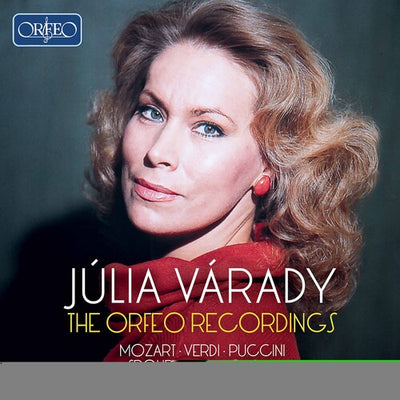
Júlia Várady - The Orfeo Recordings
Orfeo honors Júlia Várady as one of the most important sopranos of the second half of the 20th century with the release of this 10 album boxed set ‘The Orfeo Recordings’ on the occasion of her 80th Anniversary on 1st September 2021.
A significant number of opera lovers and connoisseurs maintain that Maria Callas’ mantle ought to have passed to Júlia Várady, and that the (now eighty-year-old) Romanian-Hungarian-German soprano actually should, in her day, have ascended the international throne of the prima donna assoluta. But as it is said, her loyalty to her two musical homes, the Bavarian State Opera and the Deutsche Oper Berlin, prevented this. Nonetheless, she made guest appearances at all the world’s major opera theaters – but she was apparently not available to the market as unrestrictedly and ubiquitously as would have been necessary for her image, in order for her to be enthroned as the Várady (as the legitimate successor of the Callas). In addition to her loyalty to the two aforementioned opera houses, another reason seemed to be a natural modesty that prevented her from constantly drawing attention to herself (with a reputation, for example, of being the “difficult one,“ or even with scandals). Her marriage to the titan Dietrich Fischer-Dieskau in 1977 may also have played a role, as she often and willingly stepped into his shadow.
Escerpts from reviews of previously released volumes included in this set:
Julia Varady sings Wagner
Varady's reading of the Wesendonck Lieder is remarkable, enthralling. There's nothing here of the slow, wallowing approach often favoured today. The feeling of the words is one of very present emotions. And transfiguration is a feature of Varady's concentrated, urgent Liebestod, her complete absorption with the text as much as with the music an object-lesson in great Wagner singing. The players of Fischer-Dieskau's Berlin orchestra cover themselves in glory. The recording is exemplary.
– Gramophone
Julia Varady sings Richard Strauss
The final scene of Salome, under the watchful eye of Varady's husband, Fischer-Dieskau, has the perfection of pitch and phrase one expects of this singer, as well as an expected acuity for the meaning of the text.
– Gramophone
Julia Varady - Puccini Arias
A lovely and somewhat surprising record by the most fascinating and patrician lyric soprano of the present age: 'surprising' because, though Varady is associated closely enough with Verdi, the Puccini connection is less readily made, 'lovely' because the voice is still so pure, the style so musical and the response so intelligent, immediate and full-hearted. She adjusts wonderfully well to the Italian idiom, lightening the vowels, freeing the upper range, allowing more portamento than she would probably do in other music, yet employing in its use the finest technical skill and artistic judgement.
– Gramophone


Verdi: Messa da requiem / Segerstam, ORF Vienna Radio Symphony
Verdi’s Messa da Requiem – an “opera in ecclestiastical robes”, as conductor Hans von Bülow called it – recorded in October 1980 at Stiftskirche Herzogenburg with Julia Varady, Alexandrina Milcheva, Alberto Cupido, Nicola Ghiuselev, ORF Choir and ORF Vienna Radio Symphony Orchestra under the baton of Leif Segerstam. The Messa da Requiem is a musical setting of the Catholic funeral mass (Requiem) for four soloists, double choir and orchestra by Giuseppe Verdi. It was composed in memory of Alessandro Manzoni, an Italian poet and novelist whom Verdi admired. The first performance, at the San Marco church in Milan on 22 May 1874, marked the first anniversary of Manzoni's death. The work was at one time referred to as the Manzoni Requiem. Considered too operatic to be performed in a liturgical setting, it is usually given in concert form of around 90 minutes in length. Musicologist David Rosen calls it 'probably the most frequently performed major choral work composed since the compilation of Mozart's Requiem'.


Mozart: Imperial Hall Concerts
Germany’s oldest Mozart festival celebrates its 100th anniversary in 2021. The present jubilee boxed set presents previously unpublished treasures from the archive of the Bavarian Broadcasting. All live recordings from the Baroque Imperial Hall at Würzburg Residence are digital remasters.


Donizetti & Verdi: Opera Arias / Fahima, Gamba, ORF VRSO
Having joined the ensemble of Deutsche Oper Berlin at the age of 22 and the ensemble of Wiener Staatsoper in 2013, Israeli-born Hila Fahima presents a mix of well-known selections and rediscovered treasures on her debut album: Donizetti’s Lucia, Norina, Linda di Chamounix, Adina, Marie from La fille du regiment, plus Verdi’s Gilda – she will be starring in this role at this year’s Bregenz Festival – and also Amalia from his I masnadieri, as well as arias from Donizetti’s little-known operas Rosmonda d’Inghilterra and Emilia di Liverpool.


Strauss: Ritter Pásmán / Wallberg, ORF Vienna Radio Symphony Orchestra
When the Court Opera Director Wilhelm Jahn commissioned the by no means unvain Johann Strauss Jr. to write a ‘genuine’ opera, he readily accepted. So, he wrote Ritter Pásmán, a work the Waltz King himself regarded as his only one in this genre, although the plot is basically like an operetta. The source was the narrative Pázmán lovag by the Hungarian writer János Aranyi (1817-1882). It deals with jealousy and a kind of tit-for-tat. The premiere of the comic opera at the Vienna Court Opera on New Year’s Day 1892 was a major society event, but its artistic success lagged somewhat behind. The reviewers of the premiere were distanced towards the work. On the one hand, they unanimously elevated the ballet music at the beginning of Act III to the status of an absolute masterpiece. (By the way, this was the first time that a cimbalom could be heard in the orchestra of the Court Opera). The present live recording was captured at the Vienna Musikverein on 27 October 1975, with the ORF Vienna Radio Symphony Orchestra under the baton of Heinz Wallberg, Eberhard Waechter as Ritter Pásmàn, Sona Ghazarian as Queen, Josef Hopfwieser as Hungarian King, and Truedeliese Schmidt as Eva as main cast. The recording includes the complete ballet music as bonus tracks, performed by the Slovac State Philharmonic Orchestra under the baton of Alfred Walter.


Berlioz: Lélio, ou Le retour à la vie / Gielen, Vienna Radio Symphony
Hector Berlioz‘ Lélio, ou Le retour à la vie was a sequel to his Symphonie fantastique, the second part of the Episode of the life of an artist, which had premiered in 1830 at the Paris Conservatory. The piece that is made up of six sections was written and composed during his travels to and in Italy; for this he made use in part of material that he had already prefabricated for the prestigious Rome Prize. Berlioz and the Irish Shakespearean actress Harriet Smithson, whose rejection he had tried to compensate in the Symphonie fantastique, got married in 1833. (It should be noted that marriage by no means turned out to be the fulfillment of all dreams.) In his memoirs about Lélio’s premiere performance in December 1832 at the Paris Conservatory, Berlioz noted the following phrases about his future wife: “... the passionate character of the work, its ardent melodies, its exclamations of love, its outbursts of anger [...] must have made an unexpected and deep impression on her sensitive nature and poetic imagination. [...] When in the monodrama the actor Bocage, who recited the role of Lélio (that is, myself), pronounced the following words: ‘Oh, if I could only find her, the Juliet, the Ophelia for whom my heart is searching!’ […] she thought to herself: ‘My God! ... Juliet, Ophelia ... there’s no doubt, he means me ... And he still loves me as before …’” Michael Gielen conducts the Vienna Radio Symphony Orchestra and the Wiener Singakademie with Herbert Lippert and Geert Smits as highly acclaimed soloists and Joachim Bissmeier as narrator in an absorbing live capture that took place on 7 Dec 2000 at the Vienna Concert Hall.


Haydn: Missa Cellensis & Jommelli: Te Deum and Mass in D major / Kubelik, Bavarian Radio Symphony Orchestra and Choir
Known as St Cecilia Mass, Haydn’s fifth Missa is the longest and most complex setting of the Latin Mass text. Rich in elaborate contrapuntal interweaving and with a duration of more than one hour, it reveals Haydn the opera composer. The present recording of a concert, performed in 1982 in the Ottobeuren Basilica with the Bavarian Radio Symphony Orchestra and Choir under the baton of Rafael Kubelik, is still considered a reference recording of the work. Niccolò Jommelli’s Mass in D major and his Te Deum were both written during his time at Charles Eugene’s Württemberg court, where he is said to have held the highest paid musician post in Europe. The Württemberg court loved French music and at the same time the virtuoso Mannheim school. These, together with Jommelli’s Italian roots, also shaped the composer’s stylistically diverse sacred oeuvre. The Te Deum with a brief length of not even a quarter of an hour, was frequently played even up until the early 19th century.


Strauss: Ariadne Auf Naxos / Thielemann, Vienna State Opera Orchestra


Mahler: Das Klagende Lied / Gielen, Vienna Radio Symphony
Mahler’s cantata Das klagende Lied today constitutes a veritable rarity in concert programmes – in an age that without contradiction recognizes Mahler as one oft he most eminent milestones in the music history of the late 19th and early 20th century. Based on a horror tale written by Mahler himself, this large-scale, vocal symphonic work forms the beginning of Mahler’s more familiar oeuvre. Mahler, at the age of only 20, submitted the score for the Beethoven Prize at the Society of the Friends of Music in Vienna. He did not receive this prize, however, and subsequently made several revisions. It was finally premiered by the composer in Vienna on 17 February 1901 only. The ‚mixed version‘ (also employed for this recording) consisting of the original first movement and the revised version of the other two parts, became customary in the course of the great Mahler Renaissance in the 1960s. The presented live capture with the 2019 deceased Michael Gielen – like Mahler not only a conductor but also a composer – with the ORF Vienna Radio Symphony Orchestra was taken in June 1990 in the Konzerthaus Vienna.
REVIEW:
This performance of Mahler’s youthful horror story realizes every gruesome detail with positively sadistic relish. There are other fine versions in the catalog, but this live version is the most graphic, exciting, and true to Mahler’s youthful vision. Impactful live sound, great singing, great conducting—this is now the one to get.
– ClassicsToday.com


Opera Rarities - Orfeo 40th Anniversary Edition
On the dark side of fame awaits the slide into obscurity. That’s certainly true for a number of operas that, while popular and highly lucrative during their composers‘ lifetime, soon followed their creators into the shadowy realm of oblivion. Operas, for example, that only ever get mentioned in connection with some much more famous sibling. Giuseppe Gazzaniga’s Don Giovanni – premiered half a year before Mozart’s masterpiece – is such an example, as is Ruggero Leoncavallo’s La Boheme and George Bizet’s Djamileh, widely considered the predecessor of Carmen. Other operas just do not stand out among other works by a composer – Jules Massenet’s operas for example are hardly a footnote of music history, his opera Therese, a thoroughly forgotten work, however, is. Two examples for works that are scarcely performed or even known outside of what is now the Czech Republic are also included in this collection of Opera Rarities on ORFEO: Antonin Dvorak’s last opera Armida and Zdenek Fibich’s Sarka.
REVIEW:
Containing radio performance recordings of six works by Dvorak, Massenet, Leoncavallo, Bizet, Gazzaniga, and Fibich mentioned often in histories of music but almost never on the bill, this is a box certainly precious for those who love opera.
– Classical Music Daily (Giuseppe Pennisi)


Gluck: Opera Gala
Gluck Opera Gala is a 2-album compilation of highlights from seven previously released albums on the ORFEO label. It contains excerpts from Gluck's semi seria opera Alceste (album 1, tracks 1-7); his reformist operas Iphigénie en Tauride (album 1, tracks 8-14), Orfeo ed Euridice (album 2, tracks 1-9) and Paride ed Elena (album 2, tracks 10-16); and two works in a more light-hearted vein, Le Cinesi (album 1, tracks 15-16) and Les Pélegrins de la Mecque (album 2, tracks 17-23). All of the recordings are star-studded, featuring performances by legendary artists such as Jessye Norman, Nicolai Gedda, Thomas Moser, Ileana Cotrubas, Dietrich Fischer-Dieskau, Franco Bonisolli and Julia Kaufmann.


Trumpet Concertos / Selina Ott
On her debut album with the ORF Vienna Radio Symphony Orchestra and Roberto Paternostro, Selina Ott presents an exciting selection from the opulent range of 20th century trumpet concertos that have been written in close temporal proximity to one another.


Orfeo 40th Anniversary - Legendary Pianists
When the ORFEO label was established in Munich 40 years ago, few would have predicted that the record company would develop into a firmly established player in the classical music market. One of the label’s priorities in the early years was vocal music, with opera rarities top of the list and, since the mid 1980s, the re-use of historic tape recordings. Big names featured on the label’s own productions, while ORFEO also developed into a talent factory for discovering and nurturing young artists. This Legendary Pianists 10-disc boxed set continues the series marking ORFEO’s 40th anniversary and features nine pianists in historical and modern recordings dating from the 1950s to the 2000s.
REVIEW:
This edition should be quite intriguing to collectors who surely will find a set of names quite different from what they might have chosen. It does not claim to be definitive; a collection, not the collection. There are ten CDs in the box featuring nine artists recorded live or recorded for broadcast, giving a sense of hearing an actual performance that contributes a heightened sense of you-are-there. Repertoire consists of mainly concertos from Bach to Brahms, via Mozart, Beethoven, Schubert and Schumann. Also, a handful of variations, etc. This is a most attractive collection of pure pleasure.
-- The Whole Note
But for Kempff at his most unbridled you need to hear 1956 WDR Cologne radio recordings of Beethoven’s Op 111 and Schumann’s Fantasie, where bass chords are augmented and the sense of uplift is so acute that you could as well be listening to Schnabel, Cortot, or Fischer live. The disc is one of 10 in Orfeo’s Legendary Pianists, which opens with the player Furtwängler described as ‘the troubadour of the piano’, Géza Anda, who fits that description like a glove in Beethoven’s First Concerto recorded in Munich under Rafael Kubelík, whereas Brahms’s Second Concerto with the same artists fans the flames with consistent intensity, the second movement especially. In the same collection, Gulda plays concertos by Beethoven and Schumann, a rather brittle-sounding Oleg Maisenberg is compelling in Schubert (including the Wanderer Fantasy), Konstantin Lifschitz brings a Gouldian tautness to the seven Bach keyboard concertos (greatly extending the cadenza in BWV1052’s finale), Carl Seemann is characteristically considered in Mozart’s Concertos K449 and 503, Gerhard Oppitz plays Brahms’s Third Sonata (the second movement being significantly broader than on his RCA recording) and we’re given the Third and Fifth Beethoven Concertos from the cycle that Rudolf Serkin and Kubelík recorded in 1977, a much-underrated set.
-- Gramophone


Mozart: Violin Concertos Nos. 1-5 / Skride, Aadland, Swedish Chamber Orchestra
Mozart composed his violin concertos in 1773 (K 207) and 1775 (K 211, 216, 218 and 219). These five works and the three single movements recorded here have been passed down complete and verified as authentic. The genesis of these works is closely linked to Mozart’s work as Kapellmeister at the Salzburg court, ending with the probably most important kick-out in music history. Mozart scored no solo cadenzas for his violin concertos; in the practice of the time, they were improvised. All the cadenzas on these recordings derive from Baiba Skride. Eivind Aadland writes: “Baiba is such an intuitive player. She has this rare quality of discovering the music as we play. So she never plays exactly the same. There is a wonderful sense of creating, discovering, of going finding new ways.“ Baiba Skride about her new album: “I know that there are so many different and super recordings of Mozart, but I think it is important to enjoy the music you have heard a thousand times and will hear a thousand times more with new eyes and simply allow the music to play.”

Showing Items 1-30 of 163