Fall Blowout Sale 2026
Fall into the sounds of the season with 50% off 100+ handpicked titles for a limited time! From the quiet introspection of Satie and the autumnal warmth of Brahms to the lush, romantic beauty of Fauré and more, this collection is made for crisp mornings, golden afternoons, and cozy evenings at home.
Refresh your collection with music that feels right at home this time of year — all at half price! Plus, enjoy FREE SHIPPING on orders of $60 or more, making it the perfect time to stock up on your autumn favorites.
Shop the Fall Blowout now and save 50% while it lasts!
186 products
-
-
-
SaleBrahms: Double Concerto; Viotti: Violin Concerto No. 22 / Tetzlaff, Järvi, Deutsches Symphonie-Orchester Berlin
Ondine · Oct 2023CD$18.99$9.49 -
-
-
SaleArtur Rodziński: The Complete Cleveland Orchestra Recordings
Sony Masterworks · Nov 2023CD$63.98$31.97 -
SaleAnshel Brusilow Conducts The Chamber Symphony of Philadelphia
Sony Masterworks · Nov 2023CD$47.98$43.18 -
-
-
SaleBrahms: Five Sonatas For Violin & Piano, Vol. 2 / Wallin, Pöntinen
BIS · Jan 2020SACD$21.99$10.99 -
-
-
SaleBrahms: Clarinet Trio; Cello Sonatas Nos. 1 & 2 / Collins, Watkins, Brown
Chandos · Jul 2014CD$21.99$10.99 -
-
-
-
-
-
-
SaleBrahms: Serenades No 1 & 2 / McGegan, Philharmonia Baroque
Philharmonia Baroque Productions · Jul 2015CD$19.99$9.99 -
-
-
SaleMichael Gielen Edition, Vol. 3 (1989-2005): Brahms - Symphonies and Concertos
SWR · Oct 2016CD$47.99$23.98 -
-
-
-
-
SaleNeeme Jarvi - Highlights From A Remarkable 30 Year Recording Career
Chandos · Jul 2012CD$21.99$10.99 -
-
-
-
-
-
-
-
-
-
-
-
-
-
-
SaleDebussy: Reveries de Bilitis - Music for Two Harps & Voice / Duo Bilitis
Brilliant Classics · May 2018CD$13.99$6.99 -
SaleBrahms, Rihm & Harbison: Double Concertos / Vogler, Wang
Sony Masterworks · Jun 2018CD$12.98$6.49 -
-
-
-
-
-
Lorin Hollander: Complete RCA Album Collection
The American pianist Lorin Hollander was only 14 years old in 1958 when he recorded his first album for RCA, a personal selection of “22 Favorites” entitled Discovering the Piano. Its success led to a sequel the following year. Over the next eight years he produced an acclaimed series of releases for the Red Label, establishing an international career which would eventually encompass more than 2,500 appearances as a pianist, conductor and passionate advocate for arts education. Hollander has performed with many of the world’s leading orchestras and collaborated with conductors such as Bernstein, Szell, Ormandy, Leinsdorf, Previn, Haitink, Ozawa and Mehta. Sony Classical is now pleased to present a new 8-disc box set offering Lorin Hollander’s complete RCA discography for the first time on CD.
A child prodigy, he was born in New York City into a musical family – his father was associate concertmaster of the NBC Symphony Orchestra under Toscanini. Lorin began playing the piano at the age of three and within two years had memorized the complete first book of the Well-Tempered Clavier. At eleven, he made his Carnegie Hall début playing Mozart’s C major Concerto K 467. His list of distinguished teachers and mentors includes Eduard Steuermann, Olga Stroumillo, Leon Fleisher, Max Rudolf and Rudolf Serkin.
Sony’s Lorin Hollander box begins with those two early albums of “favorites” by Bach, Mozart, Beethoven, Schubert, Schumann, Chopin, Mendelssohn, Liszt, Brahms, Grieg, Rimsky-Korsakov, Falla, Granados, Rachmaninoff and Paderewski. In 1963, with Erich Leinsdorf and the Boston Symphony, he premièred and recorded the Fantasy and Variations for Piano and Orchestra by Norman Dello Joio. RCA Victor’s release, a coupling with the Ravel G major Concerto, became Hollander’s international record début and found critical acclaim on both sides of the Atlantic. High Fidelity in the US wrote that “the eighteen-year-old pianist’s amazing digital skill and bravura are just what are demanded for the Fantasy and Variations”, while Gramophone in the UK, was grateful for “our first taste on records of the music of Norman Dello Joio, the 50-year-old New York composer who was at one time a pupil of Hindemith. The piano part is immensely athletic: Hollander scuttles up and down the keyboard with great efficiency, and the orchestra is equally on its toes.”
Hollander recorded further virtuoso concertos in 1964 and 1965. The Prokofiev Fifth, also with Leinsdorf and the BSO, was hailed as “a super-brilliant performance” by High Fidelity. Of the Khachaturian Piano Concerto coupled with Bloch’s Scherzo fantasque – made in London with the Royal Philharmonic Orchestra under André Previn – High Fidelity wrote enthusiastically: “The Scherzo fantasque has many of the jagged dissonances and virile qualities of Bloch’s writing in the early Twenties. It is fiercely virtuosic and thus ideally suited to the percussive, tigerish Mr. Hollander. In the Khachaturian … Hollander’s work is also first-rate technically … I find the performance excellent.”
Two solo albums from 1965 and 1966 rounded out Hollander’s RCA discography, Mussorsky’s Pictures at an Exhibition, coupled with works by Prokofiev and Rachmaninoff, and a coupling of Beethoven’s “Tempest” Sonata, the Schumann Arabeske, a Brahms Intermezzo and Myra Hess’s beloved Bach transcription “Jesu, Joy of Man’s Desiring”. The set concludes with a curiosity, recorded for Columbia’s “Modern American Music Series” in 1973: the concert work for soprano and chamber ensemble fashioned by American composer Leon Kirchner from his opera Lily. Kirchner plays the piano part and conducts an ensemble featuring Lorin Hollander on celesta, clarinettist Richard Stoltzman, violinist James Buswell and violist Nobuko Imai. The soprano soloist is Diana Hoagland.
SET CONTENTS
DISC 1:
• Rimsky-Korsakoff (arr. Rachmaninoff): Flight of the Bumblebee
• Granados: Spanish Dance in E Minor, Op. 5, No. 5 "Playera - Andaluzia"
• Schubert: Momento Musical In F Minor, Op. 94, No. 3
• Mendelssohn: Venetian Boat Song, No. 6
• Chopin: Etude in C Minor, Op. 10, No. 12 "Revolutionary"
• Paderewski: Menuet célèbre in G Major
• Falla: Ritual Fire Dance
• Liszt: Liebestraum No. 3
• Chopin: Für Elise (Albumblatt)
• Chopin: Prelude in C Minor, Op. 28/20
• Brahms: Waltz in A-Flat Major, Op. 39/15
• Debussy: Claire de lune
• Chopin: Waltz in C Sharp Minor, Op. 64/2
• Beethoven: Minuet No. 2 in G Major
• Mozart: Piano Sonata No. 16 in C Major, K. 545: I. Allegro "Sonata Facile"
• Mozart (arr. Hollander): Minuet (From "Don Giovanni")
• Bach: Two-Part Invention No. 13 in A Minor, BWV 784
• Schumann: Album für die Jugend, Op. 68: X. Fröhlicher Landmann, von der Arbeit zurückkehrend.
• Schumann: Album für die Jugend, Op. 68: II. Soldatenmarsch. Munter und straff
• Schumann: Träumerei
• Grieg: Anitra's Dance
• Chopin: Etude in G-Flat, Op. 25, No. 9 "Butterfly"
DISC 2:
• Chopin: Polonaise in A-Flat Major, Op. 53
• Chopin: Scherzo No. 2 in B-Flat Minor, Op. 31
• Liszt: Hungarian Rhapsody No.6 in D-Flat Major, S.244/6
• Liszt: Mephisto Waltz No. 3, S.216
• Brahms: 3 Intermezzi, Op. 117/2
• Brahms: Rhapsody in G Minor, Op. 79/2
• Rachmaninoff: Prelude in C-Sharp Minor, Op. 3/2
DISC 3:
• Dello Joio: Fantasy and Variations for Piano and Orchestra
• Ravel: Piano Concerto in G Major
Lorin Hollander, piano / Boston Symphony Orchestra / Erich Leinsdorf, conductor
DISC 4:
• Prokofiev: Violin Concerto No. 1 in D Major, Op. 19 [Erick Friedman, violin]
• Prokofiev: Piano Concerto No. 5 in G Major, Op. 55
Lorin Hollander, piano / Boston Symphony Orchestra / Erich Leinsdorf, conductor
DISC 5:
• Khachaturian: Piano Concerto in D-Flat Major, Op. 38
• Bloch: Scherzo fantasque, B. 78
Lorin Hollander, piano / Royal Philharmonic Orchestra / Andre Previn, conductor
DISC 6:
• Mussorgsky: Pictures at an Exhibition
• Rachmaninoff: Prelude In C-Sharp Minor, Op. 3/2
• Prokofiev: Toccata, Op. 11
DISC 7:
• Beethoven: Sonata No. 17 in D Minor, Op. 31/2 "The Tempest
• Bach, J. S. (arr. Hess): Choral: "Jesu, Joy of Man's Desiring"
• Brahms: Intermezzo in B-Flat Minor, Op. 117/2
• Schumann: Arabeske, Op. 18
DISC 8:
• Kirchner: Lily (1973)
Diana Hoagland, soprano / Columbia Chamber Soloists / Leon Kirchner, pianist/conductor
• Kirchner: String Quartet No. 2 (1958)
Lenox String Quartet
Brahms: Double Concerto; Viotti: Violin Concerto No. 22 / Tetzlaff, Järvi, Deutsches Symphonie-Orchester Berlin
This album by violinist Christian Tetzlaff and cellist Tanja Tetzlaff, together with the Deutsches Symphonie-Orchester Berlin conducted by Paavo Järvi, is dedicated in the memory of their longtime artistic partner, pianist Lars Vogt (1970–2022). At the heart of this album is Brahms, one of Lars Vogt’s favorite composers, and his late orchestral masterpiece, the Double Concerto. Brahms himself had admired one of Viotti’s violin concertos so much that he included material from the violin concerto into his work. With Christian Tetzlaff’s recording of the violin concerto, this album finally brings these two works together. Also included is Dvorák’s beautiful Silent Woods for cello and orchestra, a work by another composer that was very close to Lars Vogt’s heart.
Artur Rodziński: The Complete Cleveland Orchestra Recordings
Following Sony Classical’s 16-CD release of Artur Rodziński’s New York Philharmonic recordings, here is the label’s eagerly awaited 13-disc collection of his complete recordings with the Cleveland Orchestra, which Rodziński headed from 1933 to 1943. The fiery, volatile Polish conductor (1892–1958) – whose lean, propulsive style emulated that of his idol Toscanini – earned a reputation as a builder of great orchestras: he led and developed the Los Angeles Philharmonic before taking up his position in Cleveland. In 1935, he brought nationwide attention to the midwestern orchestra when he conducted it in the US première of Shostakovich’s opera Lady Macbeth of the Mtsensk District. During his tenure in Cleveland, Rodziński moulded its orchestra into a brilliant ensemble which his successor, George Szell, would then elevate to international pre-eminence. Meanwhile, Rodziński was also active in Europe, becoming the first naturalized American to conduct the Vienna Philharmonic at the Salzburg Festival. There Toscanini admired his work and in 1938 picked him to train his new NBC Symphony Orchestra. In Cleveland between 1939 and 1942, Rodziński conducted a number of important recordings for Columbia Masterworks, all of them contained in this new set.
With dedicatee Louis Krasner as soloist, he made the first studio recording of the Berg Violin Concerto. His other acclaimed 78-sets include the Berlioz Symphonie fantastique, Rimsky-Korsakov’s Scheherazade (“among the finest statements ever given this incorrigibly popular score” – High Fidelity), Strauss’s Ein Heldenleben, the Fifth Symphony of Tchaikovsky (“Remarkable here is the tension of the second movement and the heroic close to the first” – Gramophone) as well as those of Sibelius and Shostakovich, Tchaikovsky’s Romeo and Juliet (“Unsullied excitement” – Gramophone), Debussy’s La Mer and the orchestral “scenario” from Jerome Kern’s Show Boat – plus a previously unreleased recording of Mendelssohn’s Violin Concerto with Nathan Milstein. Until now, most of these albums have only been released on 78s and reissued on LP. Thus Sony Classical’s meticulously transferred and mastered 13-disc collection of Rodziński’s Cleveland recordings fills a large gap in this still widely admired conductor’s CD discography.
Anshel Brusilow Conducts The Chamber Symphony of Philadelphia
The Chamber Symphony of Philadelphia was founded in 1965 by Anshel Brusilow, then concertmaster of the Philadelphia Orchestra. Brusilow, who studied conducting and played under Pierre Monteux, George Szell and Eugene Ormandy, auditioned more than 1,000 musicians for the 36 full-time positions and conducted the ensemble from 1966 until 1968, when it was disbanded for want of adequate philanthropic support in the city for a second orchestra. But over the course of two-and-a-half 34-week seasons it had already performed more than 200 concerts and made six albums for RCA Victor.
Sony Classical is now issuing all these LP recordings by the Chamber Symphony of Philadelphia on CD for the first time. The original LP releases were praised by High Fidelity, which called the Chamber Symphony of Philadelphia “an orchestra of rare quality”. Reviewing its début release, Brahms’s D major Serenade, the US classical music magazine opined: “Brusilow could hardly have chosen a better work to show off the capabilities of his new orchestra – every first-chair woodwind and brass player has his chance to shine (and each does shine, brilliantly).” The Brahms was followed by a series of choice couplings: Tchaikovsky’s “Mozartiana” Suite with Arensky’s Variations on a Theme by Tchaikovsky (“Brusilow is thoroughly at home in this literature, and his players respond beautifully to his direction” – High Fidelity); symphonies by Haydn and Cherubini; a French programme of Ravel, Ibert and Françaix (“Perhaps a reflection of the Monteux influence … this record … carries true stylistic conviction in matters of phrasing, texture, and timbre” – High Fidelity); and Richard Strauss’s Le Bourgeois gentilhomme as well as Hugo Wolf’s Italian Serenade.
The orchestra also premièred and recorded a new sacred choral work by Richard Yardumian, the Philadelphia-based composer championed by Eugene Ormandy. Come, Creator Spirit for mezzo-soprano, chorus (or congregation) and orchestra was the first mass setting by an established American composer in the English vernacular following the Vatican Council’s 1963 decision. The work was lauded for its integrity, spiritual fervor, and power to communicate the essence of devotion in all its nuances from praise to supplication.
Brahms: Five Sonatas For Violin & Piano, Vol. 2 / Wallin, Pöntinen
Ulf Wallin and Roland Pöntinen made their first duo-recording for BIS in 1991 and have released acclaimed recital albums ranging from Schumann and Liszt to Alfred Schnittke, by way of Schoenberg and Hindemith. With the present disc they bring their most recent project to a close: a recording of all the works by Johannes Brahms for violin and piano. These include not only the three well-known and -loved numbered violin sonatas, but also the Scherzo from the so-called F.A.E. Sonata and the composer’s own violin versions of the two sonatas for clarinet and piano. Wallin and Pöntinen open the present release with Sonata No. 2 in E flat major, Op. 120, composed in 1894 for clarinet and transcribed for the violin a year later. As the clarinet part extends further down than the lowest note on the violin, Brahms made considerable revisions to the clarinet part, which entailed changes in the piano part, and consequently the printing of a new piano score. This is followed by the second and third violin sonatas, in A major and D minor respectively. Both works were composed during the summer of 1886 in Thun in Switzerland and are clearly related, even though they inhabit completely different expressive worlds.
Brahms: Clarinet Trio; Cello Sonatas Nos. 1 & 2 / Collins, Watkins, Brown
Paul Watkins presents three enduring masterpieces of the chamber music repertoire, Johannes Brahms’s two cello sonatas and the Clarinet Trio. Joining Mr. Watkins are two musicians of the highest caliber, the pianist Ian Brown, his established duo partner, and clarinetist Michael Collins. Completed in 1865, the Cello Sonata No. 1 is somewhat reserved in character, with an elaborate fugal finale that pays homage to Bach. Some twenty years later, Brahms composed his more adventurous, expansive and extroverted Cello Sonata No. 2. The Clarinet Trio, op. 114 was written for clarinetist Richard Mühlfeld, an artist who inspired Brahms to compose a series of works for the clarinet considered some of the supreme masterpieces in the instrument’s repertoire. “Perhaps no clarinetist around today is capable of floating a purer, smoother and more beautifully contoured melodic line than Michael Collins, and he is often heard at his best in [Brahms’s] four late masterpieces.” - BBC Music Magazine “Paul Watkins [is] unquestionably, in my opinion one of today’s foremost cellists.” - Fanfare
Brahms: 3 Sonatas / Collins, Hough
Friends of long standing as well as regular partners in chamber music, Michael Collins and Stephen Hough bring their combined musical insights and expertise to bear on Johannes Brahms’s sonatas for clarinet and piano. Together with the composer’s trio for clarinet, cello and piano and clarinet quintet, the sonatas are among the most treasured works in the repertoire of the instrument – but it is partly down to good luck that we have them at all. When Brahms in 1891 heard the clarinetist Richard Mühlfeld, principal clarinet of the Meiningen Court Orchestra, he had already announced his retirement. He was enraptured by Mühlfeld’s playing and its vocal qualities, however, and made a ‘comeback’: during the following couple of years he composed all four of his clarinet works. These were written especially for Mühlfeld, whose spirit does seem to pervade the two sonatas – we hear an unusually sunny and lyrical Brahms, with plenty of opportunity to sing for both instruments. When the sonatas were published, they appeared with alternative viola parts to replace the clarinet, and soon violin versions prepared by the composer were also brought out. For the opening work on the disc, Michael Collins has therefore taken a leaf out of Brahms’s book, by adapting the composer’s Violin Sonata No. 2, another late work. The amount of adaptation needed is small: a lot of the violin writing fits the clarinet well, and the sonata share much of the songlike quality of the two ‘real’ clarinet sonatas.
REVIEW:
Clarinetist Michael Collins must have lived with the two Op. 120 sonatas for all his professional career. That seems abundantly clear from his superb playing in both of those sonatas. His Brahmsian experience is also evidenced by his highly persuasive and idiomatic adaptation of Op 110. As for Stephen Hough, his Brahms credentials are well known, not least for his splendid recordings of the piano concertos (review) and, more recently, of the late piano pieces (review). It was a great idea to bring these two fine musicians together for this project and the idea has paid off handsomely.
The production values are high. The recorded balance is ideal and the instruments are reproduced truthfully. I listened to the stereo layer of this SACD and was very satisfied with the results. As I’ve already indicated, Stephen Johnson’s essay is excellent.
This is a disc which will grace any Brahms collection.
-- MusicWeb International
Chopin Edition
This refreshed Chopin Edition from Brilliant Classics retains many of the definitive recordings from its predecessor of 2015, but boasting some exciting updates. The Concertos and piano concertante music are consolidated in a bright new cycle from Czechia, recorded last autumn by Siberian superstar Ekaterina Litvintseva and the KFPar under Mardirossian. Schmitt-Leonardy’s sonatas are joined by No. 1 – recorded late in 2015, and therefore just missing inclusion in the previous edition – bringing the complete cycle under his fingers. Alwin Bär’s own Scherzi performances are reunited with his iconic 1998 recording of the Barcarolle, Fantasy and Berceuse. The Études are featured in a stunning complete cycle recorded in 2014 by the phenomenal Chopinist and 2023 OPUS KLASSIK double-nominee Zlata Chochieva. Finally the complete Nocturnes are given over to another noted young Chopin interpreter: the 2018 Geza Anda winner Claire Huangci, who recorded the set two years earlier, in 2016.
REVIEW:
In 2015 Brilliant Classics issued a complete Chopin edition culled from both original productions and licensed recordings from other labels, and featuring a variety of musicians. The label’s revised 2023 Chopin edition retains roughly two-thirds of the contents, while substituting about six CDs worth of alternative performances. Is it “new and improved”? Mostly yes. Here is a rundown of the contents:
Discs 1 & 2: The 2015 Chopin box featured Eva Kupiec in the two concertos (amazingly conducted by Stanislaw Skrowaczewski), with Abbey Simon in the other concerted works. Here we have less individual yet elegantly transparent performances of the entire Chopin piano/orchestra oeuvre with Ekaterina Litvintseva, supported by Vahan Mardirossian leading the Czech Chamber Philharmonic Orchestra Pardubice.
Discs 3 & 4: The well-played chamber works with violinist Duccio Ceccanti, cellist Vittorio Ceccanti, and pianist Simone Gragnani are held over from 2015. So are Anna Haase’s slightly tremulous yet heartfelt Polish songs, superbly accompanied by Lucius Rühl.
Disc 5: Zlata Chochieva’s Etudes count among my top five recommendations in these works, wisely replacing Alessandro Deljavan’s mannered and overloaded readings.
Disc 6: As before, we have Wolfram Schmitt-Leonardy’s intelligently paced and imaginatively detailed Ballades and Impromptus.
Disc 7: Folke Nauta’s broad and sonorous readings of the standard seven Polonaises are back, along with his rather underplayed Andante spianato e Grande polonaise.
Disc 8: The youthful Polonaises plus unimportant minor works like the Bourées, the Largo in E-flat, and the Fugue again turn up in Alessandra Ammaro’s splendid and mindfully virtuosic renditions.
Disc 9: The label replaces Fred Oldenburg’s good, workmanlike recording of the First sonata with a superior version from Wolfram Schmitt-Leonardy, while retaining the latter’s wonderful Second and Third sonatas. Recently I compared his recording of the Second sonata’s strange Finale next to those of Horowitz and Rubinstein, and actually found Schmitt-Leonardy’s creative inflections more engaging (sound clip).
Disc 10: In place of Ivan Moravec’s Four Scherzos (originally issued by Dorian), we have Alwin Bär’s scintillating 1998 cycle, coupled with his equally compelling Fantasy in F minor and Barcarolle, along with a rather fussy Berceuse.
Disc 11: A hodgepodge of performances. I raved in detail about Schmitt-Leonardy’s reference-worthy Op. 28 Preludes when they first came out. Paolo Giacometti shines in the C-sharp minor Prelude Op. 45, Oldenburg serves up the Three Ecossaises quite well, while Marian Mika plays two versions each of the Waltz in F minor Op. 70 No. 2 and the Funeral March Op. 72 No. 2 using alternative texts.
Discs 12 & 13: Rem Urasin’s Mazurka cycle evokes the high rhetoric and subjectivity of pianists like Jean-Marc Luisada and Andrew Rangell, minus their eccentricity. Just don’t expect lightness, humor, or snappy embellishments.
Discs 14 & 15: Claire Huangci’s rippling and graceful pianism in the Nocturnes differs from the seasoned drama of the Earl Wild cycle that appeared in the 2015 box. The Duo Pianistico di Firenze’s Rondo Op. 73 and Variations in D fill out CD 15.
Disc 16: Alessandro Deljavan works overtime trying to emulate the great Romantic pianists, yet his lurching phrasings and contrived voicings throughout the Waltzes often belabor the obvious and fail to ring true. The piano itself sounds poorly regulated, and doesn’t always hold its tuning.
Disc 17: Frank van de Laar basically picks up the slack, playing the Rondos, the Variations brilliantes Op. 12, the Bolero Op. 19, the Allegro de concert Op. 46, and the Tarantella Op. 43 with plenty of finesse and good taste, if not quite matching Vladimir Ashkenazy’s ebullience.
For its attractive price tag and overall consistency (have Rubinstein’s Waltzes and Mazurkas handy, though!) Brilliant Classics’ 2023 Chopin Edition holds its own alongside similar multi-artist complete Chopin collections on other labels featuring bigger names. It should appeal to general music lovers just getting started with Chopin’s music who wish to take a deep dive into the composer’s oeuvre.
-- ClassicsToday.com (Jed Distler)
Brahms: Serenades No 1 & 2 / McGegan, Philharmonia Baroque
Music Director Nicholas McGegan and the Philharmonia Baroque Orchestra bring to life the depth and brilliance of Brahms' two orchestral Serenades on this disc, recorded live at First Congregational Church, Berkeley, California. In the late 1850s, Brahms took on the post of choral director at the court of Lippe-Detmold. The position provided him access to an orchestra, and Brahms took full advantage of his good fortune. The two orchestral Serenades were the great composer's first efforts in the genre, and in the tradition of Mozart, Beethoven and Schubert, they are light-hearted, lyrical and sunny. The second is notable for scoring that excludes violins. In both works, color, charm, wit (and a nod to Classical formal traditions) are present in abundance.
Michael Gielen Edition, Vol. 3 (1989-2005): Brahms - Symphonies and Concertos
-----
REVIEW:
Gielen proposes we listen to Brahms for the sake of his musical arguments rather than for the lustrous sounds that he's capable of conjuring, an approach that seems eminently sensible, and a valid alternative to various fleshier interpretive options.
– Gramophone
Legendary Singers
A slipcase containing four 1CDs and a 2CD with archive recordings of the SWR which go as far back as 1952. The recordings belong to some of the greatest singers of all times, the repertoire consists of art songs (lied), arias and baroque arias.
Neeme Jarvi - Highlights From A Remarkable 30 Year Recording Career
This year, we celebrate the thirty-year conducting career of Neeme Järvi with Chandos records, as well as the conductor’s own seventy-fifth birthday. Chandos marks the occasion with this two-disc set of highlights, featuring a varied selection of concert hall rarities and core classics, along with some popular showpieces and examples of Järvi’s championing of Estonian and American music. Gramophone said of his recently concluded Halvorsen series, “Järvis finds in the music a drama and pathos that might come as a revelation even to the composer.”
Brahms: Works for Solo Piano, Vol. 5
This is the penultimate release in the Chandos series of Brahms works for solo piano, performed by Barry Douglas. | Brahms is often considered both a traditionalist and an innovator with his music being rooted in the structures and compositional techniques of Baroque and Classical eras. | These recordings are being performed in the finest international venues including the Wigmore Hall and Concertgebouw. | This fifth volume is the most virtuosic of the series, including the Scherzo in E flat minor, technically demanding variations, several intermezzi, and three Hungarian Dances. | Barry Douglas is gainging a reputation of one the few world-class piano virtuosi of the romantic repertoire. | Barry Douglas won the 1986 Tchaikovksy Competition in Russia.
125 Years of the Royal Scottish National Orchestra
During the 2015/2016 season, the Royal Scottish National Orchestra celebrates their 125th birthday. This two disc set includes the very best compiled recordings over a three decade span, including works by Wagner, Nielsen, Webern, Holst, and more. The Royal Scottish National Orchestra was originally founded in 1891 under the name the Scottish Orchestra. They have worked with the very best conductors, composers, and soloists, Aaron Copland, Luciano Pavarotti, and Richard Strauss to name a few.
THE GREAT WAR CENTENARY
Brahms, Schumann: Violin Works / Dukes, Donohoe
Recognized as one of the world’s leading viola players, Philip Dukes has enjoyed a career spanning over thirty years as an accomplished concerto soloist, recitalist, and chamber musician. He joins forces with Peter Donohoe, acclaimed as one of the foremost pianists of our time, for this extraordinary recording of works by Brahms and Schumann. As he writes in his booklet note, Phillip wanted to find a new approach to these works: ‘I wanted it to sound fresh and alive, almost as when I was looking at the scores for the first time all those years ago, but with the secret benefit of all that subsequent experience under my belt. So, I did just that. I purchased a new, excellent, well researched edition, I listened to all manner of different recordings (of the versions both for clarinet and for viola), and I devoted three months to the project, the culmination of which is what you will hear.’
Here With You / A. McGill, Gloria Chien
Anthony McGill, principal clarinet of the New York Philharmonic, and pianist Gloria Chien, a frequent performer with the Chamber Music Society of Lincoln Center, make their commercial recording debut as a duo on Here with You, an album of early and late German Romantic masterworks they’ve treasured throughout their 15 years of mutual admiration and musical collaboration. It’s a project that embodies, in the artists’ words, a “shared expression of beauty and friendship.” Johannes Brahms and Carl Maria von Weber were accomplished pianists who wrote for — and performed with — the leading clarinetists of their day. Brahms’ Sonata No. 1, Opus 120, spotlights fast-paced, intense dialogues between the two players, while his Sonata No. 2 explores the clarinet’s entire tonal range. Weber’s Grand Duo Concertant has been described as “a double concerto without orchestra” showcasing sheer virtuosity for both instruments. The Chicago Symphony Orchestra’s newest Mead Composer-in-Residence, Jessie Montgomery wrote Peace in 2020 as a response to the global pandemic. McGill and Chien offer the world-premiere recording of the clarinet and piano version.
Music for Brass Septet, Vol. 5 / Septura
-----
REVIEW:
The Fifth in this series from the quite remarkable London-based Septura is a disc full of innovative ideas of re-scoring familiar music made by members of the septet. The most extended section of the disc comes with six of the Preludes Debussy wrote for solo piano arranged by Simon Cox; here Septura embellish the music with the sonorities Debussy would no doubt have used. Indeed the arrangement of La Cathedral engloutie, which ends the disc, emerges as one of the finest pieces the composer never actually wrote. The virtuosity that the group display is quite remarkable, technical challenges never existing in their elevated musical world. The recording quality is equally superb.
– David's Review Corner (David Denton)
Debussy: Reveries de Bilitis - Music for Two Harps & Voice / Duo Bilitis
Harpists Eva Tebbe and Ekaterina Levental remark that Debussy makes the invisible visible and turns the unspeakable into a musical world full of mysticism, layers of ambiguity and evocative meanings. A century after his death, he is being celebrated across the world in 2018, and this album promises to make a special contribution on record with arrangements of works, most of them relatively unfamiliar, which particularly lend themselves to the ethereal and exquisite combination of voice and harps. Much of the music here was written while Debussy was composing his only opera Pelléas et Mélisande, a Symbolist drama based on the play by Maurice Maeterlinck, who recognized that in many ways Debussy had not only set his play to music but even outstripped and further enriched his original. There is the early and peaceful Ballade from 1890, then the Proses lyriques from 1892-3 and the seductive Trois Chansons de Bilitis (1897), from which this musical partnership takes its name. Bilitis is the fictional poet of Classical antiquity invented by Pierre Louÿs, writing in an erotic, symbolist vein after the fashion of Sappho: and when in 1900 Debussy came to use the texts of Louÿs again for the Musique de Scène pour les chansons de Bilitis, the music accompanied a tableau vivant in pre-Raphaelite style of winsome and scantily clothed young women. The recital is completed by the Danse sacrée et danse profane – originally composed for harp and orchestra in 1904, here with the orchestral parts arranged for a second harp – and the six Epigraphes Antiques from 1914, which return to the musical material of the Bilitis works but in the composer’s more allusive late style which would lead to his final masterpiece written for Serge Diaghilev, Jeux.
Brahms, Rihm & Harbison: Double Concertos / Vogler, Wang
The cellist Jan Vogler, who lives in New York and Dresden, has recorded three Double concertos for violin, cello and orchestra with his wife, the outstanding violinist Mira Wang, with the renowned Royal Scottish National Orchestra under direction of Peter Oundjian. Brahms' famous Double concerto captivates with wonderfully sweeping melodies, romantic sounds, eloquent solos and great orchestral sound. The English press wrote about one of the previous concerts: "Vogler, in particular, treated his solo sections like an operatic recitative, even in the faster Vivace sections of the finale, and Wang, his wife, matched him both in virtuosity and in beauty of tone. The highlight, however, was the opening of the slow movement, which produced sensational legato tone, soloists and orchestra slotting into one another like concentric circles, and creating a sound like molten chocolate.” The American composer John Harbison (born 1938), whose cello concerto premiered by Yo-Yo Ma has already caused a sensation, composed the Double concerto for the Boston Symphony Orchestra commissioned by the Friends of the Dresden Festival. The highly praised world premiere with Jan Vogler and Mira Wang took place on April 8th 2010 in Boston under the direction of Carlos Kalmar. Now this colorful, dynamic work full of glittering virtuosity can be heard for the first time in a recording. The German composer Wolfgang Rihm (born 1953) is considered one of the most important composers of our time. His "Duo Concerto", performed at Carnegie Hall in New York by Jan Vogler and Mira Wang with the Orpheus Chamber Orchestra in 2015, completes this fascinating new recording of three Double concerts with the Royal Scottish National Orchestra.
Variations / Sarah Beth Briggs
Beethoven wrote in his diary that he wanted “to show the British what a treasure they have in God Save the King”, a reference to his set of variations on the national anthem, composed in 1803. Sarah Beth Briggs recorded the virtuoso set precisely one month before the passing of Queen Elizabeth II in 2022, and the recording heralds the coronation of King Charles III in May 2023. The lesser-known Variations on an Original Theme in F major (1802) represent Beethoven the revolutionary. Uniquely, each variation was written in a different key which would have jarred the ears of the composer’s contemporaries. Sarah Beth Briggs’ collection of Variations underlines a lineage of the genre through the classical and Romantic eras. Opening the program is 9 Variations on a Minuet by Duport by Mozart, whom Beethoven greatly admired. The work takes a theme by cellist Jean-Pierre Duport, chamber music director of the court of the Prussian King, Friedrich Wilhelm II, from whom the composer hoped to gain favor. Mendelssohn’s Variations Serieuses was written as a tribute to Beethoven, and was included in an album of works that raised funds for the now famous bronze statue of Beethoven in Bonn. Mendelssohn’s near contemporary Brahms paid tribute to his troubled friend Robert Schumann, using a melody from Bunte Blätter (“Colorful Leaves”) in his poignant Variations on a Theme by Schumann.
REVIEWS:
Briggs’ execution is fluidly graceful and well-modulated. She approaches this repertoire with a studied care that betrays a love for the period and composers.
-- Wild Mercury Rhythm
All nine of Mozart’s Variations on a Theme by Jean-Pierre Duport, K 573 are quite delicate, sounding here almost as if they were played on a toy piano. Only the finale includes authoritative sounds. Beethoven’s 7 Variations on `God Save the King’ is sturdier; I especially enjoy the lively, witty, chordal IV. Also included is Beethoven’s 6 Variations on an Original Theme. In Variations Serieuses, Mendelssohn managed to write 17 imaginative ones. That number only slightly outdoes Brahms, who came up with 16 Variations on a Theme by Robert Schumann. Lovely music, elegant playing.
-- American Record Guide
Path to the Moon / van der Heijden, Coleman
The performers write: ‘Selecting the repertoire for our album Path to the Moon, we wanted to explore a number of possibilities for binding together a programme. To place different works alongside one another is a wonderful way of bringing out new and unusual qualities in each piece. William T. Horton’s fantastic image The Path to the Moon immediately inspired a flurry of ideas, including works on the subjects of both night and the moon, as well as pieces which invoke the exploratory nature of humankind’s voyage to the moon. Britten wrote his Sonata for Cello and Piano only two years after the first object made by humans had touched the surface of the moon, in 1959. Humans throughout history and from all cultures have been drawn to and taken inspiration from the moon and we have tried to reflect this in our eclectic choice of song repertoire: from Toru Takemitsu to Nina Simone and from Lili Boulanger to Florence Price. As we hope you will hear on this album, Walker’s Cello Sonata rings with echoes of the sound-worlds of blues and jazz and is infused with a beautiful lyricism. We really believe that Walker’s Cello Sonata deserves to become a staple of the chamber music repertoire and are absolutely thrilled to offer you a recording of it in the context of our own exploration of a path to the moon.’
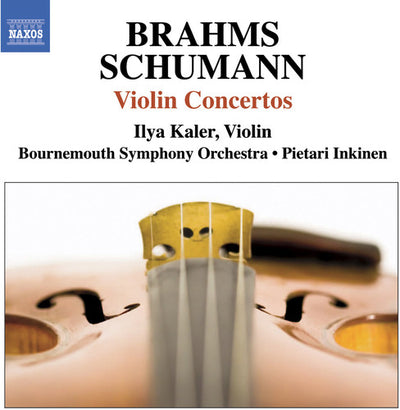
Brahms, Schumann: Violin Concertos / Inkinen, Kaler, Bournemouth
Ilya Kaler’s new recording of the Brahms concerto on Naxos is eminently recommendable. When reviewing his recent recording of the Tchaikovsky violin concerto (see review) I remarked that Kaler’s performance was one “of elegance as well as brilliance” that “wears it war-horse status lightly, impressing itself upon the listener by virtue of its freshness and natural feeling”. Those comments are equally applicable to this recording.
Kaler’s conception of Brahms’ score is one that rejoices in its beauties. Ably supported by the warm sounds exhaled by the Bournemouth Symphony Orchestra, Kaler’s violin sings with a golden tone and sweetly inflected phrasing. He takes his time over the first movement, but maintains his rhythmic control and sense of the music’s overall architecture. In this his performance succeeds where, as Jonathan Woolf points out, Julia Fischer’s similarly conceived account fails. Kaler also lingers lovingly over the gorgeous slow movement – taking over 10 minutes. His pacing is more conventional in the Hungarian finale, which smiles more than it swaggers here.
The coupling of Brahms and Schumann is astute. Firstly it makes programmatic sense. Both concertos share the tonality of D – Brahms in the glowing major, Schumann in the dramatic minor. Both were written for Joachim, and the bond between Schumann and Brahms themselves is as well known as it is complicated.
Secondly, the coupling is an attractive addition to the Naxos catalogue. It complements an earlier disc (Naxos 8.550938), on which Kaler joins cellist Maria Kliegel in Brahms’ double concerto, offered as a coupling for Kliegel’s performance of the Schumann cello concerto. Buy these two discs, and you have the complete Schumann and Brahms string concertos at one fell swoop.
The coupling of the Schumann and Brahms concertos is also fairly unusual in the broader catalogue. While recordings of the Brahms proliferate, there are few recordings of the Schumann concerto and when they do appear they tend to be lumped together with more Schumann. Only Joshua Bell, to my knowledge, has coupled these two concertos on disc before. That disc now forms half of a mid-price twofer in the price bracket above this release (Decca – The Joshua Bell Edition – 4756703). Bell's recording is also available at bargain basement price on Australian Eloquence, but sundered from its Brahms coupling.
Schumann wrote his violin concerto very quickly in the autumn of 1853. Joseph Joachim and Clara Schumann had reservations about the piece. In happier times Schumann would probably have revised the piece, but the rapid decline in his mental health prevented this and the score languished unplayed and unknown until the 1930s. It is an attractive piece, constructed along classical lines, and deserves more attention and respect than it is usually accorded. The first movement has a symphonic seriousness and integrity, contrasting the wild, surging argument of its first subject with a gentle, sensitive second subject. The central movement is quietly beautiful. The finale, in the form of a polonaise and with prominent wind writing, brings the concerto dancing to a close.
Kaler's performance is successful and offers collectors a distinct choice. Bell's recording has a straight forward brilliance and Kremer's EMI recording with Muti, like Menuhin's electric premiere recording of the uncut score, emphasises the drama of the work. Kaler takes a different view. Again favouring spacious tempi – his first movement at 14:28 takes a minute longer than Bell's and two minutes longer than Menuhin's – he presents the concerto very much as the classical conception of a poetic soul. Where the other interpreters listed above play for Florestan, Kaler takes Eusebius' part.
The balance favours the violin in both concertos, but there is air enough around the soloist, and the warm Lighthouse Concert Hall acoustic gives the orchestral sound a lovely glow. Listening through earphones can be disconcerting in the Schumann where either Kaler's or the conductor’s breathing is quite prominent. I did not notice this so much when listening through speakers.
Keith Anderson's liner-notes live up to his usual high standard, but gloss over the circumstances of the Schumann concerto's rediscovery by Joachim's great-niece and avoid entirely discussion of the political wrangling over the concerto's premiere performances.
Another wonderful disc from Ilya Kaler and a bargain of the month.
-- Tim Perry, MusicWeb International