Fall Blowout Sale 2026
Fall into the sounds of the season with 50% off 100+ handpicked titles for a limited time! From the quiet introspection of Satie and the autumnal warmth of Brahms to the lush, romantic beauty of Fauré and more, this collection is made for crisp mornings, golden afternoons, and cozy evenings at home.
Refresh your collection with music that feels right at home this time of year — all at half price! Plus, enjoy FREE SHIPPING on orders of $60 or more, making it the perfect time to stock up on your autumn favorites.
Shop the Fall Blowout now and save 50% while it lasts!
182 products
-
-
-
-
-
-
-
-
-
SaleSchubert: Symphony No. 5 - Brahms: Serenade No. 2 / Gardiner, Orchestre Revolutionnaire et Romantique
SDG · Aug 2018CD$19.99$9.99 -
-
-
-
-
-
-
-
-
-
-
-
-
-
-
-
-
-
Romance / Lang Lang
Haydn, Brahms & Zemlinsky: String Quartets
Brahms: Works for Solo Piano, Vol. 6 / Douglas
REVIEW:
Douglas’s hefty, full-bodied sound, built from the bottom up, befits the mellow power of Brahms’s sound world. In the dark E flat minor Op 118 Intermezzo, most pianists focus attention on the right-hand melody and treat the rumbling left-hand lines as muted filigree. Douglas, however, does almost the exact opposite, and the effect is revelatory.
– Gramophone
Brahms: Concerto No 1, Handel Variations / Van Cliburn
It is some eighteen months since Van Cliburn's surprisingly successful account of the Brahms Second Concerto appeared, and on the face of it this vast youthful inspiration of the First Concerto should suit Van Cliburn's special qualities even more closely. And so it proves, and though Leinsdorf and the Boston Symphony do not prove such perceptive collaborators as the lamented Reiner with his Chicago Orchestra, this is in terms of pianistic display and dynamic driving force as exciting a performance as we have ever had on record. The way for example that Van Cliburn in the finale sweeps the music on from the first subject into the second is irresistible. Those pianists who insist on relaxing may seem a little lacking in excitement in direct comparison—even to Clifford Curzon. Where they score—and Curzon of course is the prime example of a thinking virtuoso in this work—is in the subtlety of shading. You could not claim for Van Cliburn much sense of 'inner' thoughtfulness. But that does not mean he is hard, and throughout the warmth of the playing is as striking as the dynamic drive. It is a pity perhaps that in the American manner the soloist is put so close to the microphone, for it is hard for him to achieve a real pianissimo, however gently he plays. But RCA's technique of spotlighting individual instruments (not merely the piano) pays off very well at the climax of the slow movement—a moment that for me at least is perhaps the most important single passage in the whole work. If in the great call of the rising fourths slowly enunciated over piano arpeggios you have a sense of culmination and achievement such as opera composers provide at moments of dramatic catharsis, then I am disposed to think favourably of the whole performance. It is so with the Gimpel performance on HMV Concert Classics where Kempe is marvellous, and here Leinsdorf (with the help of the spotlighting engineers) directs with more warmth than I remember from him for a long time.
In the first movement of course, Curzon's subtlety coupled with his wiry strength is a hard combination to compete with, but Van Cliburn's youthful impetuosity is most convincing. The speed is not fast (much less fast than in the Fleisher/Szell performance for example) and Leinsdorf, though not specially good on detail, gives the music a tremendous sweep which exactly matches the soloist's sense of command.
I hope I have made it clear that this is very much, a performance that 'adds up'. In other words it takes one along with it, just as a fine performance live in the concert hall, and on that account I have been wary of drawing too sharp a contrast with Curzon on the basis of a side-by-side comparison of extracts. Curzon, I think, would be most people's choice, but if I wanted bravura above all, then Van Cliburn even more than his fellow young American, Leon Fleisher, provides it. Apart from the balance, the recording—I have so far heard mono only—is good, though it never achieves the atmospheric clarity that the Decca engineers provided for Curzon.
-- Gramophone [3/1965]
reviewing the original LP release of the concerto
Carl Schuricht Collection II
Schubert: Symphony No. 5 - Brahms: Serenade No. 2 / Gardiner, Orchestre Revolutionnaire et Romantique
This brilliant release features a live recording of the Orchestre Revolutionnaire et Romantique led by Sir John Elliot Gardiner performing Schubert’s Symphony No. 5 and Brahms’ Serenade No. 2 in A Major. The recorded concert took place in November 2016 inside the stunning acoustics of the Concertgebouw, Amsterdam. Schubert’s Symphony No. 5 was written mainly in September 1816 and was completed on October 3 of that same year just six months after the completion of his prior symphony. In character, the writing is often said to resemble Mozart; Schubert was infatuated with the composer at the time he composed it. Brahms’ second Serenade was written in 1859 and dedicated to Clara Schumann. The five movement work is scored for chamber orchestra, including double woodwinds but omitting violins, trumpets, trombones and percussion.
-----
REVIEW:
In matters of colour and timing, the playing of this early-Romantic repertoire has undergone its own revolution in the past 30 years. Under Goodman and Mackerras, even Minkowski, the Minuet of Schubert’s Fifth is neat but plain by comparison with Gardiner. Every phrase of the Andante is weighted and cherished. For its combination of tenderness, gravity and springtime joys, the performance may be set alongside Klemperer’s Philharmonia (with a first flute, Marlen Root, who has nothing to fear by comparison with Gareth Morris). The conclusion is quickly faded, but applause is retained after the Brahms. It’s a disc of pure delight.
– Gramophone
France - A Musical Tour Of The South Of France
The Places
The tour opens with views of the Camargue, the marshy region near Arles with its wild life. Views of the Côte d’Azur are intercut with glimpses of the Munich Glyptothek with its collections of Roman and Greek statuary. Near Arles is the ancient Abbey of Montmajour and the fortified monastery and Abbey on Saint-Honorat, one of the Iles de Lérins. In Arles we see the Roman theatre and necropolis and, at Saint-Rémy-de-Provence, the remains of the ancient Gallo-Greek town of Glanum.
The Music
Music for the tour includes Debussy’s evocative Prélude à l’après-midi d’un faune, two Gymnopédies by Erik Satie and Ravel’s two suites from his ballet Daphnis et Chloé, followed by his Introduction and Allegro for Harp, Flute, Clarinet and String Quartet.
Picture format: NTSC 4:3
Sound format: PCM Stereo / Dolby Digital 5.1 / DTS 5.1
Region code: 0 (worldwide)
Running time: 57 mins
No. of DVDs: 1
Géza Anda plays Solo Recitals, 1950-1955
REVIEW:
Hungarian virtuoso Géza Anda (1921-1976) opens a recital derived from radio broadcasts from SWR Stuttgart with Haydn’s perky F Major Sonata (17 April 1950), given a sparkling bravura rendition. Anda’s pearly play and deft touch make themselves felt in every concerted bar, and the runaway Presto finale might be a minor meteor. Schumann ever maintained Anda’s devotion, and he often programmed Symphonic Etudes, including the free interpolation of the five posthumous variations. The rendition included here (2 October 1951) includes two of the posthumous etudes, nos. 4 and 5, inserted after the sixth and eighth of the traditional studies. The first exploits sweeping arpeggios and glissandi techniques; the latter opens a jeweled music-box filled with nectar crystals. The serenity yields to the following Etude, a staccato study in syncopations that becomes quite frantic. Etude X, for want of a better term, has always struck me as “Brahmsian” for its double octaves. The agitato mysteries of Etude XI have rarely been so rarified in their mist contours, except perhaps from Cherkassky. The Etude XII finale, besides its obvious, heroic bravura, exudes the Innigkeit requisite...
The Ravel waltzes, in their sturdy percussion, date from 19 May 1951. Anda does not spare the fortissimos nor the pedal, moving to extremes in the first two waltzes, from aggression to erotic insinuation. The dance marked “Presque lent--dans un sentiment intime” has its perfect executor in Anda, which rivals the classically-chiseled entry by Robert Casadesus. Lithe and sensuously nimble, the last two waltzes--Moins vif et Epilogue--combine Vienna glitter and Schubert’s intimate suggestiveness in Ravel’s idiosyncratic kaleidoscopic panoply. Rolf Liebermann’s 1951 Sonata (2 October 1951) marks one of the few pieces Anda programmed that post-date World War II. His “modern” repertory ceased, for the most part, with the 1945 Third Concerto of Bartok. Liebermann (1910-1999) begins his nine-minute work with a toccata-style Vivace with periodic moments of pointillist staccati. The heart of the piece is the Andante espessivo, rather angular and reminiscent of Ravel, Gershwin, and modal Poulenc.
The second disc is devoted to the 1955 (May 21) recital at Ludwigsburg, a venue frequented by Anda’s esteemed colleague, Clara Haskil. Anda opens with the First Ballade of Chopin, a reading of balanced intensities, gothic and introspective at once. The music’s fierce Neapolitan harmonies and inner tumult manage to find a noble repose in the course of its poetic declamation mid-way, only to yield to the Dionysiac dramaturgy of its late pages with a passionate abandon that belies Anda’s repute for “objectivity.”
Anda recorded the Op. 25 set of Chopin Etudes for EMI, and he often featured the complete ensemble as a concert staple. He plays the A-flat Major for its serene beauty, and thus sets the tone for the remainder, to be played in the classic style of Backhaus, for poetry and strength of form.
The Brahms E-flat Major intermezzo, a simple, nostalgic folk song evocation, makes the perfect commentary to all of the “learned” counterpoint of this evening’s colossal recital at Ludwigsburg, where the spirit of colleague Clara Haskil must have lingered nigh.
-- Audiophile Edition
Bax & Chung - Piano Duo
The real life marriage of two great concert pianists, Alessio Bax and Lucille Chung, has led to one of the leading piano duos of their generation. To cite the UK magazine Music and Arts, "Theirs is a marriage of wondrous colours and dextrous aplomb, subtly balanced to make a musical performance sound as one." Stavinsky's Pétrouchka was originally arranged for four-hands by the composer as a rehearsal score for the Ballet Russes production of the same name, but in this stripped-down it brings Stravinsky's melodic, rhythmic and harmonic inventiveness to the fore. Brahms's 16 Waltzes Op.39 are an enchanting collection of Romantic miniatures that simultaneously nod to the musical lineage of the composer's home in Vienna whilst asserting his own flair and individuality. The final four tangos by Piazzolla are a full of Argentine flair and vigour, and were arranged especially for this recording by Bax & Chung.
Violin Concertos Conducted By Wilhelm Furtwangler
Schumann: Fantasiestücke - Kreisleriana - Brahms: Theme & Va
This is Volume 1 in Imogen Cooper’s new series on Chandos Records, dedicated to the complete works for piano by Robert Schumann. Recognised worldwide as a pianist of virtuosity and poetic poise, Imogen Cooper has established a reputation as one of the finest interpreters of the classical and romantic repertoire. She has dazzled audiences and orchestras throughout her distinguished career, bringing to the concert platform a unique musical understanding and lyrical quality.
Debussy: Orchestral Works
Satie: Complete Piano Works, Vol. 4 (New Salabert Edition)
Heroic Horn - Best Loved Classical Horn Music / Various Artists
For those who are new to an instrument, the first question is often: where to start? The ‘Best Loved’ series offers an easy answer to that question and a perfect introduction to the wonderful, varied world of classical music. Spotlighting individual instruments in some of the best-loved pieces ever written, and with a mix of solo, chamber and orchestral works, the series provides a convenient introduction to classical music’s infinite variety of instrumental sounds and styles. The focus in these releases is a light and relaxed approach, rather than academic and theoretical: a joyful exploration and celebration of individual instrumental sounds. The present release is a showcase of the horn.
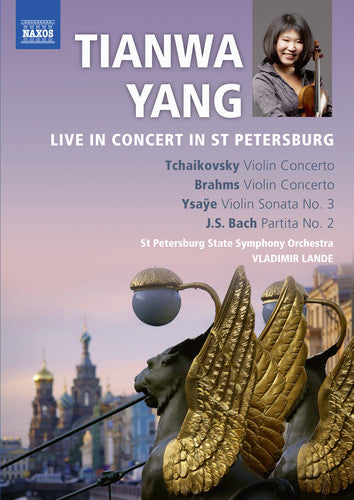
Tianwa Yang Live in Concert in St. Petersburg