Conductor: Riccardo Chailly
29 products
Rossini: Il Barbiere di Siviglia / Chailly, Horne, Ramey, Nucci, Orchestra del Teatro alla Scala
A suave account of Rossini’s classic comedy, with Riccardo Chailly and his La Scala forces clearly enjoying the piece and a top-quality cast fulfilling the requirements of all the principal roles.
– BBC Music Magazine
Mahler: Symphonies Nos. 1-2; 4-9
The eight Mahler symphonies contained in this box were all recorded live as part of the Leipzig Mahler cycle that began with the acclaimed Mahler Festival in 2011. They once again confirmed the Gewandhausorchester's reputation as a Mahler reference orchestra, which was consolidated in particular thanks to the intensive examination of Mahler's work under the direction of former Gewandhaus Kapellmeister Riccardo Chailly, who emphasized the compositional qualities of the works, traced the origins of their interpretive history and avoided false pathos and sentimentality despite all the drama and urgency. This becomes clear especially in the more than two hours of documentation material which supplements these exceptional Mahler recordings. In addition to Riccardo Chailly, leading Mahler experts such as Henry-Louis de la Grange and Reinhold Kubik give an insight into Mahler's works and their interpretation. In addition to its musical excellence, the Leipzig Mahler cycle impresses with its graphic design. Each cover of the cycle is adorned with a work by the Leipzig painter Neo Rauch that was inspired by Mahler's music and painted specifically for this cycle.
Excerpts of reviews from previously released volumes in this set:
Mahler: Symphony No. 7 / Gewandhaus Orchestra Leipzig
The Leipzig players do Chailly proud. There are so many stunning solos, from tenor horn at the start to the first trumpet who never splits brilliant top notes in the finale. This of all symphonies requires a terrifying amount of preparation - there's none better than this one.
– BBC Music Magazine
Mahler: Symphony No. 5 / Gewandhaus Orchestra Leipzig
Chailly is a pleasure to watch, being neither over-demonstrative nor affectedly matter-of-fact. If the rest of this projected second Chailly Mahler cycle is as good as this, then I suspect we have treats aplenty in store.
– Gramophone (Editor's Choice, November 2014)
Chailly's latest Mahler Five surely has the best of all possible worlds for this comprehensive darkness-to-light epic. It's rewarding to see the Leipzig Gewandhaus strings articulating with such mobile engagement.
– BBC Music Magazine
Mahler: Symphony No. 9 / Gewandhaus Orchestra Leipzig
Here we have something very special, and a good deal more than 'just another Mahler Ninth. This Leipzig Ninth is Chailly off the leash, liberating the music in a way that is impassioned, positive, fitfully fractured and often ethereal. He flicks the Symphony's heartbeat opening into action with the most economical of gestures.
– Gramophone (Editor's Choice, November February 2015)
Puccini: Tosca / Chailly, Teatro Alla Scala
“La Scala’s season opens with a powerful Tosca” (Financial Times). Premiered in 1900 with huge success, Puccini’s “melodramma” Tosca is one of the most dramatic thrillers in the history of opera. In this performance Riccardo Chailly conducted “a magnificent orchestra and a sonorous choir” (NMZ) while Anna Netrebko had sung “phenomenally. She still has one of the most beautiful voices today.” (Deutschlandfunk) With “Francesco Meli, probably unsurpassable in this role at the moment: lyrically soft, and then again impressively expressive”, and Luca Salsi also “very convincing as the slick, power-conscious Scarpia” (BR Klassik), La Scala has engaged the highest-calibre partners imaginable.
Riccardo Chailly, Lucerne Festival Orchestra - The First Years
This box set documents Riccardo Chailly's first years as principal conductor of the Lucerne Festival Orchestra. In summer 2016, he steps into the office as Claudio Abbado's successor with Mahler's 8th Symphony. In a colorful, fresh and stirring performance of the overture and incidental music to William Shakespeare's "A Midsummer Night's Dream" and Tchaikovsky's "Manfred" Symphony, Chailly and the Lucerne Festival Orchestra bring the musical imagery of both works to life. In summer 2018, the performers transport us to Ravel's musical universes full of colors, scents and flavors: from the pulsating three-four time of the waltzes to the ancient love story of Daphnis and Chloé and the relentless rhythm of the Boléro. A recording from summer 2019 of Rachmaninoff's Third Symphony and Third Piano Concerto with Denis Matsuev marks the various stages in the composer's life and demonstrates once again the close bond between the orchestra and their new principal conductor.
Mendelssohn: Midsummer Night's Dream - Tchaikovsky: Manfred Symphony [Blu-ray]
In the Overture and Incidental Music to William Shakespeare’s ‘Midsummer Night’s Dream,’ Felix Mendelssohn brings the illustrious company of elves, lovers’ passions and the solitude of the forest or a moonlit night to musical life. It became a model for other literary reflections in music like Peter Tchaikovsky’s ‘Manfred Symphony.’ It’s four movements- or “images,” as the composer himself named them- capture the world-weariness of George Byron’s ‘Manfred: A Dramatic Poem’ in music. Riccardo Chailly and the Lucerne Festival Orchestra awaken the musical imagery of both works in a colorful, fresh, and enchanting performance. This release was recorded live at the Concert Hall of KKL Luzem, Lucerne Festival in August of 2017.
Mahler: Symphony No 2 / Chailly, Oelze, Connolly, Leipzig Gewandhaus
Recorded live at Gewandhaus zu Leipzig, 17 and 18 May 2011.
Picture format: NTSC 16:9
Sound format: PCM Stereo / Dolby Digital 5.1 / DTS 5.1
Region code: 0 (worldwide)
Subtitles: English, German, French
Running time: 95 mins
No. of DVDs: 1 (DVD 9)
Mahler: Symphony No 2 / Chailly, Oelze, Connolly, Leipzig Gewandhaus [blu-ray]
br />
Having reviewed a slew of Twos on CD over the past few months I decided I had to make room for this much-lauded Blu-ray from Leipzig. Recorded as part of the 2011 International Mahler Festival it’s one of two video recordings from that event – the other is Chailly’s Mahler Eight – available on both DVD and Blu-ray. Up until now EuroArts has had something of a monopoly on this repertoire, having given us most of the Abbado cycle from Lucerne and the Boulez Mahler 2 from Berlin. Despite some technical issues with the Abbado Blu-rays, it’s a fine collection and a worthy companion to Leonard Bernstein’s quirky set of DVDs from Universal.
As far as the Resurrection itself is concerned, I’ve always felt it one of Abbado’s weaker efforts, on both CD and video, and I have some misgivings about the Boulez DVD as well. The Bernstein – recorded in Ely Cathedral in 1972 – is vintage Lenny, but the dizzying camerawork is a major distraction. Some viewers may also object to his jittery podium presence, but for sheer exaltation Bernstein is in a class of his own. Interpretatively, the video outshines his later, audio-only remake for DG, by which time creeping self-indulgence overwhelms all insight. By contrast, Riccardo Chailly’s Decca CD set is much more sensible which, for me at least, all too often means dull. Will this live performance from Leipzig be any different, I wonder?
First impressions are very favourable; from the conductor’s slashing downbeat to the final, dying note of the first movement one is cosseted by playing – and sonics – of rare elegance and beauty. Chailly adopts sensible speeds and tempo relationships are nicely judged; the almost holographic sound – in stereo at least – really brings out the sting of cymbals and bray of brass. As for the woodwinds, they’re immaculate, timps crisp and powerful, the harps finely etched. And all the while there’s a pleasing sense of progress, the music artfully shaped without seeming self-consciously so. The camerawork is discreet and intuitive, visuals the epitome of clarity and naturalness.
A cracking start, then, and the most sense-sating Mahler video I’ve yet encountered. Textures are rendered with great subtlety, and despite the relative intimacy of the angular auditorium there’s plenty of room for the music to grow and blossom, everything from ppp to sfz easily accommodated. And listen out for those dark, barely audible tam-tam strokes, just some of the many ear-caressing moments that permeate this performance. True, there’s no risk-taking here, but there are no mannered, self-regarding gestures either. Chailly is admirably ‘straight’, old fashioned even, and yet his reading is full of unexpected charm and character.
Nowhere is this better illustrated than in the beautifully calibrated Andante; dance rhythms are deftly done, Mahler’s gentle pizzicati miracles of finesse and feeling. This really is a most distinguished orchestra, the chromium-plated delivery of the Lucerners – impressive as it is – no match for the rich, woody patina that comes with age and tradition. And lest one think this band is too cultured for its own good the Scherzo is full of animation and, in a moment of pure theatre, that final beat of the gong is allowed to resonate for what seems like ages.
Mezzo Sarah Connolly’s ‘Urlicht’, infinitely varied, is an absolute joy, the warmth and ease of her singing a perfect fit in this most cultured company. As for Chailly, his restraint is most welcome here, every last nuance and change of metre well caught; as a result of this reticence, the orchestral detonations of the last half-hour or so are all the more seismic. At times it seems as if the music is coming from the very bowels of the earth – apt, given the impending arrival of the Last Trump and the pit-like design of the auditorium – the soft-grained chorus rising above the tumult.
Chailly may not have the galvanising energy of his rivals at this point, but his broad, unhurried pace engenders a thrill of its own. Soprano Christiane Oelze’s steely, but steady, tones are a decent foil to Connolly’s more rounded ones, and I’ve rarely heard the choirs’ ‘Bereite dich’ delivered with such hope and trepidation. Once or twice, the playing is a tad untidy, but that’s forgivable under the circumstances. Chailly’s habit of holding back really pays dividends in the closing pages where, as Donne would have it, the all-embracing sound seems to emanate from the ‘round earth’s imagin’d corners’. The brass scythes through the mix – as it should do – and the organ adds plenty of heft; as for the bells and tam-tams, they’re just sensational, every strand of the score delivered with clarity and punch.
Dull this ‘Resurrection’ most certainly isn’t, and I came away from it with renewed admiration for maestro Chailly. There’s so much to cherish in this performance, from the burnished playing and deeply felt singing to the fine picture and unrivalled sound. Indeed, if I were awarding stars for sonics this would easily be a five out of five; it’s every bit as immersive as the Decca Blu-ray of Prokofiev’s Romeo and Juliet, which I reviewed last year. Purely as a performance – and I’m thinking of recent CDs as well – Chailly’s is a thoroughly satisfying alternative to those visceral, more urgent accounts from Jonathan Nott, James Levine and Simone Young; but if we’re talking DVD or Blu-ray, this newcomer sweeps the board.
-- Dan Morgan, MusicWeb International
-------
Recorded live at Gewandhaus zu Leipzig, 17 and 18 May 2011.
Picture format: 1080i Full-HD
Sound format: PCM Stereo / DTS-HD Master Audio
Region code: 0 (worldwide)
Subtitles: English, German, French
Running time: 95 mins
No. of Discs: 1 (BD 25)
Beethoven & Mendelssohn: Violin Concertos
The Daily Telegraph describes Nikolaj Znaider as "the most stimulating young musician playing today, drawing on musical intelligence, perception and dynamism to give performances of rare intensity.” This release presents one of the world's foremost violinists playing two landmark concertos, accompanied by the Leipzig Gewandhausorchester, "one of Europe's finest orchestras" (The Guardian), under the baton of its music director Riccardo Chailly.
It was the Gewandhausorchester that, in 1845, first performed Mendelssohn’s Concerto for Violin and Orchestra in E minor. Mendelssohn himself had conducted Beethoven's Violin Concerto in D major several times and helped this milestone in the history of music to its great breakthrough.
Picture Format: NTSC 16:9
Sound Formats: PCM Stereo, Dolby Digital 5.1, DTS 5.1
Region Code: 0 (Worldwide)
Running Time: 84 Minutes
Riccardo Chailly - Concert, Opera, Documentary
On the occasion of his 70th birthday, this box set shows the different facets of Riccardo Chailly's life. The documentary Music – A Journey For Life, the first ever film portrait of the Italian maestro, shows him at work with the Gewandhausorchester Leipzig, at La Scala in Milan or during rehearsals for an energetic, authentic and atmospherically dense “La Bohème” at the Palau de les Arts Reina Sofía in Valencia, the recording of which is also included in the box. With an interpretation of Edvard Grieg's Piano Concerto in A minor with the fabulously inspired Lars Vogt and the recording of two milestones of the violin literature by Beethoven and Mendelssohn with Nikolaj Znaider, the box harks back to Chailly's time as Gewandhauskapellmeister. A recording with Chailly as principal conductor of the Lucerne Festival Orchestra pays tribute to Maurice Ravel with a program of waltzes and wild dreams of ecstasy and elegance.
Debussy / Jean-Paul Gasparian
The French pianist Jean-Paul Gasparian has chosen Debussy for his first album with naïve, an album full of sensitivity and colour, including the first ever recording of the transcription of the Rondes de printemps. With this album devoted solely to Debussy, Jean-Paul Gasparian invites listeners to integrate the atmospheres, colours and timbres that make up Debussy’s world. ‘The piano, here,’ he says, ‘is a tool that lets your imagination wander, a machine that creates perceptions. Like a sort of stationary journey.’ It is also an opportunity for Jean-Paul Gasparian to show us another facet of his temperament, already seen in Rachmaninoff and the Romantic repertoire, and return to his beginnings.
Mendelssohn: Midsummer Night's Dream - Tchaikovsky: Manfred Symphony
In the Overture and Incidental Music to William Shakespeare’s ‘Midsummer Night’s Dream,’ Felix Mendelssohn brings the illustrious company of elves, lovers’ passions and the solitude of the forest or a moonlit night to musical life. It became a model for other literary reflections in music like Peter Tchaikovsky’s ‘Manfred Symphony.’ It’s four movements- or “images,” as the composer himself named them- capture the world-weariness of George Byron’s ‘Manfred: A Dramatic Poem’ in music. Riccardo Chailly and the Lucerne Festival Orchestra awaken the musical imagery of both works in a colorful, fresh, and enchanting performance. This release was recorded live at the Concert Hall of KKL Luzem, Lucerne Festival in August of 2017.
Mahler: Symphony No. 8 / Chailly, Lucerne Festival Orchestra
Gustav Mahler’s 8th Symphony breaks the boundaries of the symphonic form in a world-embracing gesture. Riccardo Chailly is one of the staunchest performers of this work, and therefore it seemed appropriate in many ways that he chose this work for his inaugural concert as Claudio Abbado’s successor and new music director of the Lucerne Festival Orchestra. The artistic statement was combined with a deeply personal conviction: it should be a “tribute to Claudio,” the highly esteemed friend and colleague to whom Chailly, as he emphasizes, owes very much. On 12 August 2016, Claudio Abbado’s unfinished Mahler cycle with the Lucerne Festival Orchestra was completed in a breathtaking performance of the Mahler 8th, simultaneously heralding in a new era in Lucerne.
Beethoven & Mendelssohn: Violin Concertos [Blu-ray]
Also available on standard DVD
The Daily Telegraph describes Nikolaj Znaider as "the most stimulating young musician playing today, drawing on musical intelligence, perception and dynamism to give performances of rare intensity.” This release presents one of the world's foremost violinists playing two landmark concertos, accompanied by the Leipzig Gewandhausorchester, "one of Europe's finest orchestras" (The Guardian), under the baton of its music director Riccardo Chailly.
It was the Gewandhausorchester that, in 1845, first performed Mendelssohn’s Concerto for Violin and Orchestra in E minor. Mendelssohn himself had conducted Beethoven's Violin Concerto in D major several times and helped this milestone in the history of music to its great breakthrough.
Picture Format: NTSC 16:9, Full HD
Sound Formats: DTS HD Master Audio, PCM Stereo
Region Code: 0 (Worldwide)
Running Time: 84 Minutes
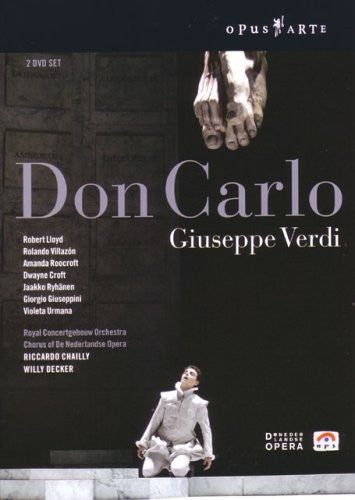
Verdi: Don Carlo / Chailly, Lloyd, Villazon, Roocroft, Et Al
APPROX RUN TIME: 199 Mins
SOUND: DTS SURROUND / LPCM STEREO
SUBTITLES: English/French/German/Spanish/Italian/Dutch
NO OF DISCS: 2
Robert Lloyd, Rolando Villazón, Amanda Roocroft, Dwayne Croft, Jaakko Ryhänen, Giorgio Giuseppini, Violeta Urmana
Royal Concertgebouw Orchestra / De Nederlandse Opera Chorus
Riccardo Chailly / Stage Director Willy Decker
Includes:
*Illustrated Synopsis and Cast Gallery. *Introduction to the opera including interviews with Robert Lloyd, Rolando Villazón, Amanda Roocroft, Violeta Urmana, Riccardo Chailly and Willy Decker.
In this majestic production of Verdi’s Don Carlo, Riccardo Chailly’s qualities as a Verdi conductor are brilliantly displayed in the dramatic precision and transparent instrumental detail he draws from both orchestra and cast. Willy Decker directs a wonderful piece of stagecraft, letting the tragedy unwind with minimal, yet telling, interventions.
The drama takes place in the mausoleum of Filippo II’s Escorial, where the tombs of countless generations of Spanish royalty line the walls. Filippo’s confrontation with Il grande inquisitore – which takes place over his own coffin, its resting place in the wall ready and waiting – is chillingly symbolic, as are the feet of the giant crucifix that hangs over Don Carlo as he sees his life sacrificed by his father.
R E V I E W S
This Don Carlo uses the four-act version of 1884, which is described in an interview extra on the first DVD as intended by Verdi to be more comprehensible than the original five-act version. That is debatable, to say the least, since the composer’s stated reasons for producing that revision (the third of four) were to make its length more manageable on stage and to improve the relation of music and text. Like many another fan of Don Carlo , I admit to a strong affection for both of the two longer editions: the 1867 French version and the 1886 Modena one (or “1884 with many of the great French bits stuck back in”). But that’s for listening, when the more late Verdi you’ve got, the better matters get, and you can take breaks at will for as long as you wish. If it comes to viewing a performance of Don Carlo , the wear-and-tear on the soloists has to be taken into account; and I’m more than willing to watch the 1884 edition.
So this Don Carlo lacks the monumental length that some critics (ignoring developments north of the Alps) complained about when the original French version of the opera appeared. But what is not done musically and temporally, stage designer Willy Decker accomplished here visually and vertically. His re-envisioned Crypt of the Kings in El Escorial features a huge, circular stone vault, with square, identical slate-colored wall plates piled seven high and 12 long to mark the burial slots of previous rulers. Towards the back of the stage is the lower shaft of an enormous cross: Christ’s down-turned toe is 12 feet above the singers, while the knee of the carved figure, at the top of the stage, is perhaps another 12 feet above. This unholy alliance of the Bauhaus and Symbolism is intended to convey the harsh, impersonal nature of religion at the royal court and the way in which it dwarfs the personality and reforming ambitions of Don Carlo. It succeeds beautifully, and remains the centerpiece of the production with the addition of minimal props.
While Decker’s visuals are impressive and his blocking effective, I’m less thrilled with his attempts at dramatic reinterpretation. For example, there’s an elaborate dumb show in the opening orchestral prelude of Philip II’s abusing Don Carlo to enforce religious conformity. When the latter attempts to kiss his father’s ring, Philip grabs Don Carlo’s hand in a painful, pincerlike grip, forcing the boy instead to slowly cross himself. Shortly afterwards, Don Carlo is grasped by the back of the neck and pushed down to the ground before the huge cross already discussed. This muddles matters right at the start by placing one of the opera’s victims, Philip, in the role of its only victor, the Grand Inquisitor. Who is the enforcer of dogma at the court and who bows his will to that dogma in the end?
The cast is variable, but generally very fine. Roberto Villazón is exceptional as Don Carlo, with just the right mix of lustrous metal in his attractively light tenor. His is also one of the most detailed assumptions of the title role, attentive to score markings and giving us the half-mad prince with poor impulse control in all his glory. Dwayne Croft is his match, using his lyrical baritone and fine phrasing to great effect (for example) at the start of the act III quartet. Robert Lloyd’s Philip II suffers at this stage of his career from a slight beat whenever he puts significant pressure on the voice, though he manages this by discreetly shortening some phrases. His Philip remains a shrewdly judged assumption of the role, more impressive for the sum of its parts than specific moments.
Amanda Roocroft may have been under the weather when they filmed this live performance (or series of performances—we are never told whether the recording was a one-shot or compiled over several nights), for her attractive soprano is marred by a wobble that regularly disturbs the musical line during the first act. Later, this problem retreats only to loudly sung high notes. Violeta Urmana similarly improves as the production continues. She has difficulty moving her large, dark voice in her act I song, slurring the repeated minor seconds, but does a fine job in act III’s “O don fatale.” Marisca Mulder is a vocally pert and attractive Tebaldo; and if Jaakko Ryhänen lacks the tonal blackness to make the most of his part as the Grand Inquisitor, he makes up for it by accuracy, strong breath support, and excellent acting. Chailly conducts his soloists sympathetically, if with only moderate energy.
Though recorded in 2004, the only audio format supplied here is LPCM Stereo. Visuals are 16:9 anamorphic, and subtitles are available in English, French, German, Spanish, Italian, and Dutch. The extras alluded to above include a plot synopsis and single pictures for each member of the cast, both of these features being as dull as they sound. The filmed interview is less interesting for its verbal content, which is often trivial, than for its succession of images showing the cast rehearsing and the stage under construction.
In sum, this is an intense, monochromatic, successful production of Don Carlo , sporting interesting ideas about stage design, and possessing performances by Villazón and Croft that are among the finest I’ve seen and heard. Don’t let the price hike for two DVDs throw you off its purchase.
FANFARE: Barry Brenesal
Puccini: La Boheme / Chailly, Livermore, James, Machado, Romeu, Buratto
Giacomo Puccini
La Bohème
from the Palau de les Arts "Reina Sofía", Valencia
Directed by Riccardo Chailly
Staged by Davide Livermore
Orquestra de la Comunitat Valenciana
Cor de la Generalitat Valenciana
Escola Coral Veus Juntes de Quart de Poblet
Escolania de la Mare de Déu dels Desemparats
Gal James (Mimì), Aquiles Machado (Rodolfo)
Carmen Romeu (Musetta), Massimo Cavalletti (Marcello)
Gianluca Buratto (Colline), Mattia Olivieri (Schaunard)
Matteo Peirone (Benoît)
The musical notes of this Puccini masterpiece provide the starting point and foundation for a new, highly successful collaboration between Riccardo Chailly and Davide Livermore. In their interpretation, there is "no moment, no movement, that goes against the musical meaning" (R. Chailly). The result is an energetic, authentic, and atmospherically strong Bohème, "in which every sacred phrase receives its own orchestral colour, its own dynamic and its own expression." (Corriere della Sera)
Bonus Film (20 min)
“The Making of La Bohème in Valencia”
(Subtitles: Italian, English, German, French)
Picture Format DVD: NTSC 16:9 Sound Formats DVD: Dolby Digital 5.1, DTS 5.1, PCM Stereo
Region Code: 0 (worldwide)
Subtitles: Original (Italian), English, German, French, Korean, Japanese
Running Time: 114:13 min
Number of Discs: 1
Music - A Journey for Life: Riccardo Chailly

As a snapshot, Paul Smaczny’s gentle 50 minute film ‘Music – A Journey for Life’, makes for fascinating, often charming viewing, and it gives a valuable insight into both Chailly’s approach to what he conducts – he loves rehearsing, but always keeps something in reserve for performance – and what makes a successful relationship between orchestra and conductor.
– Gramophone
Languages: English, German, Italian
Subtitles: German, French, English, Korean, Spanish, Italian
Picture Formats DVD: 16:9 NTSC
Sound Formats BD: PCM Stereo, Dolby Digital 5.1, DTS 5.1
Running time: 93:07 min
Mahler: Symphony No 9 / Chailly, Gewandhaus Orchestra

Mahler: Symphony No 9 / Chailly, Gewandhaus Orchestra [blu-ray]

This Blu-ray Disc is only playable on Blu-ray Disc players and not compatible with standard DVD players.
Also available on standard DVD
Mahler: Symphony No 8 / Chailly, Leipzig Gewandhaus
Mahler’s Eighth Symphony is arguably the grandest and most ambitious piece of symphonic music ever written. The composer himself regarded it as his opus summum, and an incredible number of participants at the hugely successful Munich première in 1910 earned it the nickname “Symphony of a Thousand”. At Leipzig’s International Mahler Festival, Riccardo Chailly commanded almost 500 musicians, and the overwhelming result of their joint effort inspired the Leipzig-based and internationally renowned artist Neo Rauch to the painting for the cover of this DVD.
Recorded live at Gewandhaus zu Leipzig, 26–27 May 2011.
Picture format: NTSC 16:9
Sound format: PCM Stereo / Dolby Digital 5.1 / DTS 5.1
Region code: 0 (worldwide)
Subtitles: German & Latin (original sung texts), German, English, French
Running time: 92 mins
No. of DVDs: 1 (DVD 9)
Mahler: Symphony No. 7 / Chailly, Gewandhausorchester Leipzig [blu-ray]
Also available on standard DVD
“It is my best work, with a primarily cheerful character”. This was Gustav Mahler’s assessment of his Symphony No. 7, which was also highly regarded by Arnold Schoenberg, who said, “I had an impression of absolute peace based on artistic harmony. Something able to set me in motion without recklessly unsettling my center of gravity.” Riccardo Chailly, in his internationally acclaimed interpretations of Mahler’s symphonies – which he and the Gewandhaus Orchestra are bringing together in a complete cycle – focuses on the musical qualities of the works, eschewing false pathos and sentimentality while giving up none of the music’s dramatic intensity. “Mahler’s Seventh Symphony, in which the composer pulled out all expressive stops and revealed himself to be an innovative modernist, has seldom been as persuasive and direct as in Chailly’s interpretation”, said the Frankfurter Neue Presse.
MAHLER, G.: Symphony No. 7 (Chailly) (Blu-ray, Full-HD)
Gustav Mahler
SYMPHONY NO. 7
(Blu-ray Disc Version)
Leipzig Gewandhaus Orchestra
Riccardo Chailly, conductor
Recorded live at Gewandhaus zu Leipzig, 27–28 February and 2 March 2014
Picture format: 1080i Full-HD
Sound format: PCM Stereo / DTS-HD Master Audio 5.1
Region code: 0 (worldwide)
Running time: 83 mins
No. of Discs: 1 (BD 25)
Mahler: Symphony No. 7 / Chailly, Gewandhausorchester Leipzig

Also available on Blu-ray
Chailly conducts a structural masterclass of the Seventh's first movement, formally considered Mahler’s most ‘problematic’ single movement. He marks an emphatic arrival on the brass cadence to close the first subject around five minutes in, and marshals the luscious second theme like a piece of the new Leoncavallo or early Strauss which Mahler apparently shaped so masterfully even while holding his nose at their frivolous realism.
What really distinguishes Chailly’s Mahler nowadays (from his earlier self but also from most of the competition) is that he pushes through the music with the Italianate passion that Abbado chose to efface over the years. Thus a brighter light than usual is shone on the two Nachtmusik movements, while the shadows run deeper as solo harp, then cello, then flute, then trumpet bring about the second movement’s reprise in a carnival-mask passing of the baton from Bruckner to Webern.
The balance favors trilling flutes and manic percussion but allows plenty of room for that guttural Leipzig brass and bass, which has surely never sounded finer.
- Gramophone
MAHLER, G.: Symphony No. 7 (Chailly) (Blu-ray, Full-HD)
Gustav Mahler
SYMPHONY NO. 7
(Blu-ray Disc Version)
Leipzig Gewandhaus Orchestra
Riccardo Chailly, conductor
Recorded live at Gewandhaus zu Leipzig, 27–28 February and 2 March 2014
Picture format: NTSC 16:9
Sound format: PCM Stereo / Dolby Digital 5.1 / DTS 5.1
Region code: 0 (worldwide)
Running time: 83 mins
No. of DVDs: 1 (DVD 9)
Mahler: Symphony No 6 / Chailly, Leipzig Gewandhaus Orchestra [blu-ray]
Also available on standard DVD
Recorded live at the Gewandhaus zu Leipzig, 6, 7 and 9 September 2012
Bonus:
- My Sixth will propound riddles – A panel discussion with Riccardo Chailly and Reinhold Kubik
Picture format: 1080i Full-HD
Sound format: PCM Stereo / DTS-HD Master Audio 5.1
Region code: 0 (worldwide)
Subtitles (bonus): German, English, French
Running time: 86 mins (concert) + 18 mins (bonus)
No. of Discs: 1 (BD 25)
Mahler: Symphony No 6 / Chailly, Leipzig Gewandhaus Orchestra
MAHLER Symphony No. 6 & • Riccardo Chailly, cond; Gewandhaus O • ACCENTUS 20268 (DVD: 86:25 + 18:28)
& Panel discussion with Riccardo Chailly and Reinhold Kubik
A Mahler Sixth in which the Andante movement comes second? And where the last movement has two hammer blows, not the three that Mahler himself included at the premiere)? Well, yes, and those are just two of the things that make Riccardo Chailly’s interpretation of this over-familiar work sound new. Another is the incredibly swift, truly scherzo-like tempo with which Chailly takes the (now) third movement, not at a pace mimicking the first, as usually happens when it comes second.
Some of the mystery is explained in the 18-minute conversation that Chailly holds in the bonus feature. The “wrong” order of the movements (Allegro energico, Andante moderato, Scherzo, and Finale: Sostenuto) is how they appeared in the conductor’s score that was actually published in March 1906. By the time a second score was published in November of the same year, the Scherzo now came second, and this is how it was premiered. In addition, the premiere had three hammer blows in the last movement, not the traditional two; that came later, too. Early in the interview Chailly admitted that he had copiously studied the scores owned by conductor Willem Mengelberg, who had known Mahler and who wrote down all sorts of things, including metronome markings (usually not in Mahler’s symphonies), that he slavishly followed for years. “But now,” Chailly says, “I am no longer such a slave to tradition.” Musicologist Reinhold Kubik of the Mahler Society mentions that when Mengelberg wrote to Alma Mahler about the order of the movements, she said that the Andante came second—and she stuck by that judgment even as late as 1957. Was she wrong? She did mention that he had conducted it that way in a city where he never played this work, but memory is a tricky thing, and the fact that she emphatically insisted that the Andante came second in letters written some 40 years apart should count for something.
Whatever your judgment of these decisions, there is no question that Chailly’s Sixth is simply mind-boggling. The first movement itself is taken at an Allegro that is certainly more energico than I’ve ever heard it before in my life. In a certain sense, this new, brisker tempo rather eliminates the feeling of jackboots marching that most other conductors bring out in it; rather, it sounds like the blind rush of a madman, interrupted by the calmer middle section.
But there is much more to Chailly’s Mahler than just faster tempos. There is a much stronger feeling of organic unity and structure in the music, a more songful legato line in each and every movement, and the playing of the Gewandhaus Orchestra is staggeringly beautiful and dramatically effective. Chailly seats the orchestra the way Mahler himself wanted it: first and second violins split left and right, cellos in the middle right behind them, other instruments spaced out so as to create the balances Mahler so carefully constructed. (Michael Gielen seated his orchestra the same way when he conducted Mahler in Cincinnati during the 1980s.) The “traditional” seating used by most orchestras, Kubik tells us, originated from that used by Leopold Stokowski when he conducted Mahler in America in the early-to-mid 20th century. And in the last movement, which runs 34 minutes, Chailly creates a world-within-a-world. His hammer blows are not just some bangy little hammer on an anvil, but a HUGE wooden mallet that looks like it needed Thor to handle it.
On the podium, Chailly presents the image of an excited schoolboy, jumping up and down, raising his arms and slicing his baton through the air like the drop of a guillotine. Perhaps it is a bit overdone, especially if you are accustomed (as I am) to watching such conductors as Kempe, Böhm, Toscanini, Gielen, and Ormandy conduct, but it doesn’t really seem like an affectation, either. Most of what he does is either in response to the music or in anticipation of how he wants the next attack or the next phrase to go. He is simply emotionally involved in each and every bar of the score, and he wants it just so. Considering the great results he gets, I can’t really find much fault with that. After all, he does ask all the principal wind players to stand up and take a bow at the end.
So often, for me, watching a conductor perform an orchestral concert is a bit like watching paint dry, unless you are a really big fan of conductor X and you want to study the way he moves on the podium, but in this case I found myself completely caught up in watching Chailly and the orchestra because they’re so deeply into what they are doing. In the trailer on this disc for his video of the Fourth Symphony, Chailly mentions that both he and the Gewandhaus Orchestra musicians have come to an understanding of how to best play Mahler: They get involved but always remain in control. “If you let Mahler control you,” he warns, “you’re heading for trouble.” In addition to all this, the high-resolution digital sound is as spectacular as Chailly’s interpretation, capturing the slightest rustle of harp strings and the sound of stays on the oboe with astounding clarity.
Looking at the trailers, there are also DVDs out of Chailly conducting the Second, Fourth, and Eighth Symphonies. The snippets I’ve heard of all of them sound amazing. I recommend looking for all of them, and also awaiting the rest of the series.
FANFARE: Lynn René Bayley
Mahler: Symphony No 5 / Chailly, Leipzig Gewandhaus

Also available on Blu-ray
Gustav Mahler
SYMPHONY NO. 5
Leipzig Gewandhaus Orchestra
Riccardo Chailly, conductor
Recorded live at the Gewandhaus zu Leipzig, 21 and 22 February 2013
Bonus:
- Riccardo Chailly on his interpretation of Mahler’s Symphony No. 5
Picture format: NTSC 16:9
Sound format: PCM Stereo / Dolby Digital 5.1 / DTS 5.1
Region code: 0 (worldwide)
Subtitles (bonus): German, English, Japanese, Korean
Running time: 73 mins (concert) + 27 mins (bonus)
No. of DVDs: 1 (DVD 9)
Mahler: Symphony No. 5 / Chailly, Leipzig Gewandhaus Orchestra [blu-ray]

This Blu-ray Disc is only playable on Blu-ray Disc players and not compatible with standard DVD players.
Also available on standard DVD
Gustav Mahler
SYMPHONY NO. 5
Leipzig Gewandhaus Orchestra
Riccardo Chailly, conductor
Recorded live at the Gewandhaus zu Leipzig, 21 and 22 February 2013
Bonus:
- Riccardo Chailly on his interpretation of Mahler’s Symphony No. 5
Picture format: NTSC 16:9
Sound format: PCM Stereo / Dolby Digital 5.1 / DTS 5.1
Region code: 0 (worldwide)
Subtitles (bonus): German, English, Japanese, Korean
Running time: 73 mins (concert) + 27 mins (bonus)
No. of Discs: 1
Mahler: Symphony No 4 / Chailly, Gewandhaus-orchester [blu-ray]
Also available on standard DVD

Mahler: Symphony No 4 / Chailly, Gewandhaus-Orchester

Gustav Mahler
SYMPHONY NO. 4
Christina Landshamer, soprano
Gewandhaus Orchestra
Riccardo Chailly, conductor
Recorded live at the Gewandhaus zu Leipzig, 26–27 April 2012
Bonus:
- The Welte-Mignon Piano Player Device
- Mahler plays Mahler – Symphony No. 4 in G major: IV. Sehr behaglich
- Riccardo Chailly on interpreting Mahler’s 4th Symphony with the Gewandhaus Orchestra
Picture format: NTSC 16:9
Sound format: PCM Stereo / Dolby Digital 5.1 / DTS 5.1
Region code: 0 (worldwide)
Subtitles: English, German, French, Japanese
Running time: 61 mins
No. of DVDs: 1 (DVD 9)
Mahler: Symphony No. 1 / Chailly, Gewandhausorchester [Blu-ray]
Also available on standard DVD
Gustav Mahler’s Symphony No. 1 is an incomprehensible wonder of music history, rigorously peculiar, disturbingly new, and timelessly modern. “Wie ein Naturlaut” (Like a sound of nature) is indicated above the first notes of the symphony. It is both the prelude and the key to his symphonic cosmos as a whole. Mahler captures this music of the world, transforms it into a symphony in the old, comprehensive sense of the word and uses it to create his masterpiece of harmony. Composed over the course of just a few months at the beginning of 1888 in Leipzig, this symphony is a true musical awakening. Riccardo Chailly and the Gewandhausorchester Leipzig bring Mahler’s sounds of nature to life in a riveting performance. This production was recorded live in January 2015 at the Gewandhaus zu Leipzig. As a bonus, this release also includes an exclusive interview with Riccardo Chailly.
Mahler: Symphony No. 1 / Chailly, Gewandhausorchester

Also available on Blu-ray
Gustav Mahler’s Symphony No. 1 is an incomprehensible wonder of music history, rigorously peculiar, disturbingly new, and timelessly modern. “Wie ein Naturlaut” (Like a sound of nature) is indicated above the first notes of the symphony. It is both the prelude and the key to his symphonic cosmos as a whole. Mahler captures this music of the world, transforms it into a symphony in the old, comprehensive sense of the word and uses it to create his masterpiece of harmony. Composed over the course of just a few months at the beginning of 1888 in Leipzig, this symphony is a true musical awakening. Riccardo Chailly and the Gewandhausorchester Leipzig bring Mahler’s sounds of nature to life in a riveting performance. This production was recorded live in January 2015 at the Gewandhaus zu Leipzig. As a bonus, this release also includes an exclusive interview with Riccardo Chailly.
-----
REVIEW:
The D major coda is played for all its worth, with standing horns joined (just as Mahler requests) by trumpet and trombone reinforcements. Multi-miked sound matches picture, taking you right inside Mahler’s orchestration at its most outlandish (and, indeed, Berliozian). Chailly’s Concertgebouw recording (1/97) was a high point of his Decca cycle but he’s one of those musicians who not only know that there is always more to say but who challenge themselves to communicate it.
– Gramophone