Aram Khachaturian

Aram Khachaturian

Composer

Composer in the Soviet Modernism tradition.

Armenian-Soviet composer known for vivid orchestral color, folk-inflected melodies, and the iconic Sabre Dance. Strong association with Armenian and Caucasian musical identity.

Signature works: Spartacus Ballet Suite, Gayane Ballet Suite, Violin Concerto in D minor, Piano Concerto in D-flat major, Sabre Dance from Gayane.

    Khachaturian: Symphony No. 1;  Dance Suite
    CPO

    Khachaturian: Symphony No. 1; Dance Suite

    CD · 1 disc

    $18.99
    Composer
    Aram Khachaturian
    Artist
    Robert-Schumann-Philharmonie
    Released
    Nov 15, 2024
    Ninety years ago, with the score of his first symphony, Aram Khachaturian achieved not only a brilliant graduation piece but also a major concert hall success. Although it was not his first orchestral work - the Dance Suite was composed during his studies with Nikolai Myaskovsky - it demonstrated to the Soviet world that he was not just a fantastic miniaturist. The dimensions of the symphony and his handling of Caucasian folklore, unique colors, and irresistible rhythms of the music fulfilled a promise that was quickly realized. Under Frank Beermann's direction, the Robert-Schumann-Philharmonie Chemnitz concludes their symphonic cycle, complementing the three concert CDs by the Staatsphilharmonie Rheinland-Pfalz to form an impressive portrait of an extraordinary figure.
    View full page
  • Khachaturian: Symphony No. 1;  Dance Suite

    Khachaturian: Symphony No. 1; Dance Suite

    CPO Nov 2024
    1 disc
    CD
    $18.99
    BIS

    Khachaturian & Rautavaara: Flute Concertos

    SACD · 1 disc

    $21.99
    Composer
    KHACHATURIAN RAUTAVAARA
    Artist
    Bezaly, Diemecke, Slobodeniouk
    Released
    Jul 08, 2016

    Flutist Sharon Bezaly has dazzled listeners and critics all over the globe, even being called “God’s gift to the flute.” With almost 40 releases to her name, her wide-ranging discography includes both standard repertoire and selections written specifically for her. This release is owed to two fellow world-class flutists, Jean-Pierre Rampal and Gunilla von Bahr. Rampal was the flutist who arranged Aram Khachaturian’s virtuosic violin concerto for the flute, at the suggestion of the composer. “Dances with the Winds,” Einojuhani Rautavaara’s 1974 composition, is dedicated to Gunilla von Bahr. Rautavaara’s “Dances with the Winds,” is an interesting addition, as the first and last movements are scored for bass flute, while the second movement is written for piccolo, and the third for alto flute. In a later revision, the composer replaced the bass flute with the alto. Bezaly includes both versions on this recording.

    View full page
  • Khachaturian & Rautavaara: Flute Concertos

    Khachaturian & Rautavaara: Flute Concertos

    BIS Jul 2016
    1 disc
    SACD
    $21.99
  • Armenian Rhapsody

    Armenian Rhapsody

    BIS Jul 2011
    1 disc
    CD
    $21.99
    Naxos

    Khachaturian, A.I.: Violin Concerto / Concerto-Rhapsody for

    CD · 1 disc

    $19.99
    Composer
    KHACHATURIAN, ARAM
    Artist
    Koeckert, Serebrier, Royal Po
    Released
    May 26, 2009
    Armenia' greatest composer Aram Khachaturian received both acclaim and criticism from the Soviet regime, including the USSR State Prize for his three Concerto-Rhapsodies. "A concerto is music with chandeliers burning bright; a rhapsody is music with.
    View full page
  • Castelnuovo-tedesco: Concerto No 2;  Khachaturian / Heifetz
    RCA

    Castelnuovo-tedesco: Concerto No 2; Khachaturian / Heifetz

    CD · 1 disc

    $17.99
    Composer
    KHACHATURIAN, KAREN CASTELNUO
    Artist
    Jascha, Heifetz
    Released
    Jul 18, 2007
    We come now to more modern fare, and firstly to a very colourful, immediately enjoyable work in Castelnuovo-Tedesco's Second Violin Concerto, written for Heifetz in 1933. This work is sub-titled I profeti (''The Prophets'') and the names of Isaiah, Jeremiah and Elijah head its three movements. Heifetz clearly relishes the score's attractive lyricism, and Wallenstein's conducting is full of personality too. The 1954 stereo recording is more than adequate. Howard Ferguson wrote his First Violin Sonata in 1931, when he was 23. This is a gently flowing, somewhat reflective piece, apart from a brief central Allegro furioso movement, to which Heifetz responds with alacrity. Elsewhere his rather sharp-toned, virtuoso approach tends to be somewhat at odds with the work's nature, and a rather close 1966 recording does not help. He is more suited to the early Sonata of Karen Khachaturian, who is Aram Khachaturian's nephew. On the evidence of this work, like his uncle, Karen writes in an outgoing, vigorous, uncomplicated style, which Heifetz plays in a cheerful, extrovert fashion. The recording was made at the same sessions as the Ferguson sonata. Francaix's String Trio is a typically brief, slight, but cleverly written piece, and here Heifetz and his two colleagues relax to give a delightfully spry, pithy performance, which is matched with a good 1964 recording. . . .

    Heifetz was without doubt a uniquely gifted artist. It has been a very rich experience for me to explore these five discs, and I can do no more than give them the highest possible recommendation.

    -- Gramophone [from a review of five titles featuring Jascha Heifetz]
    View full page
    Supraphon

    Aram Khachaturian: Composer - Conductor - Pianist

    CD · 2 discs

    $33.99
    Composer
    KHACHATURIAN, ARAM
    Artist
    Aram Khachaturian
    Released
    Jan 29, 2013
    Gayane, Masquerade and the Violin Concerto (here featuring a bravura performance by Leonid Kogan) need no introduction. Noteworthy too is the sterling delivery of the young pianist Antonín Jemelík in the recording of the Piano Concerto with the Czech Philharmonic Orchestra.
    View full page
  • Aram Khachaturian: Composer - Conductor - Pianist

    Aram Khachaturian: Composer - Conductor - Pianist

    Supraphon Jan 2013
    2 discs
    CD
    $33.99
  • Khachaturian: Cello Concerto, Concerto Rhapsody / Yablonsky, Fedotov
    Naxos

    Khachaturian: Cello Concerto, Concerto Rhapsody / Yablonsky, Fedotov

    CD · 1 disc

    $19.99
    Composer
    KHACHATURIAN, ARAM IL?YICH
    Artist
    Yablonsky, Fedotov, Russian Philharmonia
    Released
    Feb 23, 2010
    Exotic rhythms, exuberant and unmistakably Georgian folk melodies, woodwind solos filled with longing, passionate writing for the primary soloist, and an immediately appealing orchestral palette – lovers of Khachaturian’s classic Violin Concerto will recognize in his Cello Concerto all the elements that make this composer a 20th century favorite.

    The work for cello and orchestra is not as well-known as its counterpart, but that is an injustice which this new recording attempts to counteract. Dmitry Yablonsky is the excellent soloist, and his account makes it clear that a potential audience favorite has been withheld from the standard repertoire for too long.

    Khachaturian no longer needs introduction to Western audiences. He is known from his ballets Gayaneh and Spartacus, and from his Violin Concerto, as a composer who pleases both the crowds and the critics. The Violin Concerto was premiered by legendary violinist David Oistrakh, and has been a staple of concert programs and new CDs ever since. It has been recorded by the likes of Leonid Kogan, Itzhak Perlman, Henryk Szeryng, Ruggiero Ricci and, more recently, Julia Fischer. The Cello Concerto has not received anything like that level of advocacy. By my count, this is just the seventh major recording of the stereo era. The work’s relative obscurity may have something to do with its gloomier overall atmosphere, its more troubled emotional state, and, worst of all, the harsh denunciations leveled at it by Soviet authorities after its premiere in 1946. Let us hope that this fantastic recording will inspire its return to the mainstream.

    The Cello Concerto opens with an orchestral introduction of only about a minute’s duration. It is heavy with foreboding and tapers off into one of the many moody, mysterious clarinet solos which punctuate the first movement. Then the cello enters and announces the memorable first theme. After that the movement is off to the races: brilliant color, skilful thematic development, and high drama mix in the same folksy idiom which characterizes so much of this composer’s music. A delicious clarinet solo prepares the way for the second subject, and there is a sudden reminiscence of the Dies irae theme by the orchestra as the cellist enters, but the Catholic hymn is warded off before it can really settle in. The development reaches its peak with a deliciously colorful dance in the seventh minute, before the cellist’s cadenza skillfully combines the movement’s dueling moods of exuberance and introspection.

    The second movement, beginning with an eerie flute solo, is a dramatic, stern creation in which we see only glimmers of the consoling ‘big tune’. One might compare it to a view of a harsh landscape with a mere hint of lush green far in the distance. The lyrical heart of this movement is evasive and fleeting.

    The finale brings the expected fireworks, but it also presents the main structural flaw: the energy level in the second half of the finale consistently decreases until the lightning-fast coda shocks the music out of its slumber. Perhaps this is partially the responsibility of the performers, but I doubt it. Dmitry Yablonsky’s cello playing is consistently riveting; his regular work as a conductor on Naxos has concealed the fact that he is a very fine cellist indeed. What’s more, the Russian Philharmonia plays superbly throughout. The orchestra itself is somewhat of an enigma — it was previously known as the TV 6 Orchestra and does not appear to give public concerts — but the level of the playing here is impressive. As mentioned, the first-desk wind players are especially praiseworthy. And, even when the final coda seems to come too soon, it is a mark of Khachaturian’s skill that we are left hungering for more rather than wishing there had been less.

    Luckily there is more. The Concerto-Rhapsody for Cello and Orchestra is a twenty-four minute work in a single movement. It makes even greater demands on Yablonsky than the longer concerto. Within a minute we are launched into an extremely long and grueling solo cadenza, in which the cellist presents all the themes we will soon be hearing amid much fiercely difficult passage-work. The Concerto-Rhapsody is, perhaps, more interesting on first listen, because its musical idiom is largely more advanced and more forbidding than a typical Khachaturian work. Oddly, on repeated hearings it is the simpler, more tuneful concerto which is more rewarding. The Concerto-Rhapsody, which occasionally quotes the Dies irae idea from the earlier work, simply does not have enough thematic material to justify its twenty-four minutes. There is a frankly dull and repetitive stretch in the development passage, which is a pity because the titanic cadenza had commanded our attention so powerfully. Near the end Khachaturian pitches in a few spectacular moments for the percussion and brass which recall the peasant dances from Gayaneh, but this comes after an awful lot of dithering over a very small number of interesting musical ideas. By contrast, the Concerto is both a potential crowd-pleaser and a satisfying, intelligent piece.

    This recording makes me wonder just why the Cello Concerto isn’t a smash hit in concert halls across the world right now. It’s instantly appealing, emotionally complex, fantastically orchestrated, virtuosic, and filled with an abundance of good tunes. At the very least, one would expect more recordings to be available, but there is almost no major competition for this Yablonsky performance. A Chandos disc featuring Raphael Wallfisch puts the Concerto in a more elegiac light and features very polished, expressive cello playing, though the acoustic is not always flattering to the cello itself and the London Philharmonic winds are not as characterful as their Russian counterparts. Wallfisch has a definite edge on Yablonsky in the expressive slow movement, but Yablonsky takes extra trouble to make the repeated-note theme in the finale genuinely interesting and varied, where Wallfisch simply runs the notes together. The coupling on the Chandos disc is the Violin Concerto, which most Khachaturian fans will likely already have.

    I have not heard the Regis recording with cellist Marina Tarasova, but the disappointed reviews on this site by Michael Cookson and Jonathan Woolf suggest that that performance, a full four minutes slower than Yablonsky’s, is not a good advocate of the piece. A Philips CD starring Christine Walevska and conductor Eliahu Inbal is long out of print.

    This new recording featuring Dmitry Yablonsky is, then, the finest available performance of the Khachaturian Cello Concerto, and as such merits the strongest possible recommendation. If the Concerto-Rhapsody does not always reach the same level of inspiration, Yablonsky’s playing is still breathtaking. These are recordings which any fan of Khachaturian would delight to have, and which should commend a richly enjoyable but long-forgotten concerto to a much wider audience. Rich, clear sound completes the package.

    -- Brian Reinhart, MusicWeb International
    View full page
  • Khachaturian: Symphony No. 2 "The Bell" & Lermontov Suite / Yablonsky, Russian Philharmonic
    Naxos

    Khachaturian: Symphony No. 2 "The Bell" & Lermontov Suite / Yablonsky, Russian Philharmonic

    CD · 1 disc

    $19.99
    Composer
    KHACHATURIAN, ARAM
    Artist
    Yablonsky
    Released
    May 13, 2016
    This music is far removed from the style of Khachaturian’s memorable ballets Spartacus (1954) and Gayaneh (1942), being more complex and profound, so the reader should not endeavor to make comparisons with the familiar Khachaturian. The Russian composer came to writing his big compositions late in his career and decided to embrace the modernism then in fashion. Khachaturian happened to be a contemporary of Prokofiev (1891-1953) and Stravinsky (1882-1971), but where Prokofiev tended to dwell more on the romantic, Khachaturian leans to Stravinsky’s exploratory and robust form of composition.

    The Second Symphony is Khachaturian’s biggest and most sophisticated work with its thematic material well hidden on a first listening. There are twists and turns to the score that are powerful and aggressive. This can be explained by the fact that the material was composed during the Second World War and Hitler’s attempt to take Moscow. Could the writing be a lament for the emotional turmoil the Russian citizens were going through? To give this symphony a title, ‘The Bell’ seems to be an error as its appearance is easily missed.

    A myriad of textures and colors are evident in the symphony and its opening passages swirl around a moody gloom. Later, contrast is created by explosive fireworks that bring the full forces of the orchestra to swamp the imagination. This music could not have been easy for either the orchestra or conductor to master since each orchestral section seems to play the staves in isolation from its neighboring section. It is telling that the recording took five days to complete, clearly a vast investment of time and expense.

    Far more in tune to the ear is the Lermontov Suite, which had its beginnings in earlier pieces brought together for this suite. Its name comes from a play about the life of playwright and poet Lermontov, one of the greatest Russian authors. Much of the suite, in addition to a waltz, is rhythmic and in ¾ time. The Mazurka is pleasant and particularly engaging but even some of the bright melody lines have darker moments. Perhaps Toye’s Haunted Ballroom meets Bernstein, and as with the symphony a powerful Andante, ‘On the death of the Poet’ brings weight to the suite.

    The four-page booklet could have been better provided with larger type and given eight pages, yet its content provides all that the listener needs. Richard Whitehouse does a sterling job in his description of the Second Symphony, finding fitting adjectives to help us understand the construction of the composition. Naxos has to be congratulated for supporting this difficult work in another worthwhile recording to rival versions by ASV, Chandos, and Decca.

    – MusicWeb International (Raymond J Walker)
    View full page
  • Violin Sonata and Dances from Gayaneh & Spartacus

    Violin Sonata and Dances from Gayaneh & Spartacus

    Nimbus Sep 2014
    1 disc
    CD
    $20.99
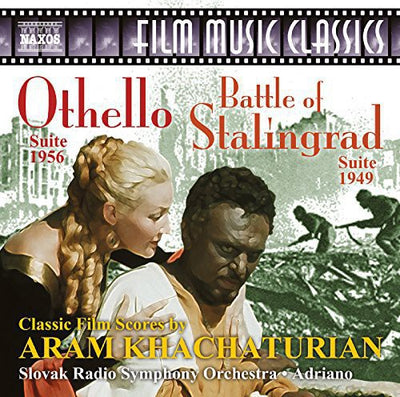
  • Khachaturian: Othello Suite, Battle of Stalingrad Suite / Adriano
    Naxos

    Khachaturian: Othello Suite, Battle of Stalingrad Suite / Adriano

    CD · 1 disc

    $19.99
    Composer
    KHACHATURIAN, ARAM
    Artist
    Adriano, Simcisko, Valaskova
    Released
    Jul 08, 2014
    This disc was one of Ian Lace’s Recommended Original Film Score Recordings when first issued at full price as Marco Polo 8.223314. Here it resurfaces at upper bargain price.

    Khachaturian, like many another composer, major and lesser, in Soviet Russia, turned his hand to the cinema and did so pretty extensively. This was a great leveller, a ready source of income and a means of reaching out to mass audiences across the Union. The pity is that we see so few of those films. If we think at all about them we much more readily accept seeing them written off as the work of political hacks. The composer’s first effort – of eighteen - was the film Pepo written for the Armenian Film Board a few years before his First Symphony (1934). His last film dated from 1960.

    Here are suites assembled from the music for two of Khachaturian’s cinema scores. They are played for all they are worth. Adherents of this composer and of twentieth century music of the USSR will want to hear how he fared in dealing with the silver screen.

    The Battle of Stalingrad original score ran to some two hours. The titles give us some impression of what is featured in this suite: I. A City on the Volga - II. The Invasion; IIIa. Stalingrad in Flames; IIIb. The Enemy is doomed; IV. For our Motherland; To the Attack! - Eternal Glory to the Heroes; V. To Victory - VI. There is a Cliff on the Volga. Much of this is urgent and not specially subtle – then again this is not meant to be about subtlety. The music often has a furious seething energy typical of the militaristic bravado found in the music for the Roman legionaries in Spartacus. We also hear little half-echoes of The Great Gate of Kiev. There are some glowing interludes such as that to be found in the almost Bridge-like battlefield bleakness of tr. 3 and at the close of tr. 4 (Eternal Glory to the Heroes). There are also moments that seem to evoke the composer’s great ballets – especially Spartacus. The cheery brassy march that is To Victory is noticeably purged of the ferocity to be found in the turbulent flag-waving first movement. This could almost be a march by Arthur Bliss. There’s a brass band version of the suite on Lawo which Nick Barnard did not think much of.

    Both Chandos and Capriccio have done extensive series of the film music of Shostakovich. No such thorough efforts have gone in Khachaturian’s direction. There has been this single disc from Naxos and some film suites from ASV. Indeed fifteen minutes of Loris Tjeknavorian’s take on The Battle of Stalingrad was issued on Alto. It was originally issued with the Second Symphony.

    If the Stalingrad score’s gaudy virtues are embraced, often at the expense of the more understated and nuanced, Othello from 1955 is much more multi-faceted. This is as befits a presumably fairly classy Shakespeare film in a translation made by Boris Pasternak – he of Doctor Zhivago fame. The Prologue and Intermezzo is especially touching with a memorable tolling solo violin which returns in the finale. There’s also some extremely inventive writing in a mode recalling Prokofiev who had died two years before this film. The Desdemona Arioso is a swellingly emotional vocalise for soprano with orchestra with more than few links with the famous Adagio from Spartacus. The little Venice Nocturne (tr.4) is a lovely miniature, showing as does much of this score, that Khachaturian is much more than a peddler of crushingly loud music. The grey psychological aspects of Nocturnal Murder make way for the intensity of Othello’s Despair. The urgently rushing A Fit of Jealousy will have you thinking of the ruthlessly athletic music for Crassus in Spartacus. If Khachaturian indulges in a Hollywood-style choir in the Finale – well, why not, and it is by no means cheesy.

    The recording is extremely good despite its 25 year vintage. The notes by the conductor are helpful in placing the score and the films from which this music is drawn.

    I hope that at some time, in a world where there are seemingly hundreds of film channels, we will get to see these films.

    There you have it: specialist territory maybe but two very welcome substantial suites from the world of Khachaturian’s film music.

    – Rob Barnett, MusicWeb International
    View full page
  • Khachaturian, A.I.: Spartacus / Ode in Memory of Lenin / Ode

    Khachaturian, A.I.: Spartacus / Ode in Memory of Lenin / Ode

    Delos Jan 2003
    1 disc
    CD
    $18.99
    Grand Piano

    Khachaturian: Recitatives and Fugues - Children's Albums, Books 1-2 / Charlene Farrugia

    CD · 1 disc

    $19.99
    Composer
    KHACHATURIAN, ARAM
    Artist
    Charlene Farugia
    Released
    Mar 12, 2021

    Aram Il’yich Khachaturian was considered the ‘mouthpiece of the entire Soviet Orient’ and remains the most renowned of 20th-century Armenian composers. His unmistakable style came with an urge to invent new forms that reconciled Western practice with Eastern idiom. His ‘apprentice’ Fugues were revised and enriched with Recitatives that conjure the colorful voices of Khachaturian’s childhood in Tbilisi. Refreshingly original, amusing and provocative, the Children’s Albums belong to a tradition that reaches back to Bach, Schumann and Tchaikovsky. The Maltese pianist Charlene Farrugia studied with Dolores Amodio, and with Diana Ketler at the Royal Academy of Music in London. For several years she was mentored by Boris Petrushansky. She gained her doctorate in performance under Kenneth Hamilton with a thesis on piano repertory for the left hand. In 2018 she received Malta’s International Achievement Award, and was made an Associate of the Royal Academy of Music in 2020. An ambassador of EMMA (Euro Mediterranean Music Academy) for Peace, under the auspices of UNESCO, she is currently on the teaching faculty at the Music Academy, Juraj Dobrila University of Pula, Croatia.

    View full page
    BIS

    Khachaturian: Piano Works / Sughayer

    SACD · 1 disc

    $21.99
    Composer
    KHACHATURIAN, ARAM
    Artist
    Iyad Sughayer
    Released
    Nov 01, 2019

    Born in 1903, Aram Khachaturian became the most significant twentieth-century musical figure in the then Soviet Republic of Armenia. Many of his most important works date from the first half of his career. The expressive immediacy of his music, conditioned by his Armenian heritage with its sensuous melodic writing, its vibrant orchestration and rhythmic drive – all resulted in a popularity equalled by few composers of his generation. Although he is primarily associated with large orchestral scores – including the ballets Gayaneh and Spartacus, perennial favourites with concert audiences – he also left a number of works for piano solo. For his debut disc, the Jordanian-Palestinian pianist Iyad Sughayer has put together a recital spanning from the ample and demanding Sonata to the delightful Children’s Album, consisting of ten miniatures, in turn playful and poignant. The recital closes with a piece which did a great deal to establish Khachaturian’s name near the outset of his international career. Composed in 1932 (allegedly in a single evening), the Toccata in E flat minor soon established itself among the showpieces of the modern repertoire and was to become a calling-card for aspiring virtuosi. Iyad Sughayer was born in 1993 in Amman, where he received his early training. At the age of 13, Iyad moved from Jordan to study at the Chetham’s School of Music in Manchester, UK.

    REVIEWS:

    Much of the music in this recital is both technically and musically challenging, yet Sughayer sounds entirely at one with its impassioned eloquence, scorching intensity and coruscating musical patterning. He captures the music’s essence with such a close sense of recreative identity that it feels on occasion as though he could be composing it as he goes along. An outstanding debut.

    – BBC Music Magazine

    This disc is unreservedly recommended to lovers of magnificent pianism and outstanding recorded fidelity. The style, technique and taste of the performer and the sonics in both formats (unquestionably helped along by the remarkable acoustics of the Stoller Hall) will amply reward the curious, more than the attractions of Aram Khatchaturian’s defiantly uneven piano music. Having said that, while I have no doubt whatsoever that Iyad Sughayer will in time make far more important recordings than this, I applaud his imagination and sense of adventure in kicking off his career with Khachaturian as opposed to more tried and tested repertoire. BIS appear to have unearthed another piano-playing diamond.

    – MusicWeb International

    View full page
  • Khachaturian: Piano Works / Sughayer

    Khachaturian: Piano Works / Sughayer

    BIS Nov 2019
    1 disc
    SACD
    $21.99
    SWR

    Ida Haendel: The SWR Recordings 1953-1967

    CD · 3 discs

    $26.99
    Composer
    VARIOUS
    Artist
    Ida Haendel
    Released
    Oct 08, 2021
    Ida Haendel (1928–2020) was one of the violin legends of the 20th century, a true individual whose seven-decade performing career reached back to the golden age of violin playing. This 3-CD collection brings together concertos by Brahms, Mendelssohn, Tchaikovsky, Dvorák, Khachaturian and Bartók, all of which Haendel played during the years leading up to 1967 under the baton of Hans Müller-Kray and the Radio-Sinfonieorchester Stuttgart. These recordings are among the most valuable treasures in today’s SWR archive.
    View full page
  • Ida Haendel: The SWR Recordings 1953-1967

    Ida Haendel: The SWR Recordings 1953-1967

    SWR Oct 2021
    3 discs
    CD
    $26.99
    Grand Piano

    Piano Works And Ballet Transcriptions

    CD · 1 disc

    $19.99
    Composer
    KHACHATURIAN, ARAM
    Artist
    Karine Poghosyan
    Released
    Jan 13, 2015
    Despite the popularity of Aram Khachaturian’s ubiquitous ballet music, his works for piano have been relatively neglected. This release, featuring two World Premiere Recordings, combines arrangements of popular pieces such as Masquerade – Suite (Arr. A. Dolukhanian) with less familiar works such as the composer’s early Poem and the abstract Piano Sonata. The Armenian pianist Kariné Poghosyan has won numerous awards as well as performed in some of the world’s most prestigious concert halls. At the Manhattan School of Music she completed her D.m.A. in a record-breaking two years with a thesis on Aram Khachaturian’s works for piano. She is currently based in New York, where she teaches at the Manhattan School of Music.
    View full page
  • Piano Works And Ballet Transcriptions

    Piano Works And Ballet Transcriptions

    Grand Piano Jan 2015
    1 disc
    CD
    $19.99
    Sono Luminus

    The Sound of Black and White / Raffi Besalyan

    CD · 1 disc

    $9.49 $18.99 Save 50%
    Composer
    GERSHWIN KHACHATURIAN LEVANT
    Artist
    Raffi Besalyan
    Released
    Aug 06, 2021

    This program is a loving tribute to A. Khachaturian, the towering musical figure from my native Armenia and to G. Gershwin, the musical genius from my adopted home, the United States. These two composers are bridged here by the phenomenal pianist/ composer and Hollywood superstar, Oscar Levant. Some of the works on the album have been my loyal recital companions since childhood, the others have become such upon my immigration to America as a young adult. The release includes a world premiere recording of Oscar Levant’s jazzy Sonatina.

    REVIEW:

    Pianist Raffi Besalyan presents a collection of works from his native Armenia and his adopted U.S, and indeed, he offers vigorous performances of music by Aram Khachaturian and George Gershwin. Most interesting are the points where the two composers meet. Highly newsworthy is the world premiere of the Piano Sonatina by Gershwin specialist Oscar Levanty. The Sonatina has a unique post-Gershwin language and makes one wants to hear more of Levant’s original music. One is left with the impression of an odd kinship between Khachaturian and Gershwin that no one else has quite caught. The presence of some of Earl Wild’s Virtuoso Etudes after Gershwin also works; the pieces bring a bit of the Russian virtuoso school, Besalyan’s specialty, to the proceedings. The whole thing is brilliantly performed and benefits from superb engineering at Sono Luminus’ Virginia studios. A satisfying cross-cultural essay.

    -- AllMusic.com (James Manheim)

    View full page
  • The Sound of Black and White / Raffi Besalyan
    Sale

    The Sound of Black and White / Raffi Besalyan

    Sono Luminus Aug 2021
    1 disc
    CD
    $18.99 $9.49Save 50%
    CPO

    Khachaturian: Piano Concerto & Concerto Rhapsody / Raiskin, Simonian, Rhenish State Philharmonic

    CD · 1 disc

    $18.99
    Composer
    KHACHATURIAN, ARAM
    Artist
    Simonian, Staatsorchester Rheinische Philharmonie, Raiskin
    Released
    Jul 06, 2018
    Aram Khachaturian conquered the world with the boundless delight he took in composing. His Sabre Dance found its place in advertising, his Adagio from the ballet Spartacus accompanied a cult series, and prominent ice skating pairs danced their way into the hearts of their spectators to the Waltz from his stage music to Lermontov’s Masquerade. On the other side, his symphonic music and concertante works even today continue to attract the greatest conductors and soloists. A unique, often imitated, but never reproduced synthesis consisting of fascinating instrumental virtuosity, exotic melodies, highly imaginative harmonies, and irresistible rhythmic spirit distinguishes the three concertos and three concert rhapsodies written by Aram Khachaturian during 1936-46 and 1961-67, and this double trilogy begins its cpo journey with the earliest and latest of these works. The Armenian pianist Stepan Simonian, who resides in Hamburg, the Russian conductor Daniel Raiskin, and the Rhine State Philharmonic, which Aram Khachaturian himself accompanied a good forty-five years ago during his visit to Germany, get things going on this quasi-authentic recording of these two concertante works for piano and orchestra timelessly reflecting each other like a mirror in a mirror.

    -----

    REVIEW:

    You can hear the really extraordinary pianistic qualities of the soloist in the piano concerto recording.

    – Klassik Heute
    View full page
  • Khachaturian: Violin Concerto & Concerto Rhapsody / Weithaas, Raiski, Rhine Philharmonic State Orchestra
    CPO

    Khachaturian: Violin Concerto & Concerto Rhapsody / Weithaas, Raiski, Rhine Philharmonic State Orchestra

    CD · 1 disc

    $18.99
    Composer
    KHACHATURIAN, ARAM
    Artist
    Weithaas, Staatsorchester Rheinische Philharmonie, Raiskin
    Released
    Feb 07, 2020

    In the 1960s Aram Khachaturian engaged in a number of experiments in which he covered terrain situated at an astonishing distance from the immediately appealing tone of the works that he had composed prior to those years. These experiments included the first of his three concert rhapsodies, in which he completely emancipated himself from the established forms that he had filled out in his concertos for piano, violin, and violoncello, which already then were world famous. While the virtuosic ambitions of the rhapsodies are in no way inferior to the technical demands of their older sister works, he now requires what is perhaps an even higher measure of expressive shared experiencing and solo messaging. The direct juxtaposition of the two concert violin compositions recorded by Antje Weithaas and Daniel Raiskin and the Rhineland-Palatinate State Symphony Orchestra conveys the extraordinarily grand leap into a “modernism” that hardly anybody would have thought possible for the author of the Sabre Dance. In 1971 Aram Khachaturian was honored for his rhapsodic risk-taking when he received the State Prize of the Soviet Union for his second concert trilogy.

    View full page
    PENTATONE

    Russian Violin Concertos / Fischer, Kreizberg, Russian National Orchestra

    CD · 1 disc

    $19.99
    Composer
    Alexander Glazunov, Aram Khachaturian, Sergei Prokofiev
    Artist
    Julia Fischer
    Released
    Jul 21, 2023

    This remarkable album marks the recording debut of German violinist Julia Fischer as well as the beginning of her extraordinary partnership with Russian-born conductor Yakov Kreizberg, which would result in numerous Pentatone releases before the conductor’s untimely death in 2011. Together they tackle three Russian violin concertos (by Khachaturian, Prokofiev, and Glazunov) which have been tragically overlooked, shedding new light on these masterpieces. After releases on SACD and vinyl, this iconic album now returns in an affordable stereo version.

    View full page
  • Postcards from Ukraine, Vol. 3 – Folk Dialogues
    Toccata

    Postcards from Ukraine, Vol. 3 – Folk Dialogues

    CD · 1 disc

    $20.99
    Composer
    Johannes Brahms, Frederic Chopin, Antonin Dvorak, Stephen Foster, Percy Grainger, Jeno Hubay, Aram K
    Artist
    Markiyan Melnychenko, Stewart Kelly
    Released
    Apr 10, 2026
    The first album of Postcards from Ukraine gave a potted history of Ukrainian music in the form of a series of miniatures for piano and violin, and the second presented four outstanding chamber works by important Ukrainian composers. This third instalment brings six new arrangements of Ukrainian folksongs, for violin and piano, by Markiyan Melnychenko, integrating them into a programme of folksong- and dance arrangements by some of his best-known virtuoso predecessors.
    View full page
  • Postcards from Ukraine, Vol. 3 – Folk Dialogues

    Postcards from Ukraine, Vol. 3 – Folk Dialogues

    Toccata Apr 2026
    1 disc
    CD
    $20.99