Vinyl · 1 disc
SACD · 1 disc
Less than a year after the release of his recording of Schubert's Impromptus (BIS-2614), Ronald Brautigam now presents two of Franz Schubert's late masterpieces, the Sonatas D 959 and D 960. They are played here on a fortepiano built by Paul McNulty after an instrument from around 1819 by the Viennese instrument maker Conrad Graf, and presumably similar to the instrument on which Schubert composed.
Although it is tempting to see Schubert's final works as the testament of a doomed artist who feels his end is nearing, the reality is quite different: the composer displayed vitality, optimism, and a prodigious capacity for work. His last two sonatas also show that he had reached a new level, having successfully emancipated himself from the Beethovenian model. These sonatas took a long time to establish themselves, not least because of their length, which was at first disconcerting for music-lovers and pianists alike. They are now considered to be among Schubert's finest works, alongside others dating from the last years of his life, such as the String Quintet in C major and the song cycle Winterreise. All these works seemed to herald considerable promise for future works; Schubert's untimely death buried a rich heritage, but even more beautiful hopes.
REVIEW:
Paul McNulty ‘s 2007 fortepiano based on a Conrad Graf model circa 1819 served Ronald Brautigam’s Haydn, Mozart and Beethoven solo recordings wonderfully well, and does so again in the fortepianist’s powerful, passionate and musically intelligent accounts of Schubert’s last two sonatas. Indeed, these are far and away the best Schubert period instrument piano recordings since those of Andreas Staier and Peter Serkin. Brautigam dives into the A Major Sonata’s opening Allegro with both assertion and flexibility, underlining Schubert’s astonishing harmonic tangents with stinging accents, subtle accelerations and full-bodied fortes that almostd detonate. To compensate for his instrument’s limited sustaining capabilities, Brautigam builds the momentum within the slow movement’s wild central climax by occasionally scaling back the long chromatic phrases so that their loudest peaks convey maximum impact. Having recently played on a similar McNulty Graf model, I can attest that the instrument’s light action makes it easier than usual to negotiate the Scherzo at a true Allegro vivace. However, Brautigam holds the tempo back and conveys more lilt and swing in the process. He also brings a patient, songful and lovingly nuanced spaciousness to the Finale that parallels Maurizio Pollini’s sublime modern instrument recording.
The instrument’s striking timbral distinctions between registers hit home in the B-flat Sonata’s Molto Moderato, especially when the low lying trills appear to emanate from an entirely different keyboard. Likewise, the frequent repeated notes in melodic phrases and ostinato-like accompaniments gain tension. One also should note Brautigam’s shifts of emphasis and timing as he observes the long first movement repeat. He imparts more urgency than what one often hears in the Andante sostenuto, mustering up genuine orchestral impact in the central climax. The Scherzo stands out for Brautigam’s mercurial pedal shifts and curvaceously inflected Trio section. I would have imagined a more headlong Finale in Brautigam’s hands, yet he takes Schubert’s “ma non troppo” caveat to heart by easing his way into the main theme, and allowing the dotted rhythms a welcome degree of grandeur and breathing room. The interpretation suggests an opera without words more than a piano showpiece, and that’s a compliment. Superb sonics, superb annotations, superb musicianship and superb pianism: what more could you want from this most recommendable Schubert release? Don’t miss it.
— ClassicsToday.com (10/10; Jed Distler)
CD · 1 disc
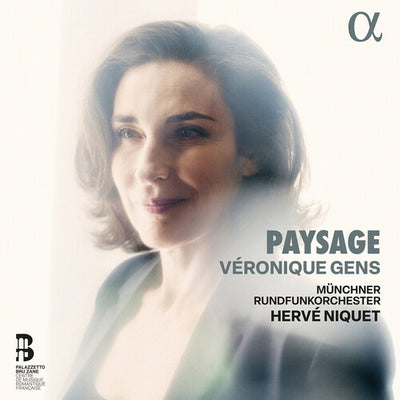
In this recital, Véronique Gens and Hervé Niquet bring back to life a neglected aspect of France’s Romantic heritage: songs with orchestral accompaniment. Aside from a few pieces by Debussy and Duparc, and Berlioz’s famous Nuits d’été, orchestral mélodies form a virtually forgotten continent. In collaboration with the specialists of the Palazzetto Bru Zane, Alpha now revisits these musical landscapes, taking us from Brittany (Hahn) to Persia, whose beauties Fauré and Saint-Saëns exalt in very different ways. Mélodies by Chausson, Gounod and Dubois and rarely heard instrumental pieces by Massenet, Fauré and Fernand de La Tombelle round out the journey with their musical reveries.
CD · 3 discs
CD · 2 discs
In a follow-up to its extremely successful album Her Voice, the Neave Trio on A Room of Her Own once again champions the works of female composers. The only non-French composer on the album is Ethel Smyth whose Piano Trio, one of her earliest works, was composed in 1880. Like many of her works from this era, it shows a clear nod to the Austro-German influences of her studies in Leipzig, particularly of Brahms. Cecile Chaminade was born just a year before Smyth, and her First Piano Trio was written in the same year as Smyth’s. The Paris première was very well received by the critics, and the Trio was published a year later. Germaine Tailleferre’s Piano Trio began life in 1916 – 17 as a work in three movements, and then gathered dust for over sixty years, until a commission from France’s Ministère de la Culture, in 1978, enabled Tailleferre to revive and re-imagine it. By then in her mid-eighties, Tailleferre replaced the original second movement and added a fourth. The Trio is an excellent example of her compositional style – a voice that remained consistent though her long compositional career. Lili Boulanger’s D’un matin de printemps and D’un soir triste are perhaps now better known in their orchestral versions: this recording proves that the two pieces work equally well at either scale. As they are among the last compositions of her short life (she died of chronic illness at twenty-four), we are left to imagine what she might have written had she lived longer.
These chamber works are still not in the mainstream. The Neave Trio put their case eloquently.
-- The Guardian (U.K.)
Showing Items 201-215 of 215