Gabriel Fauré

Composer

    Faure: Cello Sonatas / Ben-Sasson, Sternfield
    Naxos

    Faure: Cello Sonatas / Ben-Sasson, Sternfield

    CD · 1 disc

    $19.99
    Composer
    FAURE, GABRIEL
    Artist
    Ina-Esther, Sternfield
    Released
    Feb 23, 2010


    FAURÉ Music for Cello and Piano • Ina-Esther Joost Ben-Sasson (vc); Allan Sternfield (pn) • NAXOS 8570545 (70:06)


    Sicilienne, op. 78. Sonata No. 2, op. 117. Après un rêve, op. 7/1. Elégie, op. 24. Romance, op. 69. Berceuse, op. 16. Papillon, op. 77. Sérénade, op. 98. Sonata No. 1, op. 109. Pavane, op. 50


    A blurb on the back cover of this album states that “Fauré’s musical language bridged a gap between 19th-century Romanticism and the music that appeared with the new century.” Sounds like something I’ve said before, even having gone so far as to say that Fauré is the missing link between Brahms and Debussy. Whether one chooses to accept that argument or not, it cannot be denied that Gabriel Fauré (1845–1924), a disciple of Saint-Saëns and an admirer of Schumann, Liszt, and Wagner, had, by the turn of the 20th century, largely fashioned a personal style based on the teachings of Gustave Lefèvre, as set forth in his book Traité d’harmonie , published in 1889. In it Lefèvre advances the idea that chords of the seventh and ninth are not dissonant, ergo, they do not require resolution; and that the third of the scale may freely alternate between major and minor within a “composite” scale that incorporates both modes. These ideas were of course embraced by the likes of Walter Piston and Roger Sessions in their own updated 20th-century treatises on harmony. And one hasn’t far to travel from the unresolved sevenths and ninths of Lefèvre and Fauré to the chromatically altered seventh, ninth, 11th, and bi-tonal chords, and the whole-tone and pentatonic scales of Debussy.


    Most of the works on this disc are early to middle Fauré, and thus closer in content and style to the romantic aesthetic than they are to the composer’s later efforts. And three of the pieces are arrangements of works originally written for other media. The famous Après un rêve of 1870, presented here in a transcription by Pablo Casals, was conceived as a mélodie for voice and piano. The 1878–79 Berceuse was a violin and piano piece. And the ubiquitous 1887 Pavane , given here in an arrangement by Henri Büsser, was an orchestral work with choral parts later added.


    Placing the remaining numbers, originally for cello, in chronological order, we have the Elégie (1883), the Romance (1894), Papillon (1894), Sicilienne (1898), the Sérénade (1908), the First Sonata (1917), and the Second Sonata (1921). While Fauré’s output did not cease in the decade between the 1898 Sicilienne and the 1908 Sérénade , it’s interesting to note that his 1898 incidental music to Pelléas et Mélisande was quite possibly his final doffing of his 19th-century Romantic hat. There’s no questioning that the next few years were a time of reexamination for Fauré. Surely, he must have heard Debussy’s opera based on the same play that was premiered in 1902, and possibly even Schoenberg’s exactly contemporaneous tone poem on the subject. And though I doubt that Sibelius would have been known in France at this early date, it’s not outside the realm of possibility that Fauré may even have heard the Finnish composer’s 1905 incidental music of the same title. Whatever the extent of Fauré’s exposure to these various stimuli may have been, changes in his compositional style and technique become evident with his 1906 song cycle La Chanson d’Eve , op. 95.


    Both of the cello sonatas belong to Fauré’s late period, the second of the two being among his last works. While still conforming to a Classical three-movement fast-slow-fast pattern, the harmonic language is now freer and the melodic treatment more fluid, giving a sense that the music is “through-composed.” With the exception of an 1888 Petite pièce in G Major, op. 49, which has been lost, the current Naxos disc, as far as I know, gives us all of Fauré’s original works for cello, plus the three aforementioned arrangements.


    German-born, prize-winning cellist Ina-Esther Joost Ben-Sasson studied with Pierre Fournier and Sergiu Celibidache. She is today an Israeli citizen, and principal cellist and frequent soloist with the Jerusalem Symphony Orchestra. Her discography, at least according to Naxos’s brief bio, includes the Bach suites for solo cello, but I was not able to find it, or any other of her recordings, listed. Allan Sternfield is a “made in the U.S.A.” product, having studied at Baltimore’s Peabody Conservatory of Music. He was subsequently coached by Leon Fleisher and Wilhelm Kempff.


    Naxos has here entered into competition with itself, for another fine release on the same label with Maria Kliegel and Nina Tichman, minus the Pavane , contains exactly the same program. Such duplication seems odd, especially since both discs seem to have been recorded only a year and a half apart. The current Joost/Sternfield CD, just released, was recorded mid 2007; the Kliegel/Tichman, released in 2008, was recorded late in 2005. It’s a head-scratcher to be sure. Be that as it may, a comparison between the two reveals little difference, certainly not enough to warrant purchasing Joost/Sternfield if you already have Kliegel/Tichman. J&S offer an extra with the inclusion of the Pavane , a piece you’re already bound to have in its original orchestral version. In general, though not in every single case, J&S are a bit slower in their tempo choices than K&T in the short pieces, and considerably so in the two sonatas. This may impart a somewhat more nostalgic feeling to J&S’s readings, which can, at times, suggest a salon atmosphere. But in terms of technical execution, tone production, and intonation, I would be happy with either recording.


    FANFARE: Jerry Dubins
    View full page
  • Faure: Cello Sonatas / Ben-Sasson, Sternfield

    Faure: Cello Sonatas / Ben-Sasson, Sternfield

    Naxos Feb 2010
    1 disc
    CD
    $19.99
  • Faure: Pavane, Songs, Requiem

    Faure: Pavane, Songs, Requiem

    OSJ Alive Jun 2014
    1 disc
    CD
    $18.99
  • Faure: Requiem

    Faure: Requiem

    Haenssler Classic Jun 2011
    1 disc
    CD
    $20.99
  • Salut d'Amour / Jones, Thwaite
    Sleeveless Records

    Salut d'Amour / Jones, Thwaite

    CD · 1 disc

    $20.99
    Composer
    VARIOUS
    Artist
    Jones, Thwaite
    Released
    Oct 18, 2019


    SALUT D’AMOUR • Matthew Jones (vn); Annabel Thwaite (pn) • SLEEVELESS 1006 (62:17)


    GERSHWIN (arr. Heifetz) It Ain’t Necessarily So. MASSENET Méditation. CHOPIN Nocturnes: in c?; in D?. ELGAR Salut d’amour. FAURÉ (arr. Bachmann) Après un rêve. PONCE (arr. Heifetz) Estrellita. CASPI La Trenza. MONTI Czardas. SCHUBERT Impromptu in B?. HAHN Nocturne. IRELAND Cavatina. SIBELIUS Romance. KREISLER Praeludium and Allegro. TRADITIONAL (arr. Gover) Suo Gân


    Serious-minded programmers (or, at least, programmers of a certain well-delineated stripe) almost banished short pieces, which had been the meat and potatoes of the recital program as well as of the recording industry, from stages and discs for about a generation. Now intrepid artists Matthew Jones and Annabel Thwaite have torn down the “Do Not Enter” signs and have risked their musical lives exploring the dangerous proscribed (politically incorrect?) repertoire that arguably ruined careers and reputations 50 years ago (but, of course, made them 50 years before that). And to their credit—or discredit—they play stylishly in Jascha Heifetz’s saucy transcription of George Gershwin’s song, It Ain’t Necessarily So —if not with Heifetz’s own dazzling aplomb, pleasantly excitingly at least. Jules Massenet’s Méditation may be the most beloved short piece ever played on the violin, and the duo plays it that way. The tone of Jones’s violin exhibits a sort of acidulous edge—just as did Aaron Rosand’s or Zino Francescatti’s, although in the cases of both those older violinists, the edge lent what they played a sort of sizzle that Jones’s playing lacks. Nathan Milstein made a very violinistic-sounding arrangement of Chopin’s Nocturne in C? Minor; and though that piece might have fit well in the program, Thwaite plays it as a piano solo—so sensitively and atmospherically that even violinists might be glad not to have heard the arrangement for violin. Jones and Thwaite realize much of the veiled emotion of Elgar’s popular miniature Salut d’amour as well as the quiet intensity of the beginning of Gabriel Fauré’s short piece, Après un rêve . Heifetz’s arrangement of Estrellita might have been his calling card, but Jones makes it his own as well in a reading that’s warmer and more tender.


    The program includes some less well-known but no less effective interludes, of which Avshalom Caspi’s brooding miniature La Trenza proves to be the first example. Vittorio Monti’s Czardas , like Massenet’s Méditation , has been one of the most frequently heard of violin encores, penetrating the popular repertoire almost as deeply as the standard one. Jones remains faithful to the original version, but he plays it with gusto and appealing ethnic coloration. Thwaite takes Franz Schubert’s Impromptu as a piano solo, exhibiting a firm grasp of the piece’s shape and making the most of its growling lower registers. Reynaldo Hahn’s Nocturne, another of the less familiar cameos, sounds allusive and affecting in Jones’s reading, as does John Ireland’s Cavatina , a piece that may strike some listeners as perhaps a bit more effective than the vastly better known piece by the same name by Joachim Raff. Sibelius’s Romance provides yet another example of a relative unknown that fits perfectly into the program, and Jones invests it with melting warmth and insinuating subtlety. Chopin’s Nocturne in D? Major serves as the last of the Thwaite’s three effective piano solos.


    Fritz Kreisler never recorded his own Praeludium and Allegro —by many accounts his very best short violin piece. Also, by Carl Flesch’s account, Kreisler didn’t take the Allegro particularly fast. And while the opening quarter notes may look bland on the page, violinists like Francescatti could bring them to life. So does Jones, who belts them out with the panache of Ethel Merman the first time and plays them almost tentatively the second. Like Kreisler himself, however, Jones makes no attempt to rush through the Allegro and deploys a variety of bow strokes to give extra personality to the perpetual motion. Following Francescatti in a way, he’s dazzling in the cadenza over a pedal point. The duo brings the program to a quiet conclusion with a Welsh lullaby, reflecting Jones’s ethnic origins.


    If this isn’t the very CD of choice for a sojourn on a desert isle, I certainly wouldn’t use it as a Frisbee in that setting either. For its interesting repertoire, familiar and unfamiliar alike, for its sensitive and idiomatic performances, for its clear recorded sound, and, not least, for the novelty of including piano solos to punctuate it, Jones and Thwaite’s unpretentious but prepossessing recital should wear well after many, many hearings, whatever the venue. Strongly recommended.


    FANFARE: Robert Maxham
    View full page
  • Salut d'Amour / Jones, Thwaite

    Salut d'Amour / Jones, Thwaite

    Sleeveless Records Oct 2019
    1 disc
    CD
    $20.99
  • Fauré: Cantique De Jean Racine / La Naissance De Venus / Pav

    Fauré: Cantique De Jean Racine / La Naissance De Venus / Pav

    Chandos Sep 2003
    1 disc
    CD
    $21.99
  • Fauré, G.: Piano Quartets Nos. 1 and 2 / Nocturne No. 4

    Fauré, G.: Piano Quartets Nos. 1 and 2 / Nocturne No. 4

    Chandos Feb 2010
    1 disc
    CD
    $21.99
  • Fauré, G.: Quintets for Piano and Strings

    Fauré, G.: Quintets for Piano and Strings

    Chandos Jan 2010
    1 disc
    CD
    $21.99
  • Ibert: Divertissement;  Fauré / Ormandy, Philadelphia Orch

    Ibert: Divertissement; Fauré / Ormandy, Philadelphia Orch

    Sony Masterworks Jan 2008
    1 disc
    CD
    $17.99
    Coviello

    V2: BASSOON FAGOTT BASSOON

    CD · 1 disc

    $20.99
    Composer
    BITSCH FAURE JOLIVET PIERNE
    Artist
    Donneweg, Buhl
    Released
    Feb 16, 2018
    Hanno Donneweg writes of his new release: “For many years, one of my heartfelt desires has been to expand the bassoon repertoire. I think this wonderful instrument deserves to draw on a more extensive body of works. […] The bassoon was very frequently favoured by composers of the Baroque period, but this interest significantly waned during the Romantic era. […] Two years ago, Andreas N. Tarkmann and I teamed up with Coviello to make a recording of solo works for bassoon and orchestra from the German-speaking world. We have now turned our attention to French compositions from the last 150 years.” Hanno Donneweg, born in 1977, took his first bassoon lessons at age nine with Horst Wartha, along with chamber music instruction from Bernd Rimbrecht at the Jugendmusikschule in St. Georgen im Schwarzwald, Germany. Between 1995 and 1998, Donneweg was a member of the National Youth Orchestra of Germany and Jeunesse Musicale International. Since 1999 he has been a scholarship recipient of the Deutschen Musikwettbewerb and a member of the Bundesauswahl Konzerte junger Kunstler. Since August 2002, Donneweg has been solo bassoonist with the Radio Symphony Orchestra Stuttgart.
    View full page
  • V2: BASSOON FAGOTT BASSOON

    V2: BASSOON FAGOTT BASSOON

    Coviello Feb 2018
    1 disc
    CD
    $20.99
  • Faure: 13 Barcarolles / Endres
    Oehms Classics

    Faure: 13 Barcarolles / Endres

    CD · 1 disc

    $14.99
    Composer
    FAURE, GABRIEL
    Artist
    Michael Endres
    Released
    Apr 06, 2018

    The 13 Barcarolles of Fauré, composed over the course of almost four decades (1882-1921), are highly representative of his piano oeuvre and are considered his most characteristic works. They reflect his separation from the romantic idiom of Chopin and Mendelssohn, in particular, and his progress towards an independent musical language in which he achieved a successful harmonious reconciliation between tradition and the modernism that was emerging at the time. Michael Endres recorded these pieces for OehmsClassics at WDR in Cologne in May 2017. The German pianist performs worldwide as a soloist and chamber music partner. He gained a Master’s degree at the Juilliard School in New York under Jacob Lateiner and studied with Peter Feuchtwanger in London. He has won several prestigious prizes at festivals and competitions, and his discography consists of 29 albums which have also been awarded.

    View full page
  • Faure: 13 Barcarolles / Endres

    Faure: 13 Barcarolles / Endres

    Oehms Classics Apr 2018
    1 disc
    CD
    $14.99
    Bridge Records

    Faure: Trio, Op. 120; Saint-saens: Trio, Op. 18; D'indy: Trio, Op. 98

    CD · 1 disc

    $18.99
    Composer
    SAIT-SAENS FAURE D'INDY
    Artist
    HORSZOWSKI TRIO
    Released
    Nov 11, 2014

    The superb Horszowski Trio is heard here in their debut recording. The Horszowskis (Jesse Mills, violin, Raman Ramakrishnan, cello and Rieko Aizawa, piano) draw their name from legendary pianist, Miecyslaw Horszowski, who made one of his specialties the repertoire of the three composers presented here.

    View full page
  • Faure: Trio, Op. 120; Saint-saens: Trio, Op. 18; D'indy: Trio, Op. 98

    Faure: Trio, Op. 120; Saint-saens: Trio, Op. 18; D'indy: Trio, Op. 98

    Bridge Records Nov 2014
    1 disc
    CD
    $18.99
    Oehms Classics

    Bertrand de Billy - ORF Radio Symphonieorchester Wien

    CD · 9 discs

    $31.99
    Composer
    VARIOUS
    Artist
    Billy
    Released
    Jun 14, 2019
    This new release features the complete symphonic recordings of OehmsClassics with Bertrand de Billy and the ORF Vienna Radio Symphony Orchestra from 2003-2010 when Bertrand de Billy was Chief Conductor in Vienna. Bertrand de Billy was born in Paris where he studied music. Starting as a member of an orchestra, he soon took on conducting. 1993-95 he was first Kapellmeister and Deputy Music Director at the Anhaltisches Theatre in Dessau, 1996-98 he held the same position at the Vienna Volksoper. 1999-2004 he was Music Director at the Gran Teatre del Liceu in Barcelona and 2002-2010 he was Music Director of the Radio Symphony Orchestra in Vienna. Bertrand de Billy is principal guest of the Orchestre de Chambre de Lausanne (2013-2016). Since 2014/2015 he is also principal guest conductor of the Dresdner Philharmonie.
    View full page
  • Bertrand de Billy - ORF Radio Symphonieorchester Wien

    Bertrand de Billy - ORF Radio Symphonieorchester Wien

    Oehms Classics Jun 2019
    9 discs
    CD
    $31.99
  • French Cello Sonatas II

    French Cello Sonatas II

    CAvi-music Jun 2014
    1 disc
    CD
    $19.99
  • Fauré: Nocturnes / Le Sage
    Alpha

    Fauré: Nocturnes / Le Sage

    CD · 1 disc

    $20.99
    Composer
    FAURE, GABRIEL
    Artist
    Eric Le Sage
    Released
    Mar 22, 2019
    With their poetry, their passionate and intimate lyricism, their refined style that gradually reveals hidden depths, the thirteen Nocturnes of Gabriel Fauré are the most significant group of works in his oeuvre for solo piano. Composed over a period of forty-six years (between 1875 and 1821), they bear witness to the composer’s remarkable stylistic evolution. From a form of expression rooted in romanticism, to an aesthetic fully aligned with 20th-century modernity, Fauré can be said to have shaped his musical personality like a sculptor. His Nocturnes are not all of equal importance, but as a whole their diversity and development offer a perfect panorama of his art. Éric Le Sage, one of the French piano school’s main representatives, whose many recordings for Alpha include the complete chamber music of Fauré, here interprets the repertoire closest to his heart.
    View full page
  • Fauré: Nocturnes / Le Sage

    Fauré: Nocturnes / Le Sage

    Alpha Mar 2019
    1 disc
    CD
    $20.99
    Alpha

    Faure: Dolly, Masques et Bergamasques, Trio / Le Sage, Pahud, Tharaud

    CD · 1 disc

    $20.99
    Composer
    GABRIEL FAURE
    Artist
    François Salque, Raphael Merlin, Pierre Colombet, Emmanuel Pahud, Eric Le Sage, Alexandre Tharaud
    Released
    Nov 19, 2013


    FAURÉ Dolly for Piano Four-Hands. Masques et bergamasques for Piano Four-Hands. Fantaisie for Flute and Piano, op. 79. Morceau de concours for Flute and Piano. Piano Trio, op. 120. Aprés un rêve for Cello and Piano (trans. Casals). Pelléas et Mélisande: Sicilienne, for cello & piano. FAURÉ-MESSAGER Souvenirs de Bayreuth for Piano Four-Hands • Eric Le Sage (pn); Alexandre Tharaud (pn); Emmanuel Pahud (fl); Pierre Colombet (vn); Raphaël Merlin (vc); Françoise Salque (vc) • ALPHA 603 (70:32)


    This comes wrapped in a certain air of carelessness. It might be called Eric Le Sage and Friends , and one assumes that Le Sage is the principal pianist, but there is no attempt to identify who plays what, on the jacket or in the booklet. Likewise, there is a reluctance to credit the arrangers and collaborators of several items, e.g., the contribution of André Meassager to the Souvenirs de Bayreuth ; some of which are taken at breakneck speed, thus obscuring their allusions to the Wagner operas they’re guying. In other pieces, however, gung-ho spontaneity is salutary. Going for the gusto, finesse occasionally takes a hit. Nestled amid the bonbons, a movingly elegiac reading of Fauré’s late Trio, too often dismissed as a feebly geriatric effort, makes a superb case for it and prompts one to hear Le Sage & Company’s three other Fauré albums. Despite occasional reservations, this gives pleasure. Recommended.


    FANFARE: Adrian Corleonis
    View full page
    Alpha

    Faure: Works For Cello & Piano / Francois Salque, Eric Le Sage

    CD · 1 disc

    $20.99
    Composer
    FAURE, GABRIEL
    Artist
    Salque, Le Sage, Meyer
    Released
    Oct 11, 2011


    FAURÉ Cello Sonatas No. 1 & 2. Romance. Elégie. Sérénade. Papillon. Berceuse. Clarinet Trio, op. 120 1 • François Salque (vc); Éric Le Sage (pn); 1 Paul Meyer (cl) • ALPHA 600 (74:02)


    Here we have the type of recital that has almost disappeared from the face of the earth: quintessentially French performances of quintessentially French music. As an analogy, I should also point out that quintessentially German, Italian, Austrian, Dutch, and British performances have also faded to a precious few. The standardization of both instrumental style and sound has, by and large, imposed a generically pretty but nationally ambiguous style and sound on orchestras, solo musicians, and chamber groups the world over. Heck, we even have a hard enough time coming up with a quintessentially American sound anymore.


    But Éric Le Sage and François Salque are indeed throwbacks to at least the 1940s. Salque’s cello avoids the generically rich, dark sort of timbre one hears from most such players the world over nowadays, but has rather a lean, edgy sonority not unlike Pierre Fournier. This does not mean that Salque’s low range lacks depth of tone, just that it’s not a basso profundo sound; it’s more like a basso cantate, which is fine by me. Likewise, Le Sage’s piano plays with light and shade, color and nuance, in a way that, fortunately, has never entirely disappeared from the lexicon of French pianists on record, from Cortot to Thibaudet.


    Thus these performances reach inside the music not just in terms of emotional response but also in terms of coloristic response. They do not lack for energy or excitement when the music calls for it, even in such a piece as the op. 69 Romance, yet despite a CD cover that is almost completely black with white and blood-red lettering, their playing is a virtual rainbow. Some modern listeners, more used to the plush generic quality of many musicians nowadays, may find this approach foreign to them or difficult to comprehend, but as the expression goes, “this is the real deal.” As good as the recording of mostly the same music by cellist Ina-Esther Joost Ben-Sasson is (Naxos 8570545), my decision in favor of this release is predicated by exactly the virtues (or, if you prefer, idiosyncrasies) mentioned in the second paragraph. I should also add that Paul Meyer manages to fit in very well indeed in the performance of the Clarinet Trio. You simply can’t sing Italian comic patter like an Italian, you can’t conduct Má Vlast as well as a Czech-born conductor can, and you can’t play French music any better than the French do it.


    FANFARE: Lynn René Bayley
    View full page
  • Fauré: La Bonne Chanson, Op. 61 & Quatuor avec piano, Op. 15

    Fauré: La Bonne Chanson, Op. 61 & Quatuor avec piano, Op. 15

    Zig-Zag Territoires Jun 2011
    1 disc
    CD
    $20.99
    APR

    The Complete French Columbia Recordings (1928 - 1939)

    CD · 4 discs

    $37.99
    Composer
    VARIOUS
    Artist
    Casadesus, Various
    Released
    Nov 01, 2019
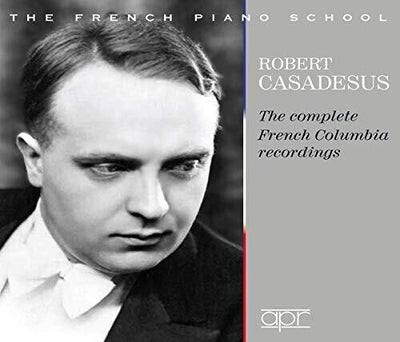
    Robert Casadesus (1899-1972) is today almost considered an American pianist - he based himself there from the Second World War onwards and he is known today through the huge number of recordings he made for US Columbia from 1940 until his death, but as a musician and pianist he was French to the core. He had studied at the Paris conservatoire with Isidor Philipp and Louis Diémer and his combination of immaculate technique, a light and brilliant touch and the refined elegance of his interpretations reveal why he was considered one of the greatest French pianists of the century. Casadesus began his recording career for French Columbia in 1928 and all his recordings for that label, until he left for the USA, are included here for the first time. Particularly noteworthy is a previously unpublished studio recording of Mozart's 'Coronation' concerto. He excelled in Mozart and Chopin and in French repertoire and all are well-represented in this collection. There are also noteworthy chamber collaborations in the Debussy cello sonata and Fauré Piano Quartet.
    View full page
  • The Complete French Columbia Recordings (1928 - 1939)

    The Complete French Columbia Recordings (1928 - 1939)

    APR Nov 2019
    4 discs
    CD
    $37.99
  • Faure: Complete Piano Quartets & Quintets
    Brilliant Classics

    Faure: Complete Piano Quartets & Quintets

    CD · 2 discs

    $17.99
    Composer
    FAURÉ, GABRIEL
    Artist
    Eymar, Kehr, Neuhaus, Sichermann, Braunholz
    Released
    Jun 24, 2014
    Faure: Complete Piano Quartets & Quintets / Composer: Gabriel Fauré / Performer: Jacqueline Eymar, Bernard Braunholz, Werner Neuhaus, Günter Kehr, Number of Discs: 2 / Length: 2 Hours 3 Mins. Recordings from the sixties (1966), sounding amazingly fresh and transparent. Reissue of one of the gems from the early VOX catalogue: Fauré 's complete piano quartets and quintets played by Jacqueline Eymar! Jacqueline Eymar (1922-2008), a pupil of Yves Nat, was one of the Grand Dames of the French piano school, together with Monique de la Bruchollerie and Yvonne Lefebure. Her style is elegant, perfectly natural, "inwardly" brilliant, playing the great French and German Romantics with exquisite taste and understanding. A superb set presenting the masterworks of Fauré's chamber music oeuvre, counting among his most frequently performed works. Fauré's Piano Quintets are both mature masterpieces and showcase how his musical language had evolved and become more experimental. Op.89 won great admiration from it's dedicatee Eugène Ysaÿe, who called it 'absolute music in the purest sense of the word'. Op.115, dedicated to another eminent composer, Paul Dukas, dates from 1921, three years before Fauré's death, and could be said to represent the pinnacle of his art. Indeed, following it's premiere in Paris, one reviewer wrote 'We had expected a beautiful work, but not one as beautiful as this.'
    View full page
  • Faure: Complete Piano Quartets & Quintets

    Faure: Complete Piano Quartets & Quintets

    Brilliant Classics Jun 2014
    2 discs
    CD
    $17.99
  • Faure: Piano Music / Stavy
    BIS

    Faure: Piano Music / Stavy

    SACD · 1 disc

    $21.99
    Composer
    FAURE, GABRIEL
    Artist
    Nicolas Stavy
    Released
    Feb 01, 2019

    This recital could almost have been entitled Around Fauré in Sixty Minutes, as the programme devised by Nicolas Stavy spans the entire career of the composer. In April 1863, when Gabriel Fauré noted down the Sonata recorded here for the first time, his 18th birthday was still a month away – the masterly Nocturne in B minor Op. 119, on the other hand, is Fauré’s final work for the piano, composed only two years before his death in 1924. Between them, and the other works included on the album, a fascinating trajectory takes shape. In the Finale of the sonata we hear a young man enjoying himself as he experiments with a Haydnesque idiom; a few years later there are traces of Mendelssohn and Schumann in 3 Romances, and of Chopin in Mazurke – also a world première recording. Especially when it comes to the choice of genre, Chopin is still an influence during the 1870s and Nocturne No. 1 and the Ballade, but both works testify to a composer finding his own voice. Fauré went on to compose another 12 nocturnes and two of these, No. 6 in D flat major from 1894 and the aforementioned Nocturne in B minor, serve as snapshots illustrating Fauré's later career and the composer's path towards increasing abstraction and a style characterised by timelessness and a detachment from fashionable trends.

    View full page
  • Faure: Piano Music / Stavy

    Faure: Piano Music / Stavy

    BIS Feb 2019
    1 disc
    SACD
    $21.99