Composer
SACD · 1 disc
Soprano Theresa Nelles and cathedral organist Winfried Bönig invite us to an atmospheric Christmas Eve in Cologne Cathedral and present a varied programme of Romantic works from various countries: music for the feast that goes straight to the heart. The great acoustics of Cologne Cathedral have been deliberately captured on this audiophile SACD. Born in Cologne, Theresa Nelles has had close ties with Cologne Cathedral since childhood, not only emotionally but also musically. During her 10 years of choir membership in the girls' choir at Cologne Cathedral, she already received her first solo tasks, was also the singer of a jazz band of the so called Cathedral-music for a long time and, after her High school graduation, studied singing at the Cologne Academy of Music with Prof. Mechthild Georg and in Rome at the Conservatorio Santa Cecilia. Engagements take the singer to festivals at home and abroad, such as the Festival Internazionale di Musica e Arte Sacra in Italy, Switzerland, South Tyrol, Russia, the International Handel Festival in Göttingen, the Beethoven Festival Bonn, the Brühl Castle Concerts, to opera houses such as Krefeld/ Mönchengladbach, Koblenz, Gelsenkirchen, the Margravial Opera House in Bayreuth, the Tonhalle Düsseldorf, the Cologne and Essen Philharmonics and, last but not least, regularly to large churches, always particularly fond of the local cathedral.
CD · 4 discs
CD · 1 disc
It is not by chance that luminous textures and sensual orchestral colors are considered essential features of French music. Its history features great names renowned for their art of instrumentation and sensitive use of timbres, who include the composers of the cello concertos on this recording: Camille Saint-Saëns, whose instrumentation technique always combines color with transparency, Édouard Lalo, who was highly esteemed by Claude Debussy for the wealth of color in his works, and Arthur Honegger, who painted striking soundscapes not only in his Cello Concerto but in his works without a large orchestra as well. Often it is the fine shadings and delicate transitions that characterize the tone colors of French music and are responsible for its delightful charm. Daniel Müller-Schott – Opus Klassik award winner 2019 – appealingly combines five works from the French sound kaleidoscope on his newest album with the DSO Berlin and Alexandre Bloch 'Four Visions of France’.
REVIEWS:
In every way, this is an impressive CD. It contains first-rate performances in excellent sound and has a most appealing programme. Included is a handsome booklet with photos and more than adequate notes on the works and artists. There is simply no reason to hesitate in adding this to your collection, if you are a cello aficionado.
-- MusicWeb International
After more than two decades in the spotlight, a still boyishly handsome Daniel Müller-Schott rightly remains one of the world’s foremost cellists, and a personal favorite of mine. He turns his attention here to chestnuts of the French repertoire, with most felicitous results.
The Saint-Saëns is of course the heavyweight entry in terms of standard repertoire status. Müller-Schott is on a plane with the work's finest exponents, giving a brisk and authentically French rendition, light and yet with dramatic flair. Equal credit in this regard is due to conductor Alexandre Bloch, who elicits an echt Gallic sound from the Deutsches Symphonie-Orchester Berlin. Much the same can be said of the other works featured here.
The recorded sound is excellent, the booklet notes (supplemented by artist bios) brief and to the point. This is a well thought out and beautifully realized release; strongly recommended.
-- Fanfare (James A. Altena)
Müller-Schott plays Saint-Saëns’ bravura test piece broadly in the opening Allegro, playfully in the Allegretto, and energetically in the closing Allegro. Later the Romance in F Major is tenderly executed by Müller-Schott. By contrast, the cellist’s take on the Élégie of Gabriel Fauré is all gentleness. His mining of the early 20h century sound in Arthur Honegger’s Cello Concerto bespeaks boldness and incisiveness.
When it comes to Édouard Lalo’s less-French than most work among those of his contemporaries: the Cello Concerto in D Minor, Müller-Schott embraces the grandiose, quasi-Wagnerian music with no small measure of impassioned fervor. Throughout all of the works featured in this interesting album, the soloist and his colleagues from the Deutsches Symphonie-Orchester Berlin play with commitment and unimpeachable style.
–Rafael's Music Notes
This collection of Gabriel Fauré’s mélodies is the first recording to be conceived for a bass voice. It juxtaposes some of the composer’s best-loved songs with some of his lesser-known works. This recital program draws out connections of poets and poetic themes, some of which restore the composer’s own original groupings. This is also the first recording to be based on the new Peters Edition, which eliminates countless errors in older publications. The young American bass Jared Schwartz received the 2013 ‘People’s Choice’ Award in the American Traditions Vocal Competition.
REVIEW:
There are a total of 25 songs on this disc and each of them has been recorded with care and affection for the music of this wonderful French songwriter. Schwartz’s excellent new recording on Toccata gives us pristine sound; it is a recording that should be in the collection of everyone who loves French song.
-- Fanfare
This album is the first to present an entire program of works by Debussy and Ravel, the greatest exponents of Impressionism in music, transcribed for two guitars. The arrangements bring new life to the rich canvas of sonorities and complex harmonies in these popular works. The reflective atmosphere in Debussy's famous Clair de lune and special upper-harmonic effects in La plus que lente contrast with the "merry romp" of the Golliwog's Cakewalk and Ravel's nod to Schubert in the Valses nobles et sentimentales.
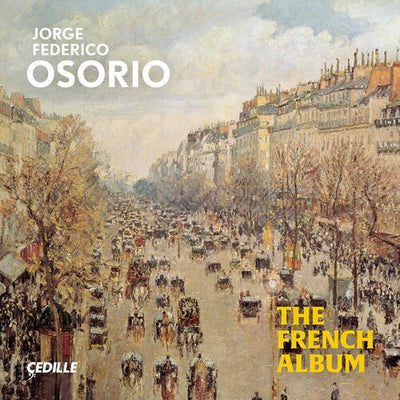
Distinguished international pianist Jorge Federico Osorio brings his flair for French music to works of the Baroque, Romantic, and early 20th century eras by Jean-Philippe Rameau, Emmanuel Chabrier, Gabriel Fauré, Claude Debussy, and Maurice Ravel. Fittingly, Osorio opens The French Album with Fauré’s exquisite Pavane and concludes with the ever-popular Pavane pour une enfante défunte by Fauré’s student, Ravel. The Mexican-born, European-trained pianist offers eight of Debussy’s pictorial Préludes, each with its unique sound world, including the mystical La Cathédrale engloutie, one of the most stunning pieces ever composed for piano. Another audience favorite is Debussy’s evocative Claire de lune from his Suite bergamasque. Providing contrast, Rameau’s whimsical Les Tricotets conjures the back-and-forth motion of knitting needles. A set of Spanish-flavored works include Chabrier’s Cuban-inspired Habanera; Debussy’s lively La Puerta del Vino, depicting sailors carousing and enjoying their wine, and La soirée dans Grenade, where the piano imitates the sound of a guitar; and Ravel’s Alborado del gracioso, brimming with Iberian rhythms.REVIEW:What appears to be a hodgepodge of French pieces actually emerges as a carefully crafted program. Pianist Jorge Federico Osorio begins with Fauré’s famous Pavane, where his elegant phrasing and fluid “walking” tempo assiduously segue into a well-contrasted Debussy group. He brings a strong rhythmic profile and dry-point clarity to works dominated by rapid passagework such as Les collines d’Anacapri, Ce qu’a vu le vent d’Ouest, and Feux d’artifice, as well as Ravel’s Alborada del gracioso.While Osorio certainly embraces the sensual undercurrents in Clair de lune, Voiles, Feuilles mortes, and La cathédrale engloutie, the climaxes have plenty of backbone. The pianist similarly integrates curvaceous lilt and unsentimental grit in Chabrier’s Habanera and Debussy’s habanera-like La Puerta del Vino and La soirée dans Grenade. Three selections from Rameau’s G major Suite stand out for Osorio’s care over ornaments, although his slightly heavy way with the final selection, Ravel’s Pavane, misses the animation and flexibility of the old Gieseking and Casadesus recordings. All told, an enjoyable and well-put-together recital.– ClassicsToday.com (Jed Distler)
Showing Items 81-100 of 207