Johann Gottlieb Graun

Composer

  • Opera Arias (Counter-Tenor): Kowalski, Jochen - GRAUN, C.H.

    Opera Arias (Counter-Tenor): Kowalski, Jochen - GRAUN, C.H.

    Berlin Classics Mar 2004
    1 disc
    CD
    $18.99
    Oehms Classics

    Graun: Der Tod Jesu

    CD · 2 discs

    $31.99
    Composer
    GRAUN, CARL HEINRICH
    Artist
    Arcis Vocalists Of Munich, Gropper
    Released
    Jan 13, 2015
    Carl Heinrich Graun’s “The Death of Jesus” was first performed on 26 March 1755 at Berlin Cathedral. The sister of King Friedrich Wilhelm II, Princess Anna Amalia, provided the impulse for the text and character of the work. Its popularity remained strong until Bach’s St. Matthew Passion supplanted it in the late 19th c., the work succumbing to a lengthy and unjustified obscurity. A passion oratorio in the galant style, this new OehmsClassic recording features the Arcis Vocalists and the Baroque Orchestra L’arpa festante led by Thomas Gropper.
    View full page
  • Graun: Der Tod Jesu

    Graun: Der Tod Jesu

    Oehms Classics Jan 2015
    2 discs
    CD
    $31.99
  • Orchestral Music (German) - Graun, J.G. / Bach, W.F. / Bach,

    Orchestral Music (German) - Graun, J.G. / Bach, W.F. / Bach,

    Berlin Classics Aug 2006
    1 disc
    CD
    $18.99
  • Graun: Montezuma

    Graun: Montezuma

    Capriccio Apr 2011
    2 discs
    CD
    $29.99
    CPO

    Johann Gottlieb Graun, Carl Heinrich Graun: Trios For Violin Or Viola & Clavier

    CD · 1 disc

    $18.99
    Composer
    GRAUN, J.G. GRAUN, C.H.
    Artist
    Les Amis De Philippe
    Released
    Jun 25, 2013


    GRAUN Trios for Violin/Viola and Clavier: in A, GrWV C:XV:90 ; in B?, GrWV A:XV:16 ; in A, GrWV A:XV:13 ; in b, GrWV C:XV:92 • Les Amis de Philippe • CPO 777 633 (68:24)


    One will probably notice in the title that I have not been specific as to which of the prolific Graun brother, Carl Heinrich or Johann Gottlieb, wrote these pieces. To make matters more complex, these works are part of a collection of chamber works found in a Dresden manuscript that has “trios” in the title, but these four works are in reality duo sonatas for either violin or viola and obbligato keyboard, here performed by conductor Ludger Rémy on the fortepiano. In untangling this Gordian knot, one should note that these works were originally trios (hence the retention of the designation), since what one presumes was their original form exists in other sources. As to who wrote them, the situation is even murkier (although there are of course only two possibilities, with a 50-50 chance of being correct), as the styles in these works are reflective of both men. My personal choice would be Johann Gottlieb Graun, based simply upon the fact that he favored the violin and viola in both concertante and solo works, but this is only the most cursory of guesses on my part based upon my own bias, and the third work, the second one in A Major, opens with a long keyboard introduction and a rather more virtuoso violin part that is quite reminiscent of Johann Quantz, and so I might be tempted to assign this one to Carl Heinrich.


    Be all of this as it may, there is no doubt that the music represents solid compositional technique. For the most part, the bulk of the harmony is carried by the keyboard, while the violin (and viola) rarely traverse their ranges with the usual virtuoso leaps and bounds. The composer keeps his violin/viola in a solid middle range, opting for contrast and depth rather than display. Three of the four works are arranged in an old-fashioned order, with a slow movement followed by two faster ones, the last usually some sort of dance tempo derivative. There are emotional depths to be plumbed here, especially in the haunting fragmented theme of the second A-Major Trio, or the long, lyrical lines of the first movement of the B?-Trio. The composer can also be strict, as in the second movement fugue of the B-Minor Trio, which contrasts in its severity with the mysterious lament of the opening movement. There is more than a bit of C. P. E. Bach in the figuration of the third movement of the first A-Major Trio, with its neat vacillation between duplets and triplets in both parts. Both instruments in each trio are used as equal partners, and in the second movement of the first A-Major Trio, as well as the nice parallel thirds in sequence in the second trio in the same key, the sonorities are calculated to match, rather than being contrasting. These are the types of works that any reputable chamber musician of the time would find a delight to play, as players must cooperate intimately to make them work, and at the same time would be pleasing to the ears of their knowledgeable audiences.


    Les amis de Philippe is conductor Ludger Rémy’s group of people whom he gathers around himself to perform such chamber works. Here, he uses violinist Anne Schumann and violist Eva Salonen, both of whom use a similar tone that is fairly rich and dark. This blends nicely with the softer sounds of the fortepiano, a choice made by Rémy that lends these works a slightly more modern (read, Classical era) interpretation. One might suggest that a harpsichord might have been more “authentic,” but I find that the textures speak better with the fortepiano. The original sources, of course, are generic, and there is nothing that would argue against Rémy’s choice. The only bobble I can detect is when Schumann’s violin enters into some of the upper registers; here there is an occasional scratch and squeal, which would probably be unremarkable had not Graun chosen to set most of the music for the violin/viola in the lower and middle portions of their range.


    In short these trio arrangements function quite well on their own, and indeed demonstrate that whichever of the brothers wrote them was quite cognizant of how the music could unfold. These performances too render this disc a good addition to any collection of 18th-century chamber music. The playing is excellent and the musicality of the works shows that they are not just museum reference pieces, but real flesh and blood contributions to the sensitive style of the period. Recommended.


    FANFARE: Bertil van Boer
    View full page
    CPO

    Graun: Grosse Passion / Max, Winter, Andersen, Schafer, Abele, Et Al

    CD · 2 discs

    $36.99
    Composer
    GRAUN, CARL HEINRICH
    Artist
    Winter, Andersen, Schafer, Abele, Max, Rheinische Kantorei, Das Kleine Konzert
    Released
    May 26, 2009


    GRAUN Grosse Passion • Hermann Max, cond; Veronika Winter (sop); Hilke Andersen (mez); Markus Schäfer (ten); Ekkehard Abele (bbar); Das Kleine Konzert; Rheinische Kantorei (period instruments) • cpo 777 452 (2 CDs: 122:28 Text and Translation) Live: Dusseldorf 9/2008


    This is my third exposure to Carl Henrich Graun’s music, the other two being his operas Montezuma (libretto by Friedrich II, King of Prussia) and Cleopatra and Cesare (libretto by Giovanni Gualberto Bottarelli). He is best known for his passion oratorio Der Tod Jesu (1755), which was so popular it rivaled Messiah . Graun wrote two other passions: Ein Lämmlein geht und träght die Schuld and this Grosse Passion that is often referred to by its opening lyric “Kommt her und schaut” (Come here and see). It is a large-scale work: 66 numbers, with some alternatives available, calling for a large chorus and orchestra with the usual quartet of soprano, alto, tenor, bass. Supplementing the recitative-aria combinations are 10 choral numbers, five duets, and one quartet.


    The libretto is somewhat of a rambling affair. Unlike Messiah , there are only a few Biblical quotes; instead, the narrative flow is often interrupted by reflections and even some lyrics that are redundant of previously expressed sentiments. Much of the libretto is over-written doggerel, especially in the early pages. The music, however, is a different matter.


    Graun was in his mid-twenties when he composed this Grand Passion . It is a surprisingly mature work, full of subtle gems. When first listening to this two-CD album, I wrote: “The music is very pleasant. Although it is quite tuneful, little of it is memorable and at two hours tends to wear out its welcome. There is almost a monotonous similarity of one number to the next. It needs something rousing like the ‘Hallelujah’ chorus.” Repeated hearings of this album have increased my appreciation considerably. Even Handel liked this Passion , and quoted some of its music in his own works.


    Graun establishes a musical mood and varies little from it. The music in the Grosse Passion is not as flamboyant as Graun’s operatic work, but careful listening to the Passion reveals a wealth of interesting details, especially in the orchestrations. The textures are very clean and transparent and occasionally command more of the listener’s attention than do the vocal lines. One number (CD 1, track 22, Choral: “Die Lust des Fleisches dämpf in mir”) sounds like a distant cousin to the familiar Doxology, Praise God from whom all blessings flow . Instead of the virtuoso showpieces found in Graun’s operas, the Grosse Passion is very reflective and subdued.


    Conductor Hermann Max and his musical forces deliver a sincere and beautifully sung and played performance. The soloists have attractive voices and pay devout attention to the musical details. If you like this musical genre, you’re likely to find this a lovely recording, performed with sensitivity and expression.


    FANFARE: David L. Kirk
    View full page
    CPO

    Johann Gottlieb Graun, Carl Heinrich Graun: Concerti

    CD · 1 disc

    $18.99
    Composer
    GRAUN, J.G. GRAUN, C.H.
    Artist
    Cappella Academica Frankfurt
    Released
    Mar 29, 2011


    The name Graun is not as well known in musical circles as it should be, nor even as it once was. It was the surname of three talented brothers, all born in Wahrenbrück in east-central Germany and all flourishing in the period between Bach and Beethoven. A church fire destroyed all record of their birth, hence the imprecise dates. The oldest, August Friedrich (1698/9 – 1765) achieved only local distinction, rising to the position of Kantor and organist at the cathedral school of nearby Merseberg, a position he held for the last 36 years of his life.

    His two younger brothers, represented on this disc, achieved much broader fame. Johann Gottlieb, a year or so older than his brother, was engaged in 1726-27 to teach J.S. Bach’s oldest son Wilhelm Friedemann to play the violin. In 1732 he earned a position in the orchestra of the then Prussian Crown Prince Frederick, and rose to the position of director after the prince was crowned King Frederick II in 1740.

    Frederick the Great built the strongest musical centre in all Europe, and the Graun brothers helped him do it. The youngest, Carl Heinrich, a professional singer in the town choir at age 10, was soon writing operas and sacred music. He studied at the University of Leipzig and became a good cellist without ever studying the instrument. But it was as a singer and opera composer that he too caught the ear of Frederick the Great. Graun wrote, and starred in, operas, sometimes to librettos written by the King.

    History has not been kind to the Grauns, as most of their music seems to have been destroyed. Even what’s left is contentious: The manuscript for the third piece on this disc has only the attribution “di Grau..” leading scholars to think it more likely that Christoph Graupner (1683–1770) wrote it. All the works on this disc represent some of the best of the orchestral High Baroque, but that is not what Carl Heinrich Graun was best known for. Besides his operas, he wrote sacred music, notably Der Tod Jesu, a passion oratorio that received annual performances in Germany for 75 years until Mendelssohn conducted Bach’s St. Matthew Passion in 1829. C. H. Graun’s best known composition was supplanted forever.

    I like the variety of selections on this disc. It begins with a Symphony, as tuneful and brief as the symphonies of English contemporary William Boyce. Then follow four concertos for different combinations of instruments all reminiscent of contemporary Telemann. All five pieces have a fast-slow-fast pattern, all feature the gritty sound of baroque strings, and one can hear in each of the slow movements the background of a basso continuo (mislabelled in the notes as a ‘bassoon continuo’).

    The five pieces here are as close as one is likely to get to what was heard at the court of Frederick the Great. The performers are all from the leading Baroque orchestras in and around Germany, notably the Freiburg Baroque Orchestra, Camerata Köln, and Concentus Musicus Wien, and they all teach at the Institute of Historical Interpretation Practice at the College of Music and the Performing Arts in Frankfurt am Main. The work of Karl Kaiser on transverse flute is especially outstanding. The 17 musicians came together in 2006 and have made three recordings. I hope they introduce us to more of the Grauns’ music.

    -- Paul Kennedy, MusicWeb International
    View full page
  • Johann Gottlieb Graun, Carl Heinrich Graun: Concerti

    Johann Gottlieb Graun, Carl Heinrich Graun: Concerti

    CPO Mar 2011
    1 disc
    CD
    $18.99
  • Graun: Weihnachtsoratorium / Gropper
    Oehms Classics

    Graun: Weihnachtsoratorium / Gropper

    CD · 1 disc

    $19.99
    Composer
    GRAUN, CARL HEINRICH
    Artist
    Arcis Vocalisten, Barockorchester L'Arpa Festante, Gropper, Mauch, Eckstein, Poplutz, Nolte, Gropper
    Released
    Oct 06, 2017

    A work caught the attention of musicians during the late 1990s - a Christmas Oratorio by Graun. The only known copy of it was being housed in the Library of Congress in Washington, D.C. But it has so far been impossible to determine either the name of the manuscript copyist or an exact dating of the work and copy. There are many indications that this is a work from the composer's phase prior to his years in Berlin. After The Death of Jesus, Thomas Gropper and his Arcis Vocalists now proudly present the second oratorio of Graun as a recorded production for OehmsClassics. Since their foundation by their chorus director Thomas Gropper in 2005, the Arcis-Vocalists have taken a firm place among the well-known semi-professional choirs of the city in the high-class and diverse Munich music scene due to their sound quality and the special program design. The project choir consists of about 80 committed singers, who mostly have a sound vocal education. Depending on the work it is flexibly occupied and can count between 30 and 80 members.

    View full page
  • Graun: Weihnachtsoratorium / Gropper

    Graun: Weihnachtsoratorium / Gropper

    Oehms Classics Oct 2017
    1 disc
    CD
    $19.99
    CPO

    Graun: Polydorus / Hochman, Barockwerk Hamburg

    CD · 2 discs

    $36.99
    Composer
    GRAUN, CARL HEINRICH
    Artist
    Barockwerk Hamburg, Hochman
    Released
    Sep 04, 2020

    The opera Polydorus penned 289 years ago last found a place in the performance program of the Gänsemarkt Opera in Hamburg in 1735. The libretto by Johann Samuel Müller depicts exchanges of identity, avaricious kings, queens bent on bloodthirsty revenge, and princes who despise their progenitors. The result is a retelling of the Polydorus legend combining Greek mythology and Shakespearean dramatic suspense. Carl Heinrich Graun, one of the best-known opera composers of the eighteenth century, wrote the emotionally moving music. The first performance in modern times by the barockwerk hamburg and the album recording of this opera rarity now being released have once again uncovered this genuinely original work and following the ensemble’s successes in recent years once again guarantee you a very special listening experience.

    View full page
  • Graun: Polydorus / Hochman, Barockwerk Hamburg

    Graun: Polydorus / Hochman, Barockwerk Hamburg

    CPO Sep 2020
    2 discs
    CD
    $36.99
  • Graun: Torna Vincitor / Forsythe, Contadin, Opera Prima Ensemble
    CPO

    Graun: Torna Vincitor / Forsythe, Contadin, Opera Prima Ensemble

    CD · 1 disc

    $18.99
    Composer
    GRAUN, JOHANN GOTTLIEB
    Artist
    Forsythe, Contadin, Opera Prima, Contadin
    Released
    Jan 01, 2021

    Of all the composers who wrote for the gamba during his times, Johann Gottlieb Graun must have been the most diligent one, even though he was not a virtuoso on this instrument. The twenty-seven works by him that are known to us represent significant contributions to the repertoire of the concerto, cantata, and sonata. All three of the works presented here contain grand solo parts for the viola da gamba that prove to be of the highest virtuosity. Graun evidently was interested in putting a virtuoso to the test. And the Italian gambist Cristiano Contadin, the founder of the Opera Prima ensemble, lives up to his reputation (as certified by the Musica magazine and other sources) as a first-class artist whose delightful delineation of tone and flawless style reveal a complete command of his instrument. The two sacred cantatas were composed in the Italian style on the basis of texts by Pietro Metastasio, the most famous librettist and poet of his times. They are sung by the American soprano Amanda Forsythe, who has won admiration especially for her interpretations of Baroque music – and is known from our cpo albums with the Boston Early Music Festival.

    View full page
    Brilliant Classics

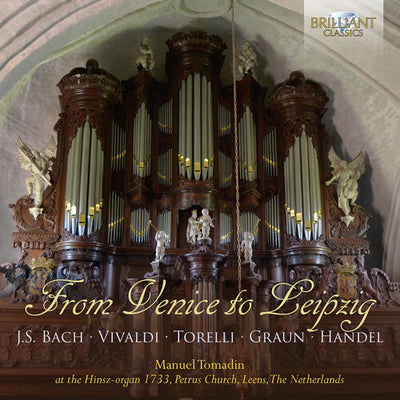
    From Venice to Leipzig - Organ Music / Manuel Tomadin

    CD · 1 disc

    $10.99 $13.99 Save 21%
    Composer
    Johann Sebastian Bach, Johann Gottlieb Graun, Georg Frideric Handel, Giuseppe Torelli, Antonio Vival
    Artist
    Manuel Tomadin
    Released
    Feb 03, 2023

    Whether or not they actually traveled south of the Alps, as Handel did early in his career, all 18th-century German composers of note were influenced by the Italian style of vocal and instrumental writing at the time. Manuel Tomadin’s latest album for Brilliant Classics explores the connections between these apparently disparate traditions, beginning with the Toccata, Adagio and Fugue BWWV564 which stands among the most striking examples of JS Bach’s work during his years as Capellmeister to the ducal court in Weimar (1710-1717). The Italian qualities of the concerto-like nature of the opening Toccata in BWV564 and then the pathos of the Adagio, with its walking bass and Neapolitan harmonies, are underlined by the following transcription made by Bach of a Vivaldi Concerto, the A minor RV522, and then Walther’s transcription of a concerto by Torelli. Just as Bach was later influenced by the violin playing and writing of the virtuoso Pisendel, German-born but widely traveled in Italy, Johann Gottlieb Graun was a pupil of Pisendel’s who had also studied with the prince of Italian violinist-composers, Giuseppe Tartini, and so Tomadin includes a solo-organ concerto of Graun’s which abounds in violinistic figuration. An arrangement of Handel’s opening Sinfonia to his oratorio Esther, another Vivaldi concerto and Bach’s magnificent A minor Prelude and Fugue BWWV543 complete this stimulating program.

    This album is also a valuable record of the historically significant organ in St Peter’s Church in the Dutch town of Leens. Dating from 1733-34, and thus contemporary with the music recorded here, the instrument is the work of the Dutch organ-builder Albertus Anthoni Hinsz. He modelled his designs on the instruments by the Schnitger family who dominated North-German organ-building at the time, and the example in Leens is a superbly preserved and scrupulously restored example of this heritage. The booklet is generously annotated with an essay by Manuel Tomadin exploring the Italian connections between the music on the album, a history of the organ, a full stop-list and a record of the specific registration used for each piece.

    View full page
  • From Venice to Leipzig - Organ Music / Manuel Tomadin
    Sale

    From Venice to Leipzig - Organ Music / Manuel Tomadin

    Brilliant Classics Feb 2023
    1 disc
    CD
    $13.99 $10.99Save 21%
    MDG

    J.S. Bach, Benda, Graun, Telemann & Vivaldi: L'Arte del Virtuoso, Vol. 3

    SACD · 1 disc

    $24.99
    Composer
    Johann Sebastian Bach, Franz Benda, Johann Gottlieb Graun, Georg Philipp Telemann, Antonio Vivaldi
    Artist
    Caterva Musica
    Released
    Jan 26, 2024

    For their 25th anniversary, caterva musica has recorded virtuoso concertos for all instrumental groups in the ensemble. L‘arte del virtuoso (The Art of the Virtuoso) is a four-part series released by MDG. The programme on Vol. 3 includes Franz Benda's dramatic flute concerto, lively chamber music by Telemann, Graun and Vivaldi, as well as a very special rarity: Johann Sebastian Bach's large-scale Sinfonia BWV 1045 with concertante violin.

    View full page
  • Wind Chamber Music

    Wind Chamber Music

    Musicaphon Jul 2025
    1 disc
    CD
    $9.99
    MDG

    L‘arte del Virtuoso, Vol. 1 - Solo Concertos / Caterva Musica

    SACD · 1 disc

    $24.99
    Composer
    Antonio Vivaldi, Johann Melchior Molter, Johann Joachim Quantz, Johann Gottlieb Graun, Nicolo Fioren
    Artist
    Caterva Musica
    Released
    Jan 06, 2023

    And another exciting debut on MDG: Caterva musica has committed itself entirely to early music. What makes it special: Each member is a gifted soloist, but knows how to fit into the accompanying orchestra when needed. Five remarkable solo concertos of the 18th century show once the stupendous virtuosity of the individual, but also but also the harmonically colorfully coordinated ensemble performance of the top-class group.

    It is the otherwise little-noticed instruments that stand out soloistically on this first set: Graun's Viola Concerto presents the viola both cantabile-sonorous and surprisingly virtuosic in the lively final movement; Johann Joachim Quantz's Horn Concerto is scored in the astonishing key of D-sharp major; Molter's Sinfonia gives the timpani, of all things, an almost concertante solo part – above which the trumpets blossom splendidly. The Cello Concerto by the today almost unknown Nicola Fiorenza effectively combines the Neapolitan stile antico with breakneck acrobatics. In doing so, Fiorenza blithely plays with the expectations of the audience, which gets its money's worth, not least with Vivaldi's Concerto for alto recorder with lively trills and fragrant garlands.

    With Caterva musica, all of this comes across as immensely fresh and unspent, and the unbridled joy of music-making is immediately transferred to the listeners. The natural recording technique has its share in this: unfiltered and if necessary in 3D - so this baroque bouquet of flowers is delivered as a sounding business card with unclouded listening pleasure!

    View full page
  • A Gift for your Garden
    BIS

    A Gift for your Garden

    SACD with CD · 1 disc

    $21.99
    Composer
    Johann Gottlieb Graun, George Frideric Handel, James Oswald, Georg Philipp Telemann
    Artist
    Ensemble Hesperi
    Released
    Jan 03, 2025
    Countless wealthy people in eighteenth-century Europe developed a passion for botany. This passion went far beyond the simple pleasure of gardens, reflecting rather a growing fascination with the natural world. German composer Georg Philipp Telemann shared this passion and energetically cultivated his collection, often begging friends and correspondents to send him specimens. The creative landscape of Telemann's life was undoubtedly filled with floral and musical colour. Ensemble Hesperi, a period ensemble based in London, presents a programme that celebrates Telemann's botanical passion. His published correspondence shows that he often wrote to his musician friends abroad, asking them to send him plant specimens. Among these friends were George Frideric Handel and Johann Gottlieb Graun, each of whom is represented here by a trio sonata, and there is also music by Telemann himself: one of his difficult 'Paris Quartets', a raucous sonata in G minor and a haunting fantasia for solo recorder. In a letter to a friend, Telemann spoke of his passion for hyacinths, tulips, ranunculi 'and especially for anemones'. The composer of four instrumental collections containing floral musical miniatures, James Oswald had to be part of this programme, and so we are treated to 'The Hyacinth', 'The Anemone' and 'The Tulip' from his 'Airs for the Spring'.
    View full page
  • A Gift for your Garden

    A Gift for your Garden

    BIS Jan 2025
    1 disc
    SACD with CD
    $21.99
    CPO

    C.P.E. Bach & Graun: Viola Concertos

    CD · 1 disc

    $18.99
    Composer
    Carl Philipp Emanuel Bach, Johann Gottlieb Graun
    Artist
    Mathis Rochat, Stephen Waarts, Christine Theus, Camerata Schweiz
    Released
    Apr 05, 2024

    For some time, writes viola virtuoso Mathis Rochat in the preface of this new release, he had been thinking to adapt Carl Philipp Emanuel Bach's Cello Concerto in B-flat Major for his own use. He calls it a "somewhat audacious transcription", but the range of the solo part is well-suited for the viola and can be performed on the instrument with great ease. Which had to be proven first! Indeed, the young Swiss artist lends the "higher-pitched" composition a power of momentum and elasticity from which the already supple, melodious music can only benefit. All the more, since it is a superb "overture" to both of the following works, which Johann Gottlieb Graun, eleven years Bach's senior, had intended for the viola. Sometimes flanked by its little sister, as in the quiet Sturm und Drang C Minor concerto, then alone in sole competition with the string orchestra, this under-appreciated instrument shows in the music of the Berlin Court a wealth of expression that need not hide behind its higher and lower rivals.

    View full page
  • C.P.E. Bach & Graun: Viola Concertos

    C.P.E. Bach & Graun: Viola Concertos

    CPO Apr 2024
    1 disc
    CD
    $18.99
  • Der letzte Mund voll Susse - Weltliche Kantaten und Instrume
    Coviello

    Der letzte Mund voll Susse - Weltliche Kantaten und Instrume

    CD · 1 disc

    $19.99
    Composer
    Carl Heinrich Graun, Johann Gottlieb Graun
    Artist
    Der Musikalische Garten, Isabel Schicketanz
    Released
    Apr 17, 2026
    'A central concern of the ensemble Der Musikalische Garten has always been to bring musical rarities to light and, in particular, to make previously unknown works accessible to a wide audience. With their new album Der letzte Mund voll Süße, the musicians are continuing this endeavour in an impressive way: the album features no fewer than four World Premiere Recordings and provides fascinating insights into the expressive diversity of the 18th century. The album opens with a previously undiscovered overture by Johann Gottlieb Graun, which can be heard here for the first time on disc. At the centre of the recording, however, are three secular cantatas by his brother Carl Heinrich Graun. While some cantatas are reminiscent of the high baroque operatic style of Vivaldi or Handel with their virtuosity and emotionally charged melodies, the cantata 'Hat die Schönheit kein Erbarmen' presents itself as an intimate chamber music reflection on the suffering of love. It's melancholy mood is taken up in the following trio sonata and developed to a dramatic conclusion. Soprano Isabel Schicketanz impresses in the vocal works with her tonal presence, technical brilliance and sensitive text organisation, her interpretation lends depth and vibrancy to the emotionally charged cantatas. Der Musikalische Garten supports this liveliness with it's orchestral sound, which it achieves with enthusiasm and esprit despite it's small instrumentation, in this way, the ensemble achieves a realisation that is both nuanced and energetic - an exciting rediscovery of two important 18th century composers that makes you sit up and take notice.
    View full page
  • Graun: Christmas Oratorio / Max, Schmithüsen, Et Al

    Graun: Christmas Oratorio / Max, Schmithüsen, Et Al

    CPO Jan 1999
    1 disc
    CD
    $18.99