One-Day Sale | November 11th, 2026

One-Day Sale | November 11th, 2026

Get a head start on your holiday shopping with our One-Day Sale! For a very limited time, explore over 400 titles at 50% OFF, featuring an extensive selection of DVDs and Blu-rays, alongside vinyl favorites and an impressive collection of CDs from renowned labels including Chandos, BIS, Sony Masterworks, Brilliant Classics, and more!

Whether you're searching for the perfect gift for a music lover or adding something special to your own collection, now is the perfect time to discover extraordinary music at half the price.

Hurry! This sale ends Thursday, November 12, at 9:00 AM CT. Don't miss your chance to shop these incredible savings before they're gone!

Shop Now & Save 50%!

    C Major Entertainment

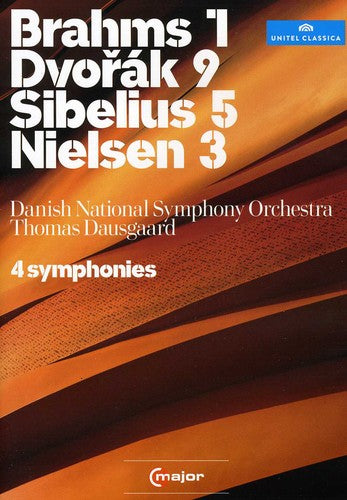
    4 Symphonies - Brahms, Dvorak, Sibelius, Nielsen / Dausgaard, Danish National Symphony Orchestra

    DVD · 2 discs

    $16.49 $32.99 Save 50%
    Composer
    BRAHMS DVORAK SIBELIUS NIEL
    Artist
    Dausgaard
    Released
    Jun 26, 2012


    4 SYMPHONIES • Thomas Dausgaard, cond; Danish Natl SO • C MAJOR 710508 (DVD: 168:00) Live: Copenhagen 2009

    BRAHMS Symphony No. 1. DVO?ÁK Symphony No. 9. SIBELIUS Symphony No. 5. NIELSEN Symphony No. 3

    If, as I did, you were to begin your examination of this release with disc 1, track 1 (the Brahms symphony), you might well conclude that there was little need to continue. There is something rather too cool and casual about Dausgaard’s interpretation of this powerful music. It lacks inner tension. There is not enough contrast between ideas. Accents are in the wrong places. Short notes are cheated of their value. And that’s not all. The second movement just plods on, the third is charmless, the fourth frantic and lurches from one tempo change to the next. Listening to the complete symphony several times could not induce me to alter my initial unfavorable observations. Adding visual insult to aural injury, sight and sound are not synchronized, and the difference between the two is disturbing, to put it mildly.

    But then came the Nielsen symphony. What a difference! Right from the opening moments it had all the vigor and élan and determination lacking in the Brahms. Rhythms were tight and crisp. The music bristled with enthusiasm and commitment. The finale positively beamed with Elgarian nobility and breadth, rising to an absolutely thrilling climax. What a joy! Nielsen’s Third had hitherto never been one of my favorite symphonies, but Dausgaard nearly made it so in this performance.

    Does Dausgaard work his magic on the two remaining works as well? The answer, I’m glad to say, is yes. Furthermore, the synchronization problem that affected the Brahms symphony is only minimal in the Nielsen and nonexistent in Dvo?ák and Sibelius. The “New World” Symphony receives one of the finest performances I have heard. Dausgaard’s approach is no romantic wallow but rather a clean, purposeful traversal filled with taut rhythms, precise attacks and releases, glowing sound, and architectural strength. Dausgaard likewise makes a strong case for the Sibelius Fifth, never allowing momentum to sag, carefully propelling the music forward with masterly control. I am particularly impressed with the ease in which he handles the tempo change for the second part of the first movement. By the time the grand climax of the finale arrives, one feels a great journey has been completed.

    All four performances were recorded live in Copenhagen’s Koncerthuset in 2009. The personnel changes from symphony to symphony, but both principal horns, both principal trumpets, and both timpanists are star players. Generally the woodwinds are excellent, but violins seem a bit thin for an orchestra that is otherwise so assured and well balanced. However, the basses make up for this deficiency with their huge, rich sound, heard at its best at the quiet endings of three of the Brahms movements and in some of the more powerful moments of the Dvo?ák symphony. Aside from the basses, the orchestra plays with a bright sound, textures are clear and clean, balances are well controlled.

    The camerawork is devoted about 20 percent of the time to Dausgaard and his facial contortions, 10 percent to views of the full orchestra from afar, and 70 percent to the business of jerking the viewer’s eyes from one instrumental close-up to another—two seconds of a horn player’s embouchure, a second of flute keys, two notes from the timpani, etc. Who determined that this is what we want to see? I find it annoying to the point where I simply can’t bear to watch.

    On ArkivMusic the price for these four symphonies is $27 ($40 for the Blu-ray version)—just under $7 a symphony, a good buy even without the inferior Brahms symphony, especially for performances as fine as the other three.

    FANFARE: Robert Markow
    View full page
  • 4 Symphonies - Brahms, Dvorak, Sibelius, Nielsen / Dausgaard, Danish National Symphony Orchestra
    Sale

    4 Symphonies - Brahms, Dvorak, Sibelius, Nielsen / Dausgaard, Danish National Symphony Orchestra

    C Major Entertainment Jun 2012
    2 discs
    DVD
    $32.99 $16.49Save 50%
    C Major Entertainment

    Salzburg Festival 2011 Opening Concert

    DVD · 1 disc

    $13.49 $26.99 Save 50%
    Composer
    BERG MAHLER
    Artist
    Boulez, Roeschmann, Prohaska, Larsson, Botha, Wiener Philharmoniker
    Released
    Jun 26, 2012
    The opening concert of the Salzburg Festival, for many regarded as the world's most renowned music festival, is by tradition a high-profile event and the 2011 gala presented here was one of the best in memory. Pierre Boulez, the "grand seigneur of subtle minimalism and exquisitely beguiling sounds" (Der Standard), assembled a cast of tremendous distinction to join the Vienna Philharmonic for this prestigious concert, conceived as a tribute to Gustav Mahler: Dorothea Roschmann, Anna Larsson, Johan Botha and rising star Anna Prohaska. After two works by Mahler's pupil Alban Berg, featuring Roschmann and Prohaska, the main event of the concert if Mahler's large-scale cantata Das klagende Lied - a "great spectral opera for the mind's eye" (Vienna Zeitung).
    View full page
  • Salzburg Festival 2011 Opening Concert
    Sale

    Salzburg Festival 2011 Opening Concert

    C Major Entertainment Jun 2012
    1 disc
    DVD
    $26.99 $13.49Save 50%
    Chandos

    Chopin: Piano Works, Vol. 2 / Lortie

    CD · 1 disc

    $10.99 $21.99 Save 50%
    Composer
    CHOPIN, FREDERIC
    Artist
    Louis Lortie
    Released
    Mar 27, 2012
    Chandos presents Volume 2 in its series of solo piano works by Chopin, played by the French-Canadian pianist Louis Lortie. Recording exclusively for Chandos, Lortie is recognized as one of the finest interpreters of Chopin today. He first recorded Chopin's Etudes for Chandos more than twenty years ago; the disc was named as one of the '50 great performances by superlative pianists' by BBC Music.

    Volume 1 of his current Chopin series also has received excellent reviews: the magazine Pianist wrote, “He is a pianist of our time when it comes to speed, energy and an unfussy approach to Chopin. His way of playing is like a sharply cut steel sculpture, super elegant and with not one single smudge.” And in the words of International Piano: “These are full-blooded and eloquent performances, an auspicious start to what looks likely to become one of the finest of Chopin surveys.”
    View full page
  • Chopin: Piano Works, Vol. 2 / Lortie
    Sale

    Chopin: Piano Works, Vol. 2 / Lortie

    Chandos Mar 2012
    1 disc
    CD
    $21.99 $10.99Save 50%
    Chandos

    Buxtehude: VII Suonate Op 2 / Purcell Quartet

    CD · 1 disc

    $10.99 $21.99 Save 50%
    Composer
    BUXTEHUDE, DIETRICH
    Artist
    URCELL QUARTET
    Released
    Mar 27, 2012

    By the end of his life, the fame of Dietrich Buxtehude as an organist was so great that in 1706 the young J.S. Bach took four weeks' leave from his employment at Arnstadt and travelled on foot over 200 miles to Lübeck to hear him perform in concert. Ironically, the meteoric rise of the career of Bach himself as a composer meant that, until very recently, Buxtehude was primarily known simply as a forerunner to the great man, when in fact he was a major composer in his own right. These Trio Sonatas for violin, viola da gamba, and harpsichord are remarkable examples of Buxtehude's beautiful chamber music, and anyone expecting them to follow a set of pre-established procedures will be surprised. Inventive and full of life, each of the sonatas is different from the others, ranging from dance-like pieces and little fugues to variation sets with some dynamic duets between the violin and viola da gamba, and slow, airy pieces too. The recording complements CHAN 0766 (Trio Sonatas, Op. 1) of which Early Music Today wrote: 'The Purcell Quartet brings its customary virtues to these perceptive period-instrument interpretations: incisiveness, tonal transparency and excellent rapport and blend.' Through twenty-nine years and nearly fifty recordings of a huge range of repertoire, The Purcell Quartet has established itself as a leader in the area of baroque chamber music, not shrinking away from taking on fully staged productions of Purcell'sDido and Aeneas and Monteverdi's L'incoronazione di Poppea and Orfeo. The Quartet has toured the world, including the USA, Chile, Bolivia, Colombia, Peru, Japan, Turkey, and all the countries of Europe, and collaborated with the very finest singers, among them Susan Gritton, Nancy Argenta, Catherine Bott, Emma Kirkby, Julia Gooding, Michael Chance, Dominique Visse, Guy de Mey, Mark Padmore, Charles Daniels, Peter Harvey, and Richard Wistreich. The Purcell Quartet has recorded exclusively for Chandos Records since 1987, its discography now numbering more than forty discs.

    View full page
  • Buxtehude: VII Suonate Op 2 / Purcell Quartet
    Sale

    Buxtehude: VII Suonate Op 2 / Purcell Quartet

    Chandos Mar 2012
    1 disc
    CD
    $21.99 $10.99Save 50%
    Naxos AudioVisual

    Gershwin: Concerto In F, Rhapsody No 2, I Got Rhythm Variations / Orion Weiss [blu-ray Audio]

    Blu-Ray · 1 disc

    $8.49 $16.99 Save 50%
    Composer
    GERSHWIN, GEORGE
    Artist
    Weiss, Falletta
    Released
    Feb 28, 2012
    This is an audio-only (i.e., with no video content) Blu-ray disc playable only on Blu-ray players.

    Also available on standard CD

    George Gershwin’s Concerto in F was a response to demands for a ‘proper concerto’ after the success of Rhapsody in Blue, avoiding programmatic content while providing a feast of tunes both uplifting and nostalgic. Originally intended as music for a film, his up-beat Rhapsody No 2 describes the bustling Manhattan cityscape while under construction. Sourced from his hit musical Girl Crazy, I Got Rhythm Variations was Gershwin’s last full score. Pianist Orion Weiss is one of the most sought-after soloists and collaborators of his generation of young American musicians.
    View full page
  • Gershwin: Concerto In F, Rhapsody No 2, I Got Rhythm Variations / Orion Weiss [blu-ray Audio]
    Sale

    Gershwin: Concerto In F, Rhapsody No 2, I Got Rhythm Variations / Orion Weiss [blu-ray Audio]

    Naxos AudioVisual Feb 2012
    1 disc
    Blu-Ray
    $16.99 $8.49Save 50%
    Naxos AudioVisual

    France - A Musical Tour Of The South Of France

    DVD · 1 disc

    $6.99 $13.99 Save 50%
    Composer
    DEBUSSY SATIE RAVEL
    Artist
    Brussels, Rahbari
    Released
    Jan 31, 2012
    FRANCE: A Musical Tour of the South of France

    The Places
    The tour opens with views of the Camargue, the marshy region near Arles with its wild life. Views of the Côte d’Azur are intercut with glimpses of the Munich Glyptothek with its collections of Roman and Greek statuary. Near Arles is the ancient Abbey of Montmajour and the fortified monastery and Abbey on Saint-Honorat, one of the Iles de Lérins. In Arles we see the Roman theatre and necropolis and, at Saint-Rémy-de-Provence, the remains of the ancient Gallo-Greek town of Glanum.

    The Music
    Music for the tour includes Debussy’s evocative Prélude à l’après-midi d’un faune, two Gymnopédies by Erik Satie and Ravel’s two suites from his ballet Daphnis et Chloé, followed by his Introduction and Allegro for Harp, Flute, Clarinet and String Quartet.

    Picture format: NTSC 4:3
    Sound format: PCM Stereo / Dolby Digital 5.1 / DTS 5.1
    Region code: 0 (worldwide)
    Running time: 57 mins
    No. of DVDs: 1
    View full page
  • France - A Musical Tour Of The South Of France
    Sale

    France - A Musical Tour Of The South Of France

    Naxos AudioVisual Jan 2012
    1 disc
    DVD
    $13.99 $6.99Save 50%
    Naxos AudioVisual

    Czech Republic - Castles And Towns In Bohemia And Moravia

    DVD · 1 disc

    $6.99 $13.99 Save 50%
    Composer
    MOZART, W.A.
    Artist
    ?Tevove, Capella Istropolitana, Kopelman
    Released
    Jan 31, 2012
    The Places
    The visit to the Czech Republic starts with Hluboká Castle, a massive building that for over three hundred years belonged to the Schwarzenberg family. The present building is modelled in part on England's Windsor Castle. Other sites visited include Konopiště Castle, the picturesque town of Telč, and Vranov Castle.

    The Music
    Music for the visit is by Mozart and consists of his four Horn Concertos, written during the last decade of his life, when he was in Vienna. They were intended for his old Salzburg friend Ignaz Leutgeb, who had also settled in Vienna, prudently married there, and, in tandem with his musical activities, had become the owner of a small cheese-shop. The concertos, one of them unfinished at the time of Mozart's death, represent his work at its height.

    Picture format: NTSC 4:3
    Sound format: PCM Stereo / Dolby Digital 5.1 / DTS 5.1
    Region code: 0 (worldwide)
    Running time: 53 mins
    No. of DVDs: 1
    View full page
  • Czech Republic - Castles And Towns In Bohemia And Moravia
    Sale

    Czech Republic - Castles And Towns In Bohemia And Moravia

    Naxos AudioVisual Jan 2012
    1 disc
    DVD
    $13.99 $6.99Save 50%
    Naxos AudioVisual

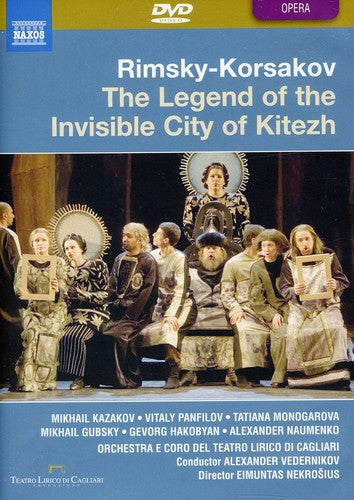
    Rimsky-korsakov: Legend Of The Invisible City Of Kitezh / Vedernikov, Kazakov, Panfilov

    DVD · 2 discs

    $18.99 $37.99 Save 50%
    Composer
    RIMSKY-KORSAKOV, NIKOLAY ANDRE
    Artist
    Vedernikov, Kazakov, Panfilov, Monogarova, Gubsky, H
    Released
    Dec 13, 2011


    RIMSKY-KORSAKOV The Legend of the Invisible City of Kitezh and the Maiden Fevronya • Vitaly Panfilov ( Prince Vsevolod ); Tatiana Monogarova ( Fevronya ); Mikhail Gubsky ( Grishka Kuterma ); Mikhail Kazakov ( Prince Yury ); Gevorg Hakobyan ( Fyodor Poyarok ); Marika Gulordava ( Page ); Valery Gilmanov ( Bedyay ); Alexander Naumenko ( Burunday ); Alexander Vedernikov, cond; Cagliari Th O & Ch • NAXOS 2.110277/78 (2 DVDs: 187:28) Live: Cagliari 5/2–4/2008


    I wanted to see this video because, for many years, I’ve heard exorbitant praise from certain critics regarding Kitezh , yet in listening to the commercial recording conducted by Valery Gergiev I felt let down. The music seemed to me flat and characterless, lacking drama, development, and momentum. Surely, I said to myself, a good stage production would change my mind, as it did with Mussorgsky’s Khovanschina.


    Yet opinions on The Invisible City of Kitezh (to abbreviate its title) are divided. Although many critics wax ecstatic over Rimsky-Korsakov’s magnificent orchestration for this work, few outside Russia are very impressed by the opera as a whole. It is an overlong, derivative grand opera in which two old tales of magic were welded together by librettist Vladimir Belsky, and finally presented intact in 1908. Even the first Russian audiences didn’t care much for it, finding it very old-fashioned in concept and musical style as well as overly rambling, though it is still periodically revived, mostly within Russia.


    This production gives us a rare glimpse of the opera as performed in Italy. The audience reaction is not enthusiastic; on the contrary, when the applause comes at the ends of acts, it sounds like perhaps 80 to 100 people half-heartedly clapping.


    One glance at the production tells you why. Although it is not Regietheater —the characters are, thankfully, clad in traditional-looking costumes—Eimuntas Nekro?ius’s idiotic staging has too much symbolism and too little that resembles reality. The first act, set in the “woods,” presents a stage littered with “wooden” structures, bird houses and the like. Get it? Woods. The presentation of Little Kitezh, where the maiden Fevronya is to marry Prince Vsevolod, is cluttered with giant, tinfoil-covered bell-like objects with people popping out of their tops. Get it? Bells. This kind of idiocy continues throughout a production of a work in which the music itself is also static and rarely wedded to the text. In act IV, scene 1, where Fevronya and Grishka are supposed to be wandering in the woods, what you see is a plain blue-tiled floor with two Erector-set structures in the background. Apparently, Nekro?ius ran out of birdhouses, but not to despair! When Grishka runs off into the woods and Fevronya is left alone, two giant, hideous bird creatures sneak out of the woods and behind her as she sleeps. Perhaps Nekro?ius has seen too many of the Alien movies. In the final scene, supposed to represent Kitezh triumphant, the stage is filled with objects that look like rocket silos.


    Musically, many passages sound like leavings from Boris Godunov, and not good leavings at that, so even when the singers are excellent the plot crawls along. It is an opera more about characters who stand there and sing than about characters creating a musical drama. Compare, for instance, the first act to the similar situation in Verdi’s Don Carlo. A prince meets a beautiful woman in the woods, and they fall in love. Verdi miraculously manages to wed lovely music, some of it even memorable, to a flexible musical structure in which the orchestra comments on or moves the action. Rimsky-Korsakov creates a static structure wedded to pretty but undistinguished melodies that just toodle along, and do so for half an hour.


    Moreover, the plot is remarkably dismal and depressing for a magic or fairy-tale opera. Everyone sings about death even before the Tartars invade Russia, and several characters die except Fevronya and the seedy drunkard Grishka Kuterma, who becomes a traitor, willing to turn Kitezh over to invading Tartars and finger Fevronya as the snitch just to save his own worthless hide. Prince Vsevolod goes off to battle for Kitezh, not to win it but to die in it. (I’m guessing he flunked military school.) He does so, but returns in the second half of act IV as a ghost, and at the end of the opera Fevronya marries the ghost. And you talk about overlong … each of the first two acts runs over a half hour, but each of the last two acts runs more than an hour apiece.


    Getting to the performance, Tatiana Monogarova is simply magnificent as Fevronya, not only vocally but histrionically, which is important because this is a rare Russian opera in that the soprano dominates everything. Here is a woman who fully understands how to inhabit a role. You come to believe wholeheartedly in her character within the first five minutes she is onstage, and she holds you in her thrall to the end. As for her voice, it is a remarkably rich lyric soprano, close to spinto in power, exactly the kind of voice Rimsky wanted for this part. Her midrange, in fact, reminds me strongly of Mirella Freni at her best, only with more power. The top range is not as lovely as Freni’s, but it has its own interesting luster and more metal. Monogarova made her American debut as Lisa in Pique Dame in Houston in 2010, and also began singing Cio-Cio-San around the same time in Europe. She is signed with IMG, and I really do wish her well in what I hope will be a major career.


    Vitaly Panfilov, as Prince Vsevolod, is neither an interesting actor nor a particularly fine singer. The voice is fluttery, dry, and percussive. He sings on pitch and phrases well, but that is all one can say of him. His stage presence registers somewhere between nil and mediocre. On the other hand, Mikhail Gubsky as the nefarious Grishka Kuterma is a superb stage actor, though his voice is strictly that of a good comprimario. Nevertheless, the world needs good comprimarios, and he is certainly one of them. His pathetic wheedling is completely believable.


    A word of praise is also due Marika Gulordava in the somewhat thankless role of the Page. The Page is analogous to Cassandra in Les Troyens or the Simpleton in Boris, someone who warns of danger to come. Though her role is important it is not as long as either of the other two, yet Gulordava is simply stunning in her one big scene. Her voice is not as beautiful as Monogarova’s, but it has a laser-beam focus with a bright, perhaps over-brilliant top. As a musician and singing actress she is first-rate. I also hope for her to have a good career. Mikhail Kazakov, singing the role of Vesvolod’s father, Prince Yury, has a nice voice but an uneven flutter and a constricted low range, a real detriment for a Russian bass.


    Alexander Vedernikov is a fine conductor who obviously loves and understands this music. He brings out all of the wonderful orchestral subtleties of the score and moves the opera about as well as can be expected under the circumstances. Indeed, his conducting here is finer for this particular work than Gergiev’s.


    My copy of the DVD may have been defective, but all through the first two acts the video is out of synch with the audio, as if one were watching something in which the video was on a two-second tape delay. On the second DVD, most of it is in synch, yet there are still strange moments when the picture freezes for a couple of seconds, only to jump ahead and eventually catch up with the audio.


    Thus there are good and bad points to be taken into consideration in approaching both the work and the performance, but if you are fond of Kitezh I would recommend this for the excellent acting of a handful of participants and the excellent singing of the two sopranos.


    FANFARE: Lynn René Bayley


    -------

    THE LEGEND OF THE INVISIBLE CITY OF KITEZH AND THE MAIDEN FEVRONYA

    Opera in 4 Acts. Sung in Russian
    Libretto by Vladimir I. Belsky

    Prince Yuri Vsevolodovich – Mikhail Kazakov
    Hereditary prince Vsevolod Yuryevich – Vitaly Panfilov
    Fevronya – Tatiana Monogarova
    Grishka Kuterma – Mikhail Gubsky
    Fyodor Poyarok – Gevorg Hakobyan
    Page – Marika Gulordava
    Two notables – Gianluca Floris, Marek Kalbus
    Bedyay – Valery Gilmanov
    Burunday – Alexander Naumenko

    Orchestra e Coro del Teatro Lirico di Cagliari
    (chorus master: Fulvio Fogliazza)
    Alexander Vedernikov, conductor

    Eimuntas Nekrošius, stage director
    Marius Nekrošius, set designer
    Nadezhda Gultiayeva, costume designer
    Audrius Jankauskas, lighting designer

    Recorded live from the Teatro Lirico di Cagliari, Sardinia, 2 and 4 May 2008

    Picture format: NTSC 16:9
    Sound format: PCM Stereo / Dolby Digital 5.0 / DTS 5.0
    Region code: 0 (worldwide)
    Subtitles: English
    Running time: 187 mins
    No. of DVDs: 2 (DVD 5 + DVD 9)
    View full page
  • Rimsky-korsakov: Legend Of The Invisible City Of Kitezh / Vedernikov, Kazakov, Panfilov
    Sale

    Rimsky-korsakov: Legend Of The Invisible City Of Kitezh / Vedernikov, Kazakov, Panfilov

    Naxos AudioVisual Dec 2011
    2 discs
    DVD
    $37.99 $18.99Save 50%
  • Mendelssohn: Works for Cello and Piano
    Sale

    Mendelssohn: Works for Cello and Piano

    Chandos Nov 2011
    1 disc
    CD
    $21.99 $10.99Save 50%
    C Major Entertainment

    Thielemann Conducts Faust - Liszt, Wagner

    DVD · 1 disc

    $13.49 $26.99 Save 50%
    Composer
    WAGNER LISZT
    Artist
    Thielemann, Wottrich, Sachsischer Staatsopernchor Dresden, Staatskapelle Dresden
    Released
    Oct 25, 2011
    Also available on Blu-ray

    THIELEMANN CONDUCTS FAUST

    Richard Wagner: A Faust Overture

    Franz Liszt: A Faust Symphony, S108/R425
    Endrik Wottrich, tenor
    Dresden State Opera Chorus
    Dresden Staatskapelle
    Christian Thielemann, conductor

    Recorded live from the Semperoper Dresden, 2011.

    Picture format: NTSC 16:9
    Sound format: PCM Stereo / DTS 5.1
    Region code: 0 (worldwide)
    Subtitles: German, English, French, Spanish, Korean, Chinese, Japanese
    Running time: 90 mins
    No. of DVDs: 1

    R E V I E W:

    3542380.az_LISZT_Faust_Symphony_WAGNER.html

    LISZT A Faust Symphony. WAGNER A Faust Overture • Christian Thielemann, cond; Endrik Wottrich (ten); Dresden St Op Ch; Staatskapelle Dresden • C MAJOR 707708 (DVD: 90:00) Live: Semperoper, Dresden 02/21–22/2011


    Now here’s a good release, entering an uncluttered field with repertoire that coincides neatly with an anniversary and that fits its performers like a glove. Where I recently argued that Christian Thielemann just about makes a (flawed) case for himself in the congested world of Beethoven symphonies, his credentials for Wagner and Liszt are far less controversial. A retro knight of big-boned, smoothly contoured orchestral playing, he is here heard to great effect in repertoire that is shamefully underrepresented. I also cannot fault the pairing of a young Wagner’s aborted attempt at a symphony with Liszt’s epic achievement on the same subject. Before Cosima, what linked Wagner and Liszt were their respective attempts to set Goethe’s Faust to music. Wagner intended this, written during his Paris years, to be merely the first movement of a Faust symphony, before Der fliegende Holländer and his Saxony post got in the way. So it remained an overture, and it was Liszt who would carry on some of Wagner’s initial intentions, such as a second movement based on the character of Gretchen. Liszt himself conducted Wagner’s piece in 1852, but despite a final revision in 1855 (the version given here) and a sketch for Gretchen’s theme, Wagner’s “symphony” remains a tantalizing what-if, giving clearance for the older composer to work on his vast set of Faustian character portraits. As Tobias Niederschlag’s admirable notes point out, Lizst’s late addition of tenor and chorus (always a bit of an afterthought in my view) to his tonal portraits can be seen as a nod to Beethoven’s Ninth, a sign of the massive ambition on display.


    Given its fractious birth, Wagner’s A Faust Overture tends, not surprisingly, to be dismissed as a rather nothingy, juvenile work, but Thielemann and the Dresdeners really do make a fine case for it. Despite the full string textures and grandly played climaxes, Thielemann wisely doesn’t linger or pull things about for effect, as he sometimes does, and the Dresdeners’ dark, burnished sound helps underline the familiar traits of mature Wagner, without preventing it from being an intense, nimble account of a work that deserves to be better known. Yes, there are hangovers of Weber in the tuttis, and obvious foreshadows of the Holländer overture, but also there is a germ of Wagner’s later epic arches of texture and melodic development. The dying chords of Tristan und Isolde , for instance, can surely be heard in the finals bars of this piece.


    With those mournful broken woodwind phrases in the “Nostalgia” opening, Wagner must have had Liszt’s symphony at the back of his mind during Tristan’s development. Although grotesque humor doesn’t feature in Wagner’s opera, both pieces share that introverted sense of Weltschmerz that naturally brings out the best from Thielemann. Faust’s feverish obsession is brilliantly conveyed in the frenzied string writing, but Thielemann doesn’t let the symphony as a whole become the empty showpiece that some of Liszt’s vast tapestries can become. The second movement (Gretchen) is, likewise, very well controlled, with the love theme played with sincerity, but no less heartfelt than many more drawn-out versions, and with much exquisite solo playing from the orchestra.


    I still have the occasional feeling of extreme control-freakery, as on Thielemann’s recent Beethoven, but here his quirks and homogenized sound fit the repertoire brilliantly, and although as typically plush and molded an experience as I had predicted from this team, this DVD confounds a lot of my prejudices about him. Most surprising is how swift Thielemann is, with the Liszt falling roughly between young (Sony audio) and old (Euroarts DVD) Leonard Bernstein in basic length, and similar in scale to Barenboim’s audio version. Likewise I wouldn’t have predicted how well Thielemann creates a sense of fun on the podium; the ironisch comes out well in the opening of the grotesque Mesphisto episode, spritely in tone, in complete contrast to the opening two sections. I would almost say light and fleet-footed, but after some comparison with 1960s Bernstein, or a terrific YouTube clip of Dmitri Mitropoulos rehearsing the same section, Thielemann cannot yield all of his steeliness. Choral singing is excellent, although I can think of more alluring sounds than the rather pinched, clunky tones of tenor Endrik Wottrich, in rather tense form here. DVD competition is scarce, but Kenneth Riegel on Leonard Bernstein’s 1976 Boston DVD is better. For true vocal allure, if weird German, Plácido Domingo on Barenboim’s Warner CD is the obvious choice.


    I do wish concert DVDs would come with the option of having an mp3 of the audio only. I, for one, would love the Wagner overture on my iPod. But C Major’s presentation is still very fine, with good booklet notes and logical DVD menuing. Pity that there are no extras (Thielemann’s Beethoven symphonies on the same label came with a 60-minute discussion of each work), but camerawork is unobtrusive and the sound is very clear and balanced, possibly at times allowing that Dresden acoustic to give quieter moments a rather cold demeanor. Perhaps, because of that last point, I find myself preferring the Bernstein DVD, boisterous and all-embracing despite much slower tempi throughout. But it is not a clear victory, especially considering modern picture, sound, and so fine a Faust Overture performance as a filler. So, yes, unlikely readers who only want one version: Get the Thielemann.


    FANFARE: Barnaby Rayfield
    View full page
  • Thielemann Conducts Faust - Liszt, Wagner
    Sale

    Thielemann Conducts Faust - Liszt, Wagner

    C Major Entertainment Oct 2011
    1 disc
    DVD
    $26.99 $13.49Save 50%
    C Major Entertainment

    Giordano: Andrea Chénier

    DVD · 1 disc

    $13.49 $26.99 Save 50%
    Composer
    GIORDANO, UMBERTO
    Artist
    Sandoval, Fantini, Hendricks, Kross, Plowright, Schirmer, Wiener Symphoniker, Bregenz Festival Choru
    Released
    Oct 25, 2011
    Hector Sandoval, Norma Fantini, Scott Hendricks, Tania Kross, and Rosalind Plowright star in this production of the Giordano opera performed by the Vienna Symphony, Bregenz Festival Chorus, and Prague Philharmonic Choir conducted by Ulf Schirmer.
    View full page
  • Giordano: Andrea Chénier
    Sale

    Giordano: Andrea Chénier

    C Major Entertainment Oct 2011
    1 disc
    DVD
    $26.99 $13.49Save 50%
    Naxos AudioVisual

    Italy: Musical Tour Of Southern Tyrol

    DVD · 1 disc

    $6.99 $13.99 Save 50%
    Composer
    MOZART, WOLFGANG AMADEUS
    Artist
    Capella Istropolitana, Turnovsky
    Released
    Sep 27, 2011
    MUSICAL JOURNEY - ITALY: A Musical Tour of the Southern Tyrol

    The Places
    The Southern Tyrol was in earlier times part of the Habsburg Empire, governed from Vienna, and ceded to Italy in 1919. The region remains largely German-speaking and enjoys a considerable degree of autonomy. Of particular interest are the rock-formations of the Dolomites and the many castles and fortified houses of the province. The tour shows two historic buildings, Scholss Velthurns and Schloss Runkelstein.

    The Music Music for thebr> tour is by Mozart, born in Salzburg in 1756. With his father, Leopold Mozart, Vice-Kapellmeister in Salzburg, he made three notable visits to Italy, and on various occasions broke his journey at Bozen (Bolzano) and visited Brixen (Bressanone). The music heard here is the Posthorn Serenade, written in Salzburg in 1779, and the Notturno, another serenade, written there in the winter of 1776–77.

    Picture format: NTSC 4:3
    Sound format: PCM Stereo 2.0 / Dolby Digital 5.1 / DTS 5.1
    Region code: 0 (worldwide)
    Running time: 59 mins
    No. of DVDs: 1
    View full page
  • Italy: Musical Tour Of Southern Tyrol
    Sale

    Italy: Musical Tour Of Southern Tyrol

    Naxos AudioVisual Sep 2011
    1 disc
    DVD
    $13.99 $6.99Save 50%
    Naxos AudioVisual

    A Musical Journey - Austria and Italy: A Musical Tour of the

    DVD · 1 disc

    $6.99 $13.99 Save 50%
    Composer
    SCHUBERT, FRANZ
    Artist
    STUTTGART PIANO TRIO
    Released
    Sep 27, 2011
    The Places: In the peace treaty of 1919 the Tyrol was divided into three regions, Southern Tyrol being ceded to Italy. The Eastern Tyrol, Austrian territory, is bounded to the south by the Lienz Dolomites, with the town of Lienz the regional capital. The region is popular with summer visitors, it's climate relatively mild, in spite of it's height above sea level. There is also a glimpse of the Earth Pyramids at Ritten (Renon) in the Italian Southern Tyrol. The Music: Music for the tour is by Franz Schubert, the son of a schoolmaster who had settled in Vienna. Although his life was chiefly spent in Vienna, he was, nevertheless, able to enjoy the Austrian countryside, during country holidays spent with friends. The beauty of the landscape is reflected in his music and, in particular, in his songs. The tour of the Lienz Dolomites is accompanied by music by Schubert for piano trio, written towards the end of his short life.
    View full page
  • A Musical Journey - Austria and Italy: A Musical Tour of the
    Sale

    A Musical Journey - Austria and Italy: A Musical Tour of the

    Naxos AudioVisual Sep 2011
    1 disc
    DVD
    $13.99 $6.99Save 50%
  • Schwertsik: Baumgesänge - Nachtmusiken - Herr K entdeckt Ame
    Sale

    Schwertsik: Baumgesänge - Nachtmusiken - Herr K entdeckt Ame

    Chandos Sep 2011
    1 disc
    CD
    $21.99 $10.99Save 50%
  • Lutoslawski: Vocal works
    Sale

    Lutoslawski: Vocal works

    Chandos Sep 2011
    1 disc
    CD
    $21.99 $10.99Save 50%
  • Dvorak: Stabat Mater; Serenade for Strings
    Sale

    Dvorak: Stabat Mater; Serenade for Strings

    Brilliant Classics Aug 2011
    2 discs
    CD
    $13.99 $6.99Save 50%
    Chandos

    Bach: Goldberg Variations / Devine

    CD · 1 disc

    $10.99 $21.99 Save 50%
    Composer
    BACH, JOHANN SEBASTIAN
    Artist
    Steven Devine
    Released
    Jun 28, 2011
    “Devine’s harpsichord Goldbergs can stand among the best in a crowded field.” - Phillip Kennicot, Gramophone – September, 2011

    =====

    Harpsichord versions of J.S. Bach’s Goldberg Variations don’t seem to roll off the presses in quite the same quantities as piano versions these days, but this is still a hotly competitive field for any new entry. Just to pick on two good examples, I’ve been having a listen to Masaaki Suzuki’s recording on the BIS label, as well as making comparisons with another fairly recent harpsichord recording by Aapo Häkkinen on the Alba label (see review). Suzuki has plenty of drive and energy, going for brisk tempi and crisp articulation which keeps everything going with plenty of zip – something you may or may not want in your Goldbergs, but is good to have around if you are in the mood. Häkkinen is frequently more reserved in tempo, and more inclined to introduce a rubato flexibility into his musical narrative.

    It’s a terrible thing to make sweeping generalisations, but Steven Devine falls somewhere in between these two players. He has a fairly flexible approach, using a certain amount of rubato to bring out the shapes of phrases but not distorting melodic lines in the process, and certainly not applying as much freedom as Häkkinen. Nor does he drive the music as hard as Suzuki. Tempi are decently forward moving without being tumultuous, and Devine’s articulation is clear without being overly picky, with a nice legato effect. Ornamentation is certainly not extreme, with a few extra passing notes here and there – certainly not exceeding the bounds of acceptable convention. There was only one point which made me check my references: Variatio 6 is played with a slightly odd semi-triplet rhythm, a sort of tum-ti-tum-ti effect, but not quite explicitly, and not quite all the time. Devine writes useful booklet notes about the history and some of the forms in this piece, but doesn’t go into his own interpretative choices when recording the work – probably not necessary when going for what is essentially an uncontroversial reading.

    This is a fine recording made using a superb instrument by Colin Booth, indeed, the one seen pictured on the cover for this release. The microphones are placed close, but the lack of mechanical noise and the fine sonority of the harpsichord mean you can be close up and intimate without feeling assaulted by upper harmonics. There are some lovely effects in this piece, and the points at which the parts cross in the two-manual variations such as Variatio 8 are particularly distinguished here. Even after extensive listening it is however tricky to know where to place this recording amongst the pantheon. I have a nostalgia-tinted affection for Trevor Pinnock on the Archiv label, though even his fine recording can sound a bit ‘chunky’ these days. While I still like Aapo Häkkinen I accept his more obvious pulling around of the phrasing can sound a little mannered in places, and certainly by comparison with Steven Devine. The Alba recording is a little more respectful in terms of distance though and is ultimately a less fatiguing listen. Häkkinen’s Joel Katzman instrument also has a thrumming/ringing quality which I can take for long periods. The Booth instrument is a little more nasal in tone, though by no means unattractive. Both recordings are almost identical in terms of overall timing by the way.

    It’s only when you start casting the net wider and encounter desperately pedestrian sounding recordings like that of Shin-ichiro Nakano on the Meister Music label that you come to appreciate the quality of these performances. There are also plenty of intolerably jangly ones around, but we’re still spoilt for choice. For every also-ran there’s another fine version, such as Ketil Haugsand on the Simax label, and the ancient and stately Wanda Landowska makes her own views on the piece more than emphatically clear despite an antique recording. All I can say is that Steve Devine’s recording of the Goldberg Variations is certainly amongst the best, making all of the crucial musical points very effectively and with plenty of expressive breathing room. There’s nothing stodgy about his playing, but neither is it lightweight and ephemeral. I can’t say it’s revelatory, but I doubt there are any of these left to come, at least, not on harpsichord. If you already have a much loved harpsichord version of this great work on your shelves then this might not push it aside, although you might by chance have one of the dodgy ones and not know what you are missing. Bearing this in mind by all means give this recording a try – you certainly won’t be disappointed.

    - Dominy Clements, MusicWeb International
    View full page
  • Bach: Goldberg Variations / Devine
    Sale

    Bach: Goldberg Variations / Devine

    Chandos Jun 2011
    1 disc
    CD
    $21.99 $10.99Save 50%
  • A Chinese Musical Journey - Shanxi: A Cultural Tour with Tra
    Sale

    A Chinese Musical Journey - Shanxi: A Cultural Tour with Tra

    Naxos AudioVisual Mar 2011
    1 disc
    DVD
    $13.99 $6.99Save 50%
  • A Chinese Musical Journey - Xinjiang: A Cultural Tour with T
    Sale

    A Chinese Musical Journey - Xinjiang: A Cultural Tour with T

    Naxos AudioVisual Mar 2011
    1 disc
    DVD
    $13.99 $6.99Save 50%
    Naxos AudioVisual

    Chopin: Piano Concerto No 2 / Nebolsin, Wit, Warsaw Philharmonic [blu-ray Audio]

    Blu-Ray · 1 disc

    $8.49 $16.99 Save 50%
    Composer
    CHOPIN, FREDERIC
    Artist
    Nebolsin, Wit
    Released
    Feb 22, 2011
    This is an audio-only (i.e., with no video content) Blu-ray disc playable only on Blu-ray players.

    Using the new Polish National Chopin Edition, acclaimed pianist Eldar Nebolsin and Poland’s national orchestra conducted by the renowned Polish conductor Antoni Wit, here present fresh interpretations of Chopin’s great works for piano and orchestra. The Second Piano Concerto was written before the first and completed in 1830, the year in which the composer set out for Vienna and then Paris. Chopin’s Variations on Là ci darem la mano, bear witness to his admiration for Mozart, instilled by his earliest teacher, the Bohemian Wojciech ?ywny. The Grande Polonaise brillante in E flat, Op. 22, was written in Vienna, and later augmented with the introductory Andante spianato.

    Sound format: PCM Stereo / DTS-HD Master Audio 5.1
    View full page
  • Chopin: Piano Concerto No 2 / Nebolsin, Wit, Warsaw Philharmonic [blu-ray Audio]
    Sale

    Chopin: Piano Concerto No 2 / Nebolsin, Wit, Warsaw Philharmonic [blu-ray Audio]

    Naxos AudioVisual Feb 2011
    1 disc
    Blu-Ray
    $16.99 $8.49Save 50%