Search results: Search results

98 results

Products

    ALTO

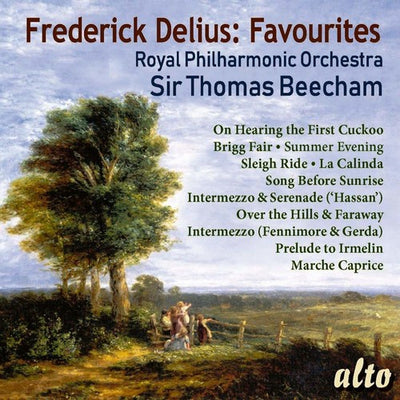
    FREDERICK DELIUS: 11 FAVOURITES

    CD · 1 disc

    $11.01
    Composer
    FREDERICK DELIUS
    Artist
    SIR THOMAS BEECHAM / ROYAL PHILHARMONIC ORCHESTRA
    Released
    Oct 12, 2018
    Contains Delius' most essential statements. Summer Night on the River, On Hearing the First Cuckoo, Brigg Fair and the Irmelin Prelude are simply magical in their effect, and Beecham's interpretations arise out of the depths of the music itself... passages such as the introduction to Brigg Fair, seem to be outside time, one yet again wonders at the poetic rightness of every nuance, the delicately exact textural balance. His identification with the composer is so complete that one is not sure whom to credit for some features... This (collection) must surely be recognised as a gem. Sleigh Ride and the Marche Caprice are entertaining enough, but all the rest are wonderful Delius - and conducted by someone who has remained the one and only Delius interpreter. Each performance is superb. (Gramophone)
    View full page
  • FREDERICK DELIUS: 11 FAVOURITES

    FREDERICK DELIUS: 11 FAVOURITES

    ALTO Oct 2018
    1 disc
    CD
    $11.01
    Chandos

    Delius: Hassan - Complete Incidental Music / Phillips, Britten Sinfonia

    CD · 1 disc

    $19.79 $21.99 Save 10%
    Composer
    Frederick Delius
    Artist
    Zeb Soanes, Britten Sinfonia
    Released
    Apr 19, 2024

    Although he had initially declined the commission, Delius was persuaded to write the incidental music for Hassan by the actor and director Basil Dean in July 1920, for performances he was planning for His Majesty’s Theatre, London, the following year. Much of the music was drafted within a few weeks, and the score would eventually prove one of the greatest successes of Delius’s career. Dean’s plans for the project encountered significant obstacles and delays, however, and he had to commission additional music from Delius to cover the production’s complex scene changes. The London première eventually took place on 20 September 1923 and was a critical sensation.

    Flecker’s play is a sinuous double-narrative that intertwines the twin stories of the lovelorn but worldly-wise Hassan, confectioner at the court of the cruel and vindictive Caliph Haroun al Rashid (called Haroun ar Rashid in Flecker’s play), and the young lovers Pervaneh and Rafi, caught up in the aftermath of a failed uprising and condemned to a terrifying and brutally protracted death. In tone and setting, Flecker’s text drew on nineteenth-century English translations of One Thousand and One Nights as well as other heavily fictionalized accounts and travel literature. Very much a product of the racial and class-based attitudes of its time, the play revels in imaginary scenes of a despotic Eastern court and its gruesomely barbaric practices.

    View full page
    Naxos

    Delius: A Mass of Life, Idyll / Opie, Hill

    CD · 2 discs

    $14.99 $29.99 Save 50%
    Composer
    DELIUS, FREDERICK
    Artist
    Hill, Watson, Opie, Wyn-Rogers, Kennedy, Bournemouth So, David
    Released
    Jun 26, 2012


    To witness a performance of Delius’s A Mass of Life, arguably his supreme creative achievement, is to look into the heart of the composer and his Nietzsche-inspired world. Moreover, this ravishing music, written between 1898 and 1905, represents Delius at the height of his powers, when musical ideas seemed to pour out of him at a time when he had finally learned to assimilate, in an entirely individual, not to say maverick manner, a confluence of modernist styles embracing Grieg, Wagner, Strauss, Charpentier and Debussy.

    There is no doubt from the vivid opening choruses of Parts 1 and 2 of this recording (and what openings!) that the message of the work is a life-affirming one. There is a dynamic momentum to the tempi which perfectly evokes Zarathustra’s ruling passion, the Will of Man, and there is a richness to the orchestral sound which adds to the sense of muscularity. The chorus negotiate Delius’s often awkward vocal intervals with great skill and the intonation is virtually flawless. Just occasionally the sheer weight of the orchestral sound, which is quite forward on this recording (more so than Hickox), is apt to overwhelm the voices but this is a minor distraction.

    Hill brings energy and élan to the third section, ‘In deine Auge’ (for me perhaps the most exhilarating section of Part 1), where the parallel with the end of Act 2 of Die Meistersinger is almost palpable and where the most unusual example of a Delius fugue (!) is given life, vigour and meaning.

    Alan Opie, who has the lion’s share of the solo music in the work, is almost Wotan-like in his performances. From his first Nietzschean dance he is majestic and brings out of the score that vibrant, heady, Teutonic contemporaneity with which Delius had clearly become enthralled at this point in his career. Opie’s singing of what is effectively the role of Zarathustra has immense authority and his impressive range (up to high G) is ideal for Delius’s onerous vocal demands.

    Andrew Kennedy, Catherine Wyn-Rogers and Janice Watson also offer fine lyrical interpretations of their solo parts and the choral accompaniments are allowed to intermingle subtly as an extension of the orchestra. The BSO are on fine form too, and special mention needs to be made of the haunting horn-playing in the introduction to Part 2 (‘On the Mountains’), a sound which sums up so much of Delius’s nature music.

    This is a must for any Delius Liebhaber and, with the added bonus of the late Prelude and Idyll, a marvellous starting point for anyone new to Delius’s unique but compelling art.

    -- Jeremy Dibble, Gramophone
    3622320.az_DELIUS_Mass_Life_Prelude.html

    DELIUS A Mass of Life. Prelude and Idyll1 • David Hill, Cond; 1Janice Watson (sop); Catherine Wyn-Rogers (mez); Andrew Kennedy (ten); 1Alan Opie (bar); Bach Ch; 1Bournemouth SO • NAXOS 8.572861-62 (2 CDs: 118:19 Text and Translation)

    A Mass of Life is quintessential Delius, musically and existentially, composed over 1904–05 in the first great rush of his maturity. From the bounding affirmative choruses to the breathtakingly sustained nature contemplations, from the melancholy to the ecstatic, the Mass of Life traces and forecasts the gamut of Delian affect with a concision, fullness, and abundance he might rival but never achieve so comprehensively again. Unless I’ve missed something, this is but the fourth recording of the work since Beecham’s nonpareil 1952 account. Though its musical demands are daunting—if nowhere near as challenging as those of Mahler’s “Symphony of a Thousand,” with which it invites comparison—the primary bar to frequent performance is its text, drawn by Delius’s friend Ernst Cassirier largely from the Dance Songs of Nietzsche’s Also sprach Zarathustra. For those coming in late, one recalls the oft-quoted passage in Eric Fenby’s Delius as I Knew Him: “When, one wet day … he was looking for something to read in the library of a Norwegian friend … and had taken down a book, Thus Spake Zarathustra—a book for all and none—by one Friedrich Nietzsche, he was ripe for it. The book, he told me, never left his hands until he had devoured it from cover to cover. It was the very book he had been seeking all along, and finding that book he declared to be one of the most important events of his life. Nor did he rest content until he had read every work of Nietzsche that he could lay his hands on”—to which Fenby, a devout Catholic, adds—“and the poison entered his soul.” For listeners and performers today it may still be something of a jolt to find, in place of the supplicating Kyrie that the unfortunate term “Mass” leads one to expect, a glowingly charged hymn to the Will, “dispeller of need, my own necessity,” followed by Zarathustra’s brief praise of laughter (“My own laughter I pronounced holy”), succeeded by Zarathustra’s love duet with Life in a meadow filled with dancing girls, an archetypal encounter transpiring in a mythical dimension “beyond good and evil,” beyond place and time, crowned by the first, murmured, utterance of the Bell Song, the work’s central mystery. A Mass of Life may, of course, be enjoyed for its power and sensuous magic without reference to its text, but only to those nurtured on Nietzsche will it reveal its full import. Shrugging incomprehension of the text renders Benjamin Luxon’s Zarathustra, for Charles Groves (with the London Philharmonic Chorus and Orchestra), merely mellifluous, while Peter Coleman-Wright’s deadpan delivery for the late Richard Hickox—with the Waynflete Singers directed by today’s conductor, David Hill, and the Bournemouth Symphony Chorus and Orchestra—proves anesthetically workmanlike. When it appeared in 1997, I rated that reading, on Chandos, the best since Beecham’s (Fanfare 20:6). That honor goes now to the present offering. While Alan Opie does not efface memories of Bruce Boyce, for Beecham—whose delivery resonated from the nexus of Delius’s realization of Nietzsche—he teases the text gingerly, making a credible Zarathustra. In some numbers, Delius asks the soloists to share parts, with some of Zarathustra’s lines persuasively taken by Andrew Kennedy, and a portion of Life’s happily rendered by Janice Watson, though Catherine Wyn-Rogers’s beguiling, seductive Life recalls Monica Sinclair’s divinatory geste for Beecham. The choral work is beyond praise, though in Hill’s brisk approach the melting lyricism heard chez Beecham tautens and leaps.

    Idyll is a late reworking of music from Margot la Rouge, composed in 1902 for the new opera competition offered by the music publisher Sanzogno. Though it failed to score and was not heard in Delius’s lifetime, it comes from the composer’s ripest years and contains gorgeous swaths of his richest utterance, which he salvaged in 1932, recomposing it to words by Whitman and making an extended love duet of it. Idyll has not lacked for vocally lustrous, persuasive performances submerging Whitman’s quaintness (“Behold me when I pass, hear my voice, approach, draw close, but speak not. Be not afraid of me”) in absolute conviction. Of major interest, the lovingly lingering 1981 account led by Eric Fenby—who took down the score from dictation by the blind, paralyzed Delius—features Felicity Lott and Thomas Allen (deleted Unicorn-Kanchana UKCD 2073). Meredith Davies’s still-available 1968 tilt at Idyll, with the Royal Philharmonic Orchestra, is made memorable by the divinatory partnership of Heather Harper and John Shirley-Quirk. In keeping with his go at the Mass of Life, Hill pushes the work a bit, spurring the impassioned moments to escalate from the pervasive tone of wistful elegy. Opie, as the anonymous man, is authoritatively resonant, in response to Janice Watson’s brightly edged soprano (touched by a bit of vibrato), with its gloriously amber lower register, buxomly filling the part of the nameless woman.

    One caveat: In the headnote the title of the work is given per the album, but you will search the catalog of Delius’s works in vain for an orchestral Prelude. The work so designated is simply the first three minutes—an orchestral prelude, to be sure—of Idyll and has never, until now, been listed separately. The fake title generates a phantom work to bedevil buyers, scholars, and connoisseurs, and detracts from—rather than adding to—the program’s generosity.

    Sound packs an immediate wallop making for occasional congestion. In the opening chorus, for instance, the leaping underlining of trombones and tubas becomes indistinct, overwhelmed by choral mass, and while one can pick out the glockenspiel, its function of festive accentuation is lost. In quieter passages, and in the capture of the vocalists, on the other hand, this upfront take is gratifyingly welcome. In German, Zarathustra’s pronouncements recall and parody the Lutheran Bible, in light of which the ostensibly stilted thee-ing and thou-ing of William Wallace’s singing translation—made for Beecham and used by him for all of his public performances (according to notes by Delius aficionado Lyndon Jenkins)—fall into place, if not quite into King James English. Whitman’s text is included.

    In sum, a superb production and the grandest addition to the Delius discography in many years. Highest recommendation.

    FANFARE: Adrian Corleonis

    View full page
  • Delius: A Mass of Life, Idyll / Opie, Hill
    Sale

    Delius: A Mass of Life, Idyll / Opie, Hill

    Naxos Jun 2012
    2 discs
    CD
    $29.99 $14.99Save 50%
    Naxos

    Delius: Appalachia, Sea Drift / Sanderling, Williams, Tampa Bay Master Chorale

    CD · 1 disc

    $9.99 $19.99 Save 50%
    Composer
    DELIUS, FREDERICK
    Artist
    Williams, Sanderling
    Released
    Sep 25, 2012
    The orchestra relishes Delius’s contrasts.

    It is a delight to welcome performances of two of Delius’s American-inspired works by forces from Florida, where Delius lived from 1892 to 1895. Although Sea Drift, a setting of a poem by Whitman, is overtly about an American subject, the music is more universal than specifically American. While the initial drafts of Appalachia were made in Paris the year after Delius left Florida - Marco Polo, Naxos’s sister label, once had a recording (8.220452) of this earlier version in their catalogues under the title of American Rhapsody - the work was very substantially expanded to the form we have it here some eight years later, long after Delius had returned to Europe.

    I first heard Sea Drift in the original Beecham recording issued on a limited edition Delius Society release of four 78s (now on Naxos) - I still have them. Beecham’s account of the score remains a marvel of sympathetic identification with the spirits of both Whitman and Delius. Unfortunately all of his recordings - and there are a good many of them, from studio and live broadcasts, not all currently available - are in mono. This is a score which absolutely demands the atmosphere of stereophonic sound. Similarly Beecham never recorded Appalachia in stereo, and his last (mono) LP (reissued by Sony) suffered from a baritone who had seemingly been chosen for his ability to sing Danish for the coupled recording of the Arabesque rather than any ability to sing sympathetically in English for the closing ‘negro spiritual’ section of Appalachia. One cannot possibly accuse Leon Williams of sounding un-American, but the tone of his voice is nevertheless rather English and rather too polite. He is not helped by the rather close proximity of the microphone, which brings him closer than the rest of the performers rather than blending him into the whole. Bryn Terfel, in his Chandos recording of Sea Drift with Richard Hickox (coupled with the Songs of Sunset and Songs of Farewell), digs far more deeply into the meaning of the words than Williams does here. The emotion of the latter is too generalised, and his voice lacks the light and shade of Terfel or John Shirley-Quirk on Hickox’s earlier Decca recording.

    Appalachia fares rather better in this reading. The orchestra relishes the contrasts in Delius’s set of variations, with a nicely winsome touch in passages such as the waltz variation at 19.57; Beecham allowed a very gusty breath of the ballroom to intrude here. Earlier they are beautifully atmospheric in the passage from 17.01 which recalls Delius’s Florida opera The magic fountain. The chorus is nicely distanced in their brief interjections in the earlier variations, and come into their own with the own variation at 27.50, when they appear to move closer. Unfortunately the close microphone placement given to Williams at 31.52 serves only to emphasise how precisely English is his diction, and the choir are now very far forward indeed, which brings a sense of stridency which is entirely foreign to the Delius idiom. The passage at 33.28 sounds uncomfortably like the closing titles for a Hollywood Western - not at all the area of America that Delius had in mind.

    This Naxos disc duplicates exactly the contents of one of Richard Hickox’s earliest recordings of British music, issued originally on an Argo LP in 1980, with Shirley-Quirk at the peak of his form in the baritone solos, which is certainly a reading which deserves to be in any Delius collection - it remains available from Arkiv Music . The Naxos recording is more immediate in general sound than the analogue Hickox, but the latter has plenty of atmosphere and the Royal Philharmonic Orchestra - many of whose members must have played this music under Beecham - respond with affection to Hickox’s somewhat slower tempos. Indeed Sanderling could sometimes be accused of hurrying, as at the baritone entry at 2.58 where the soloist sounds a bit hustled. It is important to keep Delius’s music moving, not allowing it to stagnate, but the flow can be maintained without undue haste; Sanderling shaves nearly four minutes off Hickox’s speeds in his earlier recording, almost a fifth of the whole duration of a fairly short work. Beecham, even with the constraint of 78 sides, was slower than this, and Delius always expressed his conviction that this conductor understood his music better than anyone else.

    It is always a suspicion that when one knows a particular performance well one might be allowing nostalgia to colour reactions to a performance. To test this I played the recording of Sea Drift to a friend of mine who, although he knew and loved the poem, did not previously know the music at all. He like me vastly preferred Hickox, observing that although that performance was noticeably slower, it at the same time had a sense of purposeful motion that Sanderling lacked. He also actually preferred the more integrated sound of the older recording.

    Naxos’s cover photograph by Giorgio Fochesato is particularly beautiful and appropriate, and the booklet commendably includes the complete texts of both works. The orchestra and chorus both perform superbly; it is nice to hear a really big choir sing this music - 137 singers are listed - as Delius would have expected in his earlier performances. They maintain pitch even in the most exposed passages of Sea Drift.

    -- Paul Corfield Godfrey, MusicWeb International
    View full page
    Naxos

    Delius & Smyth: String Quartets / Villiers Quartet

    CD · 1 disc

    $19.99
    Composer
    Frederick Delius, Ethel Smyth
    Artist
    Villiers Quartet
    Released
    Oct 14, 2022

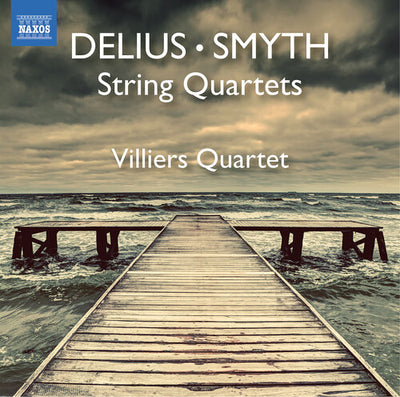
    The String Quartet in E minor by Ethel Smyth, one of the most innovative and original figures in English music, has a masterful coherence and consistency. With eloquent writing for the viola in particular, it is both playful and reverential, and ends with a flourish – forthright, bold and uncompromising, like Smyth herself. Delius wrote the early String Quartet in 1888 but it was rejected for performance and he was later to reuse the Scherzo for his mature Quartet of 1916–19. In 2018 the score of the two opening movements of the 1888 Quartet, long assumed lost, reappeared at auction and have been edited and reunited with the final two in this premiere recording, which adds significantly to our understanding of Delius’s early compositional directions.

    REVIEWS:

    A Delius discovery is brought to life with compelling musicianship…The Villiers Quartet gives it a fine first recording, captured in warm and well-balanced sound.

    -- The Strad

    Full marks to the Villiers Quartet for bringing this new and challenging repertoire to life.

    -- Gramophone

    ...what I like about this quartet very much is its questing nature – this is a kind of musical laboratory for Delius to test out ideas, nascent harmonies and textures that would define his mature music in the years ahead.

    -- MusicWeb International

    View full page
  • Delius & Smyth: String Quartets / Villiers Quartet

    Delius & Smyth: String Quartets / Villiers Quartet

    Naxos Oct 2022
    1 disc
    CD
    $19.99
    Naxos

    Delius, F.: Violin Sonatas (Complete)

    CD · 1 disc

    $19.99
    Composer
    DELIUS, FREDERICK
    Artist
    Stanzeleit, Fenyo
    Released
    Jun 30, 2009
    Beneath the shimmering surface of Delius’s little-known violin sonatas are the latent exuberance and nostalgic rapture which have made his orchestral music so popular. Across the decades separating the B major Violin Sonata of 1892 from the Third Violin Sonata of 1930, Delius developed a unique musical language which leavened the post-Romantic heritage of Wagner with French Impressionism and European and Afro-American folk idioms; an intoxicating mix that moved Sir Thomas Beecham to call him ‘the last great apostle in our time of beauty and romance in music’.
    View full page
  • Delius, F.: Violin Sonatas (Complete)

    Delius, F.: Violin Sonatas (Complete)

    Naxos Jun 2009
    1 disc
    CD
    $19.99
  • Quiet Summer Evening
    SOMM Recordings

    Quiet Summer Evening

    CD · 1 disc

    $20.99
    Composer
    Lennox Berkeley, Nigel Brooks, Geoffrey Bush, Frederick Delius, Edward Elgar, Terence Higgins, Gordo
    Artist
    Peter Cigleris, Sarah Watts, Alexei Watkins, Michael Mace, Chamber Ensemble of London
    Released
    Jul 17, 2026
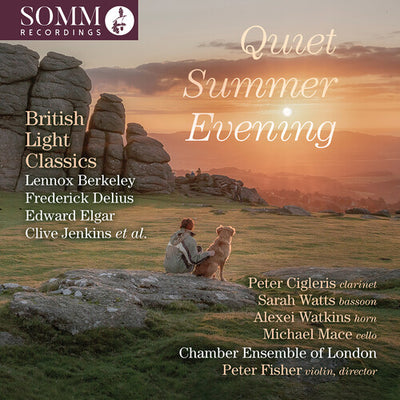
    SOMM Recordings is pleased to release their second recording with the Chamber Ensemble of London, a virtuoso group of hand-picked string players directed by violinist Peter Fisher, whom The Times counts amongst "a handful of the world's finest musicians." Following the ensemble's 2022 SOMM release, Eclogue - British Chamber Music, which Gramophone praised for it's "unfailingly sympathetic music-making throughout," this new release is Quiet Summer Evening - British Concertante Music, drawing on the rich tradition of light classical music. The programme opens with Rhapsody for Clarinet & Strings by Geoffrey Bush. He was initially taught by John Ireland and, on his advice, studied composition and classics at Balliol College, Oxford, emerging with degrees in both subjects in 1946. Bush's hauntingly beautiful rhapsody features the sought-after clarinettist Peter Cigleris, whose growing discography includes three previous releases with SOMM. He is also the soloist in 5 Pieces for Clarinet & String Orchestra by Clive Jenkins, CEOL's associate composer. Jenkins was born in Plymouth, and he shows his roots in many of his compositions-including these pieces, each of which has a name connected with Plymouth. Another work by Jenkins included here is Fantasy for Horn & Strings, featuring Alexei Watkins, a graduate of the Royal Academy of Music, where he was awarded the Dennis Brain Prize. Watkins is also featured in Orion (Serenade for Horn & Strings) by prize-winning conductor-composer Andy Meyers, as well as Lullaby, an expressive and programmatic piece by composer and BBC Radio 3 producer Luke Whitlock. Bassoonist Sarah Watts is a multi-instrumentalist who has become well known worldwide as a prolific composer of colourful and inspiring music. Here, she performs her composition Everywhere Is Somewhere Else. Additionally, she is the soloist for the contemplative Sunday Afternoon by notable arranger, conductor, and composer Nigel Brooks, excerpted from the broadcast series Stars on Sunday, and also A Little Waltz by the prolific mid-twentieth-century composer, arranger, and master orchestrator Gordon Jacob. Other pieces by composers from former generations include Canto popolare, extracted from Edward Elgar's concert overture In the South; Lennox Berkeley's single-movement Andantino, which he adapted from his Festival Anthem; and one of Frederick Delius's earliest surviving compositions, Romance. The soloist for Berkeley's Andantino and Delius's Romance is cellist Michael Mace, who pursues a wide and varied musical career as performer and teacher. Peter Fisher is the violinist for Elgar's Canto popolare and the appealing Vers le Sud (Towards the South) by Terence Higgins who, notwithstanding his early promise, decided against a full-time professional musical career and-like composers Wilfrid Josephs and Alan Rawsthorne-qualified as a dentist. Fisher also plays the CD's title piece, Quiet Summer Evening, a contemplative piece by composer-pianist Don Shearman, who enjoyed a long and distinguished career in light music.
    View full page
  • Quiet Summer Evening

    Quiet Summer Evening

    SOMM Recordings Jul 2026
    1 disc
    CD
    $20.99
  • Poul Elming Sings H. C. Anders
    Kontrapunkt

    Poul Elming Sings H. C. Anders

    CD · 1 disc

    $22.99
    Composer
    Robert Schumann, Edvard Grieg, Frederick Delius, Niels Wilhelm Gade, Carl Nielsen
    Artist
    Poul Elming, Tove Lønskov
    Released
    Oct 02, 2006
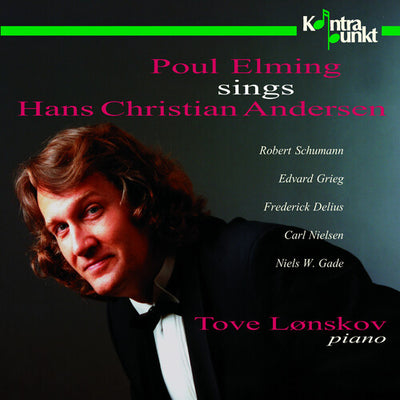
    The year 2005 marked the bicentennial anniversary of Hans Christian Andersen's birth, whose's writing has been the treasury of the world. Internationally renowned tenor Poul Elming compiled an album of Lieder by great composers inspired Andersen's poetry.
    View full page
  • Poul Elming Sings H. C. Anders

    Poul Elming Sings H. C. Anders

    Kontrapunkt Oct 2006
    1 disc
    CD
    $22.99
    Chandos

    Delius: The Walk to the Paradise Garden / Hickox

    CD · 1 disc

    $13.99
    Composer
    DELIUS, FREDERICK
    Artist
    Hickox
    Released
    Aug 26, 2016
    The Bournemouth Symphony Orchestra playing under the baton of Richard Hickox, Delius’s palette of colours shines through once again. Hickox was indeed a sensitive and flexible Delian and the Bournemouth Symphony Orchestra responded passionately to him from the start: their collaboration began with famous performances of the first ever complete cycle of Vaughan Williams’s symphonies in London.

    Especially in ‘The Walk to the Paradise Garden’ – a highlight here – the collection demonstrates the glittering qualities of Delius’s enchanting musical world, which evokes an atmosphere of serene pleasure in nature.

    Highly recommended by the Penguin Guide in 1995, one year its recording.
    View full page
  • Delius: The Walk to the Paradise Garden / Hickox

    Delius: The Walk to the Paradise Garden / Hickox

    Chandos Aug 2016
    1 disc
    CD
    $13.99
  • Delius: French Masterworks

    Delius: French Masterworks

    Danacord Sep 2012
    1 disc
    CD
    $18.99
  • Delius: North Country Sketches, In A Summer Garden, Appalachia
    Sony Masterworks

    Delius: North Country Sketches, In A Summer Garden, Appalachia

    CD · 1 disc

    $17.99
    Composer
    DELIUS, FREDERICK
    Artist
    Sir Thomas, Beecham
    Released
    May 07, 2009
    This 1949 recording (originally on 78s) of North Country Sketches already has appeared on CD in Sony's British Pageant series. The very start of the fourth movement, "The March of Spring", sounded fractionally clipped there, and regrettably it still does in this version, which ultimately offers no perceptible sonic improvements over the earlier release. Nevertheless, Delians will be more than happy to tolerate a minor flaw or two to get their hands on this matchlessly idiomatic performance. This is Beecham at his best; he gets the first section ("Autumn, the wind soughs in the trees") off to a delightfully misty beginning, even though the double bass and bassoon pedal notes don't really come across. Still, you'd be hard put to imagine the desolation and solitude of the Yorkshire moors much better characterized, even though the transfer retains its former ill-defined lower registers, and even flutes and clarinets can have a nasal, hollow quality above mezzo-forte.


    However, any sonic shortcomings are amply compensated, and although there's some questionable wind tuning toward the close of "Winter Landscape", Beecham's careful dynamic gradations register well and the lonely feel of the piece is highly palpable. And save for that clipped start, there's also much to enjoy in the closing section where the awkwardly placed cello and violin solos are skillfully managed.


    This CD also includes a complete 1952 recording of Appalachia. Beecham probably knew it better than anyone, and after a rather plain, possibly too-relaxed introduction, he portrays all 14 variations with great sensitivity. Delius' vividly impressionistic North Country Sketches is the more attractive work, though, and its relatively poor representation on CD gives this release additional value. If you find that the limited dynamic range and astringency of Sony's reissue leaves too much detailing hidden, consider Chandos' 1995 recording from Richard Hickox and the Bournemouth Symphony. It's an assured and likeable performance, splendidly engineered and adroitly played, but in terms of atmosphere, Beecham is still in a league of his own.
    --Michael Jameson, ClassicsToday.com
    View full page
  • Delius: North Country Sketches, In A Summer Garden, Appalachia

    Delius: North Country Sketches, In A Summer Garden, Appalachia

    Sony Masterworks May 2009
    1 disc
    CD
    $17.99
  • Delius: Orchestral Music Arranged for 2 Pianos, Vol. 2

    Delius: Orchestral Music Arranged for 2 Pianos, Vol. 2

    SOMM Recordings Jul 2013
    1 disc
    CD
    $20.99
  • Delius: English Masterworks

    Delius: English Masterworks

    Danacord Feb 2012
    1 disc
    CD
    $18.99
    Collegium Records

    Classical Tranquillity / Rutter, Manchester Camerata

    CD · 1 disc

    $8.99 $10.99 Save 18%
    Composer
    Johann Sebastian Bach, Claude Debussy, Frederick Delius, Edvard Grieg, George Frideric Handel, Mauri
    Artist
    Manchester Camerata, John Rutter
    Released
    Nov 03, 2023

    John Rutter writes: Tranquillity is a state of mind. You might be more likely to describe a favorite countryside scene rather than a person as ‘tranquil’, but you are really describing the effect it has on you. You feel calm, serene, still, at peace, relaxed, untroubled, chilled-out . . . perhaps we have so many different words for this state of mind because it is so important, and yet so elusive in an often noisy, frantic world.

    Music has an extraordinary power to evoke tranquillity – as is revealed in the eleven pieces I have chosen to make up this collection. Ten of them happen to be among my personal favorites, drawn from the music of seven composers, plus the treasure trove of anonymous folk music, and I have added an orchestral version of my choral setting of Lord, make me an instrument of thy peace, a text formerly believed to be by St Francis of Assisi.

    CONTENTS:

    • trad.: She moved through the fair
    • Satie: Gymnopédie No. 1
    • Delius: On Hearing the First Cuckoo in Spring
    • Ravel: Pavane pour une infante défunte
    • Rutter: Lord, make me an instrument of thy peace
    • Grieg: Symphonic Dance, Op. 64 No. 2
    • Bach: Bist du bei mir [When you are with me]
    • Ravel: Sonatine: Mouvement de Menuet
    • Debussy: Suite bergamasque: Clair de lune
    • Handel: Semele: Where’er you walk
    • Rutter: Sheep may safely graze
    View full page
  • Classical Tranquillity / Rutter, Manchester Camerata
    Sale

    Classical Tranquillity / Rutter, Manchester Camerata

    Collegium Records Nov 2023
    1 disc
    CD
    $10.99 $8.99Save 18%
    Chandos

    Delius: Sea Drift, Songs Of Sunset, Etc / Hickox, Terfel

    CD · 1 disc

    $13.99
    Composer
    DELIUS, FREDERICK
    Artist
    Hickox
    Released
    Aug 28, 2015

    5 out of 5 stars for Performance and Sound!

    This disc was an award-winner when it first appeared in 1993, and rightly so. These are among Delius’s finest and most consistent works, and Hickox directs them with an authority and atmosphere that recalls Beecham or Barbirolli. Bryn Terfel, as soloist in Sea Drift, contributes one of the finest and most deeply-felt performances of his now extensive discography, and this is one of the most restrainedly expressive interpretations this outpouring of wild pathos has received on disc. Throughout the three works the choirs are ideally responsive to the beauty of the poetry, coming into their own in the late Songs of Farewell. If Songs of Sunset doesn’t quite efface the memory of Charles Groves’s 1968 account with Janet Baker and John Shirley-Quirk, this is still a splendid account of a subtle work that offers far more than mere fin-de-siècle languor. Altogether a notable release which it’s a pleasure to welcome back to currency.

    -- Calum MacDonald, BBC Music Magazine
    Reviewing earlier release of this recording
    View full page
  • Delius: Sea Drift, Songs Of Sunset, Etc / Hickox, Terfel

    Delius: Sea Drift, Songs Of Sunset, Etc / Hickox, Terfel

    Chandos Aug 2015
    1 disc
    CD
    $13.99
  • Elgar: Violin Concerto; Salut d'Amour; Delius: Suite
    Channel Classics

    Elgar: Violin Concerto; Salut d'Amour; Delius: Suite

    CD · 1 disc

    $20.99
    Composer
    Frederick Delius, Edward Elgar
    Artist
    Nicolas Dautricourt, Frederic Chaslin, BBC National Orchestra of Wales, Capriccio Quartet
    Released
    Feb 21, 2025
    'If you want to know who, for me, is the greatest living composer, I'll tell you without hesitation - it's Elgar, whom I place on the same level as my idols Beethoven and Brahms!' So said the great virtuoso Kreisler.' Nicolas Dautricourt continues: 'This Concerto, with it's unbridled lyricism and unique proportions, is an Everest for any violinist.' In this, his first recording for Channel Classics, the French violinist brings together three works by two English composers. In 1888, in the same year Elgar wrote the famous Salut d'amour for his fiancee Caroline Alice Roberts, Frederick Delius composed his Suite for Violin and Orchestra, one of his very first works. The Suite, which only received it's premiere in 1984, is heard here in this insightful arrangement by Frederic Chaslin for violin, piano and string quartet.
    View full page
  • Elgar: Violin Concerto; Salut d'Amour; Delius: Suite

    Elgar: Violin Concerto; Salut d'Amour; Delius: Suite

    Channel Classics Feb 2025
    1 disc
    CD
    $20.99
  • Delius: Orchestral Music Music for 2 Pianos, Vol. 1

    Delius: Orchestral Music Music for 2 Pianos, Vol. 1

    SOMM Recordings Mar 2012
    1 disc
    CD
    $20.99
    Naxos

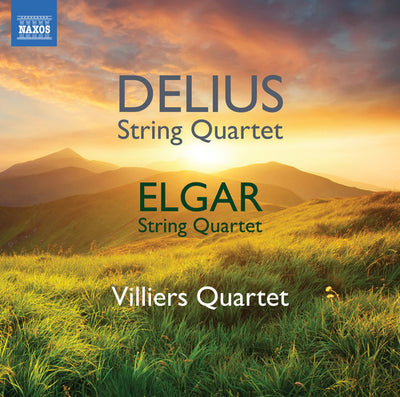
    Delius & Elgar: String Quartets / Villiers Quartet

    CD · 1 disc

    $19.99
    Composer
    DELIUS ELGAR
    Artist
    VILLIERS QUARTET
    Released
    May 12, 2017

    The legacy of the First World War left its mark on the music of near contemporaries Edward Elgar and Frederick Delius. The powerful outer movements of Elgar's String Quartet in E minor frame a wistful and sombre Andante piacevole. Delius was dissatisfied with the first, three-movement version of his Quartet and revised the score. On this recording the final 1917 version is followed by the original versions of the opening movement and of the Late Swallows slow movement, offering a rare glimpse into Delius's compositional workshop.

    View full page
  • Delius & Elgar: String Quartets / Villiers Quartet

    Delius & Elgar: String Quartets / Villiers Quartet

    Naxos May 2017
    1 disc
    CD
    $19.99
  • Delius: American Masterworks

    Delius: American Masterworks

    Danacord Dec 2012
    1 disc
    CD
    $18.99
    SOMM Recordings

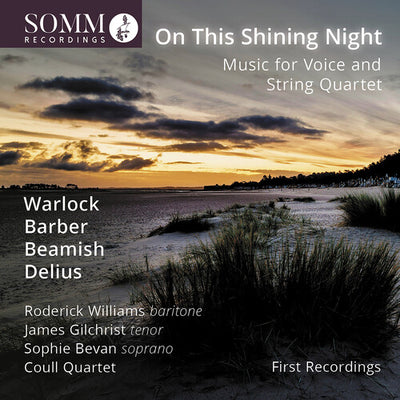
    Barber, Beamish, Delius & Warlock: On This Shining Night / Williams, Gilchrist, Bevan, Coull Quartet

    CD · 1 disc

    $20.99
    Composer
    Samuel Barber, Sally Beamish, Frederick Delius, Peter Warlock
    Artist
    Roderick Williams, Sophie Bevan, James Gilchrist
    Released
    Nov 18, 2022

    SOMM Recordings is delighted to announce a thrilling first collaboration between long-time SOMM stablemates, baritone Roderick Williams and the Coull Quartet, joined by tenor James Gilchrist and soprano Sophie Bevan. With six world premiere recordings, On This Shining Night is a ravishing recital focusing revealingly on a 20th-century phenomenon: works for voice and string quartet. It takes its title from a James Agate setting by Samuel Barber (whose masterly "Dover Beach" is also heard), here in a sublime arrangement by Roderick Williams. Williams also provides arrangements of Barber’s "Sleep Now" and three Frederick Delius pieces from his Seven Songs from the Norwegian: the evocative "Twilight Fancies," vivacious "Young Venevil" and exotic "I-Brasil." They serve, as Robert Matthew-Walker’s erudite booklet notes observe, as companions to 11 songs by Delius’s close friend and associate, Peter Warlock, including the gentle intimacy of "Corpus Christi," the “mini-cantata” "Sorrow’s Lullaby," and unique free-recitative of "My gostly vader."

    Composed for Williams and the Coull Quartet, Sally Beamish’s five-part Tree Carols offer striking, variegated settings of poems by Fiona Sampson in their premiere recording. Roderick Williams’ SOMM catalogue include the acclaimed three-volume Twelve Sets of English Lyrics by Hubert Parry (SOMMCD 257, 270, 272), Sally Beamish’s Four Songs from Hafez (Birdsong, SOMMCD 0633), and the classic English song cycles A Shropshire Lad and Maud (SOMMCD 0615), which MusicWeb International declared a “game changer… in terms of our appreciation of Arthur Somervell’s songs”. The Coull Quartet has recorded a wide repertoire for SOMM. Their recording of Nicholas Maw and Benjamin Britten quartets (SOMMCD 065) was a Gramophone Editor’s Choice and a BBC Music Magazine Benchmark Recording. Gramophone declared their recent SOMM release with Clélia Iruzun, Treasures from the New World, featuring piano quintets by Amy Beach and Henrique Oswald (SOMMCD 0609), “a delight”.

    View full page