Search results: Search results

37 results

Products

    Naxos

    Christmas at Trinity / Burdick, Choir of Trinity Church

    CD · 1 disc

    $19.99
    Composer
    VARIOUS
    Artist
    Owen Burdick
    Released
    Oct 01, 2001

    REVIEW:

    Almost every year a first rate choir records a traditional program of sacred Christmas music--and this year it looks as if it's the Choir of Trinity Church, Wall Street's turn. The ensemble and its excellent organist certainly uphold the standard set years ago by their British counterparts, particularly those at the various Cambridge University colleges--King's, Trinity, and St. John's, to name the more notable. And even though this New York City church can't boast as many centuries' existence as those revered English institutions, there is something especially charming about the fact that it hosted the New World premieres of both Messiah and the hymn Silent Night, the latter performed by a Tyrolean ensemble on Christmas Eve, 1827.

    For those familiar with the famed King's College Choir carol services, the programming here will ring a few bells, from the opening, processional-style Once in Royal David's City to the closing Hark! the Herald Angels Sing. In between are one after another of the now-standard Christmas carol, hymn, and anthem selections in their best-known settings--Peter Cornelius' "The Three Kings", Patrick Hadley's "I sing of a maiden", David Willcocks' arrangement of "Of the Father's heart begotten", Philip Ledger's arrangement of the "Sussex Carol", William Mathias' "A babe is born", Gustav Holst's "Lullay, my liking", the English hymnal harmonization of "O come, all ye faithful", the Vaughan Williams/Forest Green version of "O little town of Bethlehem", and a lovely Ledger a cappella setting of "Silent night".

    The choir sings with warmth, precision, purity of articulation (you can hear every word), and great care in balance and blend. There is one thing however in which the choir failed: as much as they tried (according to director Owen Burdick) to "not sound British", they do, but in the very best way possible--beauty of tone, clarity of diction, and fully committed, sincere singing. Yes, Americans can do these things too. And as for this umpteenth program of already well-represented pieces, the fact is, those who love Christmas and singing (and how can these not go hand in hand?) never tire of this music, these lovely, characterful, joyous, hopeful tunes--and this recording and its fine performances capture them all as well as any choir ever has. The sound gives a realistic impression of the church's acoustic space while giving ideal clarity and depth to the singing. [10/17/2001]
    --David Vernier, ClassicsToday.com

    View full page
  • Christmas at Trinity / Burdick, Choir of Trinity Church

    Christmas at Trinity / Burdick, Choir of Trinity Church

    Naxos Oct 2001
    1 disc
    CD
    $19.99
  • British Choral Music Of The Twentieth Century

    British Choral Music Of The Twentieth Century

    Nimbus Oct 1996
    5 discs
    CD
    $37.99
  • A Christmas Celebration

    A Christmas Celebration

    Chandos Oct 1993
    1 disc
    CD
    $6.99
    Opus Arte

    On Christmas Night / Hyde, Williams, Choir of Magdalen College

    CD · 1 disc

    $19.99
    Composer
    VARIOUS
    Artist
    Williams, Hyde
    Released
    Oct 28, 2016

    The acclaimed Magdalen College Choir celebrates the diversity of the twentieth-century English carol repertoire in a programme that combines well-loved standards and innovative choir favorites ranging in emotion from quiet contemplation to festive joy. The selection of carols and organ solos, led by director and organist Daniel Hyde, culminates in Ralph Vaughan Williams’s celebrated Fantasia on Christmas Carols with renowned baritone Roderick Williams in the solo part. Several carols focus on the sheer joy of the miraculous Incarnation itself. William Mathias’s A babe is born is a lively setting which gives full rein to the composer’s syncopated, jazzy parallelisms. Optimism is also the principal mode of Christopher Steel’s People look east. In its ebullient joy, the piece bounces off into a different key in the third verse and deploys the voices in canon, before swinging back to a final recapitulation, replete with a jubilant descant. Composers for organ have found themselves drawn to this treasury of festive folksongs. The French organist and teacher Marcel Dupre was requested by his daughter Marguerite to write a setting of the carol Il est ne le divin enfant. The resulting piece is a set of variations on the theme, with the rune variously in the pedals, decorated, and finally worked into a masterly fugue. In similar fashion, Herbert Sumsion transformed a number of carols into preludes for the instrument. Among them was The holly and the ivy which plucks little motifs from its source before gradually introducing the tune itself, building up to a grand statement before subsiding into quiet peace.

    View full page
  • On Christmas Night / Hyde, Williams, Choir of Magdalen College

    On Christmas Night / Hyde, Williams, Choir of Magdalen College

    Opus Arte Oct 2016
    1 disc
    CD
    $19.99
    Naxos

    In Terra Pax - A Christmas Anthology / Wetton, Bournemouth SO, City Of London Choir

    CD · 1 disc

    $19.99
    Composer
    FINZI HOLST VAUGAN WILLIAMS
    Artist
    Doyle, Williams, Davan Whetton
    Released
    Nov 17, 2009
    This new holiday season has brought with it some smartly programmed Christmas choral recordings, including this one that combines The City of London Choir, soloists, organ, and the Bournemouth Symphony in both familiar works (Herbert Howells' A spotless Rose and Here is the little door; John Gardner's Tomorrow shall be my dancing day; John Rutter's What sweeter music; John Joubert's There is no rose) with those we just don't hear often enough. Among the latter are three extended pieces, Holst's Christmas Day--a festive and cleverly structured joining of several carols with its central theme, Good Christian men, rejoice; Finzi's In terra pax--a 16-minute setting of texts from poet Robert Bridges and from the gospel of St. Luke, its pleasingly meandering, engagingly tuneful, colorfully orchestrated style (with occasional big, dramatic outbursts) making for an evocative tone painting of "A frosty Christmas Eve when the stars were shining..."; and from Kenneth Leighton, not his well-loved Lully, lulla, thou little tiny child, but the longer and very challenging A hymn of the Nativity, which shows impressive virtuosity from the choir. It's also a pleasure to hear Peter Warlock's delightful little gem, Tyrley, tyrlow, as well as the more often-performed Balulalow.

    Baritone Roderick Williams and soprano Julia Doyle are ideal soloists in the Finzi, but Williams stands out for his warm, lyrical tone, fluid, natural phrasing, and affecting expression. He's a very gifted interpreter whose discs of Finzi songs and "Children's" songs are well worth checking out. Doyle's opening to the Leighton and subsequent interaction with the choir in this difficult a cappella work is very well done, as is the substantial contribution from the orchestra. Conductor Hilary Davan Wetton has a cool and perfectly judged sense of both the celebratory and the serene, important in realizing the variety of mood and complexity in these 20th-century works. I had a little trouble with the extremely slight intonation discrepancy between choir and organ in Rutter's What sweeter music, which must have been a function of the particular acoustic space--a different venue from most of the other selections. Some listeners will notice; others won't.

    The program ends in grand style with Vaughan Williams' God bless the Master (the last of his set of four "Winter" songs from his Folk songs of the four seasons. You can't help but be caught up in the joyful spirit that's apparent throughout all the performances on this disc, from the soloists and accompanists to the choir and orchestra. And while that alone is reason enough to own this, you really shouldn't miss the Leighton or the very rarely-recorded In terra pax, in this now-reference version of the work.

    --David Vernier, ClassicsToday.com
    View full page
    Signum Classics

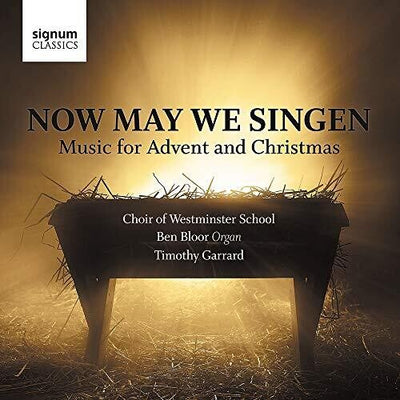
    Now May We Singen

    CD · 1 disc

    $19.99
    Composer
    VARIOUS
    Artist
    Bloor, Mann, Sullivan, Garrard
    Released
    Sep 20, 2019
    The Choir of Westminster School blends the ancient and modern in this festive collection of choral works, drawing on Advent and Christmas music by composers including Judith Weir, James MacMillan, John Tavener, Roxanna Panufnik and Ralph Vaughan Williams. With a national reputation for excellence, the Choir of Westminster school gives annual concerts at the Barbican and performs regularly at venues including Westminster Abbey, St John's Smith Square and the Houses of Parliament. Under the direction of Timothy Garrard, Director of Music, the Choir rehearses regularly throughout the week in preparation for twice-weekly services in Westminster Abbey and evensongs in the School Chapel.
    View full page
  • Now May We Singen

    Now May We Singen

    Signum Classics Sep 2019
    1 disc
    CD
    $19.99
    Signum Classics

    Christmas with St. John's / Nethsingha, Choir of St. John's Cambridge

    CD · 1 disc

    $19.99
    Composer
    GRUBER RUTTER TRANCHELL
    Artist
    Nethsingha
    Released
    Aug 12, 2016
    The St. John's College Choir (men and boys) has enjoyed wide success with previous holiday releases, partly due to excellent engineering, more due to the clarity of the choral singing, and most of all due to the fresh and coherent programming concepts offered by director Andrew Nethsingha. Here you get a variety of short pieces rooted in, but not hewing to, traditional carols, a few by well-known composers (John Rutter, Bob Chilcott, Peter Warlock), the majority by names that will be new even to many English listeners. The overall mood is meditative, with just a few of the bumping-along, organ-accompanied sorts of work; much of the music is a cappella. A wonderful holiday release with a good measure of seriousness.

    – All Music Guide (James Manheim)
    View full page
  • Christmas with St. John's / Nethsingha, Choir of St. John's Cambridge

    Christmas with St. John's / Nethsingha, Choir of St. John's Cambridge

    Signum Classics Aug 2016
    1 disc
    CD
    $19.99
    St. Olaf Records

    Promise of Peace: St. Olaf Christmas Festival 2022

    CD · 2 discs

    $10.99 $21.99 Save 50%
    Composer
    Fredrik Melius Christiansen, Various
    Artist
    St. Olaf Cantorei, Manitou
    Released
    Oct 13, 2023

    Promise of Peace is the audio recording of the full-length 2022 St. Olaf Christmas Festival, held in Minneapolis on December 2-3; 2022. Recorded live in Orchestra Hall, this album features performances from the St. Olaf Choir; St. Olaf Orchestra; St. Olaf Chapel Choir; St. Olaf Cantorei; Manitou Singers; and Viking Chorus.

    View full page
  • Promise of Peace: St. Olaf Christmas Festival 2022
    Sale

    Promise of Peace: St. Olaf Christmas Festival 2022

    St. Olaf Records Oct 2023
    2 discs
    CD
    $21.99 $10.99Save 50%
  • Journey Into Light - Music for Advent, Christmas, Epiphany &

    Journey Into Light - Music for Advent, Christmas, Epiphany &

    Signum Classics Jan 2012
    1 disc
    CD
    $19.99
  • BLUES EVERYWHERE I GO

    BLUES EVERYWHERE I GO

    Arte Verum Sep 2015
    CD + Vinyl
    $26.99
  • JAMES, Harry: Concerto for Trumpet (1939-1941)

    JAMES, Harry: Concerto for Trumpet (1939-1941)

    Naxos Nov 2002
    1 disc
    CD
    $19.99
  • MONTEVERDI: IL RITORNO DI ULISSE IN PATRIA

    MONTEVERDI: IL RITORNO DI ULISSE IN PATRIA

    ERATO Dec 2017
    2 discs
    DVD
    $23.49
  • British Music for Strings, Vol. 5
    CPO

    British Music for Strings, Vol. 5

    CD · 1 disc

    $18.99
    Composer
    Balfour Gardiner, Eugene Goossens, Imogen Holst, Dorothy Howell, Gordon Jacob, William Mathias
    Artist
    Sudwestdeutsches Kammerorchester Pforzheim, Douglas Bostock
    Released
    Oct 02, 2026
    Good things come in fives, said conductor Douglas Bostock as he set out to prepare a truly unrivalled selection of British works for string orchestra for this cpo recording. Over the past few years, he has created a stunning kaleidoscope in which international luminaries (Elgar, Parry, Bantock, Ethel Smyth) and more national figures join together in these recordings in an enlightening and uplifting way. The release of this fifth volume marks not only the conclusion of the series, but also the end of an era. After seven years in the role, Douglas Bostock is stepping down as principal conductor of the Sudwestdeutsches Kammerorchester Pforzheim, an orchestra that has provided him with outstanding support in this homage to his homeland. And once again, the sons and daughters of Albion rise up and soar over their unique musical landscapes - Imogen Holst draws inspiration from an old picaresque novel, Gordon Jacob delivers brilliant variations on a theme by Purcell, the conductor Eugene Goossens demonstrates his creative imagination, and finally, despite his "progressive" tone, the Welshman William Mathias leaves no doubt as to where he was born. A thoroughly successful finale!
    View full page
  • Vaughan Williams, Mathias / Bebbington, Ulster Orchestra
    SOMM Recordings

    Vaughan Williams, Mathias / Bebbington, Ulster Orchestra

    CD · 1 disc

    $20.99
    Composer
    VAUGHAN WILLIAMS MATHIAS
    Artist
    Bebbington, Vass
    Released
    Mar 01, 2011
    These three very different works have been dealt with admirably. A huge sympathy and understanding is evident.

    3612260.az_MATHIAS_Piano_Concertos_1.html

    MATHIAS Piano Concertos: No. 1; No. 2. VAUGHAN WILLIAMS Fantasy • Mark Bebbington (pn); George Vass, cond; Ulster O • SOMM SOMMCD 246 (70:42)


    An English online reviewer wrote that it is always interesting to hear early works by Ralph Vaughan Williams. Interesting yes, because of what came later, but this Fantasy—begun in 1896 and finally completed in 1904—does not hold a great deal of interest for its own sake. Vaughan Williams did not find his true voice as a composer until he incorporated the modality of British folk song into his music. Here we have second-hand Brahms. Additionally, the piano was not Vaughan Williams’s instrument, and the keyboard writing in the Fantasy speaks of application rather than fluency. Even in the highly individual and much more successful Piano Concerto of 1931, the soloist is given full chords and double-octave passages that sound heavy and cumbersome. Much of this Fantasy strives for grandeur, a quality Vaughan Williams achieved in spades in works like the Sea Symphony and Job , but in this case the result seems empty, partly due to an absence of memorable thematic material and the lack of a personal voice. The composer suppressed this piece, along with a good deal of his other early work, and it remained unknown until after his death.


    By contrast, the Welsh composer William Mathias (1934–92) seemed to find his voice early: a Celtic lyricism sitting alongside a hard-edged rhythmic vitality that is clearly Stravinskian. Mathias also had an identifiable sound as an orchestrator, often pointing rhythmic passages and climaxes with tuned percussion. His Piano Concerto No. 1 was written in 1955 when the composer was a 20-year-old student. The work greatly impressed Edmund Rubbra, among others. It is a three-movement concerto with buoyant outer movements but a rather stern (perhaps self-consciously modern) central Largo. After several performances Mathias withdrew the concerto, but was reconsidering editing it for publication when he died.


    The standout on this disc is Mathias’s Second Piano Concerto of 1961. Clearly influenced by Tippett’s Piano Concerto, but none the worse for that, it combines strength with fluidity. The work is in four movements: a lyrical prelude, a tough allegro molto vivace , a brief lento leading into a multifaceted finale marked allegro alla danza . Tippett is recalled in the glittering high figuration of the piano part, and stentorian brass fanfares making use of the interval of the major second to harden their harmonies—but these are also fingerprints we associate with the mature Mathias. For the record, both these concertos precede other recorded concertos by the composer: those for harp, clarinet, and the third for piano (Lyrita), and the Oboe Concerto (Nimbus).


    Mark Bebbington has made several fine discs of little-known English music and this is one of the best. He is sensitive to all the technical and interpretive demands of these highly contrasting composers. George Vass and the Ulster Orchestra provide immaculate support, and the recording is clear and well balanced. Highly recommended.


    FANFARE: Phillip Scott


    ---------

    I first came across Ralph Vaughan Williams ‘Fantasia’ for piano and orchestra whilst carefully studying the 1996 imprint of Michael Kennedy’s invaluable ‘A Catalogue of the Works of Ralph Vaughan Williams’. It was one of many pieces that were hidden from view and were likely to remain so due to an embargo on works that the composer had withdrawn or laid aside around the end of the Great War. These included The Garden of Prosperine, the Heroic Elegy, the Bucolic Suite and the present Fantasia (Fantasy). They were works that I imagined I would never hear. Fortunately Ursula Vaughan Williams lifted the embargo and in recent years a number of these compositions have been recorded. Each time I have listened to one of these re-discovered pieces I have felt that the musical world has been cheated of a great piece of music for such a long time. This is the case with the present Fantasy. It may not be one of the composer’s masterpieces, but it is certainly a work with which the listener can do business.

    This twenty-one minute score was originally begun in October 1896 and was finally completed on 9 February 1902. It was subsequently revised in 1904. Since then it has lain in the British Library. This Fantasy (Kennedy refers to Fantasia) is regarded as a ‘student’ piece by critics, however it must be realised that RVW continued studying until relatively late in life. His sojourn with Ravel was during 1907/08 when the composer was thirty-five years old! The present work was begun when he was 24 years old and finished when he was 32. So it is hardly a neophyte’s ’prentice piece.

    For many listeners RVW is not normally associated with the pianoforte. To be true he made use of it in his Double Piano Concerto and in Fantasia on the Old 104 th Psalm Tune. Both of these works have their enthusiasts and have been reappraised in recent years. However, there are only a handful of solo piano works, not a few of which are arrangements of other works or are teaching pieces.

    The form of the Fantasy is in one movement of six sections with an overall structure of slow-fast-slow. Without perusing the score it is hard to say how idiomatic the solo part is: how well it fits under the pianist’s hands. However the impression is that it has all the hallmarks of a ‘romantic concerto’.

    Many listeners will play ‘spot the influence’. And it is not hard to hear all sorts of things going on in this work. Certainly Brahms and Grieg are never too far from the second section. Rob Barnett at MusicWeb International has identified a mood of orthodox chant: I felt that Mussorgsky’s Pictures at an Exhibition was recalled. Liszt is amongst the exemplars. However, this is no stitching together of other composer’s music. Vaughan Williams has created a valid work that reflects the times in which it was written and possibly the fact that he had studied with Stanford and latterly Max Bruch. Finally, there are moments when the ‘real’ RVW stands revealed and we hear intimations of Job (is it my imagination?) and the later symphonies. It is this, more than anything that makes the Fantasy such an important work to have on disc.

    William Mathias has been reasonably well-served with recordings. Just a quick glance at the Arkiv catalogue reveals some 77 discs dedicated to, or featuring music by, the composer. However there are a number of critical works missing from these listings. For example I believe that there is no recording of the Concerto for Orchestra, Litanies and the Holiday Overture. The present CD fills in an important gap with the early Piano Concerto No.1 which dates from 1955 and the Second Concerto from some five years later. Lyrita have already presented the Third Concerto on SRCD325.
    Dr Rhiannon Mathias has noted that her father ‘always held a fascination’ for the concerto form. Apart from the piano concertos, there are ‘one each for flute, oboe, clarinet, violin, horn, organ, harp and harpsichord’ in the composer’s catalogue as well as a couple of early concertos written when in his teens.

    The Piano Concerto No.1 seems to me a very confident and well-wrought work for a nineteen year old student at Aberystwyth University, although it is in no way precocious. Apparently, the work seriously impressed Edmund Rubbra, who was the external examiner. The work was premiered in London on 19 May 1957. After a few more performances it was withdrawn.

    The concerto is written three well-balanced movements. The Guardian critic of this present CD rightly points out that this work is ‘angular’ in its effect. However this is not the whole story: the slow movement contains ‘nocturnal’ music that is particularly reflective and beautiful. However, much of the concerto does nod to Bartók and Prokofiev although this is presented with many of the fingerprints that were to dominate much of Mathias music over the next thirty-five years. For example, we hear sharp harmonies and syncopated rhythmic figures and the playing of the main themes together rather than separately. The piano part has been described as ‘exhilarating’ and this mood is well reflected in Mark Bebbington’s interpretation of the work. The score for this recording was prepared and edited by Dr Rhiannon Mathias.

    From the ‘cool’ opening bars of the Piano Concerto No. 2, Op. 13 we are in a different world to the earlier piece. This is a lyrical work that is suffused with poetry. Much of the opening movement is reflective and perhaps even tentative in its exploration of the two main themes. However there are moments of tension and even angst in these pages.

    Mathias has added a ‘scherzo’ in all but name. In fact, it is presented as a ‘danse infernale’ which promotes music of ‘ferocious energy’ that utilises ‘brittle and rhythmically alert’ themes and harmonies. This is in complete contrast to the typically gentle first movement.

    The ‘lento’ is the heart of the work and has an improvisatory feel to much of the proceedings. That said there is a structure to this movement that references a theme from the first movement, and gradually leads the music to a ‘nobilmente’ climax before a brief link passage leads to the concluding ‘rondo.’ This is Mathias dance-music at its best: from the initial solo piano statement of the main theme to the concluding riot of sound this music impresses. The composer makes use of themes from earlier movements and this gives the ‘rondo’ a sense of unity and purpose.

    This is a work that is difficult to tie down for influences: I have detected Malcolm Arnold and Michael Tippett, but the truth is that this is William Mathias’s own unique sound-world at its best. It is hard to see why this concerto is not so much more popular and regularly played.

    The work was commissioned by the Welsh Committee of the Arts Council of Great Britain, and was duly given its first performance at the 1961 Llandaff Festival.

    It almost goes without saying that Mark Bebbington’s playing is superb throughout the entire disc. Bebbington has done so much for British music in recent years, with his cycles of music by John Ireland and Frank Bridge, the Dale and Hurlstone Sonatas and the Ferguson and Bax piano concertos. In the present disc the playing of these three very different works call for a wide range of interpretation and technical styles. These have been dealt with admirably and suggest a huge sympathy towards, and understanding of, these works.

    As usual with SOMM recordings, everything is ‘done decently and in order’: the sound reproduction is first, the cover painting by James Hamilton Hay (1874-1916), the sleeve-notes, the background preparation of the scores by Dr Graham Parlett and Dr Rhiannon Mathias. It all adds up to an excellent production.

    It seems redundant to say that I recommend this CD! Every RVW enthusiast will demand a copy for the World Premiere Recording of the Fantasy. I guess that fewer listeners will be Mathias fans - however, they ought to be! - but these two works, again premiere recordings, are important additions to the catalogue of British (Welsh) piano concertos. For fans of William Mathias they are essential: for newcomers to his music they are a fine introduction to a great composer who has a style that is largely all his own.

    -- John France, MusicWeb International
    View full page
  • Vaughan Williams, Mathias / Bebbington, Ulster Orchestra
    Sold Out

    Vaughan Williams, Mathias / Bebbington, Ulster Orchestra

    SOMM Recordings Mar 2011
    1 disc
    CD
    $20.99
    Chandos

    On Christmas Night / Nethsingha, Choir of St. John's

    SACD · 1 disc

    $21.99
    Composer
    RUTTER BURTON MATHIAS DARKE
    Artist
    Cambridge, Nethsingha, Challenger
    Released
    Oct 25, 2011
    This excellent and most enjoyable disc will be a high quality Christmas present for a musical friend - or to give to yourself!

    It’s four years now since Andrew Nethsingha moved from Gloucester Cathedral, where he had been a distinguished Director of Music, to St. John’s College, where as part of his training he had once been the Organ Scholar, under George Guest. Having established himself securely with the college’s choir he’s begun recording with them for Chandos and the partnership has already produced some impressive results. These include a very fine Howells collection, an equally good mixed recital of church music and a disc of music by Lassus, which I haven’t heard but which impressed my colleague, Gavin Dixon. Their latest offering is of music for Advent and Christmas; in every respect it maintains the high standards set by their previous releases.

    Before commenting on the music, can I commend Chandos for the quality of the booklet? This label is always strong on documentation but there must be a temptation for record companies to economise a little on such releases - “it’s only carols”. In fact, Chandos provide all the texts and, best of all, a really useful and thorough essay by Martin Ennis, which includes a separate and interesting paragraph on every one of the twenty-four items on the programme. The essay, in fact, is a model of its kind and the best I can recall seeing for a release of seasonal music.

    The programme has been very carefully chosen and includes a welcome mix of the familiar, the unfamiliar and the familiar in slightly less-than-familiar guise. Into this latter category would come items such as the exuberant and effective arrangement by Philip Marshall, the former organist of Lincoln Cathedral, of I saw three ships. The version of Ding! dong! merrily on high would also fall into the exuberant, indeed flamboyant, category. It was made by the Music Director of the Mormon Tabernacle Choir and requires two organists. The organ features strongly - and most effectively - in Stephen Jackson’s arrangement of Noël nouvelet. Indeed, the organ writing is a key element in giving the setting its pronounced French flavour. It’s good to see Andrew Nethsingha give a bow to one of his predecessors at St. John’s, Christopher Robinson. Instead of the usual - and excellent - Willcocks descant to Hark! the herald angels sing we hear Robinson’s descant and a jolly good one it is!

    Moving to the unfamiliar elements in the programme we find Christopher Robinson there too. I’d not heard before his setting of Make we joy - a text more famously set by Walton. I like this Robinson setting very much indeed; it’s buoyant and strongly rhythmic. Also new to me was Michael Finnissy’s Telling. Written in 2008, this is a setting for unaccompanied choir of an anonymous sixteenth century text. Martin Ennis draws attention, rightly, to the “refined harmonic sensibility” of the piece. I think it’s a beautiful composition and, in an intelligent piece of programme ordering, we find that Kenneth Leighton’s fine Coventry Carol, which comes next in the running order, complements the Finnissy nicely. Mention should also be made of Matthew Martin’s Adam lay ybounden. This is very different from some other settings - one thinks of Boris Ord’s celebrated setting, for starters. Martin’s piece is slow and reflective and it’s good to have another slant on this well-known text. I also liked the item by James Burton, perhaps best known as Director of the Oxford Schola Cantorum. His Balulalow eschews trebles - the altos take the top line - giving an interesting, darker texture. Some of the harmonies are quite close and I think it’s a lovely piece.

    And so to the familiar seasonal items. It’s right to include them to give the programme balance. Nethsingha and his singers pay these pieces - and their listeners - the important compliment of taking as much care over them as they have done over the less conventional fare. Harold Darke’s classic piece is given a lovely performance and lovely too is the choir’s account of Philip Ledger’s sympathetic arrangement of Silent Night - good planning, too, to place this immediately after his equally good arrangement of the Sussex Carol. Ledger’s predecessor at King’s College, Sir David Willcocks, is represented by his justly popular Tomorrow shall be my dancing day. O little town of Bethlehem, mainstay of innumerable carol services, makes an equally welcome appearance. It wouldn’t be a Christmas programme without John Rutter. When you hear his lovely What sweeter music, which, as Martin Ennis justly observes, contains “one of his most winning melodies”, you realise just why for so many people Rutter has become synonymous with Christmas music. The present performance is first class, with every little detail of Rutter’s music nicely observed.

    The singing on this disc is very fine indeed. Solos are well taken and the choir as a group blends extremely well and sings with excellent tone and great clarity. Several of the pieces are accompanied by organ and the college’s Senior Organ Scholar, John Challenger, does a marvellous job. I relished especially his splendid contributions - very different from each other in character - to the Jackson and Mathias pieces.

    It only remains to say that the Chandos sound is up to the label’s usual exalted standard - I listened to this hybrid SACD as a conventional CD. This most enjoyable disc will be a high quality Christmas present for a musical friend - or to give to yourself!

    -- John Quinn, MusicWeb International
    View full page
  • BLACK DYKE MILLS BAND: Champions of Brass
    Sold Out

    BLACK DYKE MILLS BAND: Champions of Brass

    Chandos May 1992
    1 disc
    CD
    $6.99
  • Swing
    Sold Out

    Swing

    Sony Masterworks Nov 1994
    1 disc
    CD
    $11.98