Search results: Search results

63 results

Products

    Profil

    Bruckner: Symphony No. 3 / Nezet-Seguin, Staatskapelle Dresden

    CD · 1 disc

    $18.99
    Composer
    BRUCKNER, ANTON
    Artist
    Staatskapelle Dresden, Nezet-Seguin
    Released
    Nov 11, 2016

    It was a debut that will long be remembered. It was in October 2006 that Yannick Nezet-Seguin first conducted the Dresden Staatskapelle, which with its invitations to younger conductors in particular was increasingly emerging “as a talent scout for the next generation of baton-wielders” (German daily Die Welt). The 31-year-old newcoming, whose very name was a tonguetwister for most, had hitherto attracted the most attention in his native Canada; since 2000 he had been directing the Orchestre Metropolitain, little brother of the Orchestre Symphonique in his birthplace of Montreal. After debuts with orchestras in Toulouse, Goteborg and Birmingham, he was now in the Semperoper, standing for the first time in his life before one of Europe’s long-established, tradition-steeped orchestras. Nezet-Seguin was no disappointment. In fact, he was just the opposite. Straight away at rehearsals, it was obvious that this young man knew exactly what he wanted in works by Britten, Ravel and Shostakovich; in concerts, he was in full command of musicians and audience alike with his energetic and precise conducting manner, his sens of sound and rhythmic structures. Word soon got around that news of “the Great Canadian Conductor for whom this country’s classical music buffs have been waiting” (Toronto Star) was more than a mere marketing device. And people believed him when he admitted that conducting had been “like a vocation” for him ever since he was ten years old. “Today I have the feeling that I am living the dream I had as a little boy,” he confessed.

    View full page
  • Bruckner 3 - Version 1877
    Profil

    Bruckner 3 - Version 1877

    CD · 1 disc

    $20.99
    Composer
    Anton Bruckner
    Artist
    Philharmonie Festiva
    Released
    Jan 17, 2025
    Despite all the warnings from the prophets of doom, Bruckner's music has thankfully prevailed. Bruckner was always in search of the ideal structure for his symphonies. Dissatisfaction and perfectionism both caused him anguish and served as motivation in his determination to advance on an artistic level. His goal was to compose absolute music in the spirit of Beethoven. It is his Third Symphony above all, "in which the trumpet introduces the theme", that encapsulates this striving for absolute music - music that is timeless and continues to touch people's hearts.
    View full page
  • Bruckner 3 - Version 1877

    Bruckner 3 - Version 1877

    Profil Jan 2025
    1 disc
    CD
    $20.99
  • Bruckner: Symphonies Nos. 4 & 5 / Bohm, Staatskapelle Dresden

    Bruckner: Symphonies Nos. 4 & 5 / Bohm, Staatskapelle Dresden

    Profil Feb 2012
    2 discs
    CD
    $24.99
    Profil

    Mozart: 4 Complete Operas - 1955 Historical Recordings

    CD · 10 discs

    $37.99
    Composer
    Wolfgang Amadeus Mozart
    Artist
    Lisa Della Casa, Christa Ludwig, Erich Kunz, Anton Dermota, Emmy Loose, Paul Schoffler, Wiener Philh
    Released
    Apr 07, 2023

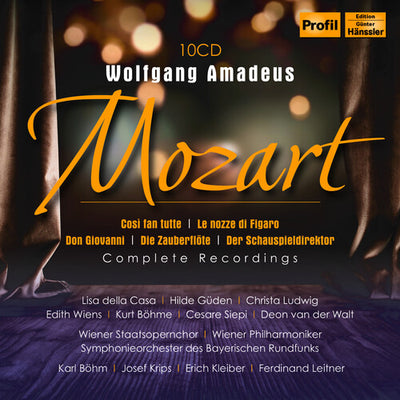
    Mozart created 22 stage works in his lifetime. This 10 CD box comprises the world-famous ‘evergreens’ in historical recordings from Vienna 1955. Soloists are Christa Ludwig, Lisa Della Casa, Hilde Gülden, Alfred Poell, Cesare Siepi, Fernando Corena, Kurt Böhme and many more.

    REVIEW:

    Böhm's conducting creates a slim, fluid Mozart sound in which the dynamic pendulum could swing a little more impulsively here and there, but which still has an instinctive feel for theatrical and dramaturgical diction on the one hand and interaction with the singers on the other.​

    -- Klassik.com

    View full page
  • Mozart: 4 Complete Operas - 1955 Historical Recordings

    Mozart: 4 Complete Operas - 1955 Historical Recordings

    Profil Apr 2023
    10 discs
    CD
    $37.99
    Profil

    Bruckner: Symphony No. 5 / Gerd Schaller

    CD · 1 disc

    $19.99
    Composer
    Anton Bruckner
    Artist
    Gerd Schaller
    Released
    May 05, 2023

    Bruckner’s Fifth is eminently suited to an arrangement for performance on the organ above all because of its musical texture. In no other Bruckner symphony, for example, does counterpoint play such an important part. I am thinking in particular of the great fugue in the final movement. It really does seem as if many passages of this magnificent work were composed as if with the organ in mind, even though the Fifth is not a piece for organ at all, being in the first place a symphonic work. And yet it lends itself admirably to the extraction of a compositional substrate with no loss of essential content. That cannot be said of all Bruckner’s symphonies. Of all his symphonies, in my opinion, the Fifth, Eighth and Ninth are most amenable to an arrangement for organ. Building on the compositional core, it is the orchestral treatment above all that plays a key role. If this is lacking, an arrangement of the work can deprive the work of its grandeur. That is again at risk if one attempts to copy the orchestra or to transpose certain orchestral effects one-to-one onto the organ. Such an approach is generally unsatisfactory, because organ writing is governed by different rules than those applying to orchestral scoring. It would be fatal to make the organ rival the orchestra. My aim from the start was to avoid imitating the orchestra and to create a work specifically for organ in the manner of an organ symphony.

    View full page
  • Bruckner: Symphony No. 5 / Gerd Schaller

    Bruckner: Symphony No. 5 / Gerd Schaller

    Profil May 2023
    1 disc
    CD
    $19.99
    Profil

    Bruckner: Symphony No. 2 / Schaller, Philharmonie Festiva

    CD · 1 disc

    $9.99 $19.99 Save 50%
    Composer
    Anton Bruckner
    Artist
    Philharmonie Festiva
    Released
    Feb 02, 2024

    Anton Bruckner's Second Symphony is certainly one of the most interesting symphonies in the cycle, even for musical amateurs, due to a number of special features. Inside Bruckner 2024: The complete symphonies in all essential versions.

    View full page
  • Bruckner: Symphony No. 2 / Schaller, Philharmonie Festiva
    Sale

    Bruckner: Symphony No. 2 / Schaller, Philharmonie Festiva

    Profil Feb 2024
    1 disc
    CD
    $19.99 $9.99Save 50%
  • Bruckner: Symphony No. 4 in E-Flat Major "Romantic"
    Profil

    Bruckner: Symphony No. 4 in E-Flat Major "Romantic"

    CD · 1 disc

    $9.99 $19.99 Save 50%
    Composer
    Anton Bruckner
    Artist
    Philharmonie Festiva
    Released
    Jun 07, 2024
    Bruckner requests a favourable reception for his Fourth Symphony, commending the work in these terms: "It is the most accessible and popular of my works and was a huge success when performed in Vienna. As a consequence of a recent letter from Munich, our Emperor has begun to take an interest in me."
    View full page
  • Bruckner: Symphony No. 4 in E-Flat Major "Romantic"
    Sale

    Bruckner: Symphony No. 4 in E-Flat Major "Romantic"

    Profil Jun 2024
    1 disc
    CD
    $19.99 $9.99Save 50%
    Profil

    Bruckner: Symphonies 4, 7 & 9 / Schaller, Philharmonie Festiva

    CD · 4 discs

    $38.99
    Composer
    BRUCKNER, ANTON
    Artist
    Gerd Schaller
    Released
    Aug 30, 2011


    BRUCKNER Symphonies: No. 4, “Romantic”; No. 7; No. 9 (Finale completion by William Carragan) • Gerd Schaller, cond; Philharmonie Festiva • PROFIL PH11028 (4 CDs: 214:16) Live: Erbrach 7/29/2007, 7/29/2008, 8/1/2010


    The main interest here will be in William Carragan’s completion of Bruckner’s extensive sketches for the finale of the Ninth. The completion supplies architectural context for the first three movements, thus providing a valuable corrective to posterity’s deeply ingrained perception of this symphony as “unfinished,” like Schubert’s Eighth (coincidentally, both “ending” with a slow movement in an exotic, otherworldly E Major). That said, I find myself ambivalent about the enterprise for two reasons. First, the quality of the existing music: Although Bruckner left a lot of the movement in a relatively advanced state of sketching—the complete exposition and substantial portions of the development and recapitulation—much of the thematic content itself nevertheless leaves an arid, underdeveloped impression that (to my ears) fails to approach the level of the preceding movements. If he had lived to do more with it, he would surely have transformed it far beyond its existing state. More seriously, much of the movement is completely missing (including all of the coda); in contrast to the finale of Mahler’s 10th, we lack any kind of comprehensive blueprint to work with, in the form of a continuity draft for the entire movement. Carragan’s completion comes into competition with an alternative one by Nicola Samale and Giuseppe Mazzuca, which has been recorded by Eliahu Inbal and the Frankfurt Radio Orchestra (Teldec). Given the lack of any concrete sketches for the coda, any conjectural realization will effectively be an original composition. Carragan’s coda is longer and more imposing than Samale-Mazzuca’s, using, in addition to thematic recalls from the first movement, references to the first movement of the Eighth, as well as borrowing the chorale-apotheosis strategy from the finale of the Fifth.


    This performance is billed as the recorded premiere of Carragan’s 2010 revision, but his own notes don’t offer any information on how it differs from his earlier version. That was recorded in 1996 by Yoav Talmi with the Oslo Philharmonic (Chandos), but since I don’t know that recording I can’t comment on differences. In any event I’m glad to have both the Carragan and Samale-Mazzuca completions. Another tack is taken by Harnoncourt and the Vienna Philharmonic (RCA, live), who present Bruckner’s sketches in the format of a lecture-recital, without adding anything (spoken commentary in both German and English)—here, I must confess I find their breaking off with the end of the sketches a more moving experience than anyone’s entirely conjectural original composing.


    So there’s much of interest here, although I would have thought that a release of the Ninth alone might have been a more competitive proposition—how many prospective purchasers will really want yet another Fourth and Seventh played by a less-than household-name conductor and orchestra?


    Happily, the performances are consistently fine ones that will grace any Bruckner collection. The Philharmonie Festiva is none other than the famous Munich Bach Orchestra, augmented for the purpose by players from the other Munich orchestras. They make a handsome sound—rich, sweet, recognizably Bavarian. The recorded acoustic (the Abbey Church in Ebrach) is ideal for Bruckner, reverberant but with plenty of bite and detail.


    The Fourth is lyrically shaped with a natural flow, played straight with little deviation from the initially established tempos, though by no means inflexible. There are many imaginative details, starting with the evocatively tapered horn phrases at the opening. Indeed, the brass playing throughout is of exceptional quality, conjuring the work’s forest atmosphere most effectively. I occasionally miss the stronger interpretive profile of the great Bruckner conductors of the present and recent past (e.g., Abbado, Dohnányi, Harnoncourt, Wand)—as in the Andante, whose grey expanses don’t have quite enough tension to my ears.


    The Seventh also goes beautifully, with a singing intensity, transparent textures, and an atmospheric first-movement coda. The Adagio has an attractive quality of breathing spontaneity, and an ear-catching sheer beauty of sound, from the thrilling amplitude of the C-Major climax to the purple-hued low brass in the coda. Schaller captures the Scherzo’s rustic Schwung in rich colors and biting detail, while his finale is less febrile than usual (13:00) with perhaps just a hint of stolidity.


    As for the familiar portion of the Ninth, the first movement is beautifully lucid with much absorbing textural detail—for example, in the thickly scored stretches of the exposition’s closing section (Rehearsal G ff.), or the nightmarish march episode inserted into the recapitulation (Rehearsal O ff., A?-Minor). Altogether the music’s keel comes across as slightly too even, including a noticeable tendency to smooth out Bruckner’s injunctions to short articulations (for instance, in the quickening woodwind figure at Rehearsal A, along with the preceding violin motive in quarter notes, mm. 28 ff.). The Scherzo is taken slower, and is less demonic in character, than usual, but still very powerful in its smooth, weighty way. The E-Major Adagio is straight, lucid, and lyrical, well shaped and sonorously imposing, if expressively less febrile than some.


    Overall, these are high-quality performances of much distinction, and the rarity of Carragan’s completion makes the set a desirable proposition for Bruckner collectors.


    FANFARE: Boyd Pomeroy


    --------

    These performances were given at the Ebrach Summer Music Festival as part of the Bruckner Festival in 2007, 2008 and 2010. In co-operation with Bavarian Radio the recordings were made in the glorious setting of the Ebrach Abbey church in Bavaria which on this evidence has a splendid acoustic.

    The Philharmonie Festiva may be a new name to many readers. This is a highly accomplished orchestra comprising mainly members of the Munich Bach Soloists augmented by musicians from the Bavarian Radio Symphony Orchestra and the Munich Philharmonic. Taking the baton is Bamberg-born conductor Gerd Schaller who is the founder and musical director of the Ebrach Summer Music Festival.

    The performance of the Ninth Symphony contains the first recording of the revised 2010 version of the finale completed by William Carragan. Carragan is a contributing editor of the Anton Bruckner Collected Edition and has prepared a new edition of Bruckner’s Symphony No. 2. From 1979 to 1983 he worked on a finale for the Bruckner Ninth. That first completion can be heard from the Oslo Philharmonic Orchestra conducted by Yoav Talmi on Chandos CHAN 8468/9 but revisions also followed in 2003 and 2006.

    Composed in 1874, the Symphony No. 4 in E flat major, known as the Romantic, has been given wholesale revisions at various times. The 1878/1880 version recorded on this disc has been described by composer and musicologist Robert Simpson as, “ clean and lean”. The memorable opening under Gerd Schaller is marvellously done; immediately convincing. Schaller’s pacing is impressive navigating the flow and broad sweep of the writing with broad assurance. The horns have a significant part throughout and the Philharmonie Festiva brass is in impressive form displaying a burnished tone.

    Composed in 1881-83, the Symphony No. 7 in E major is the most popular of Bruckner’s symphonies and it brought the composer the greatest success he had known. It was Arthur Nikisch who conducted the première at Leipzig in 1884. Schaller attains great nobility in a performance that leaves a powerful effect. The orchestral climaxes are remarkable with Schaller astutely building the tension from calm hush to furious climax.

    Bruckner was working on his Symphony No. 9 in D minor at the time of his death in 1896. The first three movements were completed with sketches left for a fourth. Bruckner said, “ I have served my purpose of earth; I have done what I could, and there is only one thing I would still like to be granted: the strength to finish my Ninth Symphony.” At Bruckner’s own suggestion the unfinished symphony was often performed with the Te deum serving as the final movement. For this Ebrach Abbey performance Schaller uses the revised 2010 version of the final movement as completed by William Carragan. In this reading I was struck how confidently Schaller demonstrates a real understanding of the score’s structure. There’s a splendid clarity about his reading. In addition I love the way Schaller emphasises the spiritual qualities especially in the gloriously played second movement Adagio.

    This is a really impressive release. The engineers have done a remarkable job providing a clear, well-balanced sound. There are decent notes in the booklet. Carragan’s completion of the Ninth Symphony is an added attraction.

    -- Michael Cookson, MusicWeb International

    View full page
  • DIABELLI: Grande Sonate Brillante
    Sale

    DIABELLI: Grande Sonate Brillante

    Profil Oct 2005
    1 disc
    CD
    $10.99 $5.49Save 50%
    Profil

    Cornelius: Der Barbier von Bagdad / Leitner, West German Radio Symphony

    CD · 2 discs

    $12.49 $24.99 Save 50%
    Composer
    CORNELIUS, PETER
    Artist
    Duesing, Peter, Donath, Laitner, Wdr So Koln
    Released
    Sep 30, 2008
    In comic operas there are stock figures. One of these is the bass, often conceited and self-important, silly or evil – or both – who often ends up being ridiculed, humiliated and has to humble himself. We first meet him in Uberto in Pergolesi’s La serva padrona, then in Il barbiere di Siviglia – Paisiello’s as well as Rossini’s – as Doctor Bartolo. Mustafa in L’Italiana in Algeri is a close relative, as is Don Magnifico in La Cenerentola. The eponymous anti-hero in Don Pasquale is also a pitiable character – the slimy Dulcamara in L’Elisir d’amore less so. Later in history Sir John in Verdi’s Falstaff is possibly the most complex character in this mould, thanks to Boito’s masterly condensation of Shakespeare’s portraits and Verdi’s music. He has predecessors: Salieri wrote a Falstaff before Verdi was even born. On German ground Otto Nicolai created a rather likeable character in Die lustigen Weiber von Windsor. In operas by Lortzing and Flotow we encounter similar second cousins. We shouldn’t forget Osmin in Die Entführung aus dem Serail either. A lesser known but well delineated relative within the German sphere is Abul Hassan Ali Ebn Bekar, the larger-than-life barber in Peter Cornelius’s Der Barbier von Bagdad. He isn’t an evil person, quite the contrary, but he is a big braggart and manages to make a mess of things. The plot goes back to a story from ‘The Arabian Nights’ and a condensed version goes something like this:

    The young and rich Nureddin is deeply in love with Margiana, the daughter of the Cadi. His childhood friend, Bostana, arranges a meeting and Nureddin sends for Abul Hassan Ali Ebn Bekar, the best barber in town, to make him presentable. The barber is more interested in talking about his knowledge of art and science and Nureddin asks his servants to throw him out. The Barber turns furious and chases the servants, knife in hand, but some tactical flatteries makes him calm down and do his job. When Nureddin tells him about his approaching meeting, the barber gets so excited that he offers to accompany Nureddin. In the second act the two lovers meet but are disturbed by the sudden return of the Cadi. Nureddin hides and when the barber hears cries from a slave being punished he believes it is Nureddin and rushes into the house. Believing Nureddin to have been murdered he sends for the Caliph, who arrives. Nureddin is found and pressurised by the Caliph. The Cadi accepts that the young couple should be married. The verbose barber makes such an impression on the Caliph that he is invited to work for him.

    Not one of literature’s masterworks, maybe, but much thinner and more incomprehensible librettos have been successfully set to music. Cornelius’s opera was not a success at the premiere on 15 December 1858 at Hoftheater in Weimar. The composer describes the disaster as follows:

    ‘My work had drawn a full house. The performance filled the evening and was excellent, splendid, considering the difficulties the work presents. Right from the start, the applause was accompanied by persistent hissing from a hired, well-organized and expediently distributed group that was unprecedented in the annals of Weimar … At the end there was a fight lasting ten minutes.’

    The reason for the debacle was decidedly not the quality of the music or the play. This was a protest against the conductor of the evening, Franz Liszt, whose radical ideas were not to everybody’s liking – and it was successful. The production was taken off the repertoire and Liszt resigned and left Weimar for good. But the one who suffered the most was Cornelius, who never saw his opera staged again during his lifetime. It was revived about twenty years later, again with no success. In 1884 in Karlsruhe, Felix Mottl – who orchestrated Wagner’s Wesendonck-Lieder – presented it, but in truncated and altered form. It was not until 1904 that it was staged in its original shape. After that it was regarded as one of the best German comic operas – next to Die Meistersinger von Nürnberg according to some judges.

    I hadn’t heard the opera before, although there exist two studio recordings. Columbia set it down in London in 1956 with Erich Leinsdorf conducting and a starry cast including Elisabeth Schwarzkopf, Nicolai Gedda, Hermann Prey and with Oskar Czerwenka as the barber. In the early 1970s Heinrich Hollreiser recorded it with Sylvia Geszty, Adalbert Kraus, Bernd Weikl and with Karl Ridderbusch as the barber. There also seems to have been an even older, Vienna-based recording, from 1952.

    What I knew from as far back as the early 1960s was the overture, which appeared now and then in recordings and on concerts. I remembered it as something quite different from the usual potpourri of melodies from the subsequent opera. This piece, with a playing time of over seven minutes, is symphonically constructed – a kind of symphonic poem in fact. It is artfully orchestrated with a lot of woodwind solos and an orchestral texture that is transparent and airy - more Mozartean than Wagnerian. What is more: the whole opera is permeated by this artfulness with impressive ensembles and powerful but still translucent choruses with some contrapuntal writing. On top of all this there is an atmospheric entr’acte opening act two, thematically built on the muezzin’s proclamation of prayer. It is the only music in the score with an oriental touch.

    The proceedings are dominated by Nureddin and Abul Hassan Ali Ebn Bekar, the barber. Both singers are excellent. Horst R. Laubenthal, then at the beginning of a great international career – was born in 1939 and made his debut in 1967. He has a mellifluous lyric tenor, ideally suited to Mozart and the lyric German tenor roles. He is also a vivid actor. The fine love duet in act two is one of the high-spots in the opera. There he is especially winning, partnered by Helen Donath, who here manages to soften her voice a little – elsewhere she can be irritatingly acidulous. There is nothing sour about Hans Sotin’s impressive barber, however. This must be a dream role for a fruity bass and Sotin revels in the opportunities to make a show. His is a large, sonorous, warm and evenly produced voice of exceptional beauty. The very lowest notes – and he is required to sing quite a few of them – are somewhat sketchy but otherwise he is admirable. He produces ringing top notes that many a baritone should envy.

    The rest of the cast are more or less comprimarios, but the young Dale Duesing – he was only 26 at the time – is a fine Caliph. Veteran Fritz Peter is a Cadi full of character and Marga Schiml – also still in her twenties – does what she can with Bostana’s role. The versatile Ferdinand Leitner, who had a special affinity with Mozart, obviously enjoys the score. He is well supported by the Cologne Radio forces. The male chorus has a field day in the riveting Hinaus aus Hof und Haus (CD 1 tr. 7), where they are ordered to throw the cackling barber out of the house.

    The sound is what is to be expected from a 35-year-old radio recording: not very spectacular but well balanced. I wouldn’t have minded some more cue-points and a libretto should have been included. Not many listeners will be familiar with the work and the brief synopsis is no substitute.

    Whether Der Barbier von Bagdad will ever be a standard work again is hard to prophesy – this kind of story has probably lost its attraction to latter-day generations. It is nevertheless rather amusing and the music definitely deserves a better fate than oblivion.

    -- Göran Forsling, MusicWeb International
    View full page
  • Cornelius: Der Barbier von Bagdad / Leitner, West German Radio Symphony
    Sale

    Cornelius: Der Barbier von Bagdad / Leitner, West German Radio Symphony

    Profil Sep 2008
    2 discs
    CD
    $24.99 $12.49Save 50%
    Profil

    Brucker: Symphony No 8; Mozart: Prague Symphony K 504 / Haitink, Dresden Staatskapelle

    CD · 2 discs

    $24.99
    Composer
    BRUCKNER MOZART
    Artist
    Haitink, Staatskapelle Dresden
    Released
    Jan 27, 2009

    After the “flood of the century” the Semperoper resumed limited activities towards the end of 2002. Light was appearing on the horizon, life was going on! The first events took place at the beginning of December, with symphony concerts in which the Staatskapelle performed Anton Bruckner's Eighth Symphony conducted by Bernard Haitink. Expectant audiences were again able to assemble in the opera. The concert of December 3 was broadcast live by MDR; the single recording made of that broadcast forms the basis of this CD.

    View full page
  • Schubert, F.: Symphony No. 8 / Bruckner, A.: Symphony No. 9

    Schubert, F.: Symphony No. 8 / Bruckner, A.: Symphony No. 9

    Profil Sep 2013
    2 discs
    CD
    $24.99
    Profil

    Various: White Nights - Viola Music from Saint Petersburg / Masurenko, Ishay

    CD · 3 discs

    $24.99
    Composer
    VARIOUS
    Artist
    Masurenko, Ishay
    Released
    Nov 19, 2021
    Tatjana Masurenko writes: "The idea for the "White Nights" album series came about many years ago in connection with my performances with Roglit Ishay... The sub-title for the recording is: "Viola music from St. Petersburg". I grew up in that wonderful city; I studied there and my family lives there. As a musician who is always on the lookout for interesting new discoveries, I wanted to record these works for viola. You will find some familiar pieces in my selection, works that have long been in the standard repertoire for violists the world over, alongside new, unexpected arrangements. I set great store by expanding the viola repertoire, which is why I often play my own arrangements of well known works, especially ones that appeal to me personally. The three albums in the "White Nights" series are very different from one another; that is because even if we have remained true to ourselves, we have of course, over time, developed further. Unlike in the first two recordings of this series, in the latest one I am no longer playing on my old viola by Testore (Milan, 1756), but on a new instrument by the violin-maker Jurgen Manthey (Leipzig, 2020), whom I have known for 25 years and whose work I rate very highly. My playing technique has changed recently. Nowadays I play repertoire of the nineteenth century with more emphasis on the historical accent. For this reason, on this recording I am using gut strings and a bow made by the most famous nineteenth-century bow-maker, Nikolai Kittel from St. Petersburg (1856). The grand piano we used on this recording is also a historic instrument: a Bluthner of 1905 from Leipzig. Looking back over this music from St. Petersburg, I see it as an inexhaustible source of inspiration, of artistic freedom and love..."
    View full page
    Profil

    Romantic Bass Duets / Moll, Stamm

    CD · 1 disc

    $19.99
    Composer
    VARIOUS
    Artist
    Stamm, Moll
    Released
    Aug 17, 2018

    The duet repertoire for two basses is hardly extensive in the field of opera, let alone in the world of Lieder. One might therefore expect an album titled Romantic Bass Duets to feature a collection of rare works by second- or third-rate song composers. This release, however, presents a first-class repertoire in rather unfamiliar arrangements. What is needed here are two singers and a pianist who fit the bill in terms of imagination and creativity. The idea of this album, the first edition of which appeared as a limited edition in 1986 and can now be obtained only from second-hand sources (if at all), was conceived by the pianist Wilhelm von Grunelius. Born in Berlin in 1942, von Grunelius was the pianist of choice for the recitals sung by the distinguished singer Harald Stamm. Born in Frankfurt am Main in 1938, this bass was a friend of Kurt Moll (1938-2017), a fellow bass of the same age. Samm once recalled in conversation that the idea first arose at a social meeting with Moll and his wife, prompting von Grunelius, a short time later, to go and research the repertoire. The result is this spectacular recording.

    View full page
  • Romantic Bass Duets / Moll, Stamm

    Romantic Bass Duets / Moll, Stamm

    Profil Aug 2018
    1 disc
    CD
    $19.99
  • Classical Piano

    Classical Piano

    Profil Jun 2010
    1 disc
    CD
    $4.99
  • Sehnsucht (Longing)
    Profil

    Sehnsucht (Longing)

    CD · 1 disc

    $20.99
    Composer
    Ludwig van Beethoven, Johannes Brahms, Robert Schumann
    Artist
    Natasa Antoniazzo, Mia Elezovic
    Released
    Apr 17, 2026
    Lieder by Beethoven, Schumann, Brahms, Strauss, Wolf, Barber, Stahuljak, Ruzic, Skender, Durovic, Keprt Longing belongs to the deepest and most moving human emotions. Time and again, we are drawn back to the beautiful sensations we have already experienced-whether it is the love for a cherished person, the bond with our homeland, or memories of our birthplace. At the same time, we yearn for the unknown, for what lies ahead yet already captivates our hearts: love, passion, success, fame, or wealth.
    View full page
  • Sehnsucht (Longing)

    Sehnsucht (Longing)

    Profil Apr 2026
    1 disc
    CD
    $20.99
  • Amor Sacro, Amor Profano

    Amor Sacro, Amor Profano

    Evoe Aug 2015
    1 disc
    CD
    $11.99
    Profil

    Chopin & Elsner: Fortepiano Trios

    CD · 1 disc

    $18.99
    Composer
    CHOPIN ELSNER
    Artist
    TRIO MARGAUX
    Released
    Nov 11, 2016
    Frederic Chopin’s Piano Trio op. 8 is one of his fully fledged masterpieces, even though the composer completed it at the young age of 19. Chopin wrote it between 1828-1829, during his studies at The Royal University of Warsaw under the aegis of his instructor for composition, Joseph Elsner. As the musicologist Maciej Galub remarked, Chopin felt he had to face three challenges as debuting composer: Appropriating the great form, then contending with the “brilliant” style of the piano compositions by his contemporaries Hummel, Weber or Ries, and finally establishing a national Polish musical idiom, for instance by using folk dances. In his piano trio, Chopin overcame these three challenges masterfully. The Piano Trio in B-flat major by Joseph Elsner, which is included on this release, was published in Vienna under the title “Grande Sonate pour le Clavecin ou Forte-piano avec Accompagnement d’un Violon et Violoncelle oblige.” Formally it corresponds to the model with three movements for the piano trios from Haydn and Mozart. The first movement is an energetic sonata allegro. This is followed by a melodic imaginative larghetto. The finale consists of a bright rondo, whose theme has folk-like features.
    View full page
  • Chopin & Elsner: Fortepiano Trios

    Chopin & Elsner: Fortepiano Trios

    Profil Nov 2016
    1 disc
    CD
    $18.99
    Profil

    Artur Balsam plays Brahms, Beethoven, Mozart, Strauss, Hindemith, Clementi, CPe Bach, Paganini, Hummel, Ravel, Debussy

    CD · 10 discs

    $33.99 $44.99 Save 24%
    Composer
    VARIOUS
    Artist
    Various
    Released
    Apr 02, 2021

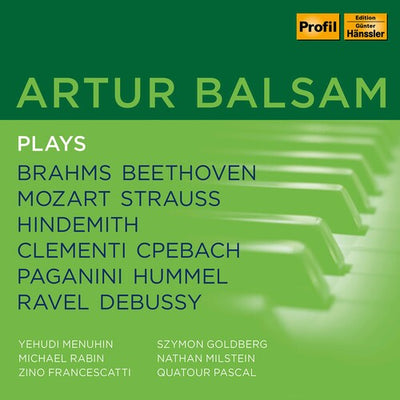
    Pianist and music teacher Artur Balsam was born in Warsaw on February 8, 1906. He attended the Helena Kijenska-Dobkiewiczowa Conservatory (now Academy) of Music established at the beginning of the 20th century in the Polish city of Lodz. After that he went to the Hochschule für Musik in Berlin, where he continued his studies with Artur Schnabel. A mere 12 years elapsed between his concert debut in 1918 and his success at the 1930 Berlin International Piano Competition; shortly after winning that competition, he was awarded the Mendelssohn Prize for chamber music in 1931 in Munich. Balsam matured into a sought-after partner at the piano: having won the Mendelssohn Prize together with the violinist Roman Totenberg, he toured the USA the following year with the brilliant young Yehudi Menuhin. After the rise to absolute power in Germany of Adolf Hitler at the head of his Nazi party, Balsam emigrated to the United States. He settled in New York in 1940, made a name for himself on the American chamber music scene and was the favorite accompanist of many famous soloists, especially in the years from 1940 to the early Seventies of the last century. He frequently partnered the great violinists Nathan Milstein and David Oistrakh, also playing for Joseph (violin) and Lillian (viola) Fuchs, Leonid Kogan (violin), Zino Francescatti (violin), Pierre Fournier (cello) and Mstislav Rostropovich (cello). Balsam was the pianist of the NBC Symphony Orchestra under Arturo Toscanini for five years. He was also a piano soloist for other leading orchestras.

    View full page
    Profil

    Portrait / Hélène Boschi

    CD · 10 discs

    $44.99
    Composer
    VARIOUS
    Artist
    Various
    Released
    Apr 02, 2021

    Hélène Boschi’s repertoire was broad-based, ranging from the Baroque (François Couperin, Jean Philippe Rameau, Johann Sebastian Bach) to contemporary music. Her favorite composers of the Viennese Classical era were undoubtedly Joseph Haydn, Wolfgang Amadeus Mozart and Franz Schubert; strangely, it seems she left behind no Beethoven recordings. One notable fact about Boschi is that she was the first female pianist to record the works of Padre Antonio Soler (1729-1783), receiving the 1952 Grand Prix du Disque in honor of her achievement. As for the nineteenth century, her passionate readings of Schumann are of the utmost importance; but Carl Maria von Weber and Muzio Clementi also captured her attention, as did Frédéric Chopin and Emmanuel Chabrier and the Impressionists Claude Debussy and Maurice Ravel. Modern classics were also integral to her repertoire – as were the works of her immediate contemporaries. Luigi Dallapiccola dedicated his 1952 piano composition Quaderno di Annalibera to Hélène Boschi, Claude Ballif paid her that honor with his Fourth Sonata op. 31

    View full page
  • Portrait / Hélène Boschi

    Portrait / Hélène Boschi

    Profil Apr 2021
    10 discs
    CD
    $44.99