Search results: Search results

80 results

Products

  • Vienna / Fritz Reiner, Chicago Symphony Orchestra
    Sold Out

    Vienna / Fritz Reiner, Chicago Symphony Orchestra

    Sony Masterworks Sep 1995
    1 disc
    CD
    $11.98
  • NEUJAHRSKONZERT 2025 / NEW YEAR'S CONCERT 2025
    SONY CLASSICS

    NEUJAHRSKONZERT 2025 / NEW YEAR'S CONCERT 2025

    Blu-Ray · 1 disc

    $20.49
    Composer
    Various
    Artist
    MUTI, RICCARDO / WIENER PHILHARMONIKER
    Released
    Mar 21, 2025
    Few concerts in the world are awaited with as much excitement as the New Year's Concert from Vienna. Under the direction of Riccardo Muti, the Vienna Philharmonic ushers in the New Year with a concert in the magnificent Golden Hall of the Vienna Musikverein. Marking his seventh time conducting this prestigious event, Riccardo Muti leads the orchestra in a program that celebrates the 200th birthday of Johann Strauss II, exploring new perspectives on the musical world of the Strauss family. Riccardo Muti has played an exceptional role in the history of the Vienna Philharmonic for over 50 years. The artistic collaboration with Maestro Muti began in 1971. Since then, he has conducted over 500 concerts with the orchestra, including six New Year's concerts, Philharmonic subscription concerts, memorial concerts, annual orchestral concerts at the Salzburg Festival, guest performances and tours, and numerous opera productions. He has been an honorary member of the Vienna Philharmonic since 2011. The annual New Year's Day Concert in Vienna has been a major event for more than eight decades, since 1939, being broadcasted on TV and radio, and reaching millions of viewers in over 90 countries across the globe. The concert has previously been conducted by world-famous maestros such as Herbert von Karajan, Lorin Maazel, Claudio Abbado, Carlos Kleiber, Zubin Mehta, Nikolaus Harnoncourt, Seiji Ozawa, Mariss Jansons, Franz Welser-Most, Gustavo Dudamel and others. The Vienna Philharmonic, as musical ambassadors of Austria, send people all over the world a New Year's greeting in the spirit of hope, friendship and peace with the lively and light-hearted and at the same time nostalgic and profound music from the vast repertoire of the family of Johann Strauss and it's contemporaries.
    View full page
  • NEUJAHRSKONZERT 2025 / NEW YEAR'S CONCERT 2025
    Sold Out

    NEUJAHRSKONZERT 2025 / NEW YEAR'S CONCERT 2025

    SONY CLASSICS Mar 2025
    1 disc
    Blu-Ray
    $20.49
  • NEW YEAR'S DAY CONCERT VIENNA (DECCA PURE ANALOGUE
    DECCA

    NEW YEAR'S DAY CONCERT VIENNA (DECCA PURE ANALOGUE

    Vinyl · 2 discs

    $59.06
    Artist
    WEINER PHILHARMONIKER / BOSKOVSKY, WILLI
    Released
    Jan 23, 2026
    The 1979 New Year's Day Concert in Vienna proved to be a watershed moment, an end of an era for Willi Boskovsky, the Wiener Philharmoniker's longstanding concertmaster. Long feted as Decca's first digitally recorded release, recent research has unearthed a set of masters that have remained undisturbed in Universal Music's vaults for almost half a century. Until today. Introducing Decca's new all-analogue vinyl series, DECCA PURE ANALOGUE, presenting some of the most iconic recordings from the Decca & Philips archives. The series is mastered by Rainer Maillard and cut by Sidney C. Meyer at the renowned Emil Berliner Studios, pressed on 180g vinyl at Pallas and presented in deluxe gatefold sleeves in hand-numbered, limited editions. Only original analogue sources are used (2-track stereo and 4-track quadraphonic tapes, plus analogue masters of early digital recordings) and no extra devices are utilized in the signal pass, i.e. no digital sound processing at all.
    View full page
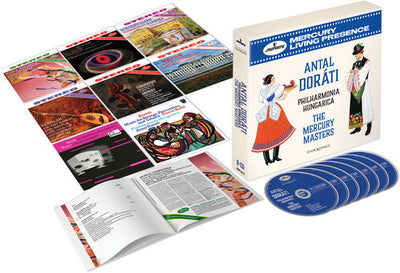
  • The Mercury Masters - Antal Doráti and the Philharmonia Hungarica
    ELOQUENCE AUSTRALIA

    The Mercury Masters - Antal Doráti and the Philharmonia Hungarica

    CD · 8 discs

    $59.70
    Artist
    DORATI, ANTAL
    Released
    Feb 14, 2025

    Driving intensity, rhythmic flair, and demonstration-quality sound are brought to the fore in a new anthology of Antal Doráti's early recordings with the Philharmonia Hungarica on Mercury and Philips. Founded in 1956, the Philharmonia Hungarica emerged from turbulent post-war times as a crack ensemble of émigré Hungarian musicians who had fled Communism for the West. While they gave concerts in Europe and the US, it was through these seven albums on Mercury and Philips that they became famous, and synonymous with the name of the conductor Antal Doráti. Together, Doráti and the Philharmonia Hungarica would go on to make a celebrated cycle of Haydn symphonies for Decca in the early 1970s. But these early recordings already demonstrate what a potent artistic combination they were, as forerunners both to that monument of gramophone history, and to the modern-day Budapest Festival Orchestra. As reviewers at the time remarked, the strings play with a particular unanimity and attack which sounds uniquely 'Hungarian'.

    A booklet essay by the music historian David Patmore tells the story of the Philharmonia Hungarica and their debut on record. All six Mercury albums were recorded at sessions in June 1958, held in the Vienna Konzerthaus: a spacious but analytical acoustic, well suited to the label's trademark high-impact sound. The repertoire played to the strengths of both label and musicians: mostly Hungarian music from the last half century, vividly colored and coursing with rhythmic energy.

    There is an early taste of the ensemble's feeling for Haydn, in the 'Surprise' and 'Drum Roll' Symphonies. Doráti's established reputation as a masterful conductor of ballet brings a sweeping sense of line to a collection of Viennese waltzes. The ace in the pack of the Mercury/Philharmonia Hungarica albums was Respighi's suites of Ancient Airs and Dances, which soon became a demonstration disc for audiophiles worldwide. Never previously collected together, this Mercury legacy is complemented by the two albums which the Philharmonia Hungarica and Doráti recorded for Philips. The ensemble's first-ever recording, made in October 1957, appeared on the Fontana imprint, coupling Bartók's Divertimento with Leo Weiner's Hungarian Dances. From 1974, the second Philips album returns to Bartók, with gripping interpretations of the Music for Strings, Percussion and Celesta and Dance Suite.

    View full page
  • The Mercury Masters - Antal Doráti and the Philharmonia Hungarica
    Sold Out

    The Mercury Masters - Antal Doráti and the Philharmonia Hungarica

    ELOQUENCE AUSTRALIA Feb 2025
    8 discs
    CD
    $59.70
  • DECCA 78S
    ELOQUENCE AUSTRALIA

    DECCA 78S

    CD · 2 discs

    $16.99
    Artist
    KLEIBER, ERICH / MARTINON, JEAN
    Released
    Jul 19, 2019
    Decca studio recordings made between 1947 and 1949 with the London Philharmonic Orchestra, newly compiled and remastered by Mark Obert-Thorn and including material new to CD. Decca first presented it's 'ffrr' technology - full frequency range recording - in 1944, originally developed by the company's engineers as a means of detecting and identifying German submarines through their engine noises. Following the success of Stravinsky's Petrushka with Ernest Ansermet (made in 1946 and reissued by Eloquence in it's comprehensive series dedicated to the Swiss conductor) other major artists visiting London were invited to make records at the acoustically excellent Kingsway Hall. One of them was Erich Kleiber, who had attracted a considerable following in London through his concerts. 'Audiences did not merely listen and applaud,' remembered his friend, the scholar Jacques Barzun. 'They knew what they were doing.' His repertoire for Decca mirrored his concerts: symphonies by Mozart and Beethoven, overtures by Dvorak and Handel, and Strauss-family favourites, all done with superb attention to rhythmic lift and dynamic balance so that, combined with Decca's pioneering technology, listeners could (and still can) hear inside the scores to a degree still remarkable for the late 1940s. The old ideal of classical 'objectivity' was Kleiber's inspiration for Beethoven's 'Pastoral' Symphony: he was 'a conductor's conductor', observed The Spectator's reviewer, seeing Kleiber in concert at the time of these recordings, who obtained precisely what he wanted with 'instinctive ease and economy of means'. The French conductor Jean Martinon also had a short-lived relationship with Decca in London before making most of his records in the US for RCA. They include deliciously light-textured accounts of Ravel's Le Tombeau de Couperin and Chabrier's Suite Pastorale as well as another gramophone rarity: the farewell aria for Joan of Arc in Tchaikovsky's opera The Maid of Orleans, sung by the Polish mezzo-soprano Eugenia Zareska.
    View full page
  • DECCA 78S
    Sold Out

    DECCA 78S

    ELOQUENCE AUSTRALIA Jul 2019
    2 discs
    CD
    $16.99
  • JOSEPH KRIPS EDITION: VOLUME 2
    ELOQUENCE AUSTRALIA

    JOSEPH KRIPS EDITION: VOLUME 2

    CD · 21 discs

    $120.64
    Artist
    KRIPS, JOSEPH
    Released
    Jul 12, 2024
    Mozart was Josef Krips's yardstick in music: 'My maxim is that everything has to sound as though it were by Mozart, or it will be a bad performance. ' Collected here are his Mozart symphony recordings with the Concertgebouworkest for Philips (1972-73), including a rehearsal sequence for Symphony No. 33, as well as the celebrated 1955 Vienna Don Giovanni for Decca. These are surrounded by the rare 'live' recording of Mahler's Das Lied von der Erde, his stereo Decca recordings of symphonies by Haydn, Schubert, Schumann, Brahms and Tchaikovsky, and a previously unpublished overture by Weber. LIMITED EDITION. By the time stereo technology had become standard in the mid-1950s, Josef Krips had built an impressive recorded legacy for Decca documented in a companion set of mono recordings from Eloquence (Josef Krips Edition - Volume 1). Decca captured the conductor in several stereo remakes of canon repertoire - the last two symphonies of Schubert, Schumann's Fourth, the 'Haffner' and 'Jupiter' of Mozart - always with something deeper and wiser to say about repertoire which he had been exploring for 40 years and more, affording absorbing comparisons with his mono versions. Complementing his mono-era version of Mozart's Die Entfuhrung aus dem Serail, Krips recorded a stereo Don Giovanni, now with a more international, less Viennese cast headed by the vocally sensuous Don of Cesare Siepi and complemented by Fernando Corena as Leporello. Other vocal treasures in the set include Inge Borkh on imperious form in Beethoven, Weber and the closing scene of Strauss's Salome. Also located in the Decca archive was a stereo recording of Weber's Oberon Overture, now published for the first time. With the Vienna Symphony Orchestra we have a live recording of Mahler's Das Lied von der Erde with star soloists Fritz Wunderlich and Dietrich Fischer-Dieskau. Too little of Krips's work outside the Austro-German canon was preserved on record, as the beautifully moulded shape and definition of his 1958 Vienna Philharmonic version of Tchaikovsky's Fifth demonstrates. You would easily guess from it that Mozart was Krips's yardstick in music, and for Philips he finally made a thorough-going survey of the mid-period and mature symphonies, from No. 21 onwards, which he had performed throughout his life. When released in France in harness with the early symphonies led by Marriner, the set included Krips leading a rehearsal sequence of Symphony No. 33 with his characteristically affable authority, and this has been released internationally for the first time on CD. As for the symphonies themselves, Krips sustains them with a natural warmth and breathing pulse that has always placed them in the top rank of 'traditional' performances. The conductor's legacy is addressed in a new essay by Niek Nelissen. Photos and original jackets evoke the 50s and 60s as much as Krips's music-making.
    View full page
  • JOSEPH KRIPS EDITION: VOLUME 2
    Sold Out

    JOSEPH KRIPS EDITION: VOLUME 2

    ELOQUENCE AUSTRALIA Jul 2024
    21 discs
    CD
    $120.64
  • Piano Library - Westminster and American Decca Edition
    ELOQUENCE AUSTRALIA

    Piano Library - Westminster and American Decca Edition

    CD · 21 discs

    $116.98
    Artist
    PIANO LIBRARY: WESTMINSTER EDITION / VARIOUS
    Released
    Sep 06, 2024

    A Limited edition original Jackets treasury of analogue-era pianism by legendary and lesser-known names from the catalogues of American Decca and Westminster. Spanning 1950 to 1963 - Clara Haskil in Scarlatti to Guiomar Novaes in Chopin and Debussy - the recordings in this set document the end of some distinguished careers (notably Benno Moiseiwitsch and Egon Petri) and the early flourishing of others, such as Jörg Demus and Nina Milkina. Classic examples of German, Russian, French, Hungarian, Romanian and American pianism illustrate the characteristics of their national schools, but most of all underline the personal artistry of musicians such as Haskil and Moiseiwitsch who always turned a phrase or a chord and made it their own. The four solo LPs for Westminster recorded in 1956 by Raymond Lewenthal marked his return to the studio after an assault which had left him unable to play for several years. He would go on to become an early champion on record of the late-Romantic, ultra-virtuoso style, but these Westminster LPs capture him in repertoire from Beethoven sonatas and Scriabin preludes to popular encores. Excerpts from some of these LPs have appeared on CD before, but not the full albums as originally sequenced. This is also true of the treasurable August 1961 sessions in New York made by Benno Moiseiwitsch, playing inimitably inflected accounts of Beethoven, Schumann and Mussorgsky. There is a first-time CD release for Petri's 'Moonlight' Sonata, alongside it's original LP couplings of the 'Pathétique' and 'Appassionata', plus the 'Hammerklavier' and Busoni's Fantasia contrappuntistica from the same sessions in June 1956. Petri's aristocratic and intellectual style could hardly be more contrasted with the spontaneous rubato of the Brazilian pianist Guiomar Novaes, in Chopin's Barcarolle. A trio of previously unissued Chopin Mazurkas makes a precious addition to the legacy of the French pianist Youra Guller. Jörg Demus is now esteemed for his Bach and Beethoven, but his mastery of Franck and Fauré has been forgotten. Each of these LPs tells it's own story, of a forgotten pianist or a little-known recording, and the piano-specialist Mark Ainley supplies valuable context with new booklet appreciations of each artist.

    View full page
  • Piano Library - Westminster and American Decca Edition
    Sold Out

    Piano Library - Westminster and American Decca Edition

    ELOQUENCE AUSTRALIA Sep 2024
    21 discs
    CD
    $116.98
    Chandos

    A Lifetime on Chandos / Neeme Järvi

    CD · 25 discs

    $131.99
    Composer
    VARIOUS
    Artist
    Jarvi, Philha
    Released
    Sep 14, 2018

    Almost forty years after his first recording on Chandos, this unique limited-edition release gathers some of the best and most-awarded recordings on the label by one of the most prolific conductors of all time: Neeme Järvi. It highlights a 200+ discography that explores an astonishingly wide repertoire, with selections from the legendary complete series of Prokofiev’s symphonies and Tchaikovsky’s ballets to the groundbreaking discoveries of composers such as Atterberg or Suchon. It features nearly a dozen of the numerous orchestras with which he has collaborated, including the RSNO, Chicago Symphony, Orchestre de la Suisse Romande, and Royal Concertgebouw Orchestra, all here celebrated at their best. Offered at a very special price and retaining the original covers, this product also includes very special notes by James Jolly, Editor in Chief of Gramophone, as well as exclusive photos and interviews with figures central to Järvi’s extraordinary musical life.

    Past praise of previously released material included in this set:

    Prokofiev: Symphony No 6, Waltzes Suite / Järvi, SNO

    As in all of his Prokofiev symphony recordings–this was the first, by the way–Järvi really digs into the music. The engineering is as big and bold as the performances. This recording deserves classic status.

    – ClassicsToday

    Smetana: Má Vlast / Järvi, Detroit Symphony

    Järvi and the Detroit Symphony Orchestra deliver an expansive reading of the complete work, and their feeling for the music's vivid imagery and richly Romantic expression is spot on.

    – All Music Guide

    View full page
  • A Lifetime on Chandos / Neeme Järvi
    Sold Out

    A Lifetime on Chandos / Neeme Järvi

    Chandos Sep 2018
    25 discs
    CD
    $131.99
    Sono Luminus

    Complete Dorian Recordings 1989-2009 / Ames Piano Quartet

    CD · 8 discs

    $53.99
    Composer
    DVORAK BRAHMS SCHUMANN STRA
    Artist
    AMES PIANO QUARTET
    Released
    Aug 25, 2009
    The Ames Piano Quartet, the resident chamber music ensemble at Iowa State University, holds a unique position in the chamber music field as one of the few piano quartets in the world. The combination of their lush string sound, blended with the orchestral quality of the piano, produces an exquisite and rare sonority. The Washington Post aptly described it as “one of the most heavenly combinations of instruments around.”

    The ensemble has toured throughout the United States, including concerts in New York, Los Angeles, Chicago, Detroit, Denver, San Diego, and Washington D.C. Internationally they have performed in Canada, Mexico, France, Austria, and the Far East. Most recently the Quartet spent a week concertizing and teaching in Havana, Cuba, the first American chamber music group to perform there in over forty years.

    Its members, all present ISU Music Department faculty, include Mahlon Darlington, violinist; George Work, cellist: (Lawrence Bulkhalter violist - discs 1, 2, 3, 4, 5, 8) Jonathan Sturm, violist; and William David, pianist. Since its formation in 1976, the ensemble has recorded eight compact discs, including six for the Dorian Recording label, all of which have received national and international critical acclaim.

    Fanfare called its CD of the Dvorak quartets, “one of the best chamber music recordings of the century.”

    The Los Angeles Times wrote of a recent Ames Piano Quartet concert, “The four generated nearly limitless excitement … arching lyricism, poetic eloquence, and great accuracy.”

    The French magazine La Cote des Arts commented, “The Ames [Piano] Quartet has a full vigorous sound, which deeply touches the soul.”

    Reviews of some of the original recordings that make up this set:

    Strauss, Widor Quartets
    The masterpieces for piano quartet can be counted on the fingers of two hands: two by Mozart, one by Schumann, three by Brahms, two by DvorAk and two by Faure. This record offers two that are certainly not masterpieces, and are probably unknown even to most chamber music players, by composers who made their mark in very different spheres and whose names are not normally associated with chamber music at all. The earlier of them is the one by Richard Strauss, composed in 1884, when, at the age of 20, he was already a precocious and highly professional musician (with almost all the chamber music he composed already behind him). Widor's quartet dates from 1891, when he was in his late forties and already an eminent organist and pedagogue and the composer of a piano trio and quintet, a sonata for cello and piano and numerous shorter pieces—not to mention the first eight of his ten symphonies for organ.

    The Strauss is heavily indebted to Brahms, notably in the two expansive, opulent outer movements, but in both the unmemorable quality of the thematic material is stretched too far (nearly 12 minutes, even without the exposition repeat, in the first movement, nearly ten in the fourth) despite the assurance of the actual craftsmanship. Some relief is provided by the nimble Scherzo and the rather sugary Andante (which are listed in the wrong order in the accompanying booklet). In 1885 the quartet was awarded, by a far from unanimous vote, a prize given by the Berlin Tonkiinstler Verein, and when it was played at Meiningen in January 1886 it made such a favourable impression on the audience (which included Strauss's employer, Georg II, Duke of Sachsen-Meiningen, to whom the score was later dedicated) that Strauss was agreeably surprised, "considering," as he wrote to Hans von Billow, "that it is by no means a pleasing or ingratiating work". The Widor is, to my ears, a more original and appealing piece, with a noble, impassioned first movement and an inventive finale, framing a tender, rather elegiac Adagio and a playful Vivace.

    The performances, by the Ames Piano Quartet (formed in 1976, and a 'resident' ensemble at Iowa State University), are of outstanding quality, as is the recording by the American company, Dorian; it will not be their fault if the hope expressed in the booklet, "that this release will begin the work of restoring both pieces to the standard repertoire", is not realized.

    -- R.G., Gramophone

    Czech Piano Quartets
    Great Czech piano quartet performances come from Iowa, Ames, IA, to be precise, home of Iowa State University where the Ames Piano Quartet is the chamber music ensemble-in-residence. The group, one of the few full-time piano quartets in the world, has already released several excellent discs on Dorian: the mandatory couplings of quartets by Dvorák, Fauré, and Brahms, plus several ingenious couplings like a disc joining quartets to quartets by Strauss and Widor. This 2002 disc has one of the most fascinating programs yet, uniting three quartets by three different Czech composers: Josef Suk's A minor Quartet, Op. 1; Vitezslav Novák's C minor Quartet, Op. 7; and Bohuslav Martinu's Quartet written in 1942.

    All three are three-movement works in the fast-slow-fast pattern, all three last a bit more than 20 minutes, and all three are interesting examples of specific aspects their composer's style. Suk's A minor Quartet, his 1891 graduation piece from Dvorák's composition class, is a passionate but well-crafted piece of ardent romanticism. Novák's C minor Quartet started life as a four-movement student work in 1894, which the composer completely rewrote in 1903, discarding three of the movements and replacing them with the two published outer movements. Martinu's Quartet was written while the composer was living in exile in Jamaica, Long Island, a refugee from war-torn Europe and shows his mature mastery at its height.

    The Ames Piano Quartet performs every work with amazing strength and total dedication. With a tight but flexible ensemble, strong but agile technique, and big, passionate tone, the Ames has what these works need to succeed. Its Suk is fervent and sincere, its Novák bold but controlled, and its Martinu driven but lyrical. Though some listeners may find the string's tone a bit edgy, others will find this only adds intensity to the performances. Recorded in Martha-Ellen Tye Recital Hall in 2002, Dorian's digital sound here is big, close, and direct. It should also be noted that this appears to be the premiere recording of Novák's quartet.

    -- James Leonard, All Music Guide

    Russian Piano Quartets
    orian's pairing of these two piano quartets is particularly apt for a number of reasons, not least of which is the relative rarity of works in this genre by Russian composers. Paul Juon was a student of Sergei Taneyev (himself a student of Tchaikovsky), and it is Juon's Rhapsody that opens the program. A troubled, yearning theme in the cello's lower register sets the course for the entire piece, whose exceptionally rich chromaticism (stopping just short of Scriabin) keeps the music awash in a late-romantic delirium. The drama of the big finale is capped by the return of the cello's theme near the end. It's passionate, Wuthering Heights-type stuff, and the Ames Piano Quartet really pours on the sauce (but not so much that it overruns the plate).


    Though written in the same year as Juon's Rhapsody (1906), Taneyev's piano quartet sounds like an earlier work due to its greater reliance on traditional Russian harmonic techniques. It's only slightly less emotionally heated, and the high strings' singing of the first movement theme brings to mind Chausson's Concert for violin, piano, and string quartet. The second movement features a catchy tune that would make a great rock n' roll anthem today. Taneyev's finale is even bigger that Juon's, though it also employs a cyclic device, in this case bringing that fetching second movement theme back for another rendition. As if two big chamber works were not enough, the disc is packed with Borodin's Polovtsian Dances in a mostly satisfying arrangement (you might miss the oboe) by Geoffrey Wilcken. Again, the Ames Piano Quartet plays with power, sensitivity, and brilliance. Dorian's recording places the piano well to the rear, but the live acoustic perfectly balances it with the strings.
    --Victor Carr Jr., ClassicsToday.com

    Review of complete set:

    While piano trios abound and string quartets are a dime a dozen, what's rare are extant, long-standing piano quartets. Compared to the former two ensembles, repertoire for the latter is less abundant but no less significant. Piano quartets are often performed by piano trios who add a viola or string quartets that sit out a member and add a pianist. The result, however, is a temporary ensemble that lacks the benefits of performing long term with the same musicians. The Ames Piano Quartet proves that not only can a piano quartet exist as its own entity, but that it can thrive. Originally formed in 1976 at the University of Iowa and now faculty artists at Iowa State University, the Ames Piano Quartet has made a name for itself as skilled interpreters of the standard popular repertoire as well as champions of new and lesser known works. The present eight-disc collection showcases the recordings the group made on the Dorian label from 1989 through 2009. Listeners will enjoy stunning, thoughtful interpretations of warhorses of the repertoire like the three Brahms quartets, two from Dvorák, and quartets from Schumann, Fauré, and Strauss, as well as enlightening performances of rarely performed quartets by Suk, Martinu, and Widor. Taken from recordings made across two decades, there is an understandable variability in recorded sound quality from disc to disc, and the Ames does not have the most spotless intonation in the world. What it does have that many others lack is a clear, singular, unified vision of the score. Every articulation, every phrase, every dynamic, and every nuance is perfectly matched across the four members. Balance within the ensemble is also pleasantly fluid, shifting to allow the melody to come to the fore without obscuring the inner voices. Adding to its polished playing and far-reaching repertoire is a very informative and well-written set of liner notes that make this collection one well worth checking out.

    -- Mike D. Brownell, All Music Guide

    View full page
  • Richard Strauss: Die Schweigsame Frau (Salzburg 08.08.1959)
    Sold Out

    Richard Strauss: Die Schweigsame Frau (Salzburg 08.08.1959)

    Andromeda Jan 2012
    2 discs
    CD
    $10.99
  • COMPLETE RECORDINGS
    Sold Out

    COMPLETE RECORDINGS

    WARNER CLASSICS Aug 2020
    70 discs
    CD
    $137.17
    Supraphon

    Karel Ančerl: Live Recordings / Czech Philharmonic Orchestra

    CD · 15 discs

    $149.99
    Composer
    Various
    Artist
    Karel Ancerl, Josef Suk, Josef Chuchr
    Released
    Feb 11, 2022

    Previously unreleased recordings by one of the great conductors of the 20th century.

    Karel Ančerl. One of the most important conductors of post-war Europe. A man who survived the Nazi concentration camps and the avowed anti-Semitism of communist Czechoslovakia. An artist who, through enormous patience and dedication, built the Czech Philharmonic into a world-class orchestra and introduced it successfully at the most important concert halls.

    From 2002 to 2008, Supraphon issued the highly acclaimed Ančerl Gold Edition with the bulk of his artistic legacy, containing nearly his complete studio recordings with the Czech Philharmonic on 48 albums. But that was far from everything. Hidden in the archive of Czech Radio, there is a wealth of concert recordings that gives us a more complete picture of this conductor. From that treasury, on 15 albums, Supraphon has selected repertoire of which studio recordings were not made; that repertoire covers a broad range from Mozart to works by Ančerl’s contemporaries.

    The recordings include masterpieces by Dvořák (Symphonies Nos. 7 and 8, Biblical Songs) and Suk (Asrael, Ripening), music by composers admired and promoted by Ančerl (Martinu Symphony No. 1 and Kabelác Symphony No. 5), and major works of the worldwide 20th-century repertoire (Debussy, Ravel, Strauss, Prokofiev, etc.). The only exception of a “duplication” of a studio recording is Smetana’s Má vlast. This taping of a Prague Spring Festival concert in May 1968 was one of the last recordings Ančerl made before his definitive departure for Toronto. The concert recordings from the years 1949-1968 document the maturing of this remarkable artist perhaps even more clearly than his studio legacy.

    REVIEW:

    Performances appearing on CD for the first time include, most notably, Josef Suk’s epic Asrael symphony (1967), a recording that captures the full emotional range of what’s surely the greatest Czech symphony after Dvo∑ák. Most impressive is the impact of Suk’s vivid orchestration, the timpani and bass drum especially, and the way An∂erl charts the work’s dramatic sequence of events, its emotional extremes and tragic demeanor. Never before have I felt the ‘angel of death’ transform into the ‘angel of love’ at the end of the work as it does here. Even the memorable Václav Talich (also on Supraphon) doesn’t quite match up. The mono sound is exceptionally clear but Suk’s The Ripening, another fine performance, is offered in stereo, as is Smetana’s Má vlast (both 1968), where the vengeful third piece, about the fearsome amazon Šárka, is driven to paroxysms of rage.

    Perhaps the most absorbing inclusion conceptually is Ervín Schulhoff’s musical setting of portions from the Communist Manifesto. Beyond his miraculous survival of Auschwitz (where his family was murdered), An∂erl joined the Communist Party of Czechoslovakia. Schulhoff had sent the only copy of his full score to the Leningrad Conservatory for safe keeping, but it was believed lost during the long siege of the city and the version that An∂erl conducts here (in 1962) is an orchestration by Svatopluk Havelka. Schulhoff had become convinced by the ideas coming out of the Soviet Union after working in Berlin in the 1920s and ’30s and was on the run from the Nazis in the later years of the 1930s, but was captured in 1941 and died in Wülzburg concentration camp in 1942 of tuberculosis. Whatever one’s political leanings (even in view of the subsequent Soviet invasion of An∂erl’s homeland, not to mention Ukraine at the present time), one can understand why he connected so deeply with fascism’s nemesis. The work itself resembles, on the one hand, the politically charged choral pieces of Prokofiev and Shostakovich, while on the other recalls the world of Mahler (try disc 15 track 6 from 7'25", where you can hear clear echoes of Mahler’s Sixth Symphony).


    This is an extremely important set, very well transferred, superbly annotated (by Petr Kadlec) and sturdily presented. I can’t recommend it more highly than that.

    -- Gramophone (Rob Cowan)

    View full page
  • Die Fledermaus (Sung In English)
    Sold Out

    Die Fledermaus (Sung In English)

    MYTO Historical Apr 2009
    2 discs
    CD
    $10.99
  • Salome
    Sold Out

    Salome

    MYTO Historical Jun 2011
    2 discs
    CD
    $10.99
  • Ariadne Auf Naxos
    MYTO Historical

    Ariadne Auf Naxos

    CD · 2 discs

    $13.99
    Composer
    STRAUSS, RICHARD
    Artist
    Boehm, Muzzarelli, Schoeffler, Seefried, Lorenz, Jelinek, Witt, Baier
    Released
    Oct 14, 2014
    With the war raging in Europe, and a mere five days after the D-Day invasion which precipitated the eventual end of the conflagration in the European theater, this performance on a much smaller, less consequential but on its own terms no less historic theater stage in Vienna of Richard Strauss’ Ariadne auf Naxos was given and recorded. Despite the troubling facts that orbit these wartime performances more generally, for those who know operatic history, the singing cast, including Irmgard Seefried, Paul Schöffler, Max Lorenz and Maria Reining is truly a legendary one, as is the conductor Karl Böhm.
    View full page
  • Ariadne Auf Naxos
    Sold Out

    Ariadne Auf Naxos

    MYTO Historical Oct 2014
    2 discs
    CD
    $13.99
  • Brass Masterworks - American Brass Band Journal
    Sold Out

    Brass Masterworks - American Brass Band Journal

    Sony Masterworks Aug 2005
    1 disc
    CD
    $11.98
  • COMPLETE PHILIPS RECORDINGS
    ELOQUENCE AUSTRALIA

    COMPLETE PHILIPS RECORDINGS

    CD · 17 discs

    $85.49
    Artist
    NETHERLANDS WIND ENSEMBLE
    Released
    May 27, 2022
    Issued complete for the first time, including several albums new to CD, is the Philips catalogue of the Netherlands Wind Ensemble - an ensemble that made a defining contribution to Dutch musical life in the 1970s. The Netherlands Wind Ensemble began life in 1959 as a wind quintet, but soon expanded to play Classical-era serenades and divertimenti which were hardly known at the time but have since been recognised and enjoyed as masterpieces of entertainment music, notably the Gran Partita of Mozart, the late Octet by Beethoven and the wonderful Octet-Partitas by his Viennese contemporary, Franz Krommer. Starting to record for Philips in 1968, the Netherlands Wind Ensemble immediately won critical praise for the technical precision of it's playing as well as the brilliance and wit of it's interpretations, whether led by it's regular conductor Edo de Waart (himself a former oboist and member of the ensemble) or played as true chamber music. The ensemble made one of the first comprehensive recordings of Mozart's wind music, including miniatures, no less delightful for their brevity and rarity, and a precious but little-known collaboration with the much-loved Dutch soprano Elly Ameling. The youthful, funky vibe of the Netherlands Wind Ensemble was captured by Philips both in exceptionally vivid recordings as well as kooky cover designs, which are reproduced on the sleeves of the issues. A booklet essay by Peter Quantrill outlines the history and character of the ensemble, drawing on a new interview with Edo de Waart. The repertoire extends into the nineteenth century with a classic account of the Wind Serenade by Dvorak - the ensemble's debut on disc - as well as ingenious arrangements of overtures and arias by Rossini, and a unique collection of 'little marches by great masters'. The Netherland Wind Ensemble's long-standing commitment to modern music is represented by the wind music of Richard Strauss and Stravinsky, and the pioneering Jazz Symphony by the Franco-American 'bad boy' of classical music in the 1920s and 30s, Georges Antheil, recorded live at the 1976 Holland Festival.
    View full page
  • COMPLETE PHILIPS RECORDINGS
    Sold Out

    COMPLETE PHILIPS RECORDINGS

    ELOQUENCE AUSTRALIA May 2022
    17 discs
    CD
    $85.49
    Profil

    Martha Modl: The Portrait Of A Legend

    CD · 2 discs

    $16.99
    Composer
    WAGNER STRAUSS FORTNER REIM
    Artist
    Martha Mödl
    Released
    Apr 24, 2012


    MARTHA MÖDL: THE PORTAIT OF A LEGEND • Martha Mödl (sop, ms); various vocalists; various conductors; various orchestras • PROFIL 12006 (2 CDs: 158:17) Live: 1950–82


    WAGNER Rienzi: Gerechter Gott! Tristan und Isolde: Doch nun von Tristan; Begehrt, Herrin was ihr wünscht; War Morold dir so wert; Nicht Hörnerschall tönt so hold; Dein Werk? O tör’ge Magd! So stürben wir, um ungetrennt; Mild und leise. Wesendonck Lieder. Die Walküre: Der Männer sippe; Du bist der Lenz. Götterdämmerung: Starke Scheite … Grane, mein Ross, sei mir gegrüsst. R. STRAUSS Elektra: Was willst du? Seht doch dort! FORTNER Bluthochzeit: Nachbarinnen! Mit einem Messer. REIMANN Melusine: Heut, hier und jetzt wird es entschieden. TCHAIKOVSKY Pique Dame: Schweigt doch endlich! BEETHOVEN Bitten. Die liebe des Nächsten. Vom Tode. Die ehre Gottes aus der Natur. Gottes Macht und Vorsehung. Bußlied


    I can’t claim to be an expert on the recordings of Martha Mödl, but to the best of my knowledge Profil has issued all of these for the very first time. At least, the company claims so on the CD insert, and I for one have never seen commercial recordings by her of Wagner’s Wesendonck Lieder or any of the Beethoven songs.


    Mödl’s strengths as a singer were, ironically, her defects as well. Although she had a superb voice that was well trained, once she was onstage singing she let herself go in a way that was as exciting as it was harrowing. With no thought of technique, she threw herself into the music, often sacrificing tonal security or beauty for a complete identification with the character or words she was singing. The liner notes compare her to Callas, and that is a fair assessment, but I find it ironic to remember that she was not always considered a legend when she was still alive. I still recall, when Furtwängler’s RAI Ring cycle was issued on Seraphim LPs, how many critics who shall remain nameless actually apologized for Mödl’s contribution, although, to be fair, they usually added that when you saw her in person you overlooked the explosive, blown-out high notes because of the intensity of her interpretations. I also heard from an acquaintance of mine that once, in a performance of Elektra with Astrid Varnay in the title role and Mödl as Klytemnestra (which she sings in the excerpt on this set), Varnay got so caught up listening to Mödl that she almost forgot to re-enter.


    From a strictly vocal standpoint, her voice is under better control on CD 2 than it is on CD 1. So many of the high notes on the first disc are attacked with such vehemence that you are almost afraid that she is going to blow the voice out, then and there, especially the two high Cs (feared by Flagstad, but apparently not by Mödl) in Isolde’s act I curse. Ludwig Suthaus was a fine singer, but not necessarily for Tristan, which lay very uncomfortably in his range, but he gives it the old college try and, sparked by Mödl, is far more intense here than in his 1952 commercial recording with Flagstad and Furtwängler. The Tristan excerpts go back and forth between two different venues and three different performances (the love duet excerpt with Wolfgang Windgassen was performed at London’s Royal Festival Hall, but not, apparently, with the Royal Philharmonic), and the singers sound rather off-mike in the 1958 Munich performance, but regardless of time or place Mödl is locked into the character with an almost psychic intensity. It’s interesting to hear such an intense vocal actress performing the Wesendonck Lieder , but this is where her high notes are more out of control than anywhere else in the set.


    Turning to CD 2, we hear at the outset a much more in-control Mödl, her voice intense but warm and well placed for Sieglinde’s two act I excerpts and a phenomenal Immolation Scene from Götterdämmerung conducted by Georges Sebastian. Mödl often said that this was her favorite role of all, and she certainly makes you think the world is coming to an end! Following this, we jump a decade to a 1967 performance as Klytemnestra (unfortunately, not with Varnay) in which she is appropriately intense, but by now the voice has a wobble. The two excerpts from modern operas, Wolfgang Fortner’s Bluthochzeit and Aribert Reimann’s Melusine, are not really my kind of music (this is from the Ugly 12-Tone Era), but they do show that Mödl was not only a great stage actress but an excellent musician, capable of learning any style of music and infusing it with dramatic energy. The liner notes indicate that Reimann composed this scene especially for Mödl.


    More interesting is her fascinating performance as the old Countess in Tchaikovsky’s Queen of Spades. Though sung in German (I hadn’t realized that Germany was still performing foreign operas in the vernacular as late as 1982), she delineates the character of the old woman with perfect feeling and a meaning for the text.


    Oddly, this survey of Mödl’s career ends with the earliest performances on the set, a series of Beethoven Lieder from 1950. Her voice is at its freshest here (perhaps Profil wanted to leave us with that sound in our ears), her interpretations are all excellent and not all over the top, and it’s interesting that her accompanist is Michael Raucheisen, who had recorded a large group of Lieder performances with the legendary tenor Leo Slezak back around 1928. They make an excellent pair, and these readings are exceptionally fine in every respect.


    Despite the flaws, this set is absolutely indispensable for Mödl fans (and I’m certainly one), for Wagner lovers, and for anyone who wants to hear one of the most intense artists of the 20th century. We’ve had so many cookie-cutter Wagner sopranos in recent years that it’s nice to remember a time when, for some of them at least, performing this music was more than a job. It was almost a matter of life and death.


    FANFARE: Lynn René Bayley
    View full page
  • Martha Modl: The Portrait Of A Legend
    Sold Out

    Martha Modl: The Portrait Of A Legend

    Profil Apr 2012
    2 discs
    CD
    $16.99
  • COMPLETE RECITALS ON WARNER CLASSICS
    WARNER CLASSICS

    COMPLETE RECITALS ON WARNER CLASSICS

    CD · 11 discs

    $39.49
    Artist
    LUDWIG, CHRISTA
    Released
    Mar 23, 2018
    Over a performing career spanning half a century, Christa Ludwig, born in 1928, consistently proved her greatness. "A source of as deep a satisfaction and fulfilment as the greatest of my operatic roles," is how she described the place of song in her life, and at the heart of this collection are the emblematic composers of the Austro-German repertoire. Throughout, Christa Ludwig's interpretative insight is as rich and compelling as her voice, exceptional for it's beauty, range and flexibility. This 11-disc collection includes recordings never before released or new to CD, and all items have been remastered in 24BIT/96KHZ from original tapes. This 11CD-set marks the 90th birthday of Christa Ludwig, a German mezzo-soprano who had a major international career between 1940 and 1990. Highlighting the wide range of her fine art in lieder and melodies, it includes many recordings which were previously unpublished or are released for the first time on CD - see colours on tracklist below. The recordings have been remastered from original tapes - except the album owned by Sony which has been remastered by them. CD wallets are designed from original LP covers and the booklet includes an exclusive interview with Christa Ludwig.
    View full page
  • COMPLETE RECITALS ON WARNER CLASSICS
    Sold Out

    COMPLETE RECITALS ON WARNER CLASSICS

    WARNER CLASSICS Mar 2018
    11 discs
    CD
    $39.49
  • COMPLETE PHILLIPS RECORDINGS
    DECCA

    COMPLETE PHILLIPS RECORDINGS

    CD · 21 discs

    $98.83
    Artist
    WILLIAMS, JOHN & BOSTON POPS
    Released
    Feb 06, 2026
    Williams' legacy with the Boston Pops is superbly represented in this boxed set which collects the albums made for Philips from his first decade at the helm of the orchestra. Rounding out the set is an intimate project with the unforgettable Jessye Norman: Williams returns to his pianist roots accompanying Norman in songs by Leonard Bernstein, Michel Legrand, Richard Rodgers, Kurt Weill, George Gershwin, Frederick Loewe, and Billy Joel. Jessye also features on a second disc in this collection with the Pops, singing the Great American Songbook. The Philip Classics recordings constitute one of the most salient testimonies of the importance of Williams' Boston Pops tenure, and the most comprehensive showcase of the musical skills, the interpretive acumen, and the stylistic range of conductor John Williams.
    View full page
  • COMPLETE PHILLIPS RECORDINGS
    Sold Out

    COMPLETE PHILLIPS RECORDINGS

    DECCA Feb 2026
    21 discs
    CD
    $98.83