Search results: Search results

193 results

Products

  • CHILL WITH HANDEL
    Sale

    CHILL WITH HANDEL

    Naxos Apr 2004
    1 disc
    CD
    $19.99 $9.99Save 50%
  • The Very Best Of Handel

    The Very Best Of Handel

    Naxos Oct 2005
    2 discs
    CD
    $29.99
  • Masterworks For Flute And Piano 2 / Bezaly, Brautigam
    BIS

    Masterworks For Flute And Piano 2 / Bezaly, Brautigam

    SACD · 1 disc

    $21.99
    Composer
    MARTIN, FRANK MARTINU, BOHUSL
    Artist
    Ronald, Sharon, Brautigam, Bezaly
    Released
    May 01, 2010
    This is a hybrid Super Audio CD playable on both regular and Super Audio CD players.

    Another imaginative, well-executed offering from BIS.

    3424690.zz4_MASTERWORKS_FOR_FLUTE_PIANO.html

    MASTERWORKS FOR FLUTE AND PIANO II • Sharon Bezaly (fl); Ronald Brautigam (pn) • BIS 1729 (SACD: 59:23)


    POULENC Sonata. MARTIN Ballade. REINECKE Sonata, “Undine”. MARTIN? Sonata. MESSIAEN Le Merle noir


    This is the second volume of this series, the pithy and ecstatic review of the first by Peter J. Rabinowitz (where he quotes from other equally impressed Fanfaristas ) appearing in 29: 6. There is really nothing much more to say about Bezaly’s playing; she is, if not the greatest, then one of the most outstanding exponents of her instrument today, and Bis was lucky enough to latch onto her some 20 albums ago and continues to make these wonderful Super Audio recordings.


    On this disc we are a little more mainstreamed in approach, with several of the selections quite familiar, at least to flute lovers. Poulenc’s sonata leads the pack, one of his best from around 1957, simply effervescent and joyous from start to finish, the aural equivalent of dancing on clouds. I had to hunt down Wolfgang Schulz’s recording with James Levine from a mandatory 1989 issue of Poulenc’s chamber music (DG) to find a worthy comparison. The Reinecke, also a standard, was written in the composer’s 40s (1882) under the influence of Friedrich de la Motte Fouqué’s story about a mermaid who marries a young knight and acquires a human soul only to have her heart broken because of his infidelities; should have stayed in the water, I guess. But the story line is only ancillary, the sonata a wonderful example of romantic structure that characterizes a verbal outline without becoming slavish to it. My favorite to this point—now supplanted—is Jeffrey Khaner’s reading on Avie, a recording that should not be missed if for no other reason than its attractive romantic program.


    The Martin? might be called a “sub-standard” not because of quality but because more flutists haven’t seemed to pick up on it yet. Like almost all of this composer’s work, it contains wonders aplenty and umpteen ear-opening examples of structural genius, aside from Martin?’s own deliciously unparagoned way with melody. Marc-André Hamelin (piano) and Alain Marion (flute) offer a somewhat different view on Analekta, perhaps more enervating and lively, but I doubt Bezaly will have you searching for alternatives. Two pieces here were written for competitions; Frank Martin’s inventive Ballade was written as a compulsory piece for Geneva in 1939 while Olivier Messiaen’s Le Merle noir (The Blackbird) was for the Paris Conservatory in 1951, the prototype of a series of pieces that explored the very intentional grounding of birdsong into the very fabric of an instrument. The Martin can be found in its orchestral guise (done a few years later by the composer) on a wonderful recording by Celia Chambers on an all-Martin album of his ballades (Chandos, conducted by Bambert).


    So in short, this is terrific stuff, bedrock material for any serious collection and absolutely foundational for anybody claiming to have a good series of flute albums.


    FANFARE: Steven E. Ritter


    ------------------------------------------------------------------------------------------------

    Sharon Bezaly and Ronald Brautigam are two of the brightest stars in the musical firmament, so BIS are indeed fortunate to have them on their roster of artists. Bezaly first came to my attention in Seascapes, but has since caught my ear in a number of recitals, among them Nordic Spell and From A to Z. Paradoxically, hers is a powerful yet unassuming talent, whereas Brautigam – whose Beethoven sonata series continues apace – strikes me as a much bigger, more forceful musical personality. That said, he scales the Mendelssohn piano concertos most beautifully qualities I was looking for here as well.

    At first glance it’s quite an eclectic selection, but that’s no bad thing. All too often programmes clustered around broadly similar repertoire (stylistically at least) are apt to pall after a while. But three-quarters of a century and several musical traditions separate the pieces by Carl Reinecke and Francis Poulenc; the latter’s Sonata gets this disc off to a promising start. The ‘rolling boil’ of the flute’s opening phrases – not to mention the seemingly effortless trills – are well matched by Brautigam’s nicely nuanced pianism. There are no really extreme dynamics here – well, not unless one counts the mercurial Presto giocoso – and that, along with BIS’s warm, well-balanced recording, makes for a most relaxing listen.
     
    A hugely encouraging start, and a riposte to all those acid audiophiles who insist that non-DSD Super Audio CDs recorded at lower bit rates are a compromise too far. Indeed, one would be hard-pressed to find a better blend of sonic virtues than those on show here. Swiss composer Frank Martin’s Ballade is a case in point, the restless murmur of piano and flute at the start superbly captured. Bezaly’s range and control at both frequency extremes is just remarkable; high notes are firm and clear, the lower registers wonderfully liquid, especially in the solo passage that begins at 3:06. There’s a pleasing sense of proportion too, and one feels this really is a marriage of true minds, Brautigam scaling the music’s more rugged terrain with ease.
     
    Predictably perhaps, Carl Reinecke’s ‘Undine’ sonata has all the evanescent charm one expects from such fare. And no, predictable does not mean humdrum; Bezaly conjures up the lightest, loveliest sounds, building a rainbow bridge under which the piano part flows most agreeably. But it’s the third movement, marked Andante tranquillo, where Brautigam seems to get the upper hand. As seductive as the flute playing undoubtedly is, I found myself following the pianist more carefully than before. And just listen to those giddy upward spirals in the final movement, Brautigam bringing the music back to earth with a mix of passion and power. As for the restraint and repose of the closing bars, it’s most sensitively done. No, it isn’t great music, but when it’s played this well who could possibly complain?
     
    The soloists shadow each other to great effect in the Martin? Sonata, a work whose carapace conceals a surprisingly lyrical centre. Brautigam and Bezaly are very well matched in the animated first Allegro, the latter’s tone characterised by an appealing breathiness in the lower registers. As flute recordings go, this recital really does capture the velvet and steel duality of the instrument most effectively. Indeed, I can see this being used as a demonstration disc, especially when it comes to the long, sustained phrases that round off the Adagio. As for the piece itself, those who don’t know it will engage with its easygoing, yet entirely individual, character. Another nugget in this most desirable pot, and a piece I will return to with great pleasure.
     
    But it’s Messiaen’s Le merle noir (the blackbird) that’s the most inspired choice here. For a composer who rejoiced in the monumental it’s good to be reminded that he is every bit as persuasive in miniature. And just as Hopkins delighted in the wonders of The Windhover, so Messiaen’s blackbird soars and sings above an undergrowth of dark, fleeting dissonances, Bezaly despatching those microtones and flourishes with great skill and confidence. Outwardly Le merle noir might seem a tad austere, but even those who don’t usually warm to Messiaen’s cooler idiom will surely respond positively to this miraculous miniature.
     
    So, another imaginative, well-executed offering from BIS. I have yet to hear the first volume in the series, but if the present disc is anything to go by it should be on the wish-list of all those who enjoy the genre. It’s certainly on mine.
     
    -- Dan Morgan, MusicWeb International
    View full page
    Chandos

    Eternal Rest - Martin, Etc / Bruffy, Phoenix Bach Choir

    SACD · 1 disc

    $21.99
    Composer
    MANTYJARVI ANONYMOUS TEASDAL
    Artist
    Bruffy
    Released
    Oct 01, 2006
    This is a hybrid Super Audio CD playable on both regular and Super Audio CD players.

    Finnish composer Jaakko Mäntyjärvi (b. 1963) writes some of today's more innovative choral music. It's not only creatively interesting but it also maintains the qualities of tonal/harmonic accessibility and text-centered immediacy that allows it to register with a broad spectrum of listeners. His collections of Shakespeare Songs, More Shakespeare Songs, and No More Shakespeare Songs? show a composer at once in love with his subject and fully in tune with his audience--and one clearly in possession of a sense of humor!

    On this recording we hear a profoundly serious work, in memory of the victims of a terrible Baltic Sea tragedy in September, 1994, in which the luxury ferry Estonia sank in a storm, killing 852 passengers. Canticum Calamitatis Maritimae incorporates elements of Psalm 107 ("They that go down to the sea in ships...") with news accounts of the disaster (taken from a Latin-language Finnish radio broadcast), employing dramatic, rich-textured choral utterances (including the whispered prayers of the opening and closing bars) along with chant-inspired passages and an occasional folk-song-like melody, all of which culminates in an extended passage of beautiful and often surprising harmonies, ideally defining the text at the end of the Psalm: "He maketh the storm a calm, so that the waves thereof are still..." This is a moving and memorable work, one that these choirs perform with care and confidence under Charles Bruffy's artful direction.

    After this solid performance, it's puzzling why Bruffy's rendition of Frank Ticheli's setting of Sara Teasdale's poem There will be rest is so dreadfully slow (completely ignoring the composer's clear markings), a strange deconstruction that robs this gorgeous and well-loved piece of its essential harmonic flow and structural coherence. Oh well, these world-class singers follow their conductor easily, unfazed by the exceptional demands of breath control and balance this pace requires--but still, what's the musical point?

    Frank Martin's Mass for double choir has been recorded many times--and mostly very well--and this is another fine rendition of a work that seems to register its "classic" credentials more impressively every time you hear it. René Clausen's In pace, cut from the same vibrant-colored harmonic cloth as the Ticheli, is another work that deserves repertoire status, and again, Bruffy's singers perfectly capture its nuances of texture and dynamics and give full measure to the big sonorities. The complementary acoustics of Camelback Bible Church in Paradise Valley, Arizona, expertly recorded for this hybrid SACD, complete a program that should have strong appeal to all choral music fans.

    --David Vernier, ClassicsToday.com
    View full page
  • Shakespeare In Song / Phoenix Bach Choir
    Chandos

    Shakespeare In Song / Phoenix Bach Choir

    SACD · 1 disc

    $21.99
    Composer
    HARRIS MARTIN SAMETZ MANTYJ
    Artist
    PHOENIX BACH CHOIR
    Released
    Aug 01, 2004

    Shakespeare's works contain some of the most memorable references to music in the English language and have inspired some of the finest music - instrumental, vocal, orchestral and operatic - ever written. On this new Chandos SACD the Phoenix Bach Choir has assembled a deeply satisfying anthology of songs on texts by Shakespeare, set by a variety of composers, to form a richly rewarding programme: a memorable marriage of literature and music.

    View full page
  • Shakespeare In Song / Phoenix Bach Choir
    Sold Out

    Shakespeare In Song / Phoenix Bach Choir

    Chandos Aug 2004
    1 disc
    SACD
    $21.99
  • FORWARD
    Sold Out

    FORWARD

    CELLAR LIVE Sep 2024
    1 disc
    CD
    $12.40
  • MONO YEARS
    DECCA

    MONO YEARS

    CD · 26 discs

    $186.95
    Artist
    ANSERMET, ERNEST
    Released
    Feb 16, 2024
    As a conductor, philosopher, mathematician and composer, Ernest Ansermet occupied an exceptional position in the world of music. At the frontier of modernity, he offered up recordings of music by several composers whom he counted among his friends: Debussy, Ravel, Roussel and Stravinsky but also Honegger, Frank Martin, Bartok and Prokofiev - all of whom are represented in this collection of recordings made for Decca between 1929 and 1955. The collection opens with a recording of six of Handel's Op. 6 Concerti Grossi made with a specially formed band of London musicians, the 'Decca String Orchestra' in 1929, the year in which the label was founded. Ansermet returned to the studio to record for the label from 1946 and from then on became one of it's most frequently recorded conductors. Fortunately, the music of his friend Igor Stravinsky is strongly represented in this collection. Of other composers Ansermet knew personally, several landmark recordings of works by Maurice Ravel are significant. 1952 was a particularly busy year for the conductor and his Orchestre de la Suisse Romande - with recordings of Handel, Prokofiev as well as his famous interpretation of Debussy's "Pelleas et Melisande". An orchestral version of Mussorgsky's two-minute "Gopak" was recorded as the last work in this collection. The stereo recording from 1955 was only available as a test pressing - this box presents it as a veritable world premiere.
    View full page
  • MONO YEARS
    Sold Out

    MONO YEARS

    DECCA Feb 2024
    26 discs
    CD
    $186.95
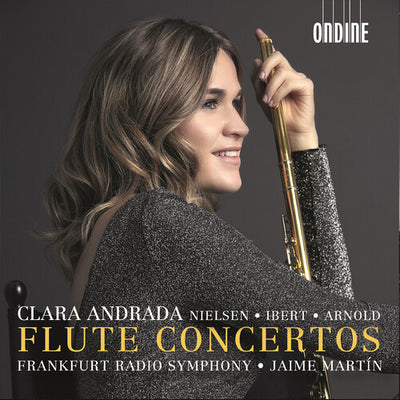
    Ondine

    Nielsen, Ibert & Arnold: Flute Concertos / Andrada, Martin, Frankfurt Radio Symphony

    CD · 1 disc

    $18.99
    Composer
    ARNOLD IBERT NIELSEN
    Artist
    Andrada, Martin
    Released
    Jan 03, 2020
    In this album Clara Andrada, solo flutist of the Frankfurt Radio Symphony, performs three 20th century flute concertos together with the orchestra conducted by Jaime Martín. Malcolm Arnold’s delightful Flute Concerto No. 1 makes a pleasant addition alongside Nielsen’s and Ibert’s flute concertos. Jaime Martín, himself an excellent flutist, is a perfect companion to these works. This is the orchestra’s second album for Ondine, and continues the fruitful collaboration between Jaime Martín and Ondine that has already produced three albums previously. Clara Andrada de la Calleis one of the leading Flute players of her generation currently holding Solo Flute positions of both the Chamber Orchestra of Europe and the Frankfurt Radio Symphony Orchestra. Born in Salamanca, she commenced her musical studies with Pablo Sagredo and Magdalena Martínez at the Syrinx School of Music. Scholarships from the Spanish Ministry of Culture and the London Wall Trust Foundation enabled her to continue her studies at the Geneva Conservatory of Music under Prof. Emmanuel Pahud and Prof. J.D. Castellon as well as the London Royal College of Music under the guidance of Jaime Martín. As a Principal Flute player, she has worked with many leading orchestras, including the London Symphony Orchestra, London Philharmonic, Swedish Radio, Rotterdam Philharmonic, and NDR Elbphilharmonie Orchestra under esteemed conductors including Nikolaus Harnoncourt, Valery Gergiev, Colin Davis, Bernard Haitink, Vladimir Ashkenazy, Myung-whun Chung, and Lorin Maazel.

    -----

    REVIEW:

    Competition abounds in Nielsen’s Flute Concerto of 1926 but Andrada is totally inside the unsettled, quixotic nature of the music and communicates lyrical passages with ardent conviction. Jaime Martín, himself a distinguished flautist, provides lithe and vibrant accompaniment in both the Nielsen and Ibert concertos, while Andrada herself directs the strings with impressive authority in the Arnold concerto. The quality of the recording in all three works is as bright and vivid as the performances.

    – Gramophone
    View full page
  • CHRISTMAS SONGS
    Sold Out

    CHRISTMAS SONGS

    UNIVERSAL JAPAN Nov 2021
    1 disc
    CD
    $15.49
  • 16 CHRISTMAS CLASSICS / VARIOUS
    ACROBAT

    16 CHRISTMAS CLASSICS / VARIOUS

    Vinyl · 1 disc

    $28.64
    Artist
    16 CHRISTMAS CLASSICS / VARIOUS
    Released
    Dec 01, 2023
    Vinyl LP pressing. There is nothing more evocative than hearing that first Christmas tune on the radio. The anticipation begins and the excitement builds. Whether it's Here Comes Santa Claus, Christmas Alphabet or the timeless White Christmas, the seasonal song will always have a special place in our hearts. Enter a Winter Wonderland with this fantastic collection from Acrobat. Bringing together 16 of the most beloved and best selling Christmas hits from 1942 through to 1961. Whether you are wrapping presents, serving up your Christmas feast or simply wanting to get into the seasonal spirit, this is the soundtrack for you. Pressed on snow white vinyl in the UK, turn your record player into a festive jukebox! Features Frank Sinatra, Johnny Mathis, Dean Martin, Bing Crosby, Connie Francis, Brenda Lee and many more. Christmas hits including Santa Claus Is Coming To Town, Winter Wonderland, Santa Baby and of course, White Christmas
    View full page
  • 16 CHRISTMAS CLASSICS / VARIOUS
    Sold Out

    16 CHRISTMAS CLASSICS / VARIOUS

    ACROBAT Dec 2023
    1 disc
    Vinyl
    $28.64
    Naxos

    Handel: Il Trionfo del Tempo e della Verita / Martini, Frankfurt Baroque

    CD · 3 discs

    $35.99
    Composer
    HANDEL
    Artist
    Joachim C, Nicholas, Junge Kantorei, Martini, Peer, Hariades, Abilgaard
    Released
    Dec 14, 1999
    This almost unknown, large scale (almost 3 hour) oratorio, The Triumph of Time and Truth, was composed by Handel in Rome in 1707 and revised by him for performances in London’s Covent Garden in 1737 (the version recorded here) and then translated into English, revised again and presented, with new additions, in 1757. The performance recorded here contains, probably, everything Handel composed for this work in its various incarnations, and then some: A brief organ concerto by the composer is added to the second part’s introduction and another pops up before the final chorus; a number from the serenata Acis & Galatea is inserted at one point; and a Saraband for two harpsichords from Handel’s Almira is used as an interlude in Part III. Furthermore, some will recognize the beautiful aria from the original, “Lascia la spina,” which became “Lascia ch’io piango” in Rinaldo, set to another text and very different music.

    All that aside, this windy work, in which four characters (here, two sopranos and two male altos) stand for Beauty, Pleasure, Time and Disillusion and duke it out until each characteristic opts to serve a better, higher cause, is definitely worth hearing. It contains the appealing, straighforwardly Baroque (if there is such a thing) style of Handel’s early Italian cantatas, mixed with his later sophisticated choral writing and dramatic recitatives. The singers have plenty to do. Both sopranos–Beauty and Pleasure, who sound uncomfortably alike and therefore cut somewhat into the drama–are excellent, with particular kudos going to Claron McFaddon’s Beauty for her lovely trills (especially in #29, with continuo), and both male altos are agile, involved, and just a bit weak in their lower registers.

    The chorus, which is very big and appears to have been recorded from a far greater distance than the soloists, is splendid, as is the orchestra under Joachim Carlos Martini’s leadership. The resonant acoustic makes the soloists sound a bit lonely, but otherwise, no complaints. This remains the only recording of the 1737 omnibus version of the work, and Handel lovers should flock to it.

    – ClassicsToday (Robert Levine)
    View full page
  • PLATINUM (70TH CAPITOL COLLECTION)
    CAPITOL

    PLATINUM (70TH CAPITOL COLLECTION)

    Vinyl · 4 discs

    $211.49
    Artist
    SINATRA, FRANK
    Released
    Oct 27, 2023
    Frank Sinatra - "Platinum (70th Capitol Collection)" / Over 44 songs, Platinum celebrates in a beautiful 4LP box set the 70th anniversary of Frank Sinatra signing to Capitol Records, a moment that established his standing as one of the greatest interpretive singers of all time. It features a cross-section of Sinatra's best Capitol tracks as well as sought-after vault rarities. Also available as a 2CD set and an exclusive, limited 4LP e-commerce edition that includes lithographs of Sinatra images from the Capitol era.
    View full page
  • PLATINUM (70TH CAPITOL COLLECTION)
    Sold Out

    PLATINUM (70TH CAPITOL COLLECTION)

    CAPITOL Oct 2023
    4 discs
    Vinyl
    $211.49
  • Finzi, Parry, Bridge - An English Suite / Boughton
    Nimbus

    Finzi, Parry, Bridge - An English Suite / Boughton

    CD · 1 disc

    $20.99
    Composer
    FINZI PARRY BRIDGE
    Artist
    Jones, Boughton
    Released
    Oct 01, 1996
    "...For Bridge enthusiasts there is no competition to this recording, which is therefore valuable in its own right."

    The three composers represented on this compilation have little in common with each other apart from their nationality and the fact that they were largely neglected during the latter part of their lives and after their deaths. Of the three, Parry always kept a foothold on the repertory because of his choral music - although much of this substantial body of work remains unrecorded to this day - but the English Suite was a posthumous work edited after the composer’s death for performance by his pupil Emily Daymond and not performed until four years after his death, in a Prom outing after which it promptly sank without trace. Some of the ideas in the music date back to Parry’s heyday in 1894 but Daymond did her mentor no favours when she suggested that two of the seven movements of the suite could be omitted if the Suite was thought to be too long, and here the Caprice movement is indeed not given – as it was in Boult’s earlier 1971 recording for Lyrita. The work is hardly over-extended at under twenty minutes, and there would have been plenty of room for the additional movement. The later recordings in the catalogue, conducted by Richard Hickox and Adrian Leaper, also include the work complete and under the circumstances there seems little to recommend this cut version under Boughton unless the other works on the disc appeal.

    Like Parry’s Suite, Finzi’s Eclogue was not published or performed until after the composer’s death, and the title was supplied by his editors. It was originally written in the 1920s as the slow movement of a piano concerto, but was revised some twenty years later to the form we now know. The first recording was made in 1977 under the indefatigable Vernon Handley and Peter Katin, but since then there have been a number of others. Martin Jones gives a very cool reading which emphasises the almost neo-classical style of the writing; one can imagine the work being played with more heated romantic fervour, but it nevertheless reveals all its crystalline beauty in this reading and the playing of the strings is beautifully refined. This is probably the best track on the disc; but the greater part of the collection really rests on the shoulders of Frank Bridge.

    After his death, Bridge was even more neglected than Parry or Finzi; indeed, for many years he was only remembered for the fact that he had supplied the theme for Britten’s Variations, and there were more recordings of that piece in the catalogues than of any of Bridge’s own orchestral music. Britten himself recorded Sir Roger de Coverley with the English Chamber Orchestra in 1969 in the Snape Maltings, and the larger body of strings he employed made a more positive impression than Boughton manages here. It was not until Sir Charles Groves devoted a whole EMI LP to the orchestral music of Bridge in 1976 that the revival of the composer’s fortunes may be said to have been safely launched. Groves could sometimes be a rather stolid and sober conductor, but at his best he was capable of producing some superb performances – his recording of Delius’s Koanga remains unchallenged in the catalogue to this day, and his Bridge compilation was another of the highlights of his recorded repertoire. He included Cherry ripe and the Lament in his compilation, and two years later Boult gave us première recordings of Rosemary and Sally in our Alley; but this Nimbus disc was - so far as I can tell - the first to include recordings of the Canzonetta and the Irish melody. Indeed this remains the only available recording of the latter work in its orchestral form, since it was not even included in Hickox’s otherwise comprehensive survey of Bridge’s orchestral music for Chandos; the other recordings in the current catalogue are of the original string quartet version.

    In terms of performances Boughton’s readings of Bridge are fine, but these are not by and large Bridge’s greatest works; indeed many of them are transcriptions for string orchestra of pieces that Bridge originally wrote for smaller forces, and many of them fall close to the category of ‘light music’ – if any music by Bridge could be so described. Boughton is just a little slower than his competitors Boult or Groves - to the advantage of the heartfelt Lament - but the differences in interpretation are minimal. The most substantial work here, There is a willow grows aslant a brook, is however something different again. This meditation on the death of Ophelia (in Hamlet) is one of Bridge’s most impassioned later works, and in terms of length and content it can hardly be categorised as a miniature. This is the only work on this disc which includes wind instruments, and it is also clearly the most ‘modern’ composition here; Boughton gives the music plenty of atmosphere. But there are many other recordings of this piece, and some of these - not least Hickox - give the music more substance.

    The real attraction for Bridge completists - who will in any event presumably already possess all the Hickox recordings - is the orchestral version of the Irish Melody, which contains yet another arrangement of the (London)derry Air to set beside those of Grainger and Harty. It is quite a bit less conventional than the setting by Harty, but decidedly less so than some of the sometimes bizarrely chromatic versions in which Grainger indulged himself. Then again, this is not really a conventionally Irish tune; it fits no known Irish metre, and its history might lead to some suspicion as to whether it is really a traditional Irish melody at all. It was first published in 1855 (without words) and was supplied to George Petrie by Jane Ross who had arranged it herself for piano and merely stated that it was “very old”. However later researchers failed to uncover any trace of its origins, or any Gaelic words; the first poet to supply lyrics was Percival Graves for an 1882 setting by Stanford. Apparently Jane Ross, who was a conscientious collector of folk-songs, may have heard the song in Donegal - where her brother was a fisherman - rather than Derry itself. There remains a suspicion that she may actually have written the melody herself – perhaps more likely than an alternative explanation which attributes the tune to the fairies. Bridge’s arrangement is the central section of a piece that is quite substantial in length and depth; he adds a double-bass part to the original quartet version. One could imagine the work might be more effective with more players; the cellos at 1.32 and 2.16 sound rather thinner than ideal. For Bridge enthusiasts there is no competition to this recording, which is therefore valuable in its own right.

    The recorded sound throughout is natural, and nicely resonant without being overblown.

    - Paul Corfield Godfrey, MusicWeb International
    View full page
  • HIS MUSIC, SINGERS & SINGLES
    ACROBAT

    HIS MUSIC, SINGERS & SINGLES

    CD · 4 discs

    $32.06
    Artist
    FAITH, PERCY
    Released
    Oct 01, 2013
    Among the top popular light music composers, arrangers and conductors of the Forties, Fifties and Sixties, Percy Faith must rate up there with the very best. Intuitive and innovative, he used his baton as an artist would use a brush, and his orchestra as a palette to paint vivid musical pictures which would help change the face of popular recorded music. This comprehensive 107-track collection trace s his career with the Decca, Majestic and, most famously, Columbia labels from 1944 to 1959, showcasing his unique arranging and conducting artistry as he recorded not only with his own orchestra and chorus, but also a host of big name vocalists, the success of whose records often owed more than a little to Faith's orchestrations. It's not only a worthy tribute to skilled practitioner whose work has generally not received the attention it certainly merits, but also a thoroughly entertaining trawl through some great popular music of the post-war era.
    View full page
  • HIS MUSIC, SINGERS & SINGLES
    Sold Out

    HIS MUSIC, SINGERS & SINGLES

    ACROBAT Oct 2013
    4 discs
    CD
    $32.06
  • Einhorn: Voices Of Light / Anonymous 4, Et Al
    Sold Out

    Einhorn: Voices Of Light / Anonymous 4, Et Al

    Sony Masterworks Oct 1995
    1 disc
    CD
    $11.98
  • QUINTESSENCE
    IMPULSE RECORDS

    QUINTESSENCE

    CD · 1 disc

    $19.99
    Artist
    JONES, QUINCY
    Released
    Jun 06, 2025
    SHM-CD. With a taut and punchy brass section, cool reeds and a finger-snapping groove, this is the sound of the modern, progressive big band at it's pinnacle, popping bebop. The band features largely the same personnel Jones had assembled for the Free and Easy dates, including saxophonists Phil Woods and Jerome Richardson, Buddy Catlett (bass), Patti Bown (piano), Melba Liston (trombone), Julius Watkins (horn), and Clark Terry (trumpet). Billy Byers, Thad Jones, Snooky Young, Freddie Hubbard and Oliver Nelson also feature. There's some Basie-esque arrangements here on tunes such as Benny Golson's "Little Karen," and Jones' original "Hard Sock Dance," a hard-swinging version of "Straight No Chaser," while Hubbard and Nelson distinguish themselves in the contemporary urban strut of Billy Byers' "Robot Portrait." There isn't a wasted moment here. SHM-CD (Super High Material) format features more clarity, depth and definition of sound.
    View full page
  • QUINTESSENCE
    Sold Out

    QUINTESSENCE

    IMPULSE RECORDS Jun 2025
    1 disc
    CD
    $19.99
  • Mozart Momentum - 1786 / Andsnes, Karg, Mahler Chamber Orchestra
    Sony Masterworks

    Mozart Momentum - 1786 / Andsnes, Karg, Mahler Chamber Orchestra

    CD · 2 discs

    $16.98
    Composer
    Mozart, Wolfgang Amadeus
    Artist
    Andsnes
    Released
    Apr 08, 2022

    Leif Ove Andsnes releases a second Mozart Momentum album with the Mahler Chamber Orchestra, presenting a portrait of the master composer during the years in which his writing for the piano was at its most revolutionary, creative and game-changing.

    “As masterly and finished and perfect as the music itself” – The Telegraph
    (on Mozart Momentum 1785)

    Leif Ove Andsnes and the Mahler Chamber Orchestra follow their “triumphant” (Gramophone), “sparkling” (New York Times) and award-winning Mozart Momentum 1785 release with its partner album, focusing on the composer’s extraordinary creativity in the year 1786. “When you realize how quickly Mozart developed during the early years of the 1780s, it makes you ask: why did this happen? What was going on? It’s about the momentum of his creativity at this time,” says Leif Ove Andsnes.

    In 1786 the white-hot inspiration of Mozart’s work on his opera The Marriage of Figaro spilled over into the composer’s piano concertos and chamber music. Suddenly, Mozart’s music was filled with a new spirit of conversation, deeper layers of meaning, and fuller explorations of instrumental and human character. In these works, Mozart was looking far beyond the confines of public taste and writing, apparently, to satisfy himself.

    The double-album Mozart Momentum 1786 includes Mozart’s Piano Concertos Nos. 23 & 24, Piano Quartet in E-flat major, Piano Trio in B-flat major and Recitative and Aria Ch’io mi scordi di te? featuring guest soprano Christiane Karg.

    The two Mozart piano concertos are game-changers in the history of the form. They fed off the new creative energies the composer was experiencing in Vienna in 1786, as he rode an unprecedented wave of popular success and musical evolution. These scores are often held up as the most exquisite that Mozart ever wrote. “There was new creative energy in the air,” says Andsnes: “Mozart seems to have gone deeper and deeper into the idiom and its possibilities and tried new techniques. I don’t know any music that offers such emotional diversity.”

    For this recording, Andsnes has been reunited with his colleagues in the Mahler Chamber Orchestra – a team “you’d be hard-put to find … better matched,” raved The Guardian. “There is an attitude in the Mahler Chamber Orchestra,” says Andsnes, “that you are not just there to play well, you’re there to find a truth in the music. It’s something that is very special and that I have never experienced in quite the same way with another orchestra.”

    The Mozart Momentum project draws no distinction between forms of music – whether orchestral, chamber or even vocal – but all the pieces are united by the presence of the piano. “The idea,” says Andsnes, “was to explore the diversity of what was going on in Mozart’s creative life at the time – to show that a separation between solo playing, chamber music playing and concerto playing isn’t really relevant.”

    Mozart Momentum 1785 was named one of “The Best Classical Albums of 2021” by Gramophone and Andsnes’s performance of Piano Concerto No. 22 was chosen as one of “The 25 Best Classical Music Tracks of 2021” by The New York Times. The release was also named “Album of the Week” by The Sunday Times and BBC Radio 3, and awarded a Diapason d’Or de l’année by France’s leading classical music magazine and Radio France.

    Includes:                 
    Piano Concerto No. 23 in A major, K. 488
    Piano Quartet No. 2 in E-flat major, K. 493       
    Rondo in D Major, K.485

    "Ch'io mi scordi di te? ... Non temer, amato bene," K. 505 (ft. Christiane Karg)  Piano Trio in B flat major, K502            
    Piano Concerto No. 24 in C minor, K. 491     

    Praise for Mozart Momentum - 1785 / Andsnes, Mahler Chamber Orchestra:

    Socially distanced they may have been but the camaraderie that was so evident in their groundbreaking Beethoven cycle with Leif Ove Andsnes is, if anything, even more apparent here.

    -- Gramophone (Recording of the Month, June 2021; Critic's Choice)

    With so many alternatives out there (among classics, Mitsuko Uchida, Murray Perahia, András Schiff), why this? The balance between pianists and ensemble is ideal, clear, vital. And the choice of cadenzas, especially the one by Dinu Lipatti, will make your ears stand up.

    -- The Guardian

    View full page
  • Funny Girl (New Broadway Cast with Lea Michele)
    MASTERWORKS

    Funny Girl (New Broadway Cast with Lea Michele)

    CD · 1 disc

    $16.17
    Artist
    New Broadway Cast Of Funny Girl
    Released
    Jan 20, 2023

    Sony Masterworks Broadway is proud to announce the release of the Funny Girl New Broadway Cast Recording. Starring Emmy Award Nominee Lea Michele as Fanny Brice, Tony and Olivier Award nominee Ramin Karimloo as Nick Arnstein, the cast also features Tony & Drama Desk Award Nominee Jared Grimes and four-time Tony Award nominee Tovah Feldshuh. (Sony)

    View full page
  • Funny Girl (New Broadway Cast with Lea Michele)
    Sold Out

    Funny Girl (New Broadway Cast with Lea Michele)

    MASTERWORKS Jan 2023
    1 disc
    CD
    $16.17
  • GRANDE-TERRE
    VERVE

    GRANDE-TERRE

    Vinyl · 2 discs

    $44.99
    Artist
    HARGROVE, ROY ( ROY HARGROVE'S CRISOL )
    Released
    Oct 18, 2024
    Roy Hargrove's Crisol - "Grande-Terre" / In April of 1998, fresh off their Grammy win for Best Latin Jazz Performance for their debut effort, Habana, Roy Hargrove's Crisol went into a studio in Guadalupe to record their follow-up album. Until now, that album, Grande-Terre, has never been heard. Featuring an all-star band of Roy's long-time collaborators, Grande-Terre showcases Hargrove's fiery playing, his exquisite writing and the band's incredible power and unique sound. Verve Label Group; Verve; Jazz
    View full page
  • GRANDE-TERRE
    Sold Out

    GRANDE-TERRE

    VERVE Oct 2024
    2 discs
    Vinyl
    $44.99