CD · 1 disc
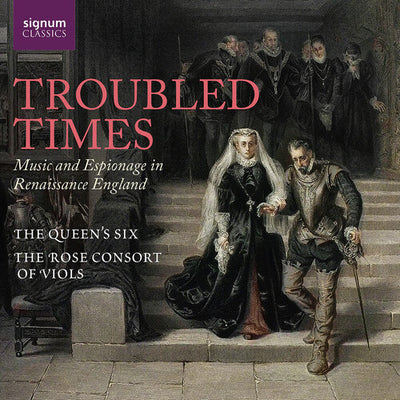
Freddy Eichelberger writes of this release: “The idea for this recording came to us after reading Anne Cuneo’s novel Le Trajet d’une riviere, in which the charming, valiant, chivalrous and Catholic Francis Tregian travels the length and breadth of Europe sword in hand, regarded as a spy by some, a messenger by others. He meets the greatest musicians of his time and copies out their music. Taking the three ‘compilations’ by Tregian that have come down to us, one of which is the famous Fitzwilliam Virginal Book, we find ourselves faced with hundreds of vocal and instrumental pieces, fantasies, madrigals and other pieces. In attempting to revive in part the musical world of Sir Francis Tregian, our aim was to explore the elements of dream and travel through time and space. The five Witches were joined by five guest Witches: two voices for the music of words, two viols enabling us to form a homogeneous consort, and the bandora which enabled us to achieve one of our aims- to recreate a genuine English broken consort.”
CD · 3 discs
The celebration of the Nativity has always been a source of inspiration for composers. The different elements of the evangelical narrative evoke numerous images: tender feelings before the Baby Jesus; the gentleness of his mother, the Virgin Mary; the procession of the three Wise Men; the angelic choirs in Heaven; and these shepherds gathered in the manger. All that appears in the musical repertoire linked to this holiday, as well as the presence of colourful instrumentations and themes connected to folk traditions. This set, released by Ricercar, brings together all these elements, drawn from the repertoires of the Renaissance and Baroque eras.
CD · 2 discs
«Apt for Viols and Voices». That's how the fusion of voices and viols is mentioned in several documents of the English renaissance. This CD is devoted to two of the most important composers of that period who've bequeathed us an important body of 'consorts' for 4 and 6 part viols as well as some very moving 'consort songs'. Both were employed at the royal court. The former Elisabeth the 1st, the latter by James the 1st. The elder remains faithful to the basic principles of polyphony acquired with his master Thomas Tallis for whom he writes the poignant elegy 'Ye Sacred Muses'. The second musician, on the other hand, a viola virtuoso, leads his instrument into new avenues and develops his polyphony through audacious experiments.