Search results: Search results

62 results

Products

    Naxos

    Joachim: Violin Concerto, Op. 11, Etc / Suyoen Kim, Et Al

    CD · 1 disc

    $19.99
    Composer
    JOACHIM, JOSEPH
    Artist
    Kim, Staatskapelle Weimar, Halász
    Released
    Oct 27, 2009


    JOACHIM Violin Concertos: in G, op. 3; in d, op. 11, “in the Hungarian Style” • Suyoen Kim (vn); Michael Halász, cond; Staatskapelle Weimar • NAXOS 8.570991 (65:57)


    From a position of near-obscurity in the early 1960s (at least in so far as recordings went), Joseph Joachim’s Hungarian Concerto received a lift-off from Charles Treger’s early complete recording with the Louisville Orchestra (Louisville LS 705) and from Aaron’s Rosand’s more brilliant but cut-down version on a Vox LP, reissued many times; while Takako Nishizaki recorded Joachim’s Third Concerto for Marco Polo (now available on Naxos 8.554733).


    That leaves the First Concerto, a one-movement affair lasting about 20 minutes from the early 1850s, when Joachim had hardly reached or passed the age of 20. Already the work displays a certain individuality: Joachim integrated the violin’s first entry into the opening tutti, after which initial statement the orchestra continues on its own. The solo part offered its youthful composer a great number of opportunities for virtuoso display, but the Concerto’s high symphonic seriousness sets it apart from more display-oriented vehicles written for their own use by his contemporaries Ernst and Wieniawski. In its harmonic and melodic style, so heavily tinged with nostalgia, the work resembles the first (or only) movements of Bruch’s later works (such as his Allegro appassionato and, especially, his Third Concerto). Suyoen Kim, producing a slender but pure tone in all registers (but with a steelier core on the G-string) from a 1742 Camillus Camilli, nevertheless projects the mix of pyrotechnical excitement and poignant lyricism the score demands. Joachim exerted a strong influence on the history of violin playing through his students, who included personalities as diverse as Jenö Hubay, Bronislaw Huberman, and Leopold Auer (who, having studied with him for two years, claimed that Joachim had opened his eyes). If the Concerto seems to wander, that’s neither Kim’s fault nor Halász’s.


    The Second Concerto, “in the Hungarian style” has been described as the most difficult of concerted works for the violin (although certainly not for the listener); it requires strength and stamina as well as sustained brilliance, demanding a very occasional sacrifice of tonal beauty to achieve the requisite tonal strength. Kim demonstrates a rock-solid technique and the same compound of brilliance and warmth she displayed in the composer’s First Concerto, while the Halász and the Orchestra find both imposing rhetoric and human warmth in the orchestral part (as in the First Concerto, the engineers have balanced the solo and orchestra parts, creating a striking profile for the former against the highly detailed backdrop of the latter). Both soloist and orchestra emphasize the Concerto’s overt ethnicity (an element perhaps most obviously missing from alternative recordings by Treger, Rosand, Elmar Oliveira (Masters 27, 15:3), Rachel Barton Pine (Cedille 90000 068, 26:6), and Christian Tetzlaff (Virgin 502109, 31:6), all of whose readings nevertheless realized a great deal of the Concerto’s potential—except for Treger’s, which fell somewhat short of the work’s technical demands, and, in any case, isn’t any longer available. But Kim’s brilliant while offering a structurally synoptic view of this prolix Concerto (just over 45 minutes in this performance), brings an occasional poignancy that relieves the dramatic tension in the first movement—compared to Tetzlaff and Dausgaard’s thrustingly craggy symphonic reading of that movement, she and Halász take by comparison a more relaxed, expansive view (skirting the danger in such a long-winded movement, that offers no extra time to pause and smell the flowers). And after a long respite in the slow movement, a passage hardly bereft of difficulties and violinistic posturing, she opens the finale with an energetic flash that rivals Rosand’s and surpasses it in Hungarian verve.


    For an imposing reading of the Hungarian Concerto, Kim’s and Halász’s could hardly be beat, and the program offers the relative novelty of the First Concerto, both in stunning performances. Strongly recommended to all kinds of listeners.


    FANFARE: Robert Maxham
    View full page
  • Joachim: Violin Concerto, Op. 11, Etc / Suyoen Kim, Et Al

    Joachim: Violin Concerto, Op. 11, Etc / Suyoen Kim, Et Al

    Naxos Oct 2009
    1 disc
    CD
    $19.99
  • Raff: Symphony No 6, Etc / Stadlmair, Bamberg So

    Raff: Symphony No 6, Etc / Stadlmair, Bamberg So

    Tudor Jan 2001
    1 disc
    CD
    $21.99
    Cedille

    Brahms & Joachim: Violin Concertos / Rachel Barton Pine

    CD · 2 discs

    $19.99
    Composer
    JOACHIM BRAHMS
    Artist
    Barton
    Released
    Jan 01, 2003

    REVIEW:

    This is not only one of the best sounding violin and orchestra recordings ever made, but the entire concept is so smart, so well executed, and so thoughtfully planned that even if it were not so musically stupendous it still would be worthy of your attention. As it is, this is one of those rare productions in which absolutely everything goes right. Consider, for example, the problems attendant upon releasing yet another recording of the Brahms Concerto. You have a small independent label with excellent musical credentials but limited resources, a soloist of great musical gifts (Rachel Barton's previous discs have all been top-notch) but who isn't a "big name", and a work that virtually every other violinist with access to a microphone has recorded, sometimes more than once. Given the fact that on musical evidence Barton's Brahms certainly deserves to be heard, what's a label to do?

    First, secure the services of a world-class orchestra under a fine conductor (Carlos Kalmar, music director of the Oregon Symphony and Chicago's Grant Park Festival, fills that bill nicely). Amazing, isn't it, that when major labels are screaming about how they can't afford to record major American orchestras Cedille has found the resources to do just that? Second, instead of simply offering the Brahms, you find an interesting coupling. And let's not kid ourselves: Joseph Joachim's Hungarian Concerto isn't just an "interesting coupling"; it is the Holy Grail of Romantic violin concertos, a work so lengthy (47-plus minutes, about the same as the Elgar concerto), so difficult, yet so deliberately symphonic and, in a sense, anti-virtuoso in conception that it has never once received even a merely adequate recording. Take that coupling, play it to a fare-thee-well (demonstrating once and for all that the work is indeed a brilliant and neglected masterpiece), and then toss in an equally fine Brahms Concerto, all offered at a two-for-one price. If that isn't a recipe for success, then nothing is.

    Indeed, Joachim's youthful Hungarian Concerto is so beautiful and full of life, its Gypsy-tinged melodies so entrancing, that only its inordinate difficulty accounts for its rarity. In concert it would be a show-stopper, and Rachel Barton has its full measure. The heavily symphonic first movement requires the soloist to engage in genuine chamber-music dialog with the orchestra, especially the principal winds. Joachim's orchestration must stand with the finest ever achieved in a concerto; there are no dead spots and no balance problems as long as the soloist has the taste and musicianship to know when to cede the spotlight and when to take command.

    Take the remarkable cadenza as a typical example: there's no barnstorming sawing and scraping, but instead a densely flowing river of lyricism joined now and then by solo flute and oboe. It's one of the most purely gorgeous passages ever written for the violin, and Barton plays it for all it's worth (and finishes up with some devastating descending chromatic octaves that actually sound like musical notes and not a rusty hinge).

    The slow movement features another very attractive principal theme, and when it returns at the movement's conclusion in the cellos, decorated by garlands of ornamentation from the soloist, the result sounds like some lost work of Dvorák at his most melodically characterful. Barton's electrifying attack on the finale, a dazzling "Rondo from hell" with a whiplash perpetual motion principal subject, sets the seal on this remarkable performance. Her double-stops (and there are tons of them: check out from 2:30 into the movement) are as sweetly tuned and richly voiced as her legato is smooth and her sense of rhythm acute. Even after this long work I wouldn't be surprised if you went right back and played the finale over again. It's that much fun.

    The word that most succinctly sums up Barton's Brahms is "aristocratic". Among recent recordings, she plays Milstein to Hilary Hahn's Heifetz. The timings are identical to Perlman and Giulini's celebrated performance with this same orchestra, but for my money Barton achieves an even finer balance between poise and virtuosity (and shows far greater dynamic sensitivity, especially in the finale). With opening-movement tempos relaxed but never slack, Barton's warm, round sound allows her to really dig into the music where necessary (witness that famous fanfare-like motive, or Joachim's first-movement cadenza)--but she never emits a raw or unlovely note. The second movement, with a gorgeous oboe solo at the start, is just heavenly, and the finale reveals plenty of high-spirited energy but also numerous delightfully phrased touches in its various episodes. At the very end Barton and conductor Kalmar produce a wind-down coda simply perfect in its timing and wit. She even includes her own eminently musical and enjoyable cadenza on a separate track. Simply jump ahead when the orchestra stops (the balance of the coda is also included, so you don't have to skip backward to get the ending).

    As noted above, the sonics are sensational. The opening of the Brahms, with dark-hued strings answered by the winds like a gleam of sun breaking through the clouds, will take your breath away. Although Barton deserves much of the credit for emitting such attractive sounds, it certainly helps that Cedille's engineers capture her shining tone with nary a trace of shrillness, even in the highest positions. Barton herself writes an excellent set of notes (surely indebted to Tovey in discussing the Joachim, but none the worse for that), and to put the icing on the cake she plays a 1742 Guarneri "del Gesu" violin, the "ex-Soldat", selected by Brahms himself for his friend and colleague, violin virtuoso Marie Soldat. Recordings don't get any better than this. Rachel Barton, conductor Carlos Kalmar, and Cedille deserve your enthusiastic support for putting this project together and executing it with such perfectionist zeal and consummate musicianship. There's also a lesson here that the whole industry should take to heart: Where there's a will, there's a way, and it's OK to make fewer recordings, especially if you make great ones. Astounding!

    --David Hurwitz

    View full page
  • Brahms & Joachim: Violin Concertos / Rachel Barton Pine

    Brahms & Joachim: Violin Concertos / Rachel Barton Pine

    Cedille Jan 2003
    2 discs
    CD
    $19.99
    Naxos

    Raff: Complete Violin Sonatas, Vol. 2 / Schneider, Kayaleh

    CD · 1 disc

    $9.99 $19.99 Save 50%
    Composer
    RAFF, JOSEPH JOACHIM
    Artist
    Kayaleh, Schneider
    Released
    Nov 08, 2019

    Joachim Raff enjoyed enormous prestige with a reputation as Germany’s leading symphonist of his time. He also wrote music for the violin, an instrument he had mastered when young, and for which he wrote with great sympathy. The enduring success of his first two sonatas prompted him to write three more: the charming, genial and joyous Sonata in D major, the symphonically conceived Sonata in G minor which, uniquely for Raff’s violin works, is cast in a single movement, and a Sonata in C minor that, while often melancholic in tone, is still suffused with his trademark lyricism.

    View full page
  • Raff: Complete Violin Sonatas, Vol. 2 / Schneider, Kayaleh
    Sale

    Raff: Complete Violin Sonatas, Vol. 2 / Schneider, Kayaleh

    Naxos Nov 2019
    1 disc
    CD
    $19.99 $9.99Save 50%
  • BRAHMS / JOACHIM: Hungarian Dances
    Sale

    BRAHMS / JOACHIM: Hungarian Dances

    Naxos Sep 1995
    1 disc
    CD
    $19.99 $13.99Save 30%
  • SYMPHONY NO. 1 'AN DAS VATERLA

    SYMPHONY NO. 1 'AN DAS VATERLA

    Tudor Jan 2001
    1 disc
    CD
    $21.99
  • SYMPHONY NO. 4, OUVERTURES 'BE

    SYMPHONY NO. 4, OUVERTURES 'BE

    Tudor Jan 2001
    1 disc
    CD
    $21.99
  • Raff: Violin Sonatas No  1, 3, & 4 / Daskalakis, Ishay

    Raff: Violin Sonatas No 1, 3, & 4 / Daskalakis, Ishay

    Tudor Jan 2001
    1 disc
    CD
    $21.99
    Naxos AudioVisual

    Musical Journey: Germany - Bavarian Lakes And Schloss Herrenchiemsee

    DVD · 1 disc

    $13.99
    Composer
    BRAHMS JOACHIM
    Artist
    Rahbari, Minsky
    Released
    Mar 30, 2010
    GERMANY


    The Places


    Bavaria has a place of its own in Germany, both geographically and culturally. The tour stars with the Alpine lake known as Königssee and explores the surrounding landscape, including the Berchtesgaden National Park and the gardens of Ludwig II's answer to Versailles, his grandiose Schloss Herrenchiemsee. The tour ends with the Chiemsee, its islands and its tranquil waters.


    The Music


    The music for the tour is by Johannes Brahms and his colleague and collaborator, the violinist Joseph Joachim. Brahms' Second Symphony, which accompanies the earlier parts of the tour, was described by some contemporaries as Brahms' Pastoral Symphony and provides, in its generally cheerful serenity, an apt accompaniment to views of the Bavarian countryside. Joachim's Overture In memoriam Heinrich von Kleist, written probably in the same year as Brahms' symphony, 1877, commemorates the centenary of the birth of the great German writer.


    Picture format: NTSC 4:3
    Sound format: Dolby Digital / DTS Surround
    Region code: 0 (worldwide)
    Running time: 50 mins
    No. of DVDs: 1
    View full page
  • Musical Journey: Germany - Bavarian Lakes And Schloss Herrenchiemsee

    Musical Journey: Germany - Bavarian Lakes And Schloss Herrenchiemsee

    Naxos AudioVisual Mar 2010
    1 disc
    DVD
    $13.99
    Delos

    Brahms: Hungarian Dances

    CD · 1 disc

    $18.99
    Composer
    BRAHMS, JOHANNES
    Artist
    Hoepcker, Bidini
    Released
    Nov 16, 2018

    Who actually wrote Johannes Brahms’ Hungarian Dances? Brahms probably heard most of these tunes as a child growing up in Hamburg, played by the Gypsy orchestras that were famous for their “Hungarian” dance tunes. These passionate and high-spirited melodies fascinate with their abrupt changes of mood, fanciful reveries and extravagant embellishments. Brahms may even have written a few of the melodies himself! But his hand is evident in the lush harmonies and emotional depth. This version for violin and piano was arranged by Brahms’ friend Joseph Joachim, the greatest violinist of his generation. The dances are played brilliantly by violinist Sabrina-Vivian Hopcker, who captures flawlessly the wild exuberance and deep sorrow of these alluring tunes. Fabio Bidini is the ideal collaborator, and together they have produced an album of uncommon beauty and appeal.

    View full page
  • Brahms: Hungarian Dances

    Brahms: Hungarian Dances

    Delos Nov 2018
    1 disc
    CD
    $18.99
  • VIOLIN CONCERTO IN D OP 77
    DEUTSCHE GRAMMOPHON

    VIOLIN CONCERTO IN D OP 77

    Vinyl · 1 disc

    $33.49
    Composer
    BRAHMS, JOHANNES
    Artist
    BRAHMS / MUTTER / BERLINER PHILHARMONIKER / KARAJA
    Released
    Jul 26, 2019
    Vinyl LP pressing. Herbert von Karajan called her "the greatest musical prodigy since the young Menuhin;" Anne-Sophie Mutter in turn praised Karajan for teaching her "to think the music through to it's logical conclusion and impose a sense of direction on it". Now their celebrated recording of one of the world's best-loved violin concertos returns to vinyl.
    View full page
  • VIOLIN CONCERTO IN D OP 77

    VIOLIN CONCERTO IN D OP 77

    DEUTSCHE GRAMMOPHON Jul 2019
    1 disc
    Vinyl
    $33.49
  • BRAHMS: TRIO OP. 114. ROBERT & CLARA SCHUMANN
    HARMONIA MUNDI

    BRAHMS: TRIO OP. 114. ROBERT & CLARA SCHUMANN

    CD · 1 disc

    $22.49
    Artist
    ZIMMERMANN, TABEA / QUEYRAS, JEAN-GUIHEN
    Released
    Mar 13, 2026
    The empathy between Robert and Clara Schumann, Joseph Joachim and Johannes Brahms engendered one of Romanticism's most fruitful artistic friendships. With the aim of mining the precious jewels of that unique intimacy, three great artists have devised a program in the form of a poetic conversation; here chamber music once more becomes shared human emotion in it's purest expression.
    View full page
  • BRAHMS: TRIO OP. 114. ROBERT & CLARA SCHUMANN

    BRAHMS: TRIO OP. 114. ROBERT & CLARA SCHUMANN

    HARMONIA MUNDI Mar 2026
    1 disc
    CD
    $22.49
    MDG

    Joachim Raff: Chamber Music, Vol. 1 / Leipzig String Quartet

    CD · 1 disc

    $23.99
    Composer
    RAFF, JOACHIM
    Artist
    Leipziger Streichquartett
    Released
    Jan 15, 2021

    Joachim Raff was an autodidact. Having grown up in Switzerland, he first tried his hand with moderate success in numerous places as a composer of salon pieces. Franz Liszt became aware of the young man's talents and hired him as a kind of private secretary. In Weimar Raff orchestrated some of Liszt's early symphonic poems and gained his appreciation. This first recording by the Leipzig String Quartet shows that this was no accident. Raff's first two quartets are large-format works which reveal great ambitions. By the time Raff composed his first quartet in 1855, he was already beginning to emancipate himself from Liszt and the narrow circle of his friends. The "Neudeutsche Verein" had just been founded when Raff left him for Wiesbaden, in financially uncertain circumstances but artistic independence. And indeed, Raff's music cannot be pigeonholed either in the "New German" or the "Brahmsian" category - perhaps the reason why he was admired by such diverse colleagues as Richard Strauss, Peter Tchaikovsky or even Franz Liszt. His first quartet op. 77 was premiered by the famous Hellmesberger Quartet, who had already offered the podium to Franz Schubert and the late Beethoven. The second quartet op. 90 was also quickly adopted by the Viennese. The turning away from a harmonically fixed formal scheme is a trend-setting move; chromaticism and free harmony gain the upper hand over schoolmasterly counterpoint. Self-marketing was not Raff's thing. Rather prim in his private life, he rarely performed publicly, though he was an excellent pianist. He also gave his work away rather than negotiate reasonable fees. As founding director of the Hoch'sche Conservatory in Frankfurt he nevertheless enjoyed great recognition among his contemporaries. To rekindle this in our time, the new recording of the Leipzig String Quartet is a highly welcome beginning.

    View full page
  • The Royal Edition - Brahms, Sibelius: Concertos / Bernstein
    Sony Masterworks

    The Royal Edition - Brahms, Sibelius: Concertos / Bernstein

    CD · 1 disc

    $17.99
    Composer
    BRAHMS, JOHANNES SIBELIUS, JE
    Artist
    Leonard, Zino, Bernstein, Francescatti
    Released
    Nov 04, 2009
    Sibelius's lines flow in a rich, warm glow of tone -- the whole concerto takes wings not, perhaps, as never before, but certainly as very seldom before. The Brahms is given a thorough-going romantic approach, full of feeling but also very carefully considered.

    ...[A] superlative version of the Sibelius... The performance Francescatti gives of the Sibelius is, technically, an impossible one: not even Heifetz plays the end of the first movement dead in tune, so it can't be done! but Francescatti does it. He also does everything else that can't be done with this concerto (as well, beginning to take things for granted, as everything that can); Sibelius's lines flow in a rich, warm glow of tone, his rhythms pulse, and, again, his chords are in tune. The orchestra are along with Francescatti, and they, too, have a rich quality of string tone and a pulsing rhythm; indeed the whole concerto takes wings not, perhaps, as never before, but certainly as very seldom before.

    -- Gramophone [10/1965, reviewing the original LP release of the Sibelius]

    ------------------------------

    Francescatti himself is in splendid form. He has a bad patch just before the G major episode in the finale, but otherwise his intonation is good and his tone as sweet as ever. The slow movement is rather more expressive than usual, the finale rather more fiery. Much of the credit for this must go to the conductor, Leonard Bernstein, who can get from an orchestra a degree of rubato usually expected only of pianists playing Chopin. The orchestral introduction to the slow movement is an example. Some will find the way Bernstein points the end of each two-bar phrase too mannered for their taste, but, apart from the fact that it's clever to get an orchestra to phrase so sensitively, he certainly matches the style of the solo playing. In the first movement there are no tricks to interrupt the flow of the whole, and the music is played with impressive breadth and understanding. The cadenza is Joachim's. This is without doubt one of the best available versions of the Brahms Violin Concerto, and if you like a thorough-going romantic approach, full of feeling but also very carefully considered, this may well be the one you will like best.

    -- Gramophone [12/1963, reviewing the original LP release of the Brahms]
    View full page
  • The Royal Edition - Brahms, Sibelius: Concertos / Bernstein

    The Royal Edition - Brahms, Sibelius: Concertos / Bernstein

    Sony Masterworks Nov 2009
    1 disc
    CD
    $17.99
    Affetto Records

    From Liszt to Ligeti / Darvarova, Weaver

    CD · 1 disc

    $18.99
    Composer
    Bela Bartok, Karl Goldmark, Jeno Hubay, Joseph Joachim, Zoltan Kodaly, Gyorgy Ligeti, Franz Liszt
    Artist
    Elmira Darvarova, Thomas Weaver
    Released
    Mar 22, 2024

    A spectacular tribute to Hungarian-born composers, from the brilliant, award-winning performers — Grammy-nominated violinist ELMIRA DARVAROVA (first and only woman-concertmaster of The Metropolitan Opera) and pianist THOMAS WEAVER (professor at Curtis Institute of Music), the album “FROM LISZT TO LIGETI” brings an exceptionally vivid narrative linking historic milestones in the legacies of a number of superb Hungarian-born musicians — composers and performers, who have so enormously contributed to enriching the world’s cultural treasure-trove.

    Liszt, Joachim, Bartók, Kodály, Hubay, Goldmark, Ligeti — they have all bequeathed us masterpieces to behold and cherish, throughout several centuries of showcasing, shaping, preserving, and amalgamating national traditions and global influences through the prism of their own personal creative gifts.

    This album is a charismatically kaleidoscopic retrospective that traces the historic perspective of how uniquely innovative artists such as Bartók and Kodály built the cornerstones of their oeuvre by exploring, embracing, critically analyzing, and then reshaping Liszt’s ideals. It also explores how Ligeti followed on the heels of Bartók and Kodály with his own ethnomusicological research, creating, still in his student days, a little-known Duo that he kept editing and crystallizing throughout his life and various periods of transforming and modernizing, but then later returning to conventionally established expressive means. Additionally, it delves into how Joachim — as a muse to numerous music giants, such as Brahms, Liszt, Dvorák, Bruch, Robert and Clara Schumann — influenced and caused cataclysmic events without which the history of music would not have been the same.

    In addition to the best-known Hungarian-born composers Liszt, Bartók, Kodály, and Ligeti, the inclusion of Joachim in this album as a co-author (not just dedicatee) of Liszt’s “Hungarian Rhapsody No. 12” (in its version for violin and piano) makes sense historically not only because Joachim in his transcription radically transformed Liszt’s composition but also because Joachim famously contributed to the creation of numerous gems by some of the greatest-ever composers, such as the violin concertos by Dvorák and Bruch (who published these works after Joachim helped in creating them) and Brahms’ First Piano Concerto (bearing Joachim’s handwritten corrections which elicited “thank-you” letters from Brahms, during the 4 years Brahms took to write that concerto).

    The inclusion in this album of the Hungarian-born composers Hubay and Goldmark is also well-justified, bringing up yet other interesting dimensions to the album’s narrative. The album’s deeply-considered collection explores the affecting lyrical gift of Goldmark, who, as the largely self-taught son of a synagogue cantor, followed his ingrained melodic instincts from growing up without riches among 20 siblings, to becoming Vienna’s leading composer (after the deaths of Brahms and Bruckner), teaching Sibelius, and writing a mind-blowing violin concerto, a symphony championed by Sir Thomas Beecham and by Leonard Bernstein, and several operas, one of which was produced at The Metropolitan Opera in 1885, and three of which were presented in Vienna during Mahler’s leadership of the Court Theatre.

    Hubay’s unparalleled contribution as a historical “cross-roads” figure is also well-defined in this album, not only because of who he was — the son of an elite musician (who conducted the Budapest premiere of Wagner’s “Lohengrin”), a student of Joachim, a department head at Brussels’ Royal Conservatory (succeeding Vieuxtemps and Wieniawski), a chamber music partner of Liszt and of Brahms (performing with Brahms the world-premiere of Brahms’ D Minor Violin Sonata, and the world-premiere of Brahms’ Third Piano Trio), composer of numerous concertos, symphonies, and operas (one of which was embroiled in a scandal reported 100 years ago by The New York Times), and the teacher of many illustrious star-violinists who became muses to Bartók, Kodály, Ravel, Holst, Vaughan Williams, Rebecca Clarke (among these violin prodigies were Bartók’s girlfriend Stefi Geyer, Eugene Ormandy of The Philadelphia Orchestra fame, and Joachim’s great-nieces Jelly d’Arányi and Adila Fachiri, who not only inspired Bartók and many others but also spear-headed the search for Schumann’s long-suppressed violin concerto, “cancelled” and hidden by its dedicatee — their great-uncle Joachim).

    The choice of Hubay’s well-known czardas “Hejre Kati” for inclusion in this album reflects the evolution and role of that genre in the history of Hungarian musical traditions — from the early roots of czardas stemming from verbunkos (used even by Haydn), to its controversial misappropriation by dilettante performers whose inflectional performing style was confused and misinterpreted by Liszt as original Hungarian folk melodies, to more tasteful artistically expressed concert-stage compositions (like Hubay’s “Hejre Kati”), to the eventual dethroning and demythologizing of the czardas by Bartók and Kodály, who discovered, revealed, and incorporated the true authenticity of their home country’s original folk music.

    The album selections follow Bartók’s evolving from the student-composer of a traditionally-profiled, Romantically-influenced Andante and the mature creator of “15 Hungarian Peasant Songs” and “Rhapsody for Violin and Piano No.1” (embodying his scientific and artistic mission to reveal the exquisitely-uncontroverted authentic beauty of ancient folk melodies) to the transfigured innovator who elevated and transformed old rustic traditions, fusing them into new and progressive forms and rhythms, reaching out to impressionism and jazz (as depicted in Bartók’s “Dance in Bulgarian Rhythm No. 6”), and paving the way for Ligeti’s experimentalism, which, through multiple “back and forth” constructing and de-constructing, reflected Ligeti’s never-ending search for artistic inspiration (this album presents the, recorded here only for the second time, recently-discovered Duo for Violin and Piano, which Ligeti never submitted for publication but continued returning to, and working on).

    The unusually meticulous album notes cover the multi-dimensional, serendipitous, and cross-pollinating nature of essential events and legacies, which endure and continue to fascinate us.

    View full page
  • From Liszt to Ligeti / Darvarova, Weaver

    From Liszt to Ligeti / Darvarova, Weaver

    Affetto Records Mar 2024
    1 disc
    CD
    $18.99
    Gramola Records

    Lehár, Brahms, Kálmán et al: Salon de Budapest / Irnberger, Kašpar

    SACD · 1 disc

    $23.99
    Composer
    Leopold von Auer, Carl Bohm, Johannes Brahms, Miska Hauser, Jeno Hubay, Jeno Huszka, Joseph Joachim
    Artist
    Thomas Albertus Irnberger, Pavel Kaspar, Brigitta Simon
    Released
    Sep 09, 2022

    Thomas Albertus Irnberger, violin, and Pavel Kašpar, piano, lead us with their album Salon de Budapest into the bourgeois salon of the late 19th century – an oasis amid the ‘good old days’ which weren’t, of course, that good to begin with: mired turmoil, social inequalities, and wars as much and more than ever since. The invited audience were to listen to Hungarian dances by Brahms, Kodály or Rachmaninoff, Csárdás’ by Franz Lehár, Miska Hauser or Jeno Hubay, Romances, Fantasies and other melodies by Tchaikovsky, Leopold Auer, Carl Bohm or Joseph Joachim. Some songs from operettas by Lehár, Jeno Huszka, Emmerich Kálmán and Pongrác Kacsóh with the Hungarian soprano Brigitta Simon complete this musical visit to the Salon de Budapest.

    View full page
  • Lehár, Brahms, Kálmán et al: Salon de Budapest / Irnberger, Kašpar

    Lehár, Brahms, Kálmán et al: Salon de Budapest / Irnberger, Kašpar

    Gramola Records Sep 2022
    1 disc
    SACD
    $23.99
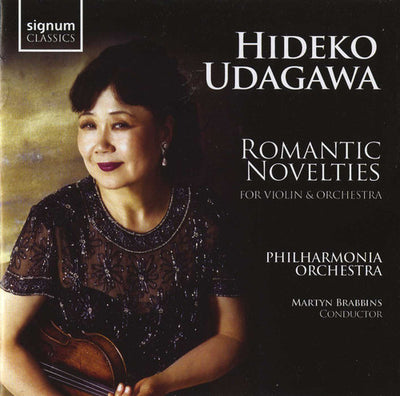
  • Romantic Novelties

    Romantic Novelties

    Signum Classics Jan 2010
    1 disc
    CD
    $19.99
    Naxos

    Music for Viola and Piano

    CD · 1 disc

    $19.99
    Composer
    MARTINU KODALY DOHNANYI ENE
    Artist
    Bradley, Hewitt
    Released
    Sep 27, 2011
    The viola works on this recording fuse lyricism with virtuosity, and sometimes invoke folkloric moments as well as more rhapsodic flights. Martinu' 1955 Sonata plays on elements of folk music and rhapsody, as well as a toccata-like intensity.
    View full page
  • Music for Viola and Piano

    Music for Viola and Piano

    Naxos Sep 2011
    1 disc
    CD
    $19.99
  • V4: ART OF VIOLIN
    Rhine Classics

    V4: ART OF VIOLIN

    CD · 2 discs

    $32.99
    Composer
    BEETHOVEN BRAHMS
    Artist
    Jascha Heifetz
    Released
    Sep 15, 2017
    MusicWeb wrote of this new release: “This is a valuable addition to the discography. The Los Angeles concerts of 1963-1964 were given at the Hollywood Bowl, in which Heifetz and Piatigorsky played the Brahms Double with Leonard Bernstein, and at the Dorothy Chandler Pavilion where the violinist essayed the Beethoven with Zubin Mehta. Neither concert has apparently been issued before. There are two bonus tracks, previously released, that come from the Bell Telephone Hour with Donald Voorhees conducting in Radio City, New York in February 1950. The Evorak is tightly coiled, cloaked and hooded, full of inimitable tonal splendor and not remotely relaxed while the Sarasate Habanera is suave and bewitching. Cembal d’amour once issued this but their transfer is cloudy and palpably inferior to this one.”
    View full page
  • V4: ART OF VIOLIN

    V4: ART OF VIOLIN

    Rhine Classics Sep 2017
    2 discs
    CD
    $32.99
  • Wagner Liaisons
    Berlin Classics

    Wagner Liaisons

    CD · 1 disc

    $19.99
    Composer
    Anton Bruckner, Franz Liszt, Felix Mendelssohn, Richard Wagner
    Artist
    Matthias Kirschnereit
    Released
    Nov 28, 2025
    The German star pianist Matthias Kirschnereitdedicates this album entirely to the piano cosmos of Richard Wagner?. Wagner himself wrote few works for solo piano, but he influenced many of his contemporaries and musical heirs with his work?. Matthias Kirschnereit presents a wide range of repertoire - Wagner: Sonata for the album M.W., Lied ohne Worte E major for Eduard Reitz, In das Album der Furstin M., Zurcher Vielliebchen Walzer, Polka, Notenbrief fur Mathilde Wesendonck, Ankunft bei den Schwarzen Schwanen; Wagner/Stradal: Schmerzen; Wagner/Rubinstein: Musikalische Bilder aus Siegfried; Liszt: Am Grabe Richard Wagners; Bizet: Premier Nocturne D Dur; Duparc: Aux etoiles; Langgaard: Stambogsblad; Bulow: Innocence; Bruckner: Erinnerung; Mendelssohn: Lied ohne Worte E Dur op.38/3?
    View full page
  • Wagner Liaisons

    Wagner Liaisons

    Berlin Classics Nov 2025
    1 disc
    CD
    $19.99