Léo Delibes

Léo Delibes

Composer

1836–1891. French composer in the French Romanticism tradition.

Best known for ballets Coppélia and Sylvia, and the opera Lakmé.

Signature works: Coppélia, Sylvia, Lakmé, Le Roi l'a dit, La Source.

    Leo Delibes: Jean de Nivelle
    Bru ZanePre-order

    Leo Delibes: Jean de Nivelle

    CD · 3 discs

    $44.99
    Composer
    Leo Delibes
    Artist
    Hungarian National Philharmonic Orchestra, Hungarian National Choir, Gyorgy Vashegyi, Cyrille Dubois
    Among Leo Delibes's output of some twenty operas, Jean de Nivelle falls within his mature period, between Le Roi l'a dit and Lakme. The work's premiere at the Opera-Comique on 8 March 1880 was a resounding success. The press praised the charm of the melodies and the quality of the libretto by Edmond Gondinet and Philippe Gille, remarking on the coexistence of two styles in the score: one melodic and light, typical of opera-comique, and another in which the vocal writing seemed more serious, the orchestration richer and the harmonies more complex. It is true that the listener frequently feels a dramatic sweep 'that transports one into the realm of grand-opera', to quote Le Menestrel. Beyond it's intrinsic interest, Jean de Nivelle reveals the growing seriousness that had come to dominate the opera-comique genre. So much so, indeed, that critics regretted the retention of spoken dialogue (however characteristic of the genre) in Delibes's work. But recitatives were soon added to facilitate it's international dissemination. It is this version that the Palazzetto Bru Zane has reconstructed and decided to record.
    View full page
  • Leo Delibes: Jean de Nivelle
    Pre-order

    Leo Delibes: Jean de Nivelle

    Bru Zane Dec 2026
    3 discs
    CD
    $44.99
    Alpha

    Je chante la nuit

    CD · 1 disc

    $20.99
    Composer
    Georges Bizet, Joseph Colombo, Claude Debussy, Leo Delibes, Albert Lasry, Wolfgang Amadeus Mozart, T
    Artist
    Agathe Peyrat, Pierre Cussac
    Released
    Sep 11, 2026
    The soprano (and ukulele player) Agathe Peyrat and the accordionist (and singer) Pierre Cussac form a unique duo, free-spirited and open to blending genres. In this programme, they embrace a classical repertoire, while putting their own spin on it "by turning the pieces into songs, with night and day as the theme." We discover an astonishing version of Mozart's Queen of the Night, melodies and opera arias by Debussy, Bizet, Saint-Saens, Puccini, Delibes and Wagner, as well as songs by Maurice Yvain, Charles Trenet, Andre Minvielle and Brigitte Fontaine, all arranged by the two artists, who play with every nuance between black and white, darkness and light: 'On this recording, light represents the great joy we feel when we play together - a joy we love to share."
    View full page
  • Je chante la nuit

    Je chante la nuit

    Alpha Sep 2026
    1 disc
    CD
    $20.99
  • Fairytale Ballets - Cinderella, Coppelia, The Sleeping Beaut
    Opus Arte

    Fairytale Ballets - Cinderella, Coppelia, The Sleeping Beaut

    Blu-Ray · 4 discs

    $52.99
    Composer
    Leo Delibes, Sergei Prokofiev, Pyotr Ilyich Tchaikovsky
    Artist
    Marianela Nunez, Vadim Muntagirov, Fumi Kaneko, Kristen McNally, Gary Avis, Bennet Gartside, Luca Ac
    Released
    Jun 26, 2026
    The Royal Ballet's perfect pairing of Marianela Nunez and Vadim Muntagirov takes centre stage in this collection of four fairytale favourites. Royal Ballet founding choreographer Frederick Ashton's Cinderella was brought back to Covent Garden in 2023 to celebrate it's 75th Anniversary with a creative team steeped in the magic of theatre, film and dance bringing new atmosphere to Cinderella's ethereal world of fairy godmothers and pumpkin carriages, handsome princes and finding true love. Ninette de Valois' charming and funny Coppelia is a classic of The Royal Ballet repertory - a story of love, mischief and mechanical dolls. The intricate choreography is set to Delibes' delightful score and shows off the technical precision and comedic timing of the whole company. Osbert Lancaster's designs bring a colourful storybook world to life in this entertaining and joyful ballet. Marius Petipa's The Sleeping Beauty holds a special place in The Royal Ballet's repertory, with it's vibrant sets and glittering costumes and featuring such iconic moments as the Rose Adage, the Vision Pas de Deux, the exuberant wedding celebration and the charming fairy-tale guests, all danced to Tchaikovsky's richly layered music - one of the most beloved ballet scores of all time. Swan Lake is perhaps the best-loved of all the classical ballets. This production by Liam Scarlett features additional choreography while remaining faithful to Petipa and Ivanov's classic. John Macfarlane's opulent designs provide an atmospheric, period setting for this enthralling love story, illuminated by Tchaikovsky's sublime score.
    View full page
  • Fairytale Ballets - Cinderella, Coppelia, The Sleeping Beaut

    Fairytale Ballets - Cinderella, Coppelia, The Sleeping Beaut

    Opus Arte Jun 2026
    4 discs
    Blu-Ray
    $52.99
  • Fairytale Ballets - Cinderella, Coppelia, The Sleeping Beaut
    Opus Arte

    Fairytale Ballets - Cinderella, Coppelia, The Sleeping Beaut

    DVD · 4 discs

    $52.99
    Composer
    Leo Delibes, Sergei Prokofiev, Pyotr Ilyich Tchaikovsky
    Artist
    Marianela Nunez, Vadim Muntagirov, Fumi Kaneko, Kristen McNally, Gary Avis, Bennet Gartside, Luca Ac
    Released
    Jun 26, 2026
    The Royal Ballet's perfect pairing of Marianela Nunez and Vadim Muntagirov takes centre stage in this collection of four fairytale favourites. Royal Ballet founding choreographer Frederick Ashton's Cinderella was brought back to Covent Garden in 2023 to celebrate it's 75th Anniversary with a creative team steeped in the magic of theatre, film and dance bringing new atmosphere to Cinderella's ethereal world of fairy godmothers and pumpkin carriages, handsome princes and finding true love. Ninette de Valois' charming and funny Coppelia is a classic of The Royal Ballet repertory - a story of love, mischief and mechanical dolls. The intricate choreography is set to Delibes' delightful score and shows off the technical precision and comedic timing of the whole company. Osbert Lancaster's designs bring a colourful storybook world to life in this entertaining and joyful ballet. Marius Petipa's The Sleeping Beauty holds a special place in The Royal Ballet's repertory, with it's vibrant sets and glittering costumes and featuring such iconic moments as the Rose Adage, the Vision Pas de Deux, the exuberant wedding celebration and the charming fairy-tale guests, all danced to Tchaikovsky's richly layered music - one of the most beloved ballet scores of all time. Swan Lake is perhaps the best-loved of all the classical ballets. This production by Liam Scarlett features additional choreography while remaining faithful to Petipa and Ivanov's classic. John Macfarlane's opulent designs provide an atmospheric, period setting for this enthralling love story, illuminated by Tchaikovsky's sublime score.
    View full page
  • Fairytale Ballets - Cinderella, Coppelia, The Sleeping Beaut

    Fairytale Ballets - Cinderella, Coppelia, The Sleeping Beaut

    Opus Arte Jun 2026
    4 discs
    DVD
    $52.99
  • Golden Age
    PENTATONE

    Golden Age

    CD · 1 disc

    $19.99
    Composer
    Georges Bizet, Leo Delibes, Gaetano Donizetti, Gioacchino Rossini, Giuseppe Verdi
    Artist
    Erin Morley, Lawrence Brownlee, Munchner Rundfunkorchester
    Released
    Oct 10, 2025
    This captivating new release from PENTATONE celebrates the glittering world of 19th-century opera and the timeless beauty of the golden age of bel canto. Featuring music by Gaetano Donizetti, Gioacchino Rossini, Georges Bizet, Leo Delibes, and Giuseppe Verdi, the album showcases soprano Erin Morley and tenor Lawrence Brownlee two of today's most exciting voices joined by the Munchner Rundfunkorchester under the baton of conductor Ivan Repusic. Together, they bring fresh brilliance to the French and Italian repertoire with performances that balance vocal agility, lyrical finesse, and emotional power. This carefully curated collection of operatic gems highlights iconic duets and arias that continue to resonate with modern audiences through their passion, beauty, and dramatic flair. It marks an exciting PENTATONE debut for both Lawrence Brownlee and Ivan Repusic, while Erin Morley returns following her acclaimed performance in the label's recording of Handel's Alcina (2024). The Munchner Rundfunkorchester also makes a welcome return, having previously appeared on PENTATONE's release of Gordon Getty's Plump Jack (2012).
    View full page
  • Golden Age

    Golden Age

    PENTATONE Oct 2025
    1 disc
    CD
    $19.99
  • George
    Naïve

    George

    CD · 1 disc

    $16.99
    Composer
    Frederic Chopin, Leo Delibes, Ruggero Leoncavallo, Franz Liszt, Jacques Offenbach, Francesco Paolo T
    Artist
    Sonya Yoncheva, Marina Viotti, Marina Viotti
    Released
    Apr 04, 2025
    Sonya Yoncheva has long been fascinated by George Sand. Writer, dramaturg, and literary critic, a journalist and an intellectual, the lover of Alfred de Musset and then of Frederic Chopin as well as being a friend of Franz Liszt, Pauline Viardot and Marie Dorval, and beyond her remarkable destiny as a woman blessed with the "glorious and complete independence" which in her age was reserved solely for men, Sand embodies the entire spirit, the essence even, of the 19th century. It is in the first place her boldness, approaching the intrepid, which appeals to the Bulgarian soprano. Sand showed daring for all of her life, and what a fount of inspiration her writings are, on all kinds of topics. Whether political, social, cultural, artistic, how pertinent they are, and how their vibrant, trenchant language dazzles! George Sand loved the arts unconditionally. And so this programme opens the doors to us, revealing her artistic universe and bringing her passions to life. Her house, her kitchen, her salon stir into action again, in this soiree in the company of her friends, these artists to whom she was so close and who, respectfully and with tender affection, listened to each other, conversed, laughed, and celebrated in music and poetry. Here, George Sand do not sing, nor do she play an instrument. So Sonya Yoncheva portrays her by reading some of her words. They bear witness to the sparkling, glittering nature of the "Lady of Nohant". What surprises there are throughout this recital! If the passionate urges of Alfred de Musset, fervent or, as so often, disappointed, nourish this journey equally, so the sumptuous Nuit de decembre by Ruggero Leoncavallo, the more hedonistic examples of Pauline Viardot, these two Mazurkas by Chopin transformed into melodies with Louis Pomey's slightly schoolboyish texts, or more obscurely the "medley" of Les Bohemiennes, marrying diverse motifs, of Brahms's Hungarian Dances, also delight heart and mind - a beautiful homage to the innate music that derives from folk and popular traditions, something that George Sands so frequently and tenderly extolled.
    View full page
  • George

    George

    Naïve Apr 2025
    1 disc
    CD
    $16.99
  • La Divina - The Best of Maria Callas
    WARNER CLASSICS

    La Divina - The Best of Maria Callas

    CD · 2 discs

    $18.99
    Composer
    Vincenzo Bellini, Georges Bizet, Gioacchino Rossini, Giacomo Puccini, Giuseppe Verdi, Amilcare Ponchielli, Gaetano Donizetti, Léo Delibes, Gustave Charpentier, Richard Wagner, Jules Massenet
    Artist
    Maria Callas
    Released
    Mar 29, 2024
    Maria Callas is credited with changing the history of opera. Known as La Divina, she continues to fascinate as a supreme artist, but also as a woman and an icon of style. Her interpretations were as compelling for their dramatic truth as for their musical integrity. Her voice, with it's extraordinary range, was as distinctive as her infallible sense for a phrase. A magnetic presence, she brought operatic heroines to vivid life, magically shaping and colouring her tone, and making insightful use of the text of the libretto.
    View full page
  • La Divina - The Best of Maria Callas

    La Divina - The Best of Maria Callas

    WARNER CLASSICS Mar 2024
    2 discs
    CD
    $18.99
    APR

    Wilhelm Backhaus - The Complete Acoustic & Selected Early Electric Recordings

    CD · 3 discs

    $32.99
    Composer
    Johann Sebastian Bach, Johannes Brahms, Cecile Chaminade, Frederic Chopin, Leo Delibes, Edvard Grieg
    Artist
    Wilhelm Backhaus
    Released
    Nov 17, 2023

    As one of the great pianists of the 20th century, WILHELM BACKHAUS (1884–1969) needs no introduction. He recorded almost continuously from 1908 until his death, but this set, focusing on his earliest recordings, completes APR’s coverage (see also APR 6026, APR 6027 and APR 5637) of all his solo and concerto output for The Gramophone Company/HMV, except the electrically recorded Brahms titles, which are available elsewhere. These early discs reveal Backhaus as an exciting young virtuoso, rather than the sober purveyor of German classics he was to become.

    View full page
    IDIS

    Masters of the Guitar, Vol. 5: Italian Recordings, 1930s-1950s

    CD · 1 disc

    $16.99
    Composer
    Toto Amici, Anonymous, Josede Azpiazu, Napoleon Coste, Leo Delibes, Luigi Denza, Calvaruso-Ferrari
    Artist
    Pasquale Taraffo, Giulio Giulietti, Luigi Mozzani, Luigi Mariotti, Mario Gangi, Mario Parodi
    Released
    Mar 31, 2023

    In Italy, the guitar had a difficult time being considered a classical instrument like it was in other countries. The first guitar course was instituted in Italian conservatories in 1965 but even in the 70s and 80s many Concerto Societies did not have or promote even the most internationally famous guitarists. This new release collects six performances by guitar students. The album begins with Pasquale Taraffo, who can be considered the perfect example of a performer on the edge between classical and popular music. The album ends with Mario Parodi, an extraordinary performer and musician who is unfortunately often overlooked. The other four protagonists of this new release are part of the Italian guitar revival: from Giulio Giulietti, to Luigi Mozzani and from Luigi Mariotti to Mario Gangi, who made classical guitar famous throughout Italy with his television appearances.

    View full page
    Bru Zane

    Les Nuits de Paris - Dance Music from Folies Bergère to Opéra / Roth, Les Siècles

    CD · 1 disc

    $20.99
    Composer
    Leo Delibes, Theodore Dubois, Jules Massenet, Camille Saint-Saens, Ambroise Thomas
    Artist
    Francois-Xavier Roth, Les Siecles
    Released
    Jan 27, 2023

    The dance permeated every layer of Romantic society. From popular dance halls to courtly salons, people showed their public face, enjoyed themselves and met one another in waltz time or to the rhythms of the quadrille or the polka. At the same time, ballet gained unprecedented fame on the stage of the Paris Opéra. The music that accompanied this frantic round in France has long been neglected, whereas the Viennese have never ceased to celebrate their waltzes. Under the expert baton of François-Xavier Roth, the orchestra Les Siècles has set out to rediscover this French repertory using historical instruments. Their album explores the output of both established composers – Camille Saint-Saëns, Ambroise Thomas, Charles Gounod, Jules Massenet – and their colleagues who specialized in Terpsichorean entertainment, including Philippe Musard, Isaac Strauss, Émile Waldteufel and Hervé.

    REVIEWS:

    Beautifully recorded and with Bru Zane’s customary excellent booklet notes, this is a disc to delight Francophiles, especially sweet-toothed ones like myself.

     -- Gramophone

    There is a blowsy joie de vivre in these performances by Roth’s French Orchestra Les Siecles that is hard to resist.

    -- The Sunday Times (UK)

    It’s all very French, and presented with great flair and warmth by Roth and his orchestra.

    -- The Guardian (UK)

    View full page
  • Delibes - Minkus: La source, ou Naïla
    Naxos AudioVisual

    Delibes - Minkus: La source, ou Naïla

    DVD · 1 disc

    $30.99
    Composer
    Leo Delibes
    Artist
    Alexis Renaud, Christophe Duquenne, Francois Roussillon, Isabell
    Released
    Apr 08, 2022
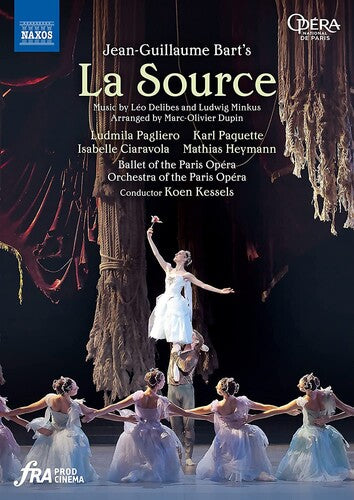
    Lost after its material records were destroyed by fire in 1883, the spectacular ballet La Source originally portrayed the idealistic vision of a magical domain in which a complex but beautiful love story of mythical figures unfolded. Jean-Guillaume Bart has long been captivated by La Source, and his new choreography retains the ballet’s romantic fascinations and its glorious music by Delibes and Minkus. Filled with exotic colour and atmosphere, Bart takes the narrative on an odyssey through near- and far-flung realms of classical dance in a brilliant production, further elevated by Christian Lacroix’s gorgeous costumes and Éric Ruf’s imaginative set designs.
    View full page
  • Delibes - Minkus: La source, ou Naïla

    Delibes - Minkus: La source, ou Naïla

    Naxos AudioVisual Apr 2022
    1 disc
    DVD
    $30.99
  • Delibes & Minkus: La Source / Kessels, Paris National Opera Ballet & Orchestra
    Naxos AudioVisual

    Delibes & Minkus: La Source / Kessels, Paris National Opera Ballet & Orchestra

    Blu-Ray · 1 disc

    $17.49 $34.99 Save 50%
    Composer
    Leo Delibes
    Artist
    Alexis Renaud, Christophe Duquenne, Francois Roussillon, Isabell
    Released
    Apr 08, 2022

    Review:

    At last! While we have plenty of filmed productions of Coppélia to watch and enjoy – whether vintage, bang up to date or downright wacky – and a very good one of Sylvia, this new release finally brings the first of Delibes’s three ballets, La source, to a wide audience via Blu-ray and DVD.

    The usual explanation for La source’s historical neglect has been that the contribution of Delibes’s co-composer Ludwig Minkus diminished the overall quality of the score. But that suggestion isn’t an adequate one – or even necessarily accurate. In the first place, we need to be clear that “co-composers” doesn’t mean that each of the score’s individual numbers was a sort of high-quality-Delibes-watered-down-by-workmanlike-Minkus hybrid. In fact, the way in which the collaborative process worked was a very practical one – even if we have no idea why it was adopted – with each man allocated responsibility for different parts of the score. Minkus was entrusted with Act 1 and the second scene of Act 3, while Delibes was responsible for Act 2 and Act 3’s first scene. That turned out, in practice, to be a pretty even split, for Minkus ended up providing about 45 minutes worth of music and Delibes penned about 44[.]

    It is certainly true that there are differences between the two men’s scores. To some extent, those derive from the mundanely practical point that each composer was writing music for very different sections of the story. Minkus’s focus in Act 1 was on establishing the ballet’s various characters and generally setting the scene, while the finale to Act 3 offered few opportunities as it gave him only six minutes to wrap up the whole drama. Delibes, on the other hand, was tasked with creating the music underpinning the more glamorous jollifications at the khan’s court, which allowed him to concentrate on writing livelier material that was characterised by far more colour, glitter and exotic sensuality.

    There is, however, a second and somewhat more fundamental explanation for the perceived contrasts between the two composers’ scores, for Minkus and Delibes had rather different conceptions of what writing music for the ballet actually meant. The former was a composer of the old school who, as Ivor Guest wrote in his booklet essay for the aforementioned Bonynge CD, “specialised in composing music for the ballet, a field not highly regarded in musical circles but which nonetheless demanded a special gift to satisfy the ballet-master’s requirements – to produce melodious numbers for the dances and suitably descriptive passages for the action, and above all to deliver to a deadline”. That has led some critics to perceive Minkus as little more than a hack journeyman who churned out unmemorable material on demand, even though audiences who have come to appreciate the manner in which his skilfully-wrought scores underpin such popular ballets as Don Quixote and La bayadère might beg to differ. In reality, his music was in no way “inferior” to that of the next generation of ballet composers: it simply aimed to achieve a very different - but certainly no less legitimate – musical and dramatic purpose. The first embodiment of that subsequent generation, Delibes himself, was, on the other hand, a composer whose conception of ballet was developing into something rather more ambitious. No less a figure than Tchaikovsky, the originator of the modern “symphonic” style of ballet score, regarded Sylvia as “the first ballet in which the music constitutes not just the main, but the sole interest. What charm, what grace, what melodic, rhythmic and harmonic richness. I was ashamed. If I had known this music earlier, then of course I would not have written Swan Lake”.

    It is far too easy, in fact, to assert glibly that any contrasts between the two composers’ contributions are necessarily qualitative in nature. Indeed, when listened to blind and without foreknowledge of who actually composed what, the score of La source – skilfully edited and occasionally augmented here by Marc-Olivier Dupin - actually emerges as a pretty seamless whole.

    In reality, there were two other much more significant causes of the ballet’s failure to maintain a long-term place in the repertoire. In the first case, its plot was undeniably involved, and it is notable that the production under consideration omits several of its complicating plotlines. Moreover, the fact that there are no less than three central female figures and that easily confused names were selected for some of the central characters (Naïla/Nouredda, Djémil/Dadjé) does not help. The inconsistency of some of the participants’ on-stage motivations can also be puzzling from time to time – though, in the absence of any other modern production with which to compare it, that may be a feature unique to this particular one.

    The second legitimate reason for La source’s relatively rapid descent into obscurity is simply accidental. It successfully maintained its place in the repertoire for a decade and there is no reason to doubt that regular revivals might subsequently have been mounted. However, a disastrous fire in 1873 destroyed the drawings, models and plans on which the original production had been based and, rather than recreate them from scratch, it no doubt seemed easier to ballet impresarios at the time to move on to different projects.

    This new Blu-ray/DVD release preserves a new production of the ballet dating from almost 150 years after its premiere. Conservatively choreographed by Jean-Guillaume Bart for the Paris Opera Ballet, it follows the original story’s broad outlines and uses much of the Minkus/Delibes score. Booklet notes author Laure Guilbert is nevertheless at pains to stress that this production is in no way a “reconstruction” of the original but instead has a character and identity of its own. Those last words might be enough to strike fear in the heart of traditionalist ballet fans, but in reality the French choreographer (gushingly described by Ms. Guilbert as a man who “fervently cultivates his attachment to the classical universe… a lover of dance who has transformed [it] into an odyssey throughout the near- and far-flung realms of the art”) is owed a real debt of gratitude for his achievement in returning La source to the stage. There are, it’s true, a few significant problem areas that would have benefited from attention. In the case of the plot, Nouredda’s motivation and reactions as she experiences her character’s trials and tribulations can be somewhat opaque or even downright puzzling. In addition, the stage production itself is visually rather disconcerting. There is, to my own eyes at least, a jarring mismatch between Christian Lacroix’s detailed and often gorgeously elaborate costumes and Éric Ruf’s essentially impressionistic set designs. The latter are highly imaginative and attractive in their own right (especially a set of prominent and exquisitely lit ropes, lowered over the stage from the flies, that represent trees) but they are clearly not intended as any sort of realistic depiction of the settings and that doesn’t gel with the detailed, elaborate and convincingly “realistic” clothing sported by the dancers. Neither element can be described as wrong in itself, but another producer might have chosen to integrate them more effectively.

    The quality of the dancing, meanwhile, is generally high, with the women, in particular, demonstrating confident assurance in their own technical skills. Ludmila Pagliero as Naïla performs with delicacy and an appropriate sense of otherworldliness; she presumably impressed not only the theatre audience but the company’s management, too, as within a year of this performance she had been promoted to the top rank of danseuse étoile. Meanwhile, the nature of her role as the princess Nouredda means that the other leading female dancer, Isabelle Ciaravola, tends to spend a disproportionate amount of time on stage looking depressed and generally mopey – although there are also moments, as already noted, when she looks bizarrely happy even though her circumstances are at their worst. If her acting is somewhat questionable, the same cannot be said, however, of Ms. Ciaravola’s dancing which is, invariably, both sensitively and often rather beautifully delivered. Of the men, Karl Paquette combines sheer energy with attention to detail in a winning performance that suffers only from an uncharacteristically drab and featureless costume, little suited, in my opinion, to the hero of a classical ballet. The role of Nouredda’s brother Mozdock, concerned about her only as far as she serves his own political ambitions, is taken by Christophe Duquenne who delivers an effectively villainous turn while leading his energetic and well-drilled soldiers in several lively numbers. Dancing as the elf Zaël, Mathias Heymann is the audience’s favourite as he leaps his way enthusiastically and repeatedly across the stage, creating a genuine character out of his role. The dancer portraying the libidinous khan, Alexis Renaud, makes the most of his opportunities but does not create as much of an impression as the other men. The rest of the company make a very positive contribution, to the extent that I thought that the numbers in which the primary focus was on the corps de ballet were among the most effectively delivered in the whole performance.

    On the technical side, I was particularly impressed by the effectively realised stage lighting which has been very well captured on film. The sound, as relayed on this recording, is also more than merely acceptable and allows us to appreciate plenty of felicitous detail from the orchestra, led on this occasion by Koen Kessels who will be known to many as music director of the Royal Ballet. Meanwhile, the experienced François Roussillon’s film direction focuses our attention to everything that we need to see while not distracting us unnecessarily or drawing undue attention to itself.

    This is an important release for balletomanes. It is, I think, unlikely that there will be an alternative version of La source any time soon...I repeat, therefore, my original reaction to the release of this new and well-produced Blu-ray disc – at last!
     
    Rob Maynard

    View full page
  • Delibes & Minkus: La Source / Kessels, Paris National Opera Ballet & Orchestra
    Sale

    Delibes & Minkus: La Source / Kessels, Paris National Opera Ballet & Orchestra

    Naxos AudioVisual Apr 2022
    1 disc
    Blu-Ray
    $34.99 $17.49Save 50%
    Danacord

    Thomas Jensen Legacy, Vol. 7 / Jensen, Tivoli Concert Orchestra, Danish Radio Symphony Orchestra

    CD · 2 discs

    $18.99
    Composer
    Georges Bizet, Johannes Brahms, Leo Delibes, Edward Elgar, Carl Frederik Emil Horneman, Johann Strau
    Artist
    Jensen
    Released
    Jan 21, 2022
    A magical evening at the Tivoli Gardens! This new compilation features live and studio recordings of light orchestral waltzes and polkas, including the greatest hits of the Danish 'Waltz King', HC Lumbye. Several studio recordings from the 1940s receive their first release on album. Album 2 features a previously unpublished live concert broadcast direct from the Tivoli Gardens, where the people of Copenhagen have enjoyed relaxation and entertainment ever since 1843. Thomas Jensen directs the Tivoli orchestra with the same authority he brought to his classic recordings of Nielsen and Sibelius.
    View full page
    Profil

    Wilhelm Backhaus Edition

    CD · 10 discs

    $44.99
    Composer
    VARIOUS
    Artist
    Wilhelm Backhaus
    Released
    Apr 30, 2021

    "Essentially, in the incredible ease and naturalness of his pianism, in the unassuming simplicity and absorption of the man, Backhaus was much the same artist and personality then. And he was far from unknown. Even before he won the Rubinstein Prize in 1905, Backhaus was internationally celebrated as a prodigious virtuoso. [...] Backhaus never failed to win a succès d'estime among professional musicians. They always knew his qualities, always marveled at his instrumental perfection, his titanic mastery that scorned every complexity, his unsurpassed freedom and endurance. There was never a time when Backhaus could not toss off any or all of the Chopin études or the Brahms-Paganini variations with an imperturbable calm, an implacable security that left one open-mouthed. Not everyone, for only the pianists really knew what was happening before their eyes and ears, knew how to measure such achievement. There they all sat, in breathless astonishment and envy and despair. [...] Backhaus was a shy, unaffected, recessive personality whose sensational capacities were so unsensationally projected that lay audiences remained totally unconscious of his fabulous accomplishments." (Gerhard Melchert)

    REVIEW:

    This 10-CD box brings us not only concert recordings of works closely associated with him but also early piano roll and studio recordings, including the first complete recording of the Chopin Etudes and a variety of other short pieces.

    Backhaus's technique has been praised by many critics, but his scintillating virtuosity in the shorter pieces on CDs 1 and 2 nevertheless came as a revelation to someone who mainly knows him from his later years. These are technical display pieces, and Backhaus plays them to the hilt.

    The most impressive piano rolls are of two Liszt pieces (La Leggierezza and a Mendelssohn paraphrase) and of a very difficult arrangement of a Delibes waltz by Dohnanyi. The sparkling virtuosity here is breathtaking.

    CD 3 has the 24 Chopin Etudes. They have been reissued repeatedly, but this was a nice opportunity to hear them again. They remain one of the best recordings of these challenging pieces, and the sound is quite good. Backhaus's seemingly effortless technical mastery without musical superficiality is spellbinding. He was the rare German pianist who excelled in Chopin.

    The Beethoven sonatas on discs 6-8 come from two recitals: Carnegie Hall, 1954 (8, 25, 17, 26, 32), with four encores, and Carnegie Hall, 1956 (5, 14, 29), with four different encores.  The performances have all the hallmark qualities of Backhaus: They are unfussy, straightforward, and totally convincing.

    Turning now to the major concertos, there are two recordings here of Beethoven's Fourth, one with the New York Philharmonic under Guido Cantelli (Carnegie Hall, 1956) and the other with the Suisse Romande under Ferenc Fricsay (Montreux, 1961). They are almost identical in their timing. The sound of the Cantelli recording is boxy, and piano and orchestra are tightly integrated. With Fricsay the sound is better, but the piano is more prominent, drawing attention to the soloist. Backhaus's well-nigh definitive interpretation exhibits superb phrasing, articulation, and dynamics, rhythmic precision, virtuosity without showiness, little rubato, and close coordination with the orchestra.

    Not only has this collection been largely cobbled together from previous releases, but CDs 9 and 10 each have less than 40 minutes of music, so there could have been additional recordings of this splendid artist. I already mentioned one omission of information. Some Beethoven sonatas have numbers in the booklet, but others don't. Here a date is duplicated; there a track number is wrong. I wonder how reliable the dates are (see Mozart concerto above). But the booklet essay by Gerhard Melchert is good and includes photographs of the artist at different stages in his career as well as reproductions of newspaper articles and of personal notes or dedications from Brahms (when Backhaus was 10), Arthur Nikisch, Moriz Rosenthal, and Rachmaninoff.

    . It struck me that Rachmaninoff and Backhaus have a lot in common. They had a superlative technique; they played serious major works as well as small showpieces (not Backhaus in his later years); their playing was unmannered and unsentimental, brilliant but never superficial; they played hardly any chamber music; they did not teach; and they were very private individuals (especially Backhaus, about whose private life little is known). There is a famous anecdote about Rachmaninoff who, when asked who he thought were the great living pianists, replied, "Well, there is Josef Hofmann and there is myself" and then fell silent. He should have added Backhaus.

    -- American Record Guide (Bruno Repp)

    View full page
  • Wilhelm Backhaus Edition

    Wilhelm Backhaus Edition

    Profil Apr 2021
    10 discs
    CD
    $44.99
    Chandos

    French Music for the Stage / Neeme Järvi, Estonian National Symphony Orchestra

    CD · 1 disc

    $21.99
    Composer
    AUBER BOIELDIEU DELIBES MAS
    Artist
    Jarvi
    Released
    Mar 05, 2021

    For their latest album, Neeme Jaarvi and his Estonian National Symphony Orchestra present a delightful program of lesser-known stage music from the nineteenth and early twentieth centuries. The Overtures by Thomas, Auber, and Boieldieu were all composed for works staged at the Opera-Comique in Paris, and are wonderful examples of the period.

    View full page
    Opus Arte

    Delibes: Coppelia / Wordsworth, Royal Opera House Orchestra

    DVD · 1 disc

    $34.99
    Composer
    DELIBES, LEO
    Artist
    Wordsworth
    Released
    Oct 23, 2020
    Also available on Blu-ray

    Toy maker Dr. Coppelius (Gary Avis) seems to have a beautiful young woman in his house: Coppelia (Ashley Dean), who sits and reads on his balcony. Franz (Vadim Muntagirov) and his vellow young villagers are curious about her and how she ignores them all. Franz’s fiancée Swanilda (Marianela Nunez) is not pleased by Franz’s interest in another woman, but equally curious. When Dr. Coppelius goes to the local tavern, the young villagers slip into his house to introduce themselves to the strangely silent young woman but are met with a house full of mechanical dolls and, seemingly, magic… A classic returns to The Royal Ballet repertory with Ninette de Valois’ charming and funny Coppelia- a story of love, mischief and mechanical dolls. The intricate choreography is set to Delibes’ delightful score and shows off the technical precision and comedic timing of the whole Company. Osbert Lancaster’s designs bring a colorful storybook world to life in this Christmas treat for the whole family.
    View full page
  • Delibes: Coppelia / Wordsworth, Royal Opera House Orchestra

    Delibes: Coppelia / Wordsworth, Royal Opera House Orchestra

    Opus Arte Oct 2020
    1 disc
    DVD
    $34.99
    BelAir Classiques

    Bessy: Pas de Dieux - Staats: Soir de Fête

    DVD · 1 disc

    $29.99
    Composer
    DELIBES GERSHWIN
    Artist
    Garforth, Sommer
    Released
    Jun 24, 2016
    This outstanding DVD release contains two magnificent, but rarely performed ballets: Gene Kelly’s Pas De Dieux, and Leo Staats’ Soir de Fete. Pas De Dieux tells the myth of Eros and Aphrodite who come to earth and land on the beach. The god and goddess seduce a lifeguard and his fiancée and enjoy the pleasures of their love. Just as the couples are dancing with their new suitor, Zeus comes to retrieve his wife and the deities ascend to Olympus, leaving the humans alone to their earthly loves. Pas De Dieux carefully follows George Gershwin’s Concerto in F. The ballet earned Kelly the Chevalier of the Legion d’Honneur by the French Government. Leo Staats’ Soire de Fete was choreographed in 1925. The work is especially notable for its remarkable use of the male dancer, who is too frequently overshadowed by his female companion. This ballet includes the males moving freely alongside their female counterparts.
    View full page
  • Bessy: Pas de Dieux - Staats: Soir de Fête

    Bessy: Pas de Dieux - Staats: Soir de Fête

    BelAir Classiques Jun 2016
    1 disc
    DVD
    $29.99
    Opus Arte

    Delibes: Coppelia / Paris Opera Ballet

    DVD · 1 disc

    $34.99
    Composer
    DELIBES, LÉO
    Artist
    Gilbert, Heymann, Martinez, Bourgeois, Bart, Kessels
    Released
    Nov 15, 2011
    Also available on Blu-ray

    Swanilda – Dorothée Gilbert
    Frantz – Mathias Heymann
    Coppélius – José Martinez
    Spalanzani – Fabrice Bourgeois

    Paris National Opera Ballet
    Orchestre Colonne
    Koen Kessels, conductor

    Patrice Bart, choreographer (after Arthur Saint-Léon)
    Ezio Toffolutti, set and costume design
    Yves Bernard, lighting design

    Recorded live from the Palais Garnier, March 2011

    Bonus:
    - Cast Gallery
    - Documentary – The Mystery of Coppélia

    Picture format: NTSC 16:9 anamorphic
    Sound format: LPCM Stereo 2.0 / DTS 5.1
    Region code: 0 (worldwide)
    Subtitles (bonus): English, French, German, Spanish
    Running time: 83 mins (ballet) + 30 mins (bonus)
    No. of DVDs: 1 (DVD 9)

    R E V I E W:

    To me Delibes’ Coppélia, like Tchaikovsky’s Nutcracker, stands amongst the very best ballets for children’s entertainment at Christmas. The world of make-believe weaves a simple yet logical plot with magical overtones, memorable music and colourful characters placed within vibrant settings.

    On this DVD, excellent performances are provided by the quartet of principal dancers. The corps de ballet contributes delightfully in well-lit pools of light. Their routines are traditional and much as we would expect. Upstage in comparative gloom are incidental villagers going about their daily business to add a nice air of authenticity. The costumes are elegant and I liked the Dr Caligari style presentation of Coppélius. Kessels sets a traditional pace much more in keeping with the spirit of the work rather than the majestic yet deliberately ponderous pace set by Mark Elder in his Covent Garden recording.

    This said, the French choreographer, Bart has decided to consider the psychological undertones of Coppélius and assemble a darker side to the illusionist to provide a love triangle between Swanilda, Frantz and Coppélius rather than the traditional development of the ballet. We have no doll sitting in an upstairs window that maddens Swanilda and whose jealousy provides a humorous situation to feed the development of plot. Instead Coppélius, very much in evidence in Act I for no apparent reason, provides Frantz with a book in which the beautiful doll is displayed. Later, in his house a large book is opened containing a life-size Swanilda/Coppelia.

    In Bart’s production the dancing is delightful and the performance has pace yet Delibes’ orchestral picture does not match the plot and does not always fit. To complement the ballet’s dark mood, a sombre street-scene at dusk is provided throughout an Act I which is atmospheric with distorted rising perspectives reminiscent of a 1920s German expressionism setting. The impeding gloom is an improvement over the flat appearance of Osbert Lancaster’s Covent Garden setting in 2000. Here, an opportunity has been lost in not providing a visual contrast between the village scene and the mysterious interior of Coppélius’s house. To dance the cheery and colourful mazurka without a warmer mood of lighting is disappointing. We are told that Bart introduces some orchestral sections from Lakmé and The King has Spoken to help carry the darker atmosphere. Although the additional music does not detract it does seem unnecessary.

    The television production supports our interest with well-chosen camera angles and clear focus on the action. It must be said that the production’s visual story was not always easy to follow even when you know the traditional plot.

    The DVD in addition to provision of the usual Chapters includes an interesting documentary with interviews of the key dancers, director and choreographer who explain their interpretations. Subtitles are available in English, German and Spanish.

    -- Raymond J Walker, MusicWeb International
    View full page
  • Delibes: Coppelia / Paris Opera Ballet
    Sold Out

    Delibes: Coppelia / Paris Opera Ballet

    Opus Arte Nov 2011
    1 disc
    DVD
    $34.99
    Opus Arte

    Delibes: Sylvia / Royal Ballet [blu-ray]

    Blu-Ray · 1 disc

    $39.99
    Composer
    DELIBES, LEO
    Artist
    Bond, Bussell, Bolle, Soares, Harvey, Galeazzi, As
    Released
    Oct 27, 2009


    A beautiful production of this charming ballet with a wonderfully melodic score by Delibes.
    Sylvia was first produced at the Palais Garnier, Paris on 14 June 1876, four years after Delibes other big success, Coppélia. Of Delibes’s Sylvia music, Tchaikovsky, who saw the ballet in Vienna in 1877, enthused, “It is the first ballet in which the music constitutes not just the main but the only interest. What charm and elegance, what riches in the melody, the rhythm, the harmony. I was ashamed. If I had known this music before, I would not have written Swan Lake.”. Praise indeed, but Tchaikovsky is being very hard on the other elements of this charming ballet based on classical mythology.

    Frederick Ashton choreographed the production, featured on this DVD, first performed at the Royal Opera House, Covent Garden on 3 September 1952. Ashton was not completely satisfied with it, however, and it was put aside. The production languished for forty years or so; and by now Ashton had died. The realization and staging of this 2005 production is the work of Christopher Newton who had danced under the direction of Ashton and was aware of the sort of refinements the great choreographer had in mind. Newton is interviewed about all this in the interviews before Act III of the ballet.

    The sets and lighting are sumptuous and atmospheric, the costumes gorgeous and colourful. Delibes’ music is full of melody, one memorable tune succeeding another right through the ballet. Darcey Bussell enchants as the warrior nymph, Sylvia; arrogant in her taunting of the statue of the god Eros who repays her by shooting her with an arrow of love so that she falls for the enamored, shepherd, Aminta (Roberto Bolle). She is gracefully athletic especially in her dances with her two male leads: Bolle and Thiago Soares as the evil Orion who lusts after Sylvia and kidnaps the nymph, carrying her off to his island lair. Here, in Act II Darcey has to dance seductively to divert the attentions of Orion, to make him drunk so that she might escape - an escape made possible by a disguised Eros. Arguably Bussell does not have the figure for seductive dancing, she is also too graceful and stately, so the dance is sinuous rather than seductive. The two male leads are strong and acrobatic, displaying tremendous leaps. The corps de ballet impress throughout with beautiful ensemble dancing and the speciality dancers – the orientals in Act II and the goats in Act III - are quite charming.

    The DVD includes interviews with Christopher Newton and Peter Farmer who added his special design talents to the original sets of Robin and Christopher Ironside. Before each act Darcy Bussell comments on the ballet and we see her and others in rehearsal and behind the scenes and between acts during the performance. Illustrated synopses of the action in each of the ballet’s three acts are also enclosed.

    David Nice’s erudite note details Delibes music as applied to the dances and shows how the composer was influenced by Berlioz and Wagner. Elgar, as a young man, Nice reminds us, played the violin in a Birmingham performance of the Sylvia Suite and later conducted it himself. Moreover, Nice claims, Delibes’s broad ‘Bacchus’ theme, influenced Elgar’s First Pomp and Circumstance March.

    A beautiful production of this charming ballet with a wonderfully melodic score by Delibes.

    -- Ian Lace, MusicWeb International [reviewing the standard DVD version]

    Note: This Blu-ray Disc is only playable on Blu-ray Disc players, and not compatible with standard DVD players.

    Leo DELIBES (1836-1891)
    Sylvia - ballet in three acts with choreography by Frederick Ashton (1876)
    Sylvia … Darcey Bussell
    Aminta … Roberto Bolle
    Orion … Thiago Soares
    Eros … Martin Harvey
    Diana … Mara Galeazzi
    The Royal Ballet
    Orchestra of the Royal Opera House/Graham Bond
    rec. The Royal Opera House, Covent Garden, London, 1, 5 December 2005

    FORMAT: All Formats
    REGIONS: All Regions
    PICTURE FORMAT: 16:9
    LENGTH: 117 Mins
    SOUND: DTS SURROUND 5.1 / LPCM STEREO
    SUBTITLES: EN/FR/DE/ES/IT
    NO OF DISCS: 1

    View full page
  • Delibes: Sylvia / Royal Ballet [blu-ray]
    Sold Out

    Delibes: Sylvia / Royal Ballet [blu-ray]

    Opus Arte Oct 2009
    1 disc
    Blu-Ray
    $39.99
  • Chopin: Les Sylphides;  Delibes, Tchaikovsky / Ormandy
    Sold Out

    Chopin: Les Sylphides; Delibes, Tchaikovsky / Ormandy

    Sony Masterworks Jun 2007
    1 disc
    CD
    $17.99
  • Delibes: Coppélia, La Source / Mogrelia, Slovak Rso
    Naxos

    Delibes: Coppélia, La Source / Mogrelia, Slovak Rso

    CD · 2 discs

    $29.99
    Composer
    DELIBES
    Artist
    Andrew, Mogrelia
    Released
    Dec 13, 1995
    1995 release. He Slovak Radio Symphony Orchestra (Bratislava) Andrerw Mogrelia, Conductor. Recorded at Concert Hall of the Slovak Radio at Bratislava, January 9-20, 1995."The Bratislava orchestra plays with characteristic finesse and grace and with glowing lyrical feeling. There is both drama and vitality in this Coppélia. The recording is warm and spacious, with the orchestra set slightly back. Other versions may have more surface brilliance, but most lovers of ballet music will enjoy the naturalness of perspective and the attractively smooth string-quality. La Source comes off equally well. The Pas de fleurs grande valse is a real lollipop and in the two suites the music (selected rather arbitrarily) has plenty of colour and rhythmic life." - Penguin Guide.
    View full page