Search results: Search results

34 results

Products

  • SYMPHONY NO. 7

    SYMPHONY NO. 7

    DUX Jan 2008
    1 disc
    CD
    $21.99
  • SYMPHONY NO 7

    SYMPHONY NO 7

    LPO Aug 2013
    1 disc
    CD
    $15.99
  • SYMPHONY NO. 7

    SYMPHONY NO. 7

    IMPORTS Sep 2015
    1 disc
    Vinyl
    $21.99
  • Bruckner: Symphony No. 7 in E Major, WAB 107 (Modified 1885

    Bruckner: Symphony No. 7 in E Major, WAB 107 (Modified 1885

    Orfeo Jul 2006
    1 disc
    CD
    $16.99
  • SYMPHONY 7

    SYMPHONY 7

    ALTO Nov 2013
    1 disc
    CD
    $11.01
    SWR

    Bruckner: Symphony No. 7 in E Major, WAB 107

    CD · 1 disc

    $13.99
    Composer
    BRUCKNER, ANTON
    Artist
    Hindemith
    Released
    Oct 14, 2014
    Paul Hindemith was an all-round musician, virtuoso violist, composer and educator. He mastered all the instruments of the orchestra to a more or less professional level of proficiency, all of which was more than adequate preparation for conducting too. He was strongly influenced in his conducting by Wilhelm Furtwängler, placing the highest value on the living tradition of interpretation. This release features his 1958 recording of Bruckner’s radiant Seventh Symphony; the mature master locating Bruckner’s achievements as a high point on the continuum between Bach and his own work.
    View full page
  • Bruckner: Symphony No. 7 in E Major, WAB 107

    Bruckner: Symphony No. 7 in E Major, WAB 107

    SWR Oct 2014
    1 disc
    CD
    $13.99
  • SYMPHONIES NOS. 6 & 7
    RCO LIVE HOLLAND

    SYMPHONIES NOS. 6 & 7

    SACD · 2 discs

    $25.99
    Artist
    BRUCKNER / JANSONS & ROYAL CONCERTGEBOUW ORCHESTRA
    Released
    Feb 24, 2015
    Ever since the tenure of it's chief conductor Eduard van Beinum (1945-59), the Royal Concertgebouw Orchestra has cherished one of the greatest Bruckner symphonic traditions in the world. With this release of Bruckner's Sixth and Seventh Symphonies, Mariss Janson's and his Amsterdam-based orchestra add a new chapter to the RCO's impressive performance and recording history of Bruckner's works.
    View full page
  • SYMPHONIES NOS. 6 & 7

    SYMPHONIES NOS. 6 & 7

    RCO LIVE HOLLAND Feb 2015
    2 discs
    SACD
    $25.99
    Ondine

    Sibelius: Symphony No. 7; Orchestral Works / Collon, Finnish Radio Symphony

    CD · 1 disc

    $18.99
    Composer
    Jean Sibelius
    Artist
    Finnish Radio Symphony Orchestra
    Released
    May 06, 2022

    Fine performances, yes, but also a comprehensive, watertight Sibelius album to cherish.

    Conductor Nicholas Collon began as the new Chief Conductor of the Finnish Radio Symphony Orchestra in September 2021. This all-Sibelius program, carefully selected by the conductor, is his debut album together with his new orchestra. Collon offers fresh and modern interpretation of Sibelius’ symphonic testament, the 7th Symphony, and brings to life the color and drama of Sibelius’ incidental music for two plays – Maeterlinck’s famous Pelléas et Mélisande and the historic King Christian II.

    The Finnish Radio Symphony Orchestra (FRSO) is the orchestra of the Finnish Broadcasting Company (Yle), and its mission is to produce and promote Finnish musical culture. The Radio Orchestra of ten players founded in 1927 grew to symphony orchestra proportions in the 1960s. Its Chief Conductors have been Toivo Haapanen, Nils-Eric Fougstedt, Paavo Berglund, Okko Kamu, Leif Segerstam, Jukka-Pekka Saraste, Sakari Oramo, Hannu Lintu, and as of autumn 2021 Nicholas Collon. In addition to the great Classical-Romantic masterpieces, the latest contemporary music is a major item in the repertoire of the FRSO, which each year premieres a number of Yle commissions.

    REVIEW:

    This is a rooted performance of Sibelius’s last symphony from the first non-Finn to lead the orchestra of the Finnish Broadcasting Company, one with true gravitas but little grandstanding.

    Everything is clear in Collon’s recording but the moving parts heave despite the sure momentum, giving the discourse a visceral edge. The slight burgeoning of each note in the trombone motto, which blossoms but is traced more than declaimed, is indicative of the bigger picture: careful, sure but unobtrusive phrasing that moves the music on while conveying, especially in the final pages, the wrenching strain that is the essential precursor to that final, pained C major. Laura Heikinheimo’s sound is ideal in conveying the sense of gravitational, inevitable progress.

    ‘Élégie’ from King Christian II and ‘The Death of Melisande’ from Pelleas and Melisande need a special tenderness and space and get it but there are numbers in which Collon sounds absorbed by Sibelius’s creation of miniature structural marvels. Rarely have I heard the ‘Nocturne’ from King Christian II come to fruition like a miniature Symphony No 2, nor its ‘Ballade’ sound like a little sister to Pohjola’s Daughter.

    But this is theater music and Collon sacrifices no greasepaint in his pursuit of structural logic. Perhaps it’s the cool finesse of the FRSO woodwinds, in particular, that succeed in drawing us into a sense of collective history in the old dances and old instruments (or imitations thereof) that characterize the music for King Christian II. It takes considered playing and extreme focus to reflect the ambiguities and fleeting emptiness of Pelleas. The broad bow strokes of ‘At the Castle Gate’, the steady withdrawal of ‘The Death of Melisande’ and the sinister lapping of ‘At the Seashore’ all speak of musicians well inside this music and determined to think patiently about its particular colors. Fine performances, yes, but also a comprehensive, watertight Sibelius album to cherish.

    -- Gramophone

    View full page
  • SYMPHONY 7
    LPO

    SYMPHONY 7

    CD · 1 disc

    $15.75
    Artist
    SHOSTAKOVICH / LONDON PHILHARMONIC ORCHESTRA
    Released
    Mar 02, 2018
    The late conductor, Kurt Masur, had a long relationship with the London Philharmonic Orchestra, dating back to 1987. This recording, made during his tenure as Principal Conductor (2000-2007), highlights the close relationship between Conductor and Orchestra. This release adds to a growing collection of Shostakovich symphonies on the LPO label. Previous recordings featuring Kurt Masur have been praised for their 'emphatic style' and 'serious class.' The most recent Shostakovich release was described by BBC Music Magazine as "the most stunning Shostakovich disc I have heard this year." The 'Leningrad' Symphony is a true monument to one of the darkest times in recent history. It's famous 'Invasion' theme portrays a brooding sense of unease as an enemy approaches. It was written to bolster the people of the besieged city of Leningrad; it's Leningrad premiere in summer 1942 was broadcast through loudspeakers during the siege as an act of defiance. The London Philharmonic Orchestra gave the UK premiere of this Symphony (it's first performance outside Russia) in June 1942, after the score had been smuggled out of occupied Russia to the West on microfilm.
    View full page
  • SYMPHONY 7

    SYMPHONY 7

    LPO Mar 2018
    1 disc
    CD
    $15.75
  • Beethoven: Symphonies No 5 & 7 / Bernstein, New York Philharmonic
    Sony Masterworks

    Beethoven: Symphonies No 5 & 7 / Bernstein, New York Philharmonic

    CD · 1 disc

    $11.98
    Composer
    BEETHOVEN, LUDWIG VAN
    Artist
    Bernstein
    Released
    Apr 05, 2011
    This release combines a pair of Beethoven performances by conductor Leonard Bernstein, in his prime, with the New York Philharmonic; the Symphony No. 5 in C minor, Op. 67, was recorded in 1961, and the Symphony No. 7 in A major, Op. 92, in 1958. Both have been digitally remastered, and the earlier recording actually comes out a bit better; by 1961 Columbia's engineers had figured out how to use the backdrop of LP sound to accent orchestral strings, an effect difficult to reproduce on CD. Charismatic, gifted, and genre-crossing, Bernstein was on top of the American musical world during this period, and these recordings remained strong sellers for some years. Hearing them half a century on reminds listeners (or apprises them anew) of several things. The first is that the New York Philharmonic, though certainly more than competent, did not have a trademark strength like its chief competitors in Philadelphia, Cleveland, Chicago, and Boston. You hope for brilliance that is not there. But you're also reminded that Bernstein was a subtler conductor than he is sometimes given credit for being. His histrionic style on the podium belied a well-considered, detailed approach to these works, for which he was confronted by decades (or more) of established tradition. The Symphony No. 5 is broad rather than exceptionally violent, with a lovely free space for the oboe cadenza in the first movement; Bernstein has it expand beyond its structural significance into a moment of sudden and profound personal reflection in the midst of societal tumult. In the Symphony No. 7 Bernstein is deliberate and persistent in the first movement's slow introduction and never really turns up the voltage until the finale, which thus acquires its proper bacchanalian mood. As with other albums in this Sony reissue series, the CD version includes both photographic reproductions of the original artwork and booklet reprints of the jacket text, with added French and German translations.

    -- James Manheim, AllMusic.com
    View full page
  • Beethoven: Symphonies No 5 & 7 / Bernstein, New York Philharmonic

    Beethoven: Symphonies No 5 & 7 / Bernstein, New York Philharmonic

    Sony Masterworks Apr 2011
    1 disc
    CD
    $11.98
  • Myaskovsky: Alastor, Symphony No. 7 & The Kremlin by Night
    Fuga Libera

    Myaskovsky: Alastor, Symphony No. 7 & The Kremlin by Night

    CD · 1 disc

    $20.99
    Composer
    Nikolai Myaskovsky
    Artist
    Ural Youth Symphony Orchestra, Yekaterinburg Philharmonic Choir, Alexander Rudin
    Released
    Apr 10, 2026
    The works of Nikolai Myaskovsky, one of the major composers of the 20th century, remain largely unexplored. The Ural Youth Symphony Orchestra and Alexander Rudin continue their project of reviving the composer's unheralded masterpieces. His early symphonic poem Alastor embodies the aspirations of a lonely romantic hero towards an unrealisable ideal. The Seventh Symphony is a mature artist's contemplation of a man and of the world. The cantata The Kremlin by Night, composed late in his career, expresses Myaskovsky's love for his motherland and it's rich history. This is the first studio recording of the cantata. "Myaskovsky's works are very close to me," says Alexander Rudin, "his music is noble, darkened, philosophical and somewhat mysterious. Much in it remains unknown. Deriving from Tchaikovsky, Myaskovsky also inherits Mussorgsky's tragic disposition and premonition of catastrophe. His inherent awareness that life was restless, somewhat dangerous and unpredictable, was connected not only with his time but also with his perception of the world."
    View full page
  • The Exclusive Subscription Concert Series - Andris Nelsons
    C Major Entertainment

    The Exclusive Subscription Concert Series - Andris Nelsons

    Blu-Ray · 1 disc

    $45.99
    Composer
    Gustav Mahler
    Artist
    Andris Nelsons, Christoph Engel, Wiener Philharmoniker
    Released
    Jun 19, 2026
    The Subscription Concert Series of the Wiener Philharmoniker from the Golden Hall of the famous Musikverein are special concerts reserved for subscribers. Due to the exceptional quality of the concerts and the limited offer, the average waiting time for subscribers is more than 10 years. With this series, these very special concerts are made available for the first time audiovisually to a wider audience worldwide. Mahler's unusually expansive five-movement Symphony No. 7 is among the composer's most ambiguous and enigmatic works, often regarded as his most challenging to perform. Andris Nelsons leads the orchestra in a new chapter of their Mahler cycle, reaffirming his stature as "one of the most celebrated conductors of our time" (Salzburger Nachrichten). Under his baton, the Seventh becomes "magic in the Golden Hall. [...] Rarely has one heard this work so finely chiselled, so dynamically balanced. An event." (Kurier). "Andris Nelsons and the Vienna Philharmonic bring total coherence to Mahler's Seventh Symphony." (Seen and Heard International)
    View full page
  • The Exclusive Subscription Concert Series - Andris Nelsons

    The Exclusive Subscription Concert Series - Andris Nelsons

    C Major Entertainment Jun 2026
    1 disc
    Blu-Ray
    $45.99
  • Brahms: Symphonies Nos. 1 & 2
    BIS

    Brahms: Symphonies Nos. 1 & 2

    SACD · 2 discs

    $29.74 $34.99 Save 15%
    Composer
    Johannes Brahms
    Artist
    Philharmonisches Staatsorchester Hamburg
    Released
    Sep 11, 2026
    Recipient of the prestigious Brahms Prize of the Schleswig-Holstein Brahms Society in 2024, Kent Nagano and the Hamburg Philharmonic State Orchestra, of which he was principal conductor from 2015 until 2025, perform the first two symphonies by the Hamburg-born composer, recorded in concert. Completed in 1876 after more than twenty years of hesitation, Brahms's First Symphony in C minor, Op. 68, bears the full weight of it's long gestation. Rooted in late Beethoven - Hans von Bulow famously called it the 'Tenth' - it traces a compelling per aspera ad astra journey: from the chromatic, drum-led opening's Faustian struggle, through a luminous slow movement and buoyant third, to a finale that breaks triumphantly into radiant C major. Critically admired but not widely loved, it remained music for connoisseurs. Composed swiftly during the summer of 1877 at the Worthersee, Brahms's Second Symphony in D major, Op. 73, stands in luminous contrast to it's brooding predecessor. Freed from the pressure of a symphonic debut, Brahms produced a work of natural ease and lyrical abundance: from the horn-launched opening movement to the enchanting third-movement minuet and the exuberant finale, it extends it's warmth - in Hanslick's words - to 'connoisseurs and laymen alike.'
    View full page
  • Brahms: Symphonies Nos. 1 & 2
    Sale

    Brahms: Symphonies Nos. 1 & 2

    BIS Sep 2026
    2 discs
    SACD
    $34.99 $29.74
  • SYMPHONIES

    SYMPHONIES

    WARNER CLASSICS Jan 2013
    4 discs
    CD
    $18.56
    C Major Entertainment

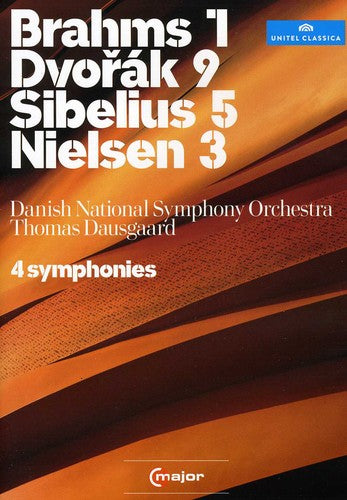
    4 Symphonies - Brahms, Dvorak, Sibelius, Nielsen / Dausgaard, Danish National Symphony Orchestra

    DVD · 2 discs

    $16.49 $32.99 Save 50%
    Composer
    BRAHMS DVORAK SIBELIUS NIEL
    Artist
    Dausgaard
    Released
    Jun 26, 2012


    4 SYMPHONIES • Thomas Dausgaard, cond; Danish Natl SO • C MAJOR 710508 (DVD: 168:00) Live: Copenhagen 2009

    BRAHMS Symphony No. 1. DVO?ÁK Symphony No. 9. SIBELIUS Symphony No. 5. NIELSEN Symphony No. 3

    If, as I did, you were to begin your examination of this release with disc 1, track 1 (the Brahms symphony), you might well conclude that there was little need to continue. There is something rather too cool and casual about Dausgaard’s interpretation of this powerful music. It lacks inner tension. There is not enough contrast between ideas. Accents are in the wrong places. Short notes are cheated of their value. And that’s not all. The second movement just plods on, the third is charmless, the fourth frantic and lurches from one tempo change to the next. Listening to the complete symphony several times could not induce me to alter my initial unfavorable observations. Adding visual insult to aural injury, sight and sound are not synchronized, and the difference between the two is disturbing, to put it mildly.

    But then came the Nielsen symphony. What a difference! Right from the opening moments it had all the vigor and élan and determination lacking in the Brahms. Rhythms were tight and crisp. The music bristled with enthusiasm and commitment. The finale positively beamed with Elgarian nobility and breadth, rising to an absolutely thrilling climax. What a joy! Nielsen’s Third had hitherto never been one of my favorite symphonies, but Dausgaard nearly made it so in this performance.

    Does Dausgaard work his magic on the two remaining works as well? The answer, I’m glad to say, is yes. Furthermore, the synchronization problem that affected the Brahms symphony is only minimal in the Nielsen and nonexistent in Dvo?ák and Sibelius. The “New World” Symphony receives one of the finest performances I have heard. Dausgaard’s approach is no romantic wallow but rather a clean, purposeful traversal filled with taut rhythms, precise attacks and releases, glowing sound, and architectural strength. Dausgaard likewise makes a strong case for the Sibelius Fifth, never allowing momentum to sag, carefully propelling the music forward with masterly control. I am particularly impressed with the ease in which he handles the tempo change for the second part of the first movement. By the time the grand climax of the finale arrives, one feels a great journey has been completed.

    All four performances were recorded live in Copenhagen’s Koncerthuset in 2009. The personnel changes from symphony to symphony, but both principal horns, both principal trumpets, and both timpanists are star players. Generally the woodwinds are excellent, but violins seem a bit thin for an orchestra that is otherwise so assured and well balanced. However, the basses make up for this deficiency with their huge, rich sound, heard at its best at the quiet endings of three of the Brahms movements and in some of the more powerful moments of the Dvo?ák symphony. Aside from the basses, the orchestra plays with a bright sound, textures are clear and clean, balances are well controlled.

    The camerawork is devoted about 20 percent of the time to Dausgaard and his facial contortions, 10 percent to views of the full orchestra from afar, and 70 percent to the business of jerking the viewer’s eyes from one instrumental close-up to another—two seconds of a horn player’s embouchure, a second of flute keys, two notes from the timpani, etc. Who determined that this is what we want to see? I find it annoying to the point where I simply can’t bear to watch.

    On ArkivMusic the price for these four symphonies is $27 ($40 for the Blu-ray version)—just under $7 a symphony, a good buy even without the inferior Brahms symphony, especially for performances as fine as the other three.

    FANFARE: Robert Markow
    View full page
  • ORCHESTRAL WORKS
    First Hand Records

    ORCHESTRAL WORKS

    CD · 1 disc

    $21.99
    Composer
    TCHAIKOVSKY PROKOFIEV SCRIAB
    Artist
    Schippers, Goossens
    Released
    Jul 30, 2012
    This historical release from First Hand features two major English orchestras and two acclaimed conductors in stereo recordings from the late 1950s, offered here for the first time on CD and for the first time ever in stereo. The recordings were transferred using original analogue session and master tapes from the EMI archive. The program includes American conductor Thomas Schippers leading the Philharmonia Orchestra in Tchaikovsky's Symphony No. 4, and English conductor Sir Eugene Goossens leading the orchestra in Scriabin's Reverie in the first recording of a Scriabin work ever made by a British orchestra. To conclude the disc, Goossens leads the Pro Arte Orchestra in Prokofiev's Symphony No. 1.
    View full page
  • ORCHESTRAL WORKS

    ORCHESTRAL WORKS

    First Hand Records Jul 2012
    1 disc
    CD
    $21.99
    C Major Entertainment

    Beethoven: The Complete Symponies & Missa Solemnis / Thielemann, Vienna Philharmonic, Staatskapelle Dresden

    Blu-Ray · 4 discs

    $92.99
    Composer
    BEETHOVEN, LUDWIG VAN
    Artist
    Christian Thielemann, Wiener Philharmoniker, Staatskapelle Dresden
    Released
    Jan 24, 2020
    The Beethoven cycle of the 21st century! Christian Thielemann’s and Wiener Philharmoniker’s recording of BEETHOVEN 9 had been their first recording in HD of all nine Beethoven symphonies, accompanied by nine hour-long documentaries, one on each symphony, featuring Thielemann and Prof. Joachim Kaiser. From insights into Beethoven’s musical thinking to interpretational comparisons, including excerpts from performances by Karajan, Böhm, Bernstein, Järvi etc., to historical perspectives – no aspect of Beethoven’s symphonic oeuvre will remain untreated! “Thielemann’s recordings of the Beethoven symphonies stand head and shoulders above the countless and mostly undistinguishable versions on offer.“ (Die Presse) “The Vienna Philharmonic literally grew beyond itself that evening in the Konzerthaus.“ (Neue Züricher Zeitung) Missa Solemnis: Thielemann “conjured up the gigantic cosmos of the Missa with such lightness and grace that its mystery seemed to reveal itself.“ (FAZ)
    View full page
    Music and Arts Programs of America

    Mahler: Symphony No. 1; Wagner: Faust Overture; Siegfried Idyll

    CD · 1 disc

    $18.99
    Composer
    MAHLER WAGNER
    Artist
    Walter
    Released
    Jul 10, 2012


    MAHLER Symphony No. 1. WAGNER Faust Overture . Siegfried Idyll • Bruno Walter, cond; NBC SO • MUSIC & ARTS 1241, mono (77:25) Live: New York 4/8/1939


    This important release brings together Walter’s complete final concert from the series of five he did at NBC in 1939. The Faust Overture appeared in a previous Music & Arts Walter collection; otherwise I’m not aware of any previous CD release of the material. The sound is excellent: full-bodied with great clarity and immediacy (capturing many of Walter’s exhortations and strenuous vocalizations)—interestingly, Walter seemed to hold a minority (high) opinion of the notorious Studio 8H.


    The Mahler is Walter’s earliest preserved performance of the work (indeed, the earliest by any conductor I’m aware of; Mitropoulos’s Minneapolis premiere recording dates from 1940). It is a reading of thrilling spontaneity, a combustible meeting of Walter’s totally idiomatic Mahler style with the distinctively bright, tightly focused expressive intensity of the NBC orchestra, which responds with total commitment. The first movement is lithe, supple, with a very flexible pulse; hear his impulsive pressing ahead in response to the music’s having modulated one key too far in the sharpward direction (E Major, Rehearsal 6 + 8). The beginning of the slow movement brings a real surprise: what sounds like Mahler’s original conception of solo cello doubling the customary bass in unison—an experiment Walter seems not to have repeated in any of his later extant performances. The finale is intensely dramatic, working to a dénouement of overwhelming emotional force and, ultimately, saturated splendor.


    Other available Walter performances give a fascinating picture of the gradual transformation of his interpretation over the years: A live 1947 version with the LPO (Testament) is similar in conception to NBC: swift, light-toned, characterful, and spontaneous, but preserved in problematic sound. A Concertgebouw performance from the same year (Tahra r RCO Live) is sharp and pungent, with a memorably old-world string style. A 1950 performance with the Bavarian State Orchestra (Orfeo) is darker, smoother, less pointed; the 1954 NYPO studio recording weightier, straighter, more severe. By comparison, the final Columbia Symphony version (1961) represents very much an old man’s view—mellow, deliberate, soft-focused, and comparatively uninflected.


    Walter conducts a memorable performance of Wagner’s Faust Overture, of seething intensity and swashbuckling drama, on a looser rein than Toscanini’s with the same orchestra two years later (Naxos). Siegfried Idyll was a great Walter specialty, and the NBC version is distinguished by its swift pacing, expressive freedom, and highly nuanced execution, with a pp conclusion of truly heart-stopping beauty. Again, comparisons are instructive: the 1935 studio recording with the VPO (Opus Kura) transparent, lean, surprisingly ascetic with very little string vibrato. A live Los Angeles PO performance from 1949 (Music & Arts) is similar in conception to NBC, but less refined, heavier in expression. Two NYP versions—the 1953 studio recording (United Archives) and a live one from 1957 (Music & Arts)—are more symphonically imposing, less intimate; the final Columbia Symphony recording (1959) slower, less flexible, of muted shades and a decidedly autumnal feeling.


    All in all, a major new addition to the Walter discography, one that shows the conductor at his formidable best, and preserved in lifelike, vivid sound. Riches indeed!


    FANFARE: Boyd Pomeroy
    View full page
  • Mahler: Symphony No. 1; Wagner: Faust Overture; Siegfried Idyll

    Mahler: Symphony No. 1; Wagner: Faust Overture; Siegfried Idyll

    Music and Arts Programs of America Jul 2012
    1 disc
    CD
    $18.99
  • Shostakovich: Symphony No. 1 & Orchestral Works / Gimeno, Luxemburg Philharmonic
    PENTATONE

    Shostakovich: Symphony No. 1 & Orchestral Works / Gimeno, Luxemburg Philharmonic

    SACD · 1 disc

    $21.99
    Composer
    SHOSTAKOVICH, DMITRI
    Artist
    Gimeno
    Released
    May 05, 2017

    Gustavo Gimeno conducts the Orchestre Philharmonique du Luxembourg in a fascinating survey of confident, assured and striking orchestral works by the young Shostakovich. This new recording from Pentatone includes his breathtaking Symphony No. 1 Op. 10 - the student work which brought Shostakovich international fame. While indebted to the Russian masters, Shostakovich's early works nevertheless demonstrate his precocious brilliance, originality and falir and they offer an intriguing glimpse at the evolution of his distinctive, mature style. From the easy going and good humored Scherzo Op. 1, the Tchaikovskian Theme and Variations in B-flat major Op. 3, or the Stravinskyan Scherzo Op. 7, his youthful vitality is never in doubt. But with his Symphony No 1 Op. 10 he produced his first masterpiece and found his own distinctive voice. It's a thrilling work full of sardonic edginess, pained introspection and dramatic outbursts, and closes with a barnstorming finale. Composed 10 years later, the aptly titled Five Fragments for orchestra Op. 42 are short, pungent and austere pieces; the arresting style is modernist but the sound is unmistakeably Shostakovich. Following his acclaimed conducting debut with the Royal Concertgebouw Orchestra in 2014, Gustavo Gimeno took up the post of Music Director of the Orchestre Philharmonique du Luxembourg with the 2015-2016 season. An auspicious collaboration with Pentatone followed in 2016 and three releases with the orchestra are planned in 2017. "His musical rhetorics are refined, his grip on the structure of the compositions is accurate and convincint" observed Joep Stapel in the NRC Handelsblad, "Gimeno knew how to keep the tension and made the musicians...excel." Elsewhere in a busy international schedule, Gimeno has debuted with major orchestras in Europe and America, and toured with the Royal Concertgebouw Orchestra to Taiwan and Japan.

    View full page
    C Major Entertainment

    Beethoven: Symphonies 1, 2 & 3 / Thielemann, VPO

    DVD · 3 discs

    $51.99
    Composer
    BEETHOVEN, LUDWIG VAN
    Artist
    Joachim, Thielemann, Wiener Philharmoniker, Kaiser
    Released
    Feb 22, 2011
    Also available on Blu-ray

    The Beethoven cycle of the 21st century!
    Christian Thielemann joins forces with the prestigious Wiener Philharmoniker in a unique and monumental project BEETHOVEN 9, their first-ever recording of all 9 Symphonies in full high definition and Surround Sound. This recording from the Golden Hall of Vienna´s Musikverein is accompanied by nine(!) hour-long documentaries, one on each symphony, featuring Christian Thielemann and Germany´s most eminent music critic, Prof. Joachim Kaiser. From insights into Beethoven´s musical thinking to interpretational comparisons, including excerpts form legendary performances by Karajan, Bernstein, Böhm, Järvi etc., to historical perpsectives – no aspect of Beethoven´s symphonic oeuvre will remain untreated! This 3 DVD-set contains Beethoven Symphonies 1, 2 & 3 and the Documentaries about Symphonies 1, 2 & 3.

    Ludwig van Beethoven: Symphonies Nos. 1, 2 and 3
    Coriolan Overture
    Egmont Overture, Op. 84
    Vienna Philharmonic Orchestra
    Christian Thielemann, conductor

    Recorded live at the Goldener Saal der Gesellschaft der Musikfreunde, Vienna

    including:
    Discovering Beethoven
    with Joachim Keiser and Christian Thielemann
    one-hour long documentary for each symphony
    Picture format: NTSC 16:9
    Sound format: PCM Stereo / DTS 5.0
    Region code: 0 (worldwide)
    Subtitles: English, French, Spanish, Italian, Korean, Chinese, Japanese Running time: 155 mins (symphonies) + 170 mins (documentaries)
    No. of DVDs: 3
    View full page
  • Beethoven: Symphonies 1, 2 & 3 / Thielemann, VPO

    Beethoven: Symphonies 1, 2 & 3 / Thielemann, VPO

    C Major Entertainment Feb 2011
    3 discs
    DVD
    $51.99
  • COLIN DAVIS: BOSTON LEGACY
    ELOQUENCE AUSTRALIA

    COLIN DAVIS: BOSTON LEGACY

    CD · 1 disc

    $128.99
    Artist
    DAVIS, COLIN
    Released
    May 22, 2026
    Reissued complete for the first time, the recorded legacy of Sir Colin Davis and the Boston Symphony Orchestra on Philips, including an unsurpassed cycle of Sibelius symphonies. Each element of the tricky chemistry came off when Colin Davis made his debut with the Boston Symphony Orchestra in 1967, in concerts of Berlioz, Stravinsky and Dvorak. In search of a new Principal Conductor at the time, the BSO offered the post to Davis, but he preferred to focus his energies on the directorship of the Royal Opera in London. However, he began making regular return visits to Boston, and in 1974 became the orchestra's Principal Guest Conductor. As the most 'European'-sounding of the great American orchestras, the BSO responded with natural affinity to Davis's sense of line and cultivated warmth in canon repertoire. When he began to explore Sibelius with them, both the orchestra and audience responded with cautious curiosity which blossomed into committed enthusiasm. Philips capitalised on this affinity by recording them together in the complete symphonies and selected tone-poems between 1975 and 1980, successfully capturing the intensity of the associated concerts. While the Sibelius cycle has maintained a firm place in the catalogue, other albums in the BSO/Davis discography have fallen from prominence. They include a fizzing Mendelssohn album of the 'Italian' Symphony and excerpts from A Midsummer Night's Dream; a delectably sprung set of excerpts from Schubert's Rosamunde, and one of the first-ever versions of the 'Great' C major Symphony to include all the repeats. Davis had a long-established harmonious working relationship with Claudio Arrau, and the Chilean pianist came to Boston to record magisterial, lovingly detailed versions of the concertos by Schumann, Grieg and Tchaikovsky. While Tchaikovsky is hardly a name associated with Davis, the conductor also drew remarkable tension, energy and volume from his Boston forces in Romeo and Juliet and the 1812 Overture (complete with chorus, organ, bells and the rest). This Original Covers box from Eloquence comprises newly remastered recordings and includes a new booklet essay by Peter Quantrill, exploring the history of Colin Davis in Boston, the elements of their happy artistic chemistry and the stories behind the scenes.
    View full page
  • COLIN DAVIS: BOSTON LEGACY

    COLIN DAVIS: BOSTON LEGACY

    ELOQUENCE AUSTRALIA May 2026
    1 disc
    CD
    $128.99
    Naxos

    Standford: Symphony No. 1, Cello Concerto & Prelude to a Fantasy / Wallfisch, Lloyd-Jones, RSNO

    CD · 1 disc

    $9.99 $19.99 Save 50%
    Composer
    STANDFORD, PATRIC
    Artist
    Wallfisch, Lloyd-Jones
    Released
    Feb 10, 2015
    Patric Standford wrote in a wide variety of forms, from large-scale orchestral and choral music to a cappella, chamber and instrumental pieces. While teaching at the Guildhall School of Music in London he won several major international composition prizes. The First Symphony, each movement of which is named after a season, grew from a string piece conceived as a memorial for the conductor Sir John Barbirolli. Dedicated to and premièred by the soloist on this recording, Raphael Wallfisch, the powerful Cello Concerto is built around a theme from the fifth movement, Ihr habt nun Traurigkeit (You now are sorrowful) of Brahms’ German Requiem.
    View full page
  • The Exclusive Subscription Concert Series - Andris Nelsons
    C Major Entertainment

    The Exclusive Subscription Concert Series - Andris Nelsons

    DVD · 1 disc

    $32.99
    Composer
    Gustav Mahler
    Artist
    Andris Nelsons, Christoph Engel, Wiener Philharmoniker
    Released
    Jun 19, 2026
    The Subscription Concert Series of the Wiener Philharmoniker from the Golden Hall of the famous Musikverein are special concerts reserved for subscribers. Due to the exceptional quality of the concerts and the limited offer, the average waiting time for subscribers is more than 10 years. With this series, these very special concerts are made available for the first time audiovisually to a wider audience worldwide. Mahler's unusually expansive five-movement Symphony No. 7 is among the composer's most ambiguous and enigmatic works, often regarded as his most challenging to perform. Andris Nelsons leads the orchestra in a new chapter of their Mahler cycle, reaffirming his stature as "one of the most celebrated conductors of our time" (Salzburger Nachrichten). Under his baton, the Seventh becomes "magic in the Golden Hall. [...] Rarely has one heard this work so finely chiselled, so dynamically balanced. An event." (Kurier). "Andris Nelsons and the Vienna Philharmonic bring total coherence to Mahler's Seventh Symphony." (Seen and Heard International)
    View full page
  • The Exclusive Subscription Concert Series - Andris Nelsons

    The Exclusive Subscription Concert Series - Andris Nelsons

    C Major Entertainment Jun 2026
    1 disc
    DVD
    $32.99
  • Fantasy
    Coviello

    Fantasy

    CD · 1 disc

    $22.99
    Composer
    Franz Schubert, Robert Schumann
    Artist
    Lei Meng
    Released
    Nov 07, 2025
    With works by Franz Schubert and Robert Schumann, this CD is dedicated entirely to the magic of musical romanticism. Two composers, two worlds of sound - united by emotional depth, imagination and a love of the piano. Lei Meng interprets Schumann's filigree Arabesque op. 18 and his passionate C major Fantasy op. 17, a musical confession full of inner drama. Schubert will perform the intimate Allegretto in C minor D 915 and the powerful, visionary Wanderer Fantasy D 760 - an orchestral masterpiece for piano. Lei Meng, born in 1991 in Harbin (China), studied at the Mozarteum Salzburg and the CNSMD in Paris, among others. She has won prizes at international competitions and has performed in Europe, China, Brazil and the USA. She has been Professor of Piano and Piano Didactics at the Mozarteum Salzburg since 2024. Her artistic versatility is reflected in numerous solo and chamber music projects. Pure romanticism - full of longing, melancholy and expressiveness. An invitation to listen and dream.
    View full page
  • Fantasy

    Fantasy

    Coviello Nov 2025
    1 disc
    CD
    $22.99
    Chandos

    Shostakovich: Cello Concertos 1 & 2 / Dindo, Noseda, Danish National Symphony

    SACD · 1 disc

    $21.99
    Composer
    SHOSTAKOVICH, DMITRI
    Artist
    Dindo, Noseda
    Released
    Jan 31, 2012
    A must-have and a life-changer for Shostakovich fans.

    3563930.az_SHOSTAKOVICH_Cello_Concertos_1.html

    SHOSTAKOVICH Cello Concertos: No. 1; No. 2 • Enrico Dindo (vc); Gianandrea Noseda, cond; Danish Natl SO • CHANDOS 5093 (SACD: 60:13)


    So many cello concerti, so little time. With dozens of competing versions of these two interpretively rich, emotionally ripe scores—the majority of them first-class accounts that come critically recommended, if with some reservations—it’s cost- and time-prohibitive to be familiar with them all. Mørk? Maslennikov? Müller-Schott? What’s a conscientious reviewer to do? Well, yours truly is tempted to fall back on the tried-and-true, which, after all, is tried and true for good reason. That means Mstislav Rostropovich. Of his several recordings, I opt for the mid-’60s performances powerfully conducted by David Oistrakh, not easy to find but most recently sighted on the Yedang Classics label. The sound is a little rough, but no one matches Rostropovich’s passion and profundity in this music.


    Nevertheless, that said, there’s always room for a convincing alternative approach, and Enrico Dindo’s is some distance from that of Rostropovich. Though he’s apparently recorded programs of Beethoven and Bach, only a 1998 release of the Brahms cello sonatas is currently listed in the Fanfare Archive. Michael Jameson called it “satisfying” ( Fanfare 21: 6), and tellingly described Dindo’s point of view as one of “letting the music (rather than any gesture intended to propel a subjective vision of the text) speak for itself.” I find that to be an accurate characterization of his approach to Shostakovich as well. Dindo’s tone is silky and sinewy, and he definitely has the chops to respond to everything Shostakovich asks for—from the buoyant rhythms of the First Concerto to the sustained introspection of the Second. He favors fast, clean lines in the First Concerto, which emphasize its satiric edge in ways reminiscent of the composer’s earlier, youthful impulsiveness (despite the fact that it was written in his 53rd year), though neither slighting, nor exaggerating, the second movement’s elegiac lyricism. In the darker Second Concerto, he adopts an appropriately serious demeanor, providing a consistent, fluid line that lacks Rostropovich’s bite, but allows the music to sing its own eloquent, if dolorous, song. In this his resembles Heinrich Schiff’s attentive, persuasive 1984 performance (Philips), although Schiff benefited from Maxim Shostakovich’s strong, emphatically pointed accompaniment, whereby Gianandrea Noseda, following Dindo’s lead, particularly in the Second Concerto provides ever-so-slightly less dramatic, albeit scrupulously detailed, support.


    I suspect these are performances that will retain their interest over time. Add Enrico Dindo’s name to the list of recommended cellists in this significant repertoire.


    FANFARE: Art Lange


    ---------

    These two concertos form a pairing which is logical and convenient but by no means ubiquitous. The Cello Concerto No. 1 is the more widely recorded of the two, with impressive accounts from the likes of Han-Na Chang, and the more enduring dedicatee’s version, Mstislav Rostropovich with Eugene Ormandy in 1959 and now available on Sony Classical. One of the best discs of these two works is with Rafa? Kwiatkowski on the Dux label. Aside from Peter Wispelwey’s recording of the Cello Concerto No. 2 along with Britten’s Third Suite on Challenge Classics, there doesn’t seem to be much choice in this repertoire when it comes to SACD recordings, so this Chandos release enters the market with a useful USP.

    Enrico Dindo won the Rostropovich Cello Competition in 1997 and has been performing widely since, also making recordings which have included Bach’s Suites and Vivaldi Concertos on Italian Decca. His playing here is remarkably rich, obtaining deep and richly expressive tones from a Rogeri instrument from 1717. The cello sound is forward, bordering on the surrealist as with so many concerto recordings these days, but not intolerably massive in relation to the orchestra. In fact this is one of the genuine strengths of this recording, with masses of colour and detail from a very powerful sounding Danish National Symphony Orchestra. The opening of the Cello Concerto No. 1 throws down the gauntlet in this regard, the double-bassoon sounding like you’ve never heard it in any other recording; dug into with such gusto that you’d expect the floor to shake and the keys to be shaken off by the vibrations. The excitement in the playing is in its shaping and development, building stirring structures rather than hitting us constantly with masses of relentless intensity. The horn-calls are also marvellous in this first Allegretto, woodwinds competing with the soloist through grating dissonance and dramatic release. Perhaps the strings could have had more presence to make the whole thing a tad more credible. They should come into their own in that most gorgeous and moving of Shostakovich statements, the central Moderato. Even here though, the first horn entry far outweighs the texture of the entire body of strings. Behind the soloist they do seem to be rather at a disadvantage in the balance. Just taking one comparison, that with Thorleif Thedéen and James DePreist on the BIS label, the balance brings the strings that much more into the picture. This allows a more equal interaction which can carry greater emotional heft. Thedéen is a little more heart-on-sleeve than Dindo, with a tighter vibrato and a more vocal way of expressing the melodic lines. I wouldn’t swap this BIS disc for the Chandos one now, but still find it has a good deal to offer.

    Whether or not you find the recorded balance a problem, Enrico Dindo’s solo lines carry so much emotional strength that you will find yourself gripped from beginning to end. One of my old favourites for these pieces is from Truls Mørk with the London Philharmonic and Mariss Jansons on the Virgin Classics label. Certain aspects of Noseda’s approach do remind me of the Jansons recording, but I have to admit that Dindo gets as much and more out of the music than almost any rival I can name. Like the texture in the inky lines of a Ralph Steadman drawing, Dindo delights in thickening and thinning sustained notes so that we are constantly in a state of awe and expectation, even when Shostakovich is in passages of transition. Listen in the Moderato to the general sonic picture at about 7:00 and on though: the intensity of the upper strings in the orchestra is almost entirely absent, which undermines at least some of that good work. Dindo’s expressive playing gives the impression of space, but Noseda’s tempi are generally a tad more brisk and compact than many. Jansons takes 12:32 with this Moderato for instance, compared to Noseda’s 10:50.

    The rough peasant feel in the final movement of this first concerto is something to relish; the aural glue not quite holding together as the winds advance in the balance and give us a kick from time to time. It has an undeniable grip and snatch flowing from Noseda’s treatment, an uncompromising approach which drags us along mercilessly and never lets go.

    Shostakovich’s Cello Concerto No. 2 is dark from the outset, the mood superbly set through the solo cello and lower strings in the opening bars. The imagination is teased by fragmentary moments of brooding beauty, such as the repeated double-stop gesture at around 4 minutes in. This is a bleak landscape and the kind of inner journey which can lead you to places both moving and disturbing. Dindo speaks emotively, the sighing downward gestures weighed with tears, the parlando moments confiding and gruff by turns. Shostakovich’s score in the first movement is as hard as nails, and the players nail it firmly. The bass drum thwacks from around 9:20 are an audiophile treat as well.

    The acoustic space is emphasised in the open textures of the opening to the central Allegretto, and the sense of volume in the 5.0 SACD surround mix is very tactile indeed. Listen to the laughing winds from about 2:30: the playing is not only needle sharp, but is also filled with personality and character throughout. The theatricality of the opening to the final Allegretto has rarely been so sharply observed, and you expect an announcement from a melodramatic actor as much as you do the entry of the cello. Those ‘nice’ tunes as they arrive are all the more earth-shatteringly emotive for these extremes of contrast. Little operatic touches and that late-Shostakovich sense of a fatefully ticking time-bomb make the whole thing as touching and filled with narrative import as I can ever remember hearing.

    Chandos easily replaces its earlier release of this repertoire with Frans Helmerson and the Russian State Symphony Orchestra on CHAN 10040. This has some lovely playing and a decent concert hall balance, but with somewhat rough-and-ready qualities from the orchestra in some of the more technically demanding passages. Fans of these two concertos simply must have this recording from Dindo/Noseda. The cover photo of Red Square is strikingly atmospheric, and there are good booklet notes and pictures inside as well. Despite my reservations about the string balance which admittedly affects the scoring of the first concerto more than the second, this is a must-have and a life-changer for Shostakovich fans.

    -- Dominy Clements, MusicWeb International
    View full page