Search results: Search results

48 results

Products

    Alpha

    Haydn 2032, Vol. 7 / Antonini, Basel Chamber Orchestra

    CD + Vinyl · 2 discs

    $39.99
    Composer
    HAYDN MOZART
    Artist
    Antonini, Kammerorchester Basel
    Released
    Oct 25, 2019
    Under the title Gli impresari, The Impresarios - i.e. The directors of the theatre troupes that Nikolaus I, Prince Esterházy engaged to perform in his opera houses - this album gathers together some of the orchestral works by Joseph Haydn linked by their origin and their reception; they were originally conceived as theatre music, before their metamorphosis into symphonies. The period from 1772 onwards, when Karl Wahr was responsible for the summer theatre programme at Esterháza, saw the peak of the multidisciplinary collaboration taking place between the court music directed by Haydn and companies engaged from outside. At the end of 1775 and the beginning of 1776, while Joseph Haydn was occupied in transforming his music for Collé's comedy into a symphony for concert performance, Karl Wahr was enjoying enormous success with his theatrical entertainments in the ballroom at the theatre in Salzburg. It was there, on 3 January 1776, that Thamos, King of Egypt was staged, a heroic drama whose choruses, musicologists now believe, were composed by none other than Wolfgang Amadeus Mozart; for this Salzburg performance he also composed four instrumental entr'actes (recorded for this release) as well as a melodrama and a Don Giovanni-esque descent into hell.
    View full page
  • Haydn 2032, Vol. 7 / Antonini, Basel Chamber Orchestra

    Haydn 2032, Vol. 7 / Antonini, Basel Chamber Orchestra

    Alpha Oct 2019
    2 discs
    CD + Vinyl
    $39.99
  • Haydn: String Quartets Vol 7 / Leipzig String Quartet
    MDG

    Haydn: String Quartets Vol 7 / Leipzig String Quartet

    CD · 1 disc

    $23.99
    Composer
    HAYDN, JOSEPH
    Artist
    Leipziger Streichquartett
    Released
    Aug 01, 2014

    "All my strength is gone." Joseph Haydn wrote these words on the final page of his unfinished last string quartet. One can hardly believe him when one listens to this new release by the Leipzig String Quartet - and encounters a composer in full possession of his creative powers. There is nary a trace of the infirmity of old age or fading inspiration; rather, the master draws on all the rich experience of his long artistic life. "I am old and weak" - this self-quotation from his song "Der Greis" (The Old Man) seems to be pure irony.

    View full page
  • Haydn: String Quartets Vol 7 / Leipzig String Quartet

    Haydn: String Quartets Vol 7 / Leipzig String Quartet

    MDG Aug 2014
    1 disc
    CD
    $23.99
    Naxos

    Haydn: Missa Cellensis, Paukenmesse / Burdick, Trinity Hoir, Rebel

    CD · 1 disc

    $19.99
    Composer
    HAYDN, JOSEPH
    Artist
    Burdick, Hoyt, Nafziger, Sollek, Davis, Lippold, Neer
    Released
    Aug 31, 2010

    As Haydn scholar H.C. Landon explains, ‘it is clear that with this Missa Cellensis…he reached, and reached with panache and astonishing vigour, the popular style for which he had been so long and so diligently searching.’ For this reason, the Mariazellermesse ‘is both the precursor to Haydn’s late Masses as well as the culmination of his early efforts in the genre.’ Fourteen years elapsed before Haydn’s setting of the Mass in Time of War, also known as the Paukenmesse because of his evocative use of the timpani; the work demonstrates Haydn’s new approach to the Mass, including dramatic extremes and more frequent integration of solo and chorus.

    View full page
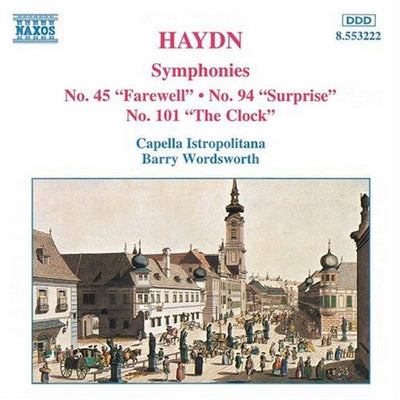
  • Haydn: Symphonies 45, 94, 101
    Naxos

    Haydn: Symphonies 45, 94, 101

    CD · 1 disc

    $19.99
    Composer
    HAYDN
    Artist
    Barry, Capella Istropolitana, Wordsworth
    Released
    Apr 07, 1995
    Haydn's Farewell Symphony was written in 1772, occasioned by the prolonged stay of Prince Nikolaus Esterházy at his Hungarian palace. Some of the musicians had been compelled to leave their wives behind in Eisenstadt when the Prince took up his summer residence. The Symphony, in the final Adagio of which the musicians leave one by one, was intended as a delicate hint that the time had come to return to Eisenstadt, although some contemporary sources suggest that the subject of complaint was the possible reduction of the musical establishment. The Symphony, in the key of F sharp minor, is scored for the usual Esterháza forces of pairs of oboes and horns, bassoon and strings. The first movement opens with the principal theme, descending arpeggios played by the first violins against sustained wind chords and the urgent syncopation of the second violins. Sonata form is treated with considerable freedom, the second subject making it's D major appearance in the development and the following recapitulation inviting an unusual further development of the principal theme. The A major second movement allows muted violins to announce the main theme, the wind having very little to add during the course of the movement. An F sharp major Minuet follows, with a Trio that allows the French horns momentary prominence. This leads to a finale that modulates to introduce the unexpected slow conclusion, in which player after player leaves the platform, until only two muted violins are left. Symphony No.101 belongs to the group of six symphonies written for Haydn's second visit to London in 1794. It was played there at a concert on 3rd March, followed by operatic songs, a performance by Viotti of a violin concerto and by Fiorillo of a Chaconne. Again, as with most of the London symphonies, there is a slow introduction, this time in D minor, an eerie preface to a bright D major movement from which the symphony derives it's nickname, The Clock, it's source the accompanying figure with which the movement opens. The Minuet returns from G major to the key of D major, it's Trio providing a lop-sided clock accompaniment to the initial flute melody. The symphony ends with a finale in which the second subject is a clear variant of the first. There is a D minor section, replaced by the major key to bring the work to a dramatic conclusion.
    View full page
  • Haydn: Symphonies 45, 94, 101

    Haydn: Symphonies 45, 94, 101

    Naxos Apr 1995
    1 disc
    CD
    $19.99
    Tafelmusik

    Haydn: Paris Symphonies / Bruno Weil, Tafelmusik

    CD · 2 discs

    $20.99
    Composer
    HAYDN, JOSEPH
    Artist
    Weill
    Released
    May 29, 2012


    HAYDN Symphonies Nos. 82–87 , “Paris” • Bruno Weil, cond; Tafelmusik Baroque O • TAFELMUSIK TMK1013CD2 (2 CDs: 144:09)


    This set, recorded in 1994, is a reissue of two Sony CDs reviewed by John Wiser in Fanfare 19:2. For these “Paris” Symphonies, the period-instrument group Tafelmusik has a suitably large string section: 8/7/5/4/2. Bruno Weil chooses generally rapid tempos, the playing is crisp and clean, the sounds sweet—this Toronto-based ensemble plays at a relatively high pitch for period-practice performers. In the notes to this set, H. C. Robbins Landon describes the first movement, Vivace assai, of Symphony No. 82 as “an enormously powerful affair, with thundering fanfares” and says that “The finale (Vivace) returns to the power of the first movement; the development section, in particular, generates an enormous forward drive, and its coda is a brilliant conclusion to this highly masculine symphony.” Weil generates as much power as this medium-sized ensemble can muster, but nowhere near that of Leonard Bernstein’s New York Philharmonic, which uses only a few more strings ( Fanfare 33:2) and was once praised by Landon himself as one of “the great Haydn recordings of all time.” In the finale, some details of the fugal section are obscured by Weil’s hectic tempo. His is a fine performance nevertheless, on a par with that of Sigiswald Kuijken’s Orchestra of the Age of Enlightenment, whose string complement is only two less than Weil’s, and whose recordings of the “Paris” Symphonies have long been accepted as the standard period-practice set. Kuijken’s slower tempos (8:26 in that Vivace assai, to Weil’s 7: 20, both with full repeats) allow Haydn’s full power to emerge, but the playing is not as crisp as that by either Weil or Bernstein’s forces. Kuijken’s tempos are too slow for my taste; neither he nor Weill takes the Minuet da capo repeat, and only Weill takes the finale’s second repeat.


    This being a reissue, there’s no space for detailed examination of all six performances, but the comparisons made above generally apply to the following five symphonies as well, except that Weil’s tempos are no longer exceptionally fast, and he doesn’t always take finale second repeats. If those performances seem less distinctive, it may be only that the other five symphonies, as fine as they are, are less dramatic and exciting than “The Bear.” Sony’s recorded sound is bright and clean, with fine detail, richer and clearer than that given Kuijken. There is much to like in both period-instrument sets, and Bernstein has been joined by another superb modern-instrument set, Kristjan Järvi leading the Lower Austria Tonkünstler Orchestra on Preiser ( Fanfare 33:4), brilliantly recorded in Vienna’s golden Musikverein. So Haydn’s “Paris” Symphonies are very well covered for all tastes.


    FANFARE: James H. North
    View full page
  • Haydn: Paris Symphonies / Bruno Weil, Tafelmusik

    Haydn: Paris Symphonies / Bruno Weil, Tafelmusik

    Tafelmusik May 2012
    2 discs
    CD
    $20.99
  • HAYDN/HUMMEL/ARUTUNIAN/JAMES + CREATION
    WARNER CLASSICS

    HAYDN/HUMMEL/ARUTUNIAN/JAMES + CREATION

    CD · 1 disc

    $17.28
    Artist
    RENAUDIN VARY, LUCIENNE
    Released
    Jan 13, 2023
    For her fourth Warner Classics album, trumpeter Lucienne Renaudin Vary has chosen four favorite concertos. Composed by Haydn, Hummel, Neruda and Arutunian, they span three centuries. Joining them on the programme are a so-called 'concerto' by big-band maestro Harry James - which lasts all of three jazzy minutes - and, inspired by Haydn's Concerto in E flat, a brief solo improvisation by Lucienne herself. "The concertos I've chosen are part of me," she says. "They've always been with me and today I perform them regularly in concert... Getting to record this album with the fantastic Lucerne Symphony Orchestra and Michael Sanderling is a dream come true."
    View full page
  • HAYDN/HUMMEL/ARUTUNIAN/JAMES + CREATION

    HAYDN/HUMMEL/ARUTUNIAN/JAMES + CREATION

    WARNER CLASSICS Jan 2023
    1 disc
    CD
    $17.28
    Naxos

    Haydn: Masses, Vol. 6 / Burdick, Glover, Rebel, Trinity Choir

    CD · 1 disc

    $13.99 $19.99 Save 30%
    Composer
    HAYDN, JOSEPH
    Artist
    Burdick, Glover, Hoyt, Liston, Lippold, Palmer, Faia, Sollek
    Released
    Dec 14, 2010
    Exceptionally elegant performances from a first rate band of musicians.

    Although it is for his instrumental music, primarily symphonies, string quartets and works for solo piano that Josef Haydn is most known, he was quite given to writing for voices and left behind a sizeable output of operas, twelve authenticated masses and numerous other settings of sacred texts for choir, soloists and orchestra. This program gives us his first and last words in the mass genre, one by an exuberant boy of seventeen the other by a tired and weary old man, although one could never discern the composer’s fatigue by listening to the music.

    The Missa Brevis in F is a little gem of economy, with Haydn sailing through the wordy Credo in under three minutes, a feat he accomplished by stacking phrases of the text on top of one another and distributing them throughout the voice parts. The unusual scoring for only two solo voices, both sopranos might have been a vehicle for he and his brother Michael, though it does stretch belief a bit to think of a seventeen year old with an unchanged voice.

    The Harmoniemesse is one of Haydn’s final works, written for the birthday celebrations of the Esterhazy Princess in 1802. The composer soon took his leave of the Esterhazy family after decades of service and although he lived another seven years, he did little composing after this period. There is no evidence in this joyful and exuberant mass that Haydn was at all ill. In fact, his later masses have been criticized over the years for their joyous optimism, and sometimes overly upbeat settings of the more reflective and serious parts of the texts. Be that as it may, this is a masterpiece, beautifully augmented by the full complement of wind instruments that give the mass its nickname of “harmonie.”

    These are performances of divinely understated elegance. Singing from the choir is dead in tune and beautifully balanced. Phrases are splendidly shaped and tempo choices are spot on. The Trinity Choir is full of fine soloists, and there is some magnificent singing from sopranos Ann Hoyt and Julie Liston is the Missa Brevis. The Rebel Baroque Orchestra is a tight band of precision players. The clarity of their playing, especially in fast passages is without flaw. The one and only defect in this production is the lack of texts and translations in the booklet. The program notes are informative and interesting and not loaded with blow by blow descriptions of the music.

    These are performances of almost text-book perfection and will be a delight to any lover of choral music. With really nothing to criticize, I can say nothing more but go add this fine recording to your library.

    -- Kevin Sutton, MusicWeb International
    View full page
  • Haydn: Masses, Vol. 6 / Burdick, Glover, Rebel, Trinity Choir
    Sale

    Haydn: Masses, Vol. 6 / Burdick, Glover, Rebel, Trinity Choir

    Naxos Dec 2010
    1 disc
    CD
    $19.99 $13.99
    Naxos

    Haydn: Nikolaimesse, Nelson Mass / Burdick, Rebel, Trinity Choir

    CD · 1 disc

    $13.99 $19.99 Save 30%
    Composer
    HAYDN, JOSEPH
    Artist
    Burdick, Hoyt, Brackett, Sands, Lippold, Sollek, Mutlu, Nolen, Trinity Choi
    Released
    Jun 29, 2010
    Challenges even the best - a bargain alternative to Trevor Pinnock.

    Naxos already had a decent recording of the ‘Nelson’ Mass (8.554416, with the ‘Little Organ’ Mass, Hob.XXII/7) on which soloists, the Hungarian Radio Chorus and the Nikolaus Esterházy Sinfonia were conducted by Béla Drahos. The new recording, Volume 3 of the Naxos series of the Haydn Masses, is also available in an 8-CD.

    The Nikolaimesse, recorded in 2002, gets the new recording off to a very good start. The music is lighter, less vintage Haydn than its more familiar companion, with mainly brisk tempi much in the manner of the short early Masses which Mozart composed for his Salzburg patron Archbishop Coloredo. It also receives a fine performance and recording. The soloists don’t merit a listing on the rear insert, but they are named inside the booklet, as they deserve to be. If I select Ann Hoyt, the soprano, for special praise, that should not be at the expense of the others.

    To be honest, I had not expected much from this CD - I hadn’t heard of any of the performers and I’d forgotten the warm reception which the complete box had received - but the performance of the Nikolaimesse alone makes it worth the modest price. All concerned convince me that this early work is at least the equal of any of Mozart’s Masses, with the exception of the Coronation (K317) the ‘Great’ Mass (K427)and, of course, the Requiem (K626).

    The ‘Nelson’ Mass is, I think, at least the equal of the three best Mozart Masses. I shall continue to give it that name as a kind of shorthand, though it has very little to do with Lord Nelson: Haydn nicknames have a habit of sticking even when they are inappropriate - there is at least enough evidence to doubt that it was at a performance of Symphony No.96 that the heavy chandelier narrowly missed causing serious injury, yet the name ‘Miracle’ continues to be attached to that work. Haydn himself called it Missa in angustiis, Mass in straitened times, but it’s easier and shorter to continue to call it the ‘Nelson’.

    The opening Kyrie announces that this is a more serious work than the Nikolaimesse. As Jennifer More Glagov notes in the excellent booklet, the lack of wind players - the Prince had just dismissed them as an economy measure - apart from three (specially hired?) trumpets gives the work an undeniably martial tone.

    The performers again give an excellent account of themselves. Only Ann Hoyt remains from the earlier line-up and continues to sing impressively - my wife came in as I was listening and was very surprised to discover that this was the voice of a singer whom neither she nor I had heard before. Naxos and others please note, we want to hear more of her. The other soloists and the choir also step up to the plate and the recording, though thicker than for the earlier work, recorded five years earlier, is more than adequate. The last semi-professional performance of the ‘Nelson’ that I heard was spoiled by a soprano who out-sang everyone else, but that is certainly not the case here. I understand that all the soloists are members of the Trinity Choir, which must make it a formidable place for the musically inclined to worship.

    John Sheppard (hereafter JS) complained of Burdick’s habit of slowing at certain points, but some of these are traditional. In the Creed, for example, the slowing at the end of track 16 on the words descendit de cælis prepares for the more marked traditional emphasis on et incarnatus est in the next section, where it used to be expected that all would kneel or bow deeply. In any case, JS soon began to be as untroubled by this practice as I was.

    William Hedley (hereafter WH) commented on the reverberant acoustic of the Trinity Church but I really was not troubled by this - different audio systems react differently to reverberant recordings. Nor was I really troubled by the other detailed criticisms which he makes. Rather than repeat these here, I refer you to his review. Whilst I admit the validity of just about all of them, I cannot consider them a serious handicap to an overall recommendation.

    WH is more than a little hard on the diction - the syllables are frequently chopped up in the wrong places, but the demise of Latin in the school curriculum makes it almost inevitable that a choir’s familiarity with that language can no more be taken for granted than a knowledge of Japanese. (Actually, the latter is a more frequent visitor to the modern UK secondary curriculum). Haydn would have expected to hear the harder Austro-Germanic pronunciation of Latin, with hard ‘g’ in virginis, and ‘c’ in crucifixus, for example; I’m pleased to report that all concerned here take the softer Italianate course.

    JS raises the possibility that the set as a whole is superior even to Hickox (Chandos CHAN0599, also available separately) or Guest (Argo/Decca). I’m not quite sure that I would go that far, but I was impressed enough by the single CD under consideration to wish to sample more of the set via the Naxos Music Library.

    I’ve already praised the quality of the Naxos notes. One small complaint concerns the absence of texts, but the Tridentine Latin Mass is pretty well known and the texts and translations are available online, as indicated above: they can be yours even without buying the CD.

    Overall, I think that WH is right to prefer John Eliot Gardiner (Philips 470 2862, with the Theresienmesse) and Trevor Pinnock (DG Archiv 423 0972, with the Te Deum). I recommended the Pinnock version of the ‘Nelson’ Mass as Download of the Month in my May 2009 Download Roundup) and thoroughly agree with WH that it offers a life-enhancing experience, but I can’t imagine purchasers of the present CD being disappointed with J Owen Burdick’s performances. Having heard the recording right through once, I couldn’t wait to hear it all again, instead of taking the usual time out to gather my impressions. Go for Pinnock for the best - even at full price and rather short value - but the new Naxos makes a very fine and less expensive alternative.

    -- Brian Wilson, MusicWeb International
    View full page
  • SYMPHONY 7
    SFS MEDIA

    SYMPHONY 7

    SACD · 1 disc

    $21.99
    Artist
    BEETHOVEN / SAN FRANCISCO SYM / THOMAS
    Released
    Jun 12, 2012
    This release from Michael Tilson Thomas and the San Francisco Symphony features Ludwig van Beethoven's Symphony No. 7 coupled with the Leonore Overture No. 3. One of his most stirring works and also one that he considered among his best, Beethoven's Symphony No. 7 was immensely popular from it's first playing. Recently, it's powerful second movement was used to great dramatic effect in the seminal moments of the Oscar-winning movie the King's Speech. While Beethoven wrote only one opera, he wrote multiple overtures for it, and the third of the series fully captures the joyful outcome of the story. Both recordings were taken from live in concerts held at Davies Symphony Hall in San Francisco.
    View full page
  • SYMPHONY 7

    SYMPHONY 7

    SFS MEDIA Jun 2012
    1 disc
    SACD
    $21.99
    Naxos

    Haydn: Concertos For 2 Lira Organizzate / Müller-Brühl

    CD · 1 disc

    $19.99
    Composer
    HAYDN, F.J.
    Artist
    Fromanger, Nelken, Hommel, Rothert, Spatling, Muller-Bruhl, Cologne Co
    Released
    Jan 27, 2009


    HAYDN Concertos for 2 Lire organizzate: in C, Hob VIIh:1; in G, Hob VIIh:2; in G, Hob VIIh:3; in F, Hob VIIh:4; in F, Hob VIIh:5 • Helmut Müller-Brühl, cond; Daniel Rothert (rcr); Philipp Spätling (rcr); Benoît Fromanger (fl); Ingo Nelken (fl); Christian Hommel (ob); Cologne CO • NAXOS 8.570481 (73:31)


    This absolutely delightful disc includes all five surviving concertos that Haydn wrote in 1786 for King Ferdinand IV of Naples for the lira organizzata, an oddball instrument combining the qualities of a street hurdy-gurdy with a small chamber organ. Maverick that he was, Haydn refused to let the instrument’s limitations circumscribe his compositional style, but rather allowed his imagination full rein while producing music of lightness and humor combined with strict divertimento form. With lire organizzate being unavailable in other cities, Haydn simply adapted the music to be played by two recorders or flutes and an oboe, simulating the high, reedy sound of King Ferdinand’s instrument.


    Technical description of the music would take too much space and would be, I feel, unnecessary to anyone familiar with Haydn’s style. Needless to say, Haydn was a composer who never cheated his audience by writing “down,” even when commissioned to tailor his style to a specific instrument or player. Thus, the solo parts, though technically undemanding, are musically clever, complementing the more complex music of the string and horn orchestra that accompanies them. Indeed, he liked this music so well that he used the second and third movements of the fifth concerto (in F, Hob. VIIh:5) as a basis for his Symphony No. 89 (1787). It’s also interesting to note that the opening theme of this concerto’s first movement bears a close resemblance to the last movement of Mozart’s “Jupiter” Symphony, and in turn is a development of the beginning of the last movement of Haydn’s own Symphony No. 13 of 1763. Its development here, of course, is entirely different, given the nature of the thematic material and the instrumental texture.


    I cannot say enough good things about the playing of either soloists or orchestra here. They are lively, charming, boisterous, elegant, and humorous in turn as the music progresses. Photos and bios of all the soloists are, thankfully, given in the booklet, and they are a lively, racially diverse, and well-schooled lot. Germans Rothert and Spätling, the recorder-players, are pupils of Günther Höller of the Cologne Music School. Frenchman Fromanger and Dane Ingo Nelken both studied flute with Jean-Pierre Rampal, though their other teachers are quite different, while oboist Hommel studied with the superb Heinz Holliger. Müller-Brühl, a name unfortunately unknown to me, is the oldest of the lot, which makes sense since his conducting style is evidently from the same school as my faves of the 1950s and 1960s, Woldike, Leitner, Münchinger, Rilling, and Ristenpart. Under his direction, this music for lire organizzate breathes the air of the streets of Naples as much as the concert halls of Austria. This music may not add particularly to your appreciation of Haydn or his musical lexicon, but it will not be a background disc for dinner parties, either. Trust me, people will stop talking and eating and just listen, that’s how good it is.


    FANFARE: Lynn René Bayley
    View full page
  • Haydn: Concertos For 2 Lira Organizzate / Müller-Brühl

    Haydn: Concertos For 2 Lira Organizzate / Müller-Brühl

    Naxos Jan 2009
    1 disc
    CD
    $19.99
    ICA Classics

    Haydn: Symphony No. 55 - Beethoven: Symphonies Nos. 7 & 8

    DVD · 1 disc

    $20.99 $26.99 Save 20%
    Composer
    HAYDN BEETHOVEN
    Artist
    Steinberg
    Released
    Mar 27, 2012
    William Steinberg conducts the Boston Symphony Orchestra. This rare material, filmed in color, represents some of the earliest televised concerts with of Steinberg with the BSO, restored using the greatest care and state-of-the-art techniques.
    View full page
  • Haydn: Symphony No. 55 - Beethoven: Symphonies Nos. 7 & 8
    Sale

    Haydn: Symphony No. 55 - Beethoven: Symphonies Nos. 7 & 8

    ICA Classics Mar 2012
    1 disc
    DVD
    $26.99 $20.99
  • Spohr: String Quintet No 7,Etc / New Haydn Quartet, Et Al

    Spohr: String Quintet No 7,Etc / New Haydn Quartet, Et Al

    Naxos May 2006
    1 disc
    CD
    $19.99
  • Haydn, F.J.: Horn Concerto No. 1 / Symphony No. 31 / Haydn,

    Haydn, F.J.: Horn Concerto No. 1 / Symphony No. 31 / Haydn,

    Nimbus Apr 2006
    1 disc
    CD
    $20.99
  • Haydn: Oratorios / Spering, Schuldt-Jensen
    Naxos

    Haydn: Oratorios / Spering, Schuldt-Jensen

    CD · 7 discs

    $53.99
    Composer
    HAYDN, F.J.
    Artist
    Various
    Released
    Apr 28, 2009
    Reviews of recordings in this set:

    The Creation


    Although The Creation is no stranger to period-instrument performance, two in particular spring to mind as particularly outstanding. The first of these is Christopher Hogwood's on L'Oiseau-Lyre, which is in English and remains the only version to assemble the huge forces for which Haydn actually wrote, with singularly thrilling results. Second, there is Hengelbrock on Deutsche Harmonia Mundi, who demonstrated that at least on recordings the music can sound just as big and colorful, but without extensive doubling of instrumental parts. In his version of The Seasons, René Jacobs accomplished a similar feat, and so does this newcomer, even outdoing Hengelbrock in wringing every last drop of color from Haydn's perennially fresh orchestration. All of the other period performances, including Brüggen, Weil, Harnoncourt (twice), Kuijken, and Gardiner, stand at some remove from these three.

    Andreas Spering has a lot going for him right from the beginning: crack vocal and instrumental forces, a strong lineup of soloists, and an excellent German radio production that sounds fabulous...This account of Chaos must stand as the most creepy and desolate on disc, the music still truly revolutionary and modern even at this late date. Spering takes time to make every detail tell: the sudden brass interjections, the startling clarinet run leading to the recapitulation, the muted strings and soloistic writing for timpani. Spering rightly treats the piece Romantically, allowing plenty of opportunities for rhetorical emphasis, as at the thrilling eruption of light and the ensuing recitative, taken a bit slower and more grandly than usual. But there's nothing mannered or unduly exaggerated: everything is dictated by the sense of the text. The chorus obviously relishes the words and sings as though they really mean something.

    There are too many outstanding details to list completely. The concluding choruses of all three parts combine blazing brass with exceptional contrapuntal clarity. Sunhae Im and Hanno Müller-Brachmann make a charming Adam and Eve. The latter hasn't the steadiest of baritone voices, particularly in his lower register (as I noted in his recent recording of Bach's B minor Mass for Naxos), but he does surprisingly well in Raphael's big Part 2 aria "Nun scheint in vollem Glanze der Himmel", and tenor Jan Kobow turns in an excellent "In Native Worth" (as it's known in English). Spering somehow manages to play the living daylights out of the great duet with chorus at the center of Part 3, which Tovey called the greatest single movement that Haydn ever wrote, without making an anti-climax out of the following Adam and Eve duet and the big closing ensemble, with its dazzling coloratura "Amens". In short, from just about every possible standpoint, this is as fine a performance of this work as I hope to hear, one that at every turn reveals the miraculously undying youthfulness of Haydn's inspiration. Now on to the The Seasons, please!

    -- David Hurwitz, ClassicsToday.com

    Il ritorno di Tobia (The Return of Tobias)

    A welcome addition … worthy to set alongside the other great achievements of Haydn’s middle period.

    This is a real find and a welcome addition to the Naxos catalogue. Haydn is justifiably famous for his oratorios The Seasons and The Creation. The latter has been recorded by these artists for Naxos to great acclaim. Now Andreas Spering and his Capella Augustina have unearthed Haydn’s first, all but forgotten oratorio, The Return of Tobias. The apocryphal subject of Tobias and the angel was extraordinarily popular in Haydn’s Vienna when he was composing this work, and he chose to home in on the section of the story when Tobias (Tobia) returns from his long absence from home and, with the help of his friend Asaria, aka the Archangel Raphael in disguise, cures his father’s blindness. Haydn takes this as an opportunity to create an oratorio which, while not as pacy or fast-moving as The Seasons and The Creation, contains much of beauty, and some very virtuosic singing for both chorus and soloists. Popular as the Tobias legend was in 1775, however, it quickly fell out of favour. It was furthermore felt that Haydn’s oratorio was too long (nearly 3 hours) and difficult to be easily revived so it fell out of favour and has barely been heard since. Length is less of an issue when you listen at home and, thankfully, the artists involved here make this difficult score seem all but effortless.

    The first accolades have to go to the young soloists. We might hope that Nikolay Borchev would have sounded a little more weighty as Tobit, the blind father, but he brings pathos and sympathy to what could have seemed a dry character. His opening aria, Ah tu m’ascolta, oh Dio appropriately invokes sympathy for a man who seems to have lost all sympathisers on earth. Similarly Anders J. Dahlin is perhaps less forthcoming than we would expect from the hero of the story, but he brings a wonderfully mellifluous tone to the character of Tobias himself, from his first aria upon his return to his parental home, until the final miracle when his father is healed. The outstanding contributions, however, come from the three women soloists. Anna, Tobias’ aged mother, is characterfully sung by Ann Hallenberg. Her rich, fruity mezzo is perfect for the tone of despair the character needs at the opening, and she lightens her tone admirably when the mood of the piece turns more joyful in Part 2. Listen to her exciting opening aria (CD1, Track 4) and you will see how Haydn can create instant interest in the character, as well as how seemingly easily Hallenberg copes with it. Her nightmare aria is Part 2 is thrilling. Sophie Karthäuser tailors her tone to handle Tobias’ virtuous and dutiful wife, Sara. Most admirable of all, however, is Roberta Invernizzi, singing the role of Raphael. The angel is given appropriately difficult, often stratospheric music and Invernizzi sings it with flawless coloratura and effortless command of the technique.

    The chorus seems totally convinced by this work and they throw themselves into their parts as if they were singing opera, which it often feels like they are. Two moments to watch out for: their fugal chorus that ends Part One is particularly exciting, and their stormy Part 2 chorus, Svanisce in un momento was resurrected by Haydn as his concert motet Insanae et vanae curae. The Capella Augustina, a period ensemble founded by Andreas Spering himself, plays this music as if it were written for it, and the chamber textures that Haydn is fond of using sound perfectly judged. Listen to Sarah’s Part 2 aria, Non parmi esser fra gl’uomini for a good example of how well orchestra and soloists blend. Spering holds the whole thing together with assured control, but also a sense of spontaneity, as if the music is unfolding in precisely the correct manner. This CD is a welcome addition to the catalogue, and something worthy to set alongside the other great achievements of Haydn’s middle period. Three cheers to Naxos for choosing to give it such a distinguished outing on CD. The booklet contains commentary, synopsis and Italian texts, but no translations.

    -- Simon Thompson, MusicWeb International

    View full page
  • Haydn: Oratorios / Spering, Schuldt-Jensen

    Haydn: Oratorios / Spering, Schuldt-Jensen

    Naxos Apr 2009
    7 discs
    CD
    $53.99
  • Haydn: Symphonies 35, 38, 39, 49, 58, & 59 / Solomons, L'Estro Armonico
    CBS Masterworks

    Haydn: Symphonies 35, 38, 39, 49, 58, & 59 / Solomons, L'Estro Armonico

    CD · 2 discs

    $24.99
    Composer
    HAYDN, FRANZ JOSEPH
    Artist
    Derek, L'Estro Armonico, Solomons
    Released
    Jul 08, 2010
    These performances are distinguished by their clean textures, rhythmic precision, and some spectacular high horn-playing. It would be hard to imagine performances of more freshness and conviction.

    The most remarkable of [these works] are the two minor-key symphonies that reflect the influence of the Sturm und Drang ("Storm and Stress") movement in German literature of the time: the impassioned No. 39 in G minor with its four horns, which inspired similar works in the same key by J. C. Bach, Vanhal and Mozart, and the sombre No, 49 in F minor, known as La passione and the last and greatest of Haydn's symphonies in the form of the sonata do chiesa (with the slow movement placed first). Of the other four works, No. 38 in C - in Haydn's festive manner - with trumpets and drums and C alto horns, is particularly striking not least because of its stunning, concertonle oboe solo in the finale, probably written, as H. C. Robbins Landon suggests in the accompanying booklet, to show oft the Esterházy orchestra's new oboist Vittorino Colombazzo. No. 59 in A, known as the Fire for reasons that remain obscure, is full of excitement and dramatic surprises, such as the totally unexpected entry of the oboes and horns two-thirds of the way through the slow movement, and the extraordinary fortissimo horn call that interrupts the return of the main theme a few bars later. No. 35 in B flat is on the whole a sunny, exuberant work, though with an unexpected outburst of passionate counterpoint in the first movement's development section; and No. 58 in F has an almost chamber-musical intimacy and boasts an amusing menuet alla zoppa ("Limping Minuet") that frames a dark-hued Trio that sounds, in Landon's words,, "rather as if a group of slightly sinister Gypsies had suddently entered the feast".

    The performances are distinguished by their clean textures, rhythmic precision and nice feeling for tempo; there is a tasteful, and never obtrusive, harpsichord continuo and some spectacular high horn-playing. Perhaps the two minor-key symphonies could do with rather more weight and intensity, but on the whole it would be hard to imagine performances of more freshness and conviction. Even the tendency towards short-breathed phrases in the slow movements and to vibrato-less bulges in the string playing seem less noticeable than before. The recording is every bit as vivid as were the earlier ones [released on Saga Records, now unavailable]—and that is high praise.

    -- Gramophone [7/1982]
    View full page
  • Haydn: Symphonies 35, 38, 39, 49, 58, & 59 / Solomons, L'Estro Armonico

    Haydn: Symphonies 35, 38, 39, 49, 58, & 59 / Solomons, L'Estro Armonico

    CBS Masterworks Jul 2010
    2 discs
    CD
    $24.99
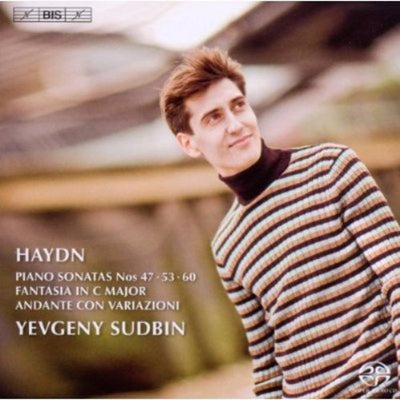
  • Yevgeny Sudbin Plays Haydn
    BIS

    Yevgeny Sudbin Plays Haydn

    SACD · 1 disc

    $21.99
    Composer
    HAYDN, FRANZ JOSEPH
    Artist
    Yevgeny, Sudbin
    Released
    May 01, 2010
    "Yevgeny Sudbin was born in St Petersburg and has lived in the UK since 1997. His previous outings on the BIS label, with recitals of Scarlatti (reviewed twice on these pages) and Scriabin have all been received to great acclaim, as has Sudbin’s concerto recordings for the same label...It is clearly apparent that Mr. Sudbin has established an enviable reputation, and for those to whom his name is already familiar, this release will be another shot in the arm of fine collections of piano recordings the world over.

    There are quite a few rather special recordings of Haydn piano sonatas, but with 51 in the catalogue there are few pianists who would even consider tackling the whole lot, John McCabe on Decca being a distinguished exception, Jeno Jandó a highly competent if marginally less distinguished budget alternative on Naxos. There are a few fortepiano recordings both complete and ongoing, the Brilliant Classics one offers a different kind of Haydn to that on a modern grand piano, as does the excellent BIS complete set played by Ronald Brautigam. A pianist whose recordings have impressed me in recent years is Ragna Schirmer, and hers is the kind of cleanly unpretentious and witty playing with which I would compare Yevgeny Sudbin’s performances here. Schirmer gives Haydn every chance to shine and blossom in recordings which are crisp and full of colour, warm and clear at the same time, carrying us away with the music’s message, alive to the echoes of past music and the surprisingly potent emotional charge which can be surprising to find in this composer.

    This is not so much a ‘better than’ kind of review, but I find it is useful to have a reference and a starting point from which to evaluate a new recording of an idiom which is familiar, even if the pieces don’t overlap. Yevgeny Sudbin has that lightness of touch which is essential for good Haydn, and especially good Haydn at the keyboard. The opening Allegro moderato movement of the Sonata No.47 in B minor says much about the rest of this programme, with richness of contrast and moments of drama fully exploited between music of almost naive simplicity. This simplicity is as important to Sudbin as every other aspect of this music. The thinning of texture to two-part lines which suggest harmony as much as proclaim it are all superbly rendered, sometimes held to the middle of the keyboard, sometimes turning the left hand into and orchestral bass section or a driving rhythmic leaping thing which serves multiple functions. The Minuet of this sonata is a development on this kind of purity of expression, and Sudbin knows exactly what he is doing, shaping phrases with elegance and a sense of proportion which seems to provide all answers: ‘yes, this is how it should sound.’

    If I were to compare Sudbin and Schirmer then, by a small margin, Sudbin seems to explore depths ‘into’ or ‘within’ the notes a bit more, digging a little deeper where Schirmer sparkles and shines with a more twinkly kind of wit. This is all by a marginal degree however – Sudbin sparkles and Schirmer digs as well, just take the Finale: presto of this sonata for some crackling at the keyboard from Sudbin, with the minor key providing a reason for that extra layer of dark passion.

    Following a minor key with a major, in this case the Sonata No.60 in C major is a good idea, and Sudbin lifts us high and carries us all the way in the opening Allegro, which is as full of smiles as a comedy turn by Michael Macintyre. His own booklet notes tell us something of how Sudbin approaches Haydn: “Is laughter the best medicine? I certainly hope so and would not hesitate to prescribe a healthy dose of Joseph Haydn twice daily.” Haydn’s humour is not to be found in heavy jokes, but in the very nature of the music itself. Any darkness is more often than not provided as a foil a contrast to those delightful moments of wit, and sometimes, as in this movement the ideas are so fun-filled that such moments need only be held for a few bars in the minor, or a segment of sublime beauty at 6:50 where the pedal suspends the music on a waft of mist for a mere moment. Sublime beauty is the essence of the Adagio of this sonata, and Sudbin traverses its measures with a good deal of freedom, creating a fascinating musical narrative in which you can become lost for what seems like a good deal longer than its 5:53 duration, but which you would gladly have last for a dreaming while longer. Sudbin has combined some of the original material from an earlier version of this movement, which was later revised to fit in with the outer movements of the sonata. I admire this kind of creative license and research based attitude, getting the best out of the music by exploring further beyond the notes on the page than would most musicians. The results certainly speak for themselves.

    Elements of Scarlatti appear with the rippling passing ornaments thrown in with effortless ease by Sudbin in the Sonata No.53 in E minor. The contrast between the spectacular Presto and the almost invisible following Adagio could hardly be greater. Sudbin plays the Adagio with such transparency that light and air shine through the whole time: it’s like a single mote of dust floating down to land, slowly and gently, onto a crystal shimmering in a bath of late afternoon sunlight. The sunshine moods anticipate Beethoven in the final Vivace molto, with quicksilver harmonic twists and turns which are still pretty breathtaking even 230 years after they were conceived. About one minute in the mood shifts several gears at once, and we are taken on a journey far beyond expectations.

    The Andante con Variazioni follows and refines the model of C.P.E. Bach, involving major and minor variations alternately. Some say this was written as a kind of memorial to Mozart for, although there are smiling moments, these are as poignant as they are jovial, and the mood of the music is certainly more tragic than comic. Refinement and poise, sensitivity and grace are all words which spring to mind for both the piece and this performance, which is given with admirable restraint, reserving the emotional core of the work for a penultimate outburst at 12:39.

    To end the programme with a flourish, Yevgeny Sudbin gives us an encore in the form of his arrangement or ‘pianistic impression’ of the finale of Haydn’s String Quartet in D major, Op.64 No.5. “I find [the string quartets] all addictive. Just as his sonatas are incredibly communicative and chamber-music like, his chamber music strikes me as having a very pianistic potential.” Larking with Haydn is therefore Sudbin’s ‘affectionate tribute’ to the Great Master, and one which fits in very well with the vibrant nature of the release as a whole. In fact this whole disc is of course a fine tribute to Haydn, showing once again how alive and resonant his music even today. The entertainment factor is high with this disc, but superficial show is never the basis of the music or the playing. I’m a big fan of the St George’s pleasantly resonant acoustic, and it works very well for the solo piano and this music, with the SACD quality transplanting you straight to Bristol’s top chamber music location. Superbly recorded performances such as these do exactly what Sudbin hopes, seeing Haydn “taken much more seriously, in an unserious sort of way.”

    -- Dominy Clements, MusicWeb International
    View full page
  • Yevgeny Sudbin Plays Haydn

    Yevgeny Sudbin Plays Haydn

    BIS May 2010
    1 disc
    SACD
    $21.99
  • Haydn: The 7 Last Words, Op. 51

    Haydn: The 7 Last Words, Op. 51

    Linn Records Jan 2001
    1 disc
    SACD
    $20.99
  • Haydn: 7 Last Words Of Our Saviour On The Cross (The)

    Haydn: 7 Last Words Of Our Saviour On The Cross (The)

    BIS Feb 2004
    1 disc
    CD
    $21.99
  • Haydn: The Seven Last Words of Christ / Minasi, Ensemble Resonanz
    HARMONIA MUNDI

    Haydn: The Seven Last Words of Christ / Minasi, Ensemble Resonanz

    CD · 1 disc

    $18.49
    Composer
    HAYDN
    Artist
    Riccardo Minasi
    Released
    Apr 05, 2019

    Following an acclaimed disc of cello concertos and symphonies by C. P. E. Bach, the musicians of the Ensemble Resonanz continue their exploration of eighteenth-century orchestral music. For several years now, under the direction of its inspired conductor Maestro Riccardo Minasi, the ensemble has taken up the challenge of playing contemporary instruments with complete mastery of historically informed performance practice. Forty years after what has been called 'the Baroque revolution', what a pleasure to rediscover these nine orchestral movements literally inhabited by the last words of Christ on the cross - and displaying that rhetorical skill of which Joseph Haydn was a peerless exponent.

    View full page
  • Haydn: The Seven Last Words of Christ / Minasi, Ensemble Resonanz

    Haydn: The Seven Last Words of Christ / Minasi, Ensemble Resonanz

    HARMONIA MUNDI Apr 2019
    1 disc
    CD
    $18.49
  • SEVEN LAST WORDS

    SEVEN LAST WORDS

    MDG Feb 2009
    1 disc
    SACD
    $24.99
  • Haydn: London Symphonies No 98, 94, 97 / Weil, Cappella Coloniensis

    Haydn: London Symphonies No 98, 94, 97 / Weil, Cappella Coloniensis

    Ars Produktion Mar 2010
    1 disc
    SACD
    $21.99
  • Great Haydn Symphonies - No 6, 45, 48, Etc / Fischer, Et Al
    Nimbus

    Great Haydn Symphonies - No 6, 45, 48, Etc / Fischer, Et Al

    CD · 2 discs

    $20.99
    Composer
    HAYDN, JOSEPH
    Artist
    Fischer
    Released
    Sep 01, 2004
    A strong contender as an introduction to some wonderful music.

    There are two ways to obtain the complete Haydn symphonies: a third set on Sony, conducted by Dennis Russell Davies seems no longer to be generally available in the UK, even as a download.

    One was made some time ago by Antal Doráti with the Philharmonia Hungarica (Decca 448 5312, 33 CDs). From this set only the Paris Symphonies seem currently to be separately available (Decca E473 8102) and, at prices ranging from around £165 to £195 – even more, £352.15, for the download from hmvdigital.com – buying the whole thing may be something of a daunting proposition. Even as a download, only that Paris set, two Double Decca sets of the London Symphonies and a Decca Eloquence recording of Nos. 94, 100 and 101 remain available separately. These are fine performances of which I can speak from personal experience, having owned several of them on LP; I still have and regularly play some of the smaller CD sets from the series which were once available.

    There is, however, a far less expensive way to obtain the symphonies complete, from the Austro-Hungarian Haydn Orchestra under Adam Fischer; the whole set comes on just 8 CDs in mp3 format (NI1722) and can be purchased from MusicWeb International for £23.00 post free. The discs can be played directly from any CD, SACD or blu-ray player which offers mp3 playback, but it’s better to drop and drag the files onto a computer hard drive and play them from there.

    Dominy Clements in recommending the set went so far as to include graphic print-outs of the same segment of Symphony No.1 from the normal CD and the mp3 version, demonstrating not only that they sound identical but that there is objective evidence to support the point.

    The selection listed above comes from that complete set and, although I don’t have access to that mp3 edition on disc, I’ve been listening to some of the symphonies in mp3 sound from the Naxos Music Library and I’m blessed if I can hear any difference between the versions on CD and the mp3 equivalents.

    I’ve reviewed the classicsonline.com downloads of Symphonies Nos.1-20 – July 2012/2 Download Roundup – and Symphonies 21-39 and ‘107’-‘108’ (also known as ‘A’ and ‘B’) – July 2009 Download Roundup. Though I could hardly recommend the downloads when they are more expensive (£39.95) than their physical equivalents on 5 CDs (NI5426-30 and NI5683-7 respectively, £23.00 each post free from MusicWeb International), I was able to confirm the high quality of the mp3 sound. So if you are looking for a complete set of the Haydn symphonies that mp3 set, NI1722, looks to me like the best. If, however, you would like to ease yourself into this wonderful music gradually, the ‘Great Haydn Symphonies’ pair of CDs, obtainable from MusicWeb International for £12 post paid, would be an excellent way to dip your toe into the water.

    By no means all the Haydn symphonies with a nickname received their nomenclature from Haydn himself, and by no means all of them are accurate. In this case, however, the set of six nicknamed works provides a very useful peg on which to hang a 2-CD set of works from all periods of Haydn’s long productive life. Not only that, but these are six of my own favourites among the composer’s huge symphonic output.

    No.6 comes from the earliest period of his tenure with the Esterházy family. It’s one of a series of three linked works, depicting Morning, Noon and Evening, though it stands well enough on its own. Early it may be, but Haydn never really had a period when his music didn’t sound fully accomplished and its appeal is enhanced by the excellent performance which it receives.

    Symphony No.45 is the most famous of the Sturm und Drang symphonies from Haydn’s middle period, around 1770. The name Sturm und Drang or storm and stress refers properly to the pre-romantic literature of the period, notably to a series of works by Goethe and Schiller. The story behind the last movement, with the musicians leaving one by one as a hint to their employer that they needed a break, is well known but that doesn’t diminish the power of the music; it remains unhackneyed no matter how many times I must have heard it. Perhaps the performance here doesn’t quite match the power of a Vanguard recording with Antonio Janigro at the helm, which used to be available, but it comes pretty close.

    No.48 also comes from the Sturm und Drang period. Its nickname refers to the belief formerly held that it was composed specially for a visit from the empress, Maria Theresa. For some reason she always seems to develop an spurious extra ‘i’ in the name of this symphony, perhaps by false association with the German name Mariatheresien-symphonie. As with No.45, it’s easy to see why the symphonies of this period came to be linked with the literature of the period. My only reservation about Fischer’s performance of this symphony may sound irrational, but the modern horns hit their notes just slightly too comfortably in comparison with period-instrument performances.

    It’s not that I didn’t enjoy Fischer’s account of this work, but compare the period-instrument performance from Roy Goodman and the Hanover Band on an inexpensive Hyperion recording (Helios CDH55119, with Nos. 49 and 50, £6.99 or less; £5.99 for mp3 or lossless download: see March 2012/2 Download Roundup) and the extra adventure involved in hitting the right notes adds an extra touch of zest to the performance, as does the inclusion of a just-audible harpsichord. Any one of the budget-price discs from this series might make a useful addition to the Nimbus ‘Great Symphonies’ set; it’s a series that was never quite completed, though it contains recordings from all periods of Haydn’s symphonic output.

    If you’ve fallen for the appeal of Haydn in Sturm und Drang mode, Nimbus offer another 2-CD set of Nos. 43, 44, 49, 52, 59 and 64 (here).

    Symphony No.82 moves us on several years to Haydn’s visit to Paris in 1785/7. Fischer’s performances of the six symphonies from this period are available on a pair of Nimbus CDs (NI5419-20 - £16.00 post free from MusicWeb International here). The only reservation that I have about recommending the ‘Great Symphonies’ set is that you may well fall for the charms of No.82 and want the whole set. If you doubt the validity of the ‘bear’ nickname for this symphony, Fischer’s growly finale makes it seem thoroughly appropriate, even though it isn’t one of Haydn’s own devising. Here again, only a preference for a period-instrument performance such as Harnoncourt’s Deutsche Harmonia Mundi 3-CD set (82876606022, all repeats observed) or Roy Goodman’s on Hyperion (Nos. 82-4, CDH55123) would be reason to look elsewhere – I’m happy with either approach.

    The Oxford Symphony was performed at Haydn’s award of an honorary doctorate by the university, so the title has some validity even though in the end he failed to compose the new work he had intended for the occasion and substituted one that was already well known in England. Simon Rattle’s account of this and other symphonies from the period between the Paris visit and Haydn’s first to London has received critical praise (Nos.88-92 and Sinfonia Concertante, EMI 3942372: Recording of the Month, but I find it too heavy by comparison with the best period performances. You don’t need period instruments, however, to make the symphonies of this period sound well, as Eugen Jochum demonstrated in his BPO recordings of Nos. 88 and 98 and his later LPO set of the ‘London’ Symphonies and as Fischer demonstrates in his version of the Oxford. This is modern-instrument Haydn without the ‘big band’ effect that I find from Rattle and I found it an excellent complement to Roy Goodman’s period-band on Hyperion Helios CDH55125.

    The nicknames of Haydn’s symphonies don’t always translate from one language to another. In German No. 94 is known as the Drum Stroke Symphony (mit dem Paukenschlag), so easily confused with what is known in English as the Drum Roll Symphony, No.103. The English nickname, Surprise, like the German, refers to the loud stroke in the slow movement, designed to wake the ladies. I first got to know this symphony from Beecham’s early-1950s Columbia (CBS) performance, once available on the Philips Classical Favourites label – no longer available but his later 1950s remake, still in mono, is on the first of two EMI Gemini 2-CD sets: details below. If Fischer and his team don’t quite recapture the magic of that version – could anyone? – I can’t think of any better recent version.

    Hungarian orchestras and conductors seem to have a particularly strong rapport with Haydn – surely it can’t just be due to the fact that he composed for the Esterházy family whose palaces spanned what is now the international border. There used to be several CDs of his music on the Hungaroton White Label which, if reissued at budget price, would still be well worth considering. David Blum recorded several of the symphonies with the Esterházy Orchestra for Vanguard which, like those Hungarotons, I still listen to with pleasure. Intermittently available on CD, there’s a very strong case for the latter especially to be reissued. Despite their Eastern European name, the Esterházy Orchestra are American. Still available, however, and of genuine Hungarian provenance, are the successful recordings which Naxos has made of Haydn symphonies with the Nicolaus Esterházy Sinfonia and Béla Drahos.

    Good as all these are, the Austro-Hungarian Orchestra, drawn from top-flight Austrian and Hungarian players, is best of all. These recordings were made over a period of seven years, during which time the orchestra had three Konzertmeister, or leaders: Rainer Küchl, Erich Binder and Wolfgang Redik. The quality of performance over that period is remarkably consistent.

    I’m not suggesting that these are perfect – even if such a thing were possible. I would have liked a little more generosity in the matter of first movement repeats, for example. Without necessarily wishing for every repeat to be observed, as Harnoncourt does in his most recent recording of the Paris Symphonies for Deutsche Harmonia Mundi, I do feel that there’s imbalance in Fischer’s No.82 – Doráti’s, too, for that matter – where the first and second movements are almost exactly the same length and the finale is shorter than either. Goodman strikes a neat compromise by observing the first-movement repeats but not those in the finale (Hyperion Helios CDH55123, with Nos.83 and 84).

    Just occasionally, too, I felt that some of Fischer’s ritardandi were slightly artificial, but that’s only if one judges them against those of Thomas Beecham, who somehow manages to make everything he does seem thoroughly natural and Haydnesque, even though he clung to outdated editions which he knew to be erroneous when better texts were already available. See the review of his EMI recordings of the London Symphonies – Bargain of the Month – and my November 2011/1 Download Roundup. Beulah have reissued Beecham’s Symphonies Nos. 101 and 103 – see April 2012/1 Download Roundup.

    The recordings are excellent throughout. Even the two earliest here, of Nos. 45 and 94 from 1988, are not at all bad but the later recordings sound even better. With short but valuable notes this inexpensive set is a strong contender.

    -- Brian Wilson, MusicWeb International
    View full page
    Orfeo

    M. Haydn: Serenade, Divertimento / Schmalfuss, Klocker, Prague Chamber Orchestra

    CD · 1 disc

    $20.99
    Composer
    HAYDN, MICHAEL
    Artist
    Klocker, Prager Kammerorchester, Schmalfuss
    Released
    Jun 25, 2007
    If you thought Mozart's Salzburg serenades were big works, then check out this extravaganza in nine movements, lasting just about an hour. Composed in 1764 and scored for everything but the kitchen sink, the work includes an opening march, two minuets, and major concerto movements for solo clarinet and solo trombone (yes, I did say trombone). Both are often performed separately. Michael Haydn's proto-classical style is, as you might expect, graceful, tuneful, and easy on the ear, and if you are familiar with any of the other releases from Klöcker and his Prague forces, then you know that you can expect lively, elegant music-making (and some terrific clarinet playing). This piece is entirely light and unassuming--entertaining when you want to pay attention, yet unobtrusive if you don't. Even the two marches aren't very militant or rhythmically sharp-edged, but if you're looking for a very pleasant hour of dinner-time music, beautifully recorded, Michael Haydn certainly gets the job done.

    --David Hurwitz, ClassicsToday.com
    View full page