Brilliant Classics Sale 2026

Brilliant Classics Sale 2026

Big works. Big collections. Brilliant savings.

For the next two weeks, save 25% on over 300 Brilliant Classics titles, including an incredible selection of iconic box sets perfect for building—or expanding—your classical collection.

Explore music from some of the world’s most celebrated composers, including Handel, Mozart, Haydn, Bach, and many more, all at a price worth making room on the shelf for.

Shop now before the sale ends Wednesday, October 7th, 2026 at 9:00AM!

    Brilliant Classics

    Telemann: 100 Menuets TWV 34:1-100 / Coen

    CD · 2 discs

    $16.19 $17.99 Save 10%
    Composer
    Telemann, Georg Philipp
    Artist
    Andrea Coen
    Released
    Nov 19, 2021
    Georg Philipp Telemann (1681-1767) composed two sets of “Seven times seven plus one Menuet’, resulting in the total of a hundred Menuets. It is not certain what Telemann meant with this numerical title, most likely the biblical holy number 7 plays an important part in it. Telemann’s menuets are well-crafted miniatures of sixteen to forty measures; those of the second collection are generally briefer than those of the first. In both collections, the keys are arranged alphabetically. With few exceptions, the dances are unvarying in their two-reprise structure and four-measure phrasing. Andrea Coen is an organist, harpsichordist, and fortepianist, who has studied with such distinguished artists as Ton Koopman and Alan Curtis, and has collaborated with such figures as Christopher Hogwood and Monica Huggett. His recordings of Baroque and early-Classical keyboard repertoire for Brilliant Classics have attracted glowing reviews. Coen recorded the “Kleine Kammermusik” and made the first complete recording of Telemann’s Fantasias (94228). According to MusicWeb International: ‘Coen, an experienced, insightful instrumentalist with a profound knowledge of historical performance practice and a sackfull of important recordings under his belt, could make Telemann sound special even on a typewriter.’ Andrea Coen about these 100 Menuets: “The most exciting thing, in this journey of a hundred stages, was to find in each individual minuet a unique and unrepeatable sense of originality: a hundred miniatures that compose a kaleidoscope as rich and coherent as was ever heard”.
    View full page
  • Telemann: 100 Menuets TWV 34:1-100 / Coen
    Sale

    Telemann: 100 Menuets TWV 34:1-100 / Coen

    Brilliant Classics Nov 2021
    2 discs
    CD
    $17.99 $16.19Save 10%
    Brilliant Classics

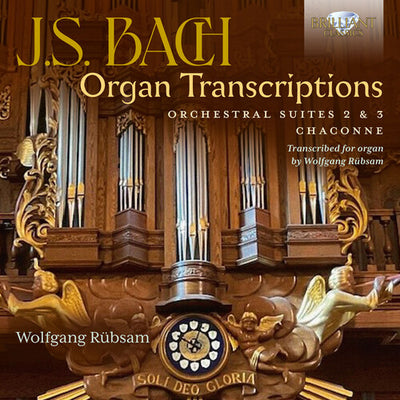
    Bach: Orchestral Suites 2 & 3; Chaconne - Transcribed for Organ / Wolfgang Rübsam

    CD · 1 disc

    $12.59 $13.99 Save 10%
    Composer
    Johann Sebastian Bach
    Artist
    Wolfgang Rubsam
    Released
    Nov 17, 2023

    Over the course of more than half a century, Wolfgang Rübsam has consistently brought new insights to bear on the keyboard music of Bach, firstly in sets of the canonic organ music for Philips, then the same for Naxos. In the last few years, his musicianship and understanding of Bach enriched by those decades of experience, he has turned to the harpsichord/piano repertoire for Brilliant Classics. A series of critically acclaimed albums has shed new light on The Well-Tempered Clavier, the Goldberg Variations, the Partitas and Toccatas with Rübsam’s performance of them on a lautenwerk – a ‘lute-harpsichord’ with a distinctive chime and colour which Bach himself would have been familiar with. Rübsam now returns to the organ, with new transcriptions and recordings of two Orchestral Suites and Chaconne from the D minor Partita for solo violin. While the Chaconne has attracted transcribers and arrangers ever since the 19th century, drawn magnetically to its evolving variations on a ground bass which accumulate an emotional power unusual even for Bach, the Orchestral Suites are much less often encountered outside their original garb. Yet we can be sure that Bach himself would have embraced Rübsam’s idea with enthusiasm. The Suites themselves are compilations of dances, probably not all originally designed for their eventual destination as high-class entertainment music for the concert series at Café Zimmermann in Leipzig, and Bach repurposed some of their movements as sinfonias and even choruses for his church cantatas. As in his fairly free transcription of the Chaconne, Rübsam has made full use of the instrument at his disposal, a magnificent Casavant instrument (1998) at the Church of St. Louis, in St. Paul, Minnesota. The booklet includes a full disposition for the organ as well as an essay introducing both the works and Rübsam’s uniquely imaginative approach to them. ‘If the sound of the lute-harpsichord highlights Bach’s debt to French lute music, especially in the First Prelude, the instrument clarifies that homage while Rübsam’s interpretation transcends it.’ (Fanfare, November 2018, The Well-Tempered Clavier, 96750)

    View full page
    Brilliant Classics

    Castello, Frescobaldi & Kapsberger: "Canto & Basso" Sonatas / Mvsica Perdvta

    CD · 1 disc

    $12.59 $13.99 Save 10%
    Composer
    Dario Castelo, Girolamo Frescobaldi, Giobanni Girolamo Kapsberger
    Artist
    Mvsica Perdvta, David Brutti, Renato Criscuolo, Nicola Lamon
    Released
    Apr 21, 2023

    The trio sonata was one of the baroque period’s most popular instrumental forms. While in its ‘classic’ form it features two higher pitched instruments, a melodic bass instrument and basso continuo, there were several others, including a popular variant for one high-pitched instrument, one bass instrument and continuo, chosen by a substantial number of composers in the 17th century and beyond, and resulting in a significant number of compositions.

    In this setup, the writing for the melody instrument is more virtuosic than in a ‘conventional’ trio sonata, and it performs more of a solo role, unlike in the trio sonata, where it is more a first among equals. At the same time, the bass instrument is used idiomatically instead of being relegated to a mere basso continuo. This contributed greatly to bolstering its role as a solo instrument, and it was given ever greater prominence as the second half of the 17th century progressed.

    From the numerous Italian composers who wrote for this genre, for this album Mvsica Perdvta have selected the two who had the greatest influence on the establishment and development of chamber music: Girolamo Frescobaldi (1583–1643) and Dario Castello (1602–31). The first edition of Frescobaldi’s Canzoni da sonare a uno, due, tre e quattro, published in Rome in 1628 (and later republished in a slightly different version in Venice in 1634) sits chronologically between the two books of Castello’s Sonate concertate in stil moderno, published in Venice in 1621 and 1629 respectively. While Frescobaldi’s canzoni can be considered the culmination of a genre that was already in decline, Castello ushered in a form that, evolving through countless different variants, would for centuries remain the leading chamber music genre. Castello’s style is faithful to the promise of its title: it still sounds very ‘modern’ for its time, especially when – as in this album – it is paired with the oeuvre of Frescobaldi, the epitome of the instrumental canzona.

    Completing the CD is a short work by Giovanni Girolamo Kapsberger (Venice, c.1580 – Rome, 1651), the only sonata that the composer known as the ‘Tedesco della tiorba’, or ‘German of the theorbo’, wrote for this ensemble, taken from Il primo libro di Sinfonie a quattro con il basso continuo (Rome 1615).The sonata à tre was one of the most typical instrumental forms of the Baroque era. While in its 'classical' form it calls for two treble instruments combined with a melodic bass instrument and basso continuo, it had several 'variants' in the ensemble, including the one for treble instrument, bass instrument and continuo, which was very popular. In this formation, to which a substantial number of composers (not only of the 17th century) dedicated an important number of compositions, the part of the treble instrument presents a more virtuosic and soloistic writing than that of the 'conventional' trio sonata. At the same time, the bass instrument, not reduced to the sole function of basso continuo, is treated as an equal melodic counterpart.

    This new recording presents the two composers who most influenced the birth and development of instrumental 'chamber' music, namely Girolamo Frescobaldi (1583-1643) and Dario Castello (1602-1631). Whereas Frescobaldi represents the pinnacle of an older style, the works of Castello look forward and form the basis of the chamber music style of centuries to come. The soloist of this recording is David Brutti, playing the Cornetto, a hybrid instrument with the fingerholes of a woodwind and a brass-type mouthpiece. Renato Criscuolo plays the bass violin, and the organ or harpsichord is played by Nicola Lamon.

    View full page
  • Castello, Frescobaldi & Kapsberger: "Canto & Basso" Sonatas / Mvsica Perdvta
    Sale

    Castello, Frescobaldi & Kapsberger: "Canto & Basso" Sonatas / Mvsica Perdvta

    Brilliant Classics Apr 2023
    1 disc
    CD
    $13.99 $12.59Save 10%