CD · 1 disc
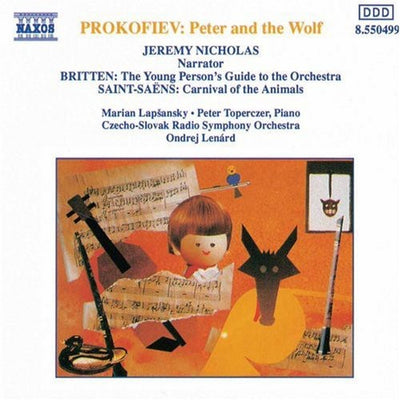
The French composer Camille Saint-Saëns was prolific and lived a long time, although by the time of his death in 1921 music had changed beyond anything he could have conceived. He was a gifted pianist and, in common with many other well known French composers, found employment and distinction as organist at one of the principal churches in Paris. The popular Carnival of the Animals, described as A Zoological Fantasy, was written in 1886, originally for two pianos and a small chamber orchestra, to celebrate that year's carnival. The composer forbade further performances of this occasional music, except for The Swan, which enjoyed immediate and irresistible popularity.
The Soviet composer Sergey Prokofiev wrote his Peter and the Wolf in 1936 to introduce to children the instruments of the orchestra. He had taken his two sons to see performances at the Moscow Children's Music Theatre and this had suggested to him the possibility of a composition of this kind. The boy Peter, represented by the strings, is playing in the meadow, forbidden territory. A bird, shown by the flute, sings in a tree: a duck, the oboe, swims in the pond, and a cat, the clarinet, comes onto the scene, sending the bird up to a higher branch. Peter's grandfather, the bassoon, warns the boy not to venture out, but meanwhile a wolf, the French horns, comes into the meadow, and adventures ensue with spoken narration.
Ten years later, in 1946, the English composer Benjamin Britten was asked to write music for an educational film introducing the instruments of the orchestra. For the purpose he chose a theme by the great 17th century English composer Henry Purcell and wrote a set of variations, each of which shows the characteristics of a particular instrument or group of instruments. The alternative title of the work, Variations and Fugue on a Theme of Purcell, is an exact description. The other title, The Young Person's Guide to the Orchestra, makes fun of the titles much favored by writers of moral tales in the 19th century, providing "young persons" with advice on how to regulate every aspect of their lives. At the most exciting part of the concluding fugue, the brass instruments play again the original theme, leading to a grand conclusion.
Distinguished international pianist Jorge Federico Osorio brings his flair for French music to works of the Baroque, Romantic, and early 20th century eras by Jean-Philippe Rameau, Emmanuel Chabrier, Gabriel Fauré, Claude Debussy, and Maurice Ravel. Fittingly, Osorio opens The French Album with Fauré’s exquisite Pavane and concludes with the ever-popular Pavane pour une enfante défunte by Fauré’s student, Ravel. The Mexican-born, European-trained pianist offers eight of Debussy’s pictorial Préludes, each with its unique sound world, including the mystical La Cathédrale engloutie, one of the most stunning pieces ever composed for piano. Another audience favorite is Debussy’s evocative Claire de lune from his Suite bergamasque. Providing contrast, Rameau’s whimsical Les Tricotets conjures the back-and-forth motion of knitting needles. A set of Spanish-flavored works include Chabrier’s Cuban-inspired Habanera; Debussy’s lively La Puerta del Vino, depicting sailors carousing and enjoying their wine, and La soirée dans Grenade, where the piano imitates the sound of a guitar; and Ravel’s Alborado del gracioso, brimming with Iberian rhythms.REVIEW:What appears to be a hodgepodge of French pieces actually emerges as a carefully crafted program. Pianist Jorge Federico Osorio begins with Fauré’s famous Pavane, where his elegant phrasing and fluid “walking” tempo assiduously segue into a well-contrasted Debussy group. He brings a strong rhythmic profile and dry-point clarity to works dominated by rapid passagework such as Les collines d’Anacapri, Ce qu’a vu le vent d’Ouest, and Feux d’artifice, as well as Ravel’s Alborada del gracioso.While Osorio certainly embraces the sensual undercurrents in Clair de lune, Voiles, Feuilles mortes, and La cathédrale engloutie, the climaxes have plenty of backbone. The pianist similarly integrates curvaceous lilt and unsentimental grit in Chabrier’s Habanera and Debussy’s habanera-like La Puerta del Vino and La soirée dans Grenade. Three selections from Rameau’s G major Suite stand out for Osorio’s care over ornaments, although his slightly heavy way with the final selection, Ravel’s Pavane, misses the animation and flexibility of the old Gieseking and Casadesus recordings. All told, an enjoyable and well-put-together recital.– ClassicsToday.com (Jed Distler)