Jongen: Couleurs retrouvees - Autour des œuvres pour orgue e
Musique en Wallonie
CD
$20.99Nov 06, 2026
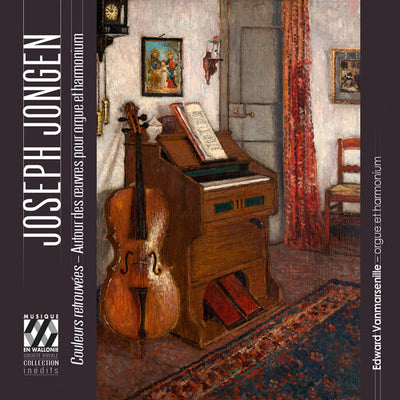
This recording highlights the early organ works of Joseph Jongen, a major figure in Belgian music at the turn of the 20th century. Composed during a period of profound transformation in the aesthetics of organ music, these pieces demonstrate the composer's keen attention to the evolution of the instrument and it's musical language. Rooted in the Belgian Romantic tradition, they draw upon the legacy of Jacques-Nicolas Lemmens and Alphonse Mailly, while already revealing a strong artistic personality. The influence of Cesar Franck is particularly evident in the harmonic richness and expressiveness of the musical discourse. The Pastorale from Opus 5 especially illustrates this sonic exploration and hints at the impressionistic colors that would characterize the composer's mature works. Through this program, the listener discovers the beginnings of a refined musical language that would fully blossom in Jongen's later output.
César Franck's Rédemption (1873) is a pivotal work. It is an "ode-symphony," coming at the crossover point between oratorio, opera and symphonic poem - a vein brilliantly exploited by Franck in Psyché (1888) and Les Béatitudes (1891). Rédemption also marks a further progression: with this vast fresco César Franck became "le père Franck", leading father figure in the new French compositional school, the composer of maturity, creator of Le Chasseur maudit (1883), the Variations symphoniques (1885) and Les Éolides (1885). Here we see the organist becoming a virtuoso in handling grand orchestral or vocal forces and taking his place amongst the major composers of the Symbolist period.
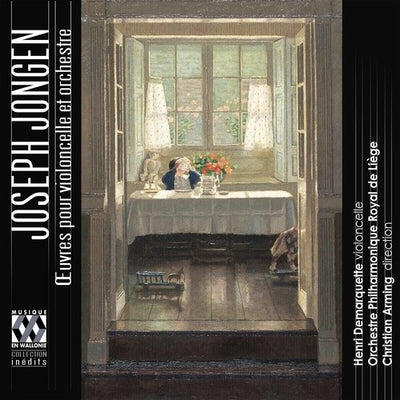
Jongen: Works for Cello & Orchestra / Arming, Demarquette, Liege Philharmonic
Musique en Wallonie
CD
$20.99May 19, 2017
Anyone who has witnessed the welcome accorded to a national football team returning home after winning an international trophy might find it hard to believe that, not all that long ago, composers too were the object of similar popular adulation. The contest that gave rise to the most extreme transports of delight and pride was the Prix de Rome. Instituted by the Belgian government in 1841 on the model of the French prize of the same name, it was awarded every two years to young composers of under thirty. After being awarded the Prix de Rome in 1897, Joseph Jongen (1873-1953) began to compose vast works for cello and orchestra. These testify to a culture both Germanic and French which allows him to make the link between the works of Richard Strauss- whom he met in Munich- and Ernest Chausson. These three pieces are performed by the brilliant French cellist Henri Demarquette, accompanied by the Liege Royal Philharmonic- whose reputation is well known- conducted by the Austrian chef Christian Arming.
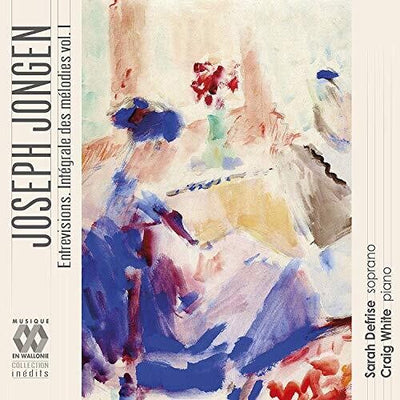
Jongen: Entrevisions (Intégrale des mélodies, Vol. I)
Musique en Wallonie
CD
$20.99Oct 11, 2019
In 2016 Sarah Defrise unearthed more than twenty unpublished songs by Joseph Jongen (1873-1953), some of them preserved amongst the composer's private papers. Such a discovery is an important event in the Belgian musical landscape. This young soprano now offers the first complete recording of these songs, of which this constitutes the first volume. We have chosen to focus on works from both the composer's youth and his maturity. This album therefore presents an unpublished cycle of setting of poems by Armand Silvestre (1892), the famous cycle op. 25 (1902), from which the first song had always previously been missing, and a selection of later songs dating from 1909 to 1928. Jongen's sensitive and subtle art is carried by the intelligent and luminous performance by the duo formed by Sarah with the English pianist Craig White.
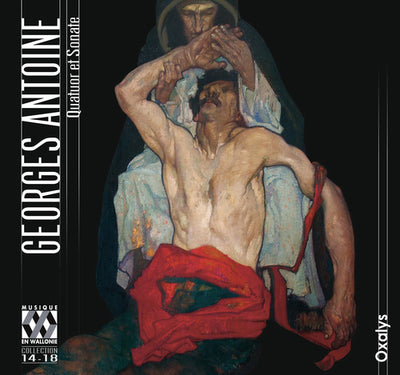
The 14-18 collection draws a musical picture of the Great War years, thanks to recordings of both erudite and popular musical pieces that emerged at the time. + The chamber music of Georges Antoine, most of whose works were composed during the war years, is the first volume of this collection. + The soldier musician (as d'Indy called him) enlisted in August 1914, was discharged in May 2015 due to deteriorating health, settled in Bretagne where he composed music and arranged concerts, voluntarily went back to the front in 1918 although still sick, before dying at Bruges four days after Armistice.
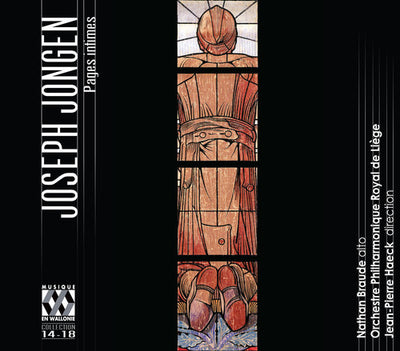
In exile in London during World War I, Joseph Jongen (Liège, 1873 - Sart-lez-Spa, 1953) composed there numerous works. This CD brings together some of his pieces for orchestra, whose masters are called Franck, Wagner, Debussy and Ravel. His symphonic works from the Great War period compel recognition as the last vestiges of a world on which the language of late romanticism had still left a reassuring mark.
The third volume of the Musical portraits series is dedicated to André-Modeste Grétry (1741-1813).
This 5CD box set includes highlights of several operas (La caravane du Caire, L'amant jaloux, Le jugement de Midas), his Six Quartets, op. 3 (Paris, 1773) and some partial adaptations of his operas (by Mozart and Franck, among others).
These works demonstrate Grétry‘s fine melodic sensibility, harmonic panache and accomplished artistry.
Johannes Ockeghem: Les Chanson / Jesse Rodin, Cut Circle [2 CDs]
Musique en Wallonie
CD
$29.99Sep 25, 2020
Intimacy, intensity, passion—this album explores the unfamiliar idea that fifteenth-century songs might cause us to sigh, weep, or laugh out loud. In bringing to life a world in which crying in public was not just acceptable but required, we have to take seriously the crushing despair of a line like “My only sorrow is that I am not dead,” or the undisguised sarcasm of “This is how she chopped and cooked me up.” In Johannes Ockeghem’s roughly two dozen songs we find not only unparalleled compositional prowess, but feelings that range from happiness to loss, anger to despair, and bitterness to merriment. The album’s all-vocal, fully texted, close-mic’d performances are rooted in a flexible, full-blooded vocal technique that aims to capture the music’s technical brilliance and emotional depth.
A contemporary of Claude Debussy, and a close friend of Maurice Maeterlinck, the composer Eugène Samuel-Holeman (1863-1942) takes us to the heart of the end-of-the-century in Belgium, to a place between symbolism and modernism. La jeune fille à la fenêtre (1904) is a monodrama sung on a text by the writer Camille Lemonnier, a major figure of the Belgian letters. Created and defended for ten years by the famous mezzo Jane Bathori, this "lyrical prose" astonishing as it's instrumentation as it's innovative harmonies, is a witness of the emancipation of the musical language at the turn of the nineteenth and twentieth centuries.
What makes a piece of music difficult? This album introduces a pair of riveting, technically ambitious, historically important, and never-before-recorded polyphonic masses of the fifteenth century, performed by an ensemble that has developed a new approach designed to honor the music’s variety and unflagging intensity. Both works stand out for their notational complexity. They are also exceptional for the skill they demand of the performers: we find hair-raising rhythms, intricate counterpoint, and long melodic phrases. Rather than mitigate these challenges with a large ensemble and a generous acoustic, this recording enhances them: the performances are one-on-a-part, featuring energetic tempi, close miking, and minimal reverberation. This approach is unforgiving—but together with bright vowels and a flexible vocal technique, it has the benefit of allowing the music to come across with uncommon directness and clarity.
“Vox humana” or “Vox celestis”? For César Franck (1822-1890) the one is often a metaphor for the other; whether in sacred or secular vein, spirituality is inherent in all his vocal music, even the most modest of his choral works. Certain of these form the focus of attention in this first recording. They remain unpublished; were they perhaps thought to be of lesser worth for having originated in a religious or private celebration or in response to a publisher’s commission? We should remember that it was often the specific circumstances that provided Franck with the stimulus necessary for the realization of some of his masterpieces. Be that as it may, listening to these choral works offers the listener some delightful discoveries.
The “Historiques” collection is devoted to reissuing historic recordings linked to particular performers. This time the focus is on the singer Pierre d’Assy (Liège 1868 - Lyon 1910). Although he died young, this bass achieved a remarkable international career. The quality of his voice is here magnificently restored in a typical operatic repertoire from the turn of the 19th to 20th centuries – Verdi, Gounod, Massenet - plus Mozart, Meyerbeer, Rossini, Berlioz and others, in recordings dating from 1908 and 1909. Meticulous remastering work and the restoration of the correct pitches (the speed of 78 rpm was far from consistent) make it hard to believe that all this dates from more than a century ago. The booklet in four languages is lavishly presented and generously illustrated with rare documents.
Édouard Lassen never stopped composing. His copious oeuvre contains examples of almost every genre in favour in the second half of the 19th century, from piano pieces to operas, choral works, symphonic and concertante pieces. His international reputation was secured especially by his theatrical works. He also produced a regular and uninterrupted flow of over 260 songs from 1857 until his death in 1904. The small-scale song form was ideally suited to his temperament imbued with universalism, assuming a dual cultural heritage. The immediate charm of Lassen’s art songs rests on a fusion between a perfect German prosody and a melodious amplitude inherited from the French tradition, the one bringing out the performer’s talents as dramatist and narrator, the other the beauty of their voice and their musicality. It is with mastery that Reinoud Van Mechelen, accompanied by pianist Anthony Romaniuk, rekindles the breath of his now unjustly forgotten melodies, mixing intimacy and depth of sensation.
It is through a double CD that Musique en Wallonie is honoring the Belgian composer Lucie Vellere. When, in 1957, the jury (entirely male) of the International Composition Contest for Women Composers, organised by Grace Spofford and the American division of the Conseil international de femmes, awarded her a first prize, Lucie Vellere found herself, for the first in her life, in the public eye. She who had always cultivated discretion now aroused curiosity. Throughout her fifty-year compositional career, Vellere cultivated an art of the melodic line that one could liken to the curves of Art nouveau, which left their mark on many composers, among them the early Debussy of the Arabesques. While Franck and Faure are often cited as her aesthetic influences, the mature Debussy appears only as filtered through Jongen. Many of the references of pictorial, poetic and musical impressionism were adopted by the composer: the elements (earth, air, fire, water), landscapes, times and seasons (evening, moonlight, autumn), evocations of temporal or spatial distance (an indeterminate past, Antiquity, the Orient). Vellere strove also for a classical sobriety and sense of proportion. This recording highlights the composer's eclectic compositions, mixing work for voice and piano, string quartets and octets, women's choir and even piano music, a panorama of her compositions that will reveal several facets of her personality.
Incomparable virtuoso, called the Paganini of the harp, Felix Godefroid was also a composer and a teacher. This recording, performed by Sophie Hallynck, highlights the composer's studies in high virtuosity. Designed for his own use and that of professionals, partake of both "absolute music" - as with the deservedly famous etude in B Flat Minor, op. 193 - and the character piece, picturesque or sentimental. These musical miniatures are pieces overflowing with musicality, in a refined style, but they express a pedagogical programme first and foremost. Godefroid conceived of his etudes as a true school for harpists. Each technical problem becomes the medium for a musical expression - an approach that gives these etudes exceptional richness and relevance. Often based on one of those melodies for which Godefroid had such a knack, each one is set apart by a strongly marked expressive character, ranging from laughter to tears, as well as by it's structure, rhythm, novel sonorities, and harmonic surprises not lacking in audacity. Sophie Hallynck has risen to the technical challenges specific to each etude while staying faithful to the spirit of the era, with the aspiration to achieve a subtle balance between virtuosity and expression. Her essential objective has always been to make technique live through music, without ever obscuring that emotion that emanates from it.
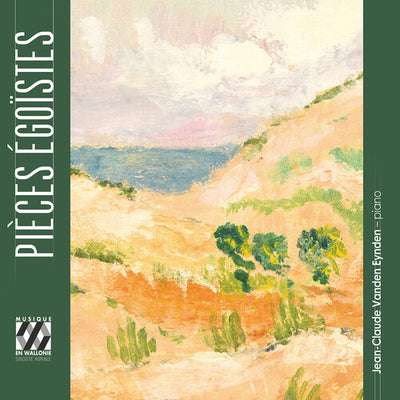
Though Belgium in the nineteenth and twentieth centuries was known above all for it's "school" of violin-playing, represented by figures such as Henry Vieuxtemps and Eugene Ysaye, it was also home to a flourishing piano "school". After independence in 1830, the new nation's conservatoires opened numerous classes, method-books and anthologies proliferated, and piano-makers kept pace with new patents and instruments. This dynamic environment naturally had an effect on composers; everyone who wrote music wrote for this king of instruments, and promoted the results either by performing them themselves or by confiding them to virtuosos to execute in concerts or competitions. The most famous of these, the Eugene Ysaye Competition (since 1951 the Queen Elisabeth International Competition), opened to pianists in 1938, with Emil Gilels emerging victorious. A quarter of a century later, Jean-Claude Vanden Eynden entered this prestigious contest and, at sixteen years of age, came away with a third prize. Trained at the Brussels Conservatoire by Eduardo del Pueyo, he would go on to an international career still active six decades later. The programme of this CD is an homage to this long lineage of teachers and students. It testifies to the practices as well as the networks of friendship that gave this "school", throughout it's various ramifications, a particular character.
Si breve e 'l tempo - Madrigals in the Low Countries
Musique en Wallonie
CD
$20.99Nov 15, 2024
In the last quarter of the 16th century, the madrigal spread well beyond Italy. Over 85 books of Italian madrigals were printed in Antwerp, mainly by Pierre Phalese the younger, giving a place of choice to both Italian and local composers. Thanks to research into the collections published at the time, La Compagnia del Madrigale is unveiling the world premiere of works taken from the volumes that made the genre such a success. It reveals their full potential and establishes the madrigal as a cosmopolitan art form.
Over time, the memory of the brilliant virtuoso that was Eugene Ysaye (Liege, 1858 - Brussels, 1931) ended up supplanting his status as a composer in the collective memory. It should be remembered, however, that Eugene Ysaye created, through his works, a fundamentally new and original genre, distinguished by a science of writing and harmonic richness. This album brings together concert works by Eugene Ysaye which, with the exception of the Saltarelle carnavalesque, have never been recorded in their orchestral version. It therefore invites us on a unique journey into the composer's sound universe, from his first to his last compositions written for soloist(s) and orchestra.
Richafort: Missa O Genitrix; Missa Veni Sponsa Christi
Musique en Wallonie
CD
$20.99Nov 15, 2024
Jean Richafort was thrust into the limelight by the success of his works, a fine reputation and his encounters with powerful figures such as Louis XII, Anne de Bretagne and Francois Ier. However, he remains mysterious regarding his origins and his professional choices. His works circulate widely, are copied and quickly disseminated: no fewer than 200 sources, both printed and handwritten, contribute to his fame. Moreover, his compositions are so appreciated that they inspire new works by leading composers from Mouton to Palestrina. The corpus of Jean Richafort's works consists of three masses, around thirty motets and about fifteen songs. Discover, in this recording, the composer's Missa O Genetrix and Missa Veni Sponsa Christi performed by the Cappella Mariana.