Search results: Search results

14 results

Products

    Supraphon

    The Complete Piano Trios

    CD · 1 disc

    $31.99
    Composer
    FOERSTER, JOSEF BOHUSLAV
    Artist
    Foerster
    Released
    Jan 29, 2013
    The piece reflects the tumultuous post-war musical development and can be designated as one of Foerster’s most progressive compositions. The young and gifted Janáček Trio interprets Foerster’s works with an understanding of the composer’s inner world and complete engagement.
    View full page
  • The Complete Piano Trios

    The Complete Piano Trios

    Supraphon Jan 2013
    1 disc
    CD
    $31.99
    Supraphon

    Foerster: Violin Concertos / Zenaty, Belohlávek, Bbc So

    CD · 1 disc

    $31.99
    Composer
    FOERSTER, JOSEF BOHUSLAV
    Artist
    Zenaty, Belohlavek
    Released
    Jun 20, 2008


    FOERSTER Violin Concertos: No. 1 in c; 1 No. 2 in d • Ivan Ženatý (vn); Ji?í B?lohlávek, cond; BBC SO • SUPRAPHON 3961 (65:23) Live: London 12/8/2007 1


    Jan Kubelík urged Josef Bohuslav Foerster to write his First Violin Concerto, which Kubelík played for the first time in Chicago in October 1910. It’s a grand Romantic work, as ingratiating melodically as Bruch’s or Goldmark’s concertos but colored—or, at least, tinted—with references to the composer’s Czech ethnicity but even more strongly influenced by the virtuoso tradition, which it perhaps owes to Kubelík, who wrote a cadenza for the premiere that bejewels its soaring melodiousness. (The notes also explain that the Concerto served as a sort of test run for Foerster’s fourth opera, The Unvanquished , with its violinist-composer hero.) Ivan Ženatý plays the work’s first movement authoritatively, adding his own cadenza, which differs in style—as so many violinists’ cadenzas do—from the composer’s passages that surround it. Ženatý draws a rich tone from the lower registers of the 1743 Prince of Orange Guarneri del Gesù and a pure and clean sound from its upper ones; such tonal opulence enables him to mine the slow movement’s rich melodic vein. The third movement opens with a triple-time dance-like theme; many virtuoso concertos concluded with dance-like finales, but this one, marked Allegro grazioso , seems more elegantly balletic. Ženatý is at home in the work’s declamatory passages (as at the first movement’s opening) as well as in the ruminative slow movement or in the comparatively genial finale. The engineers have balanced the sonorous orchestral part and the brilliant solo in this live performance (with applause at the end). I believe the performance of the First Concerto on Orfeo 403971 may no longer be available.


    The Second Concerto (the program claims to offer the first complete performance of both works), the notes accede, has not claimed the attention of violinists. Sketched in 1917 and 1918 and completed in 1926, the Concerto received its premiere on January 19, 1927. Of a piece with the First Concerto melodically, the Second nevertheless lacks its bravura, relying more heavily on pervasive lyricism. But such ingratiating melodiousness, projected against occasionally gauzy orchestration, should compensate for the Concerto’s lack of brilliance. The first two movements, marked Andante sostenuto and Andante moderato (the second movement flowing almost seamlessly out of the first), finally give way to a concluding Allegro. But while those first two movements hardly lack drama—the orchestra occasionally surges as sonorously as it does in Chausson’s Poème or Delius’s Concerto—the general atmosphere remains ecstatically if intimately tranquil. Even the finale, which begins with a hint of the folk dance, settles back into its characteristic melodic warmth. The recorded sound remains balanced throughout the Second Concerto in a way similar to that of the First, though the studio recording sessions took place on December 4–5, 2007, at the BBC’s Maida Vale Studios.


    Foerster’s violin concertos offer a continuation of the luxurious melodic flow of those by Bruch, Goldmark, and, especially, Dvo?ák; and Ženatý’s sympathetic performances should provide a warm-hearted introduction to them even for listeners not favorably disposed to the violin music of this period. Very strongly recommended.


    FANFARE: Robert Maxham
    View full page
  • Foerster: Violin Concertos / Zenaty, Belohlávek, Bbc So

    Foerster: Violin Concertos / Zenaty, Belohlávek, Bbc So

    Supraphon Jun 2008
    1 disc
    CD
    $31.99
    Naxos

    Foerster: Symphony No. 1, Festive Overture & From Shakespeare / Štilec, Janáček PO

    CD · 1 disc

    $9.99 $19.99 Save 50%
    Composer
    Josef Bohuslav Foerster
    Artist
    Marek Stilec
    Released
    Oct 14, 2022

    Josef Bohuslav Foerster was the successor to Dvořák as organist in Prague, a lifelong friend of Mahler, and a pivotal figure in Czech music, whose almost 200 compositions take in all the major genres. The three selected works here offer an overview of his orchestral music. Recalling several equally majestic pieces by Smetana, the arresting Festive Overture combines Czech flair with Viennese elegance, while From Shakespeare explores characterization with warmth and resourceful orchestration. The early Symphony No. 1 in D minor offers a darkness-to-light trajectory suffused with rich mid-Romantic colors.

    View full page
  • Foerster: Symphony No. 2; Cyrano de Bergerac
    Naxos

    Foerster: Symphony No. 2; Cyrano de Bergerac

    CD · 1 disc

    $19.99
    Composer
    Josef Bohuslav Foerster
    Artist
    Hradec Kralove Philharmonic Orchestra
    Released
    Dec 05, 2025
    Josef Bohuslav Foerster was a pivotal figure in Czech musical history and a lifelong friend of fellow German-speaking Bohemian, Gustav Mahler. Foerster's Symphony No. 2, dedicated to the memory of his sister, Marie, achieves a satisfying unity, with it's sombre qualities eloquently transformed into a fervent apotheosis. Cyrano de Bergerac was Foerster's most successful orchestral piece and is a perfect example of his late-Romantic finesse. Conceived as an autonomous work not intended as incidental music, it's 'five symphonic images' each relates to a specific place in the drama.
    View full page
  • Foerster: Symphony No. 2; Cyrano de Bergerac

    Foerster: Symphony No. 2; Cyrano de Bergerac

    Naxos Dec 2025
    1 disc
    CD
    $19.99
  • Foerster: String Quartets

    Foerster: String Quartets

    Supraphon Jun 2010
    2 discs
    CD
    $47.99
    Naxos

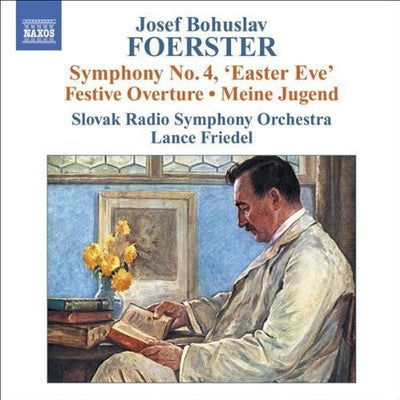
    Foerster: Symphony No 4, Etc / Friedel, Slovak Radio Symphony

    CD · 1 disc

    $19.99
    Composer
    FOERSTER
    Artist
    Friedel, Slovakian Rso
    Released
    Mar 21, 2006

    Josef Foerster was by all accounts a contented soul, and this shows in his music, which is generally open and optimistic in character. Certainly the Festive Overture and the tone poem Meine Jugend fall into this category: he sounds a bit like Richard Strauss without the danger or decadence. Symphony No. 4, subtitled "Easter Eve", strikes a deeper note, and it's a lovely work. There is no competition for the two shorter pieces, which are well played and conducted and make a very good impression. Foerster lived to the ripe old age of 91, and he wrote a ton of music, so who knows what other gems are out there waiting to be discovered.

    In the symphony (Foerster's best-known piece along with the tone poem Cyrano de Bergerac) conductor Lance Friedel is about six minutes slower (out of 40-plus) than Smetácek on Supraphon, and some listeners will prefer the latter's livelier tempos. (There's also an historical recording under Kubelik that really isn't competitive on account of very dated sonics.) Questions of tempo aside, if you didn't know the Smetácek you'd surely not care at all, because Friedel has the measure of the piece and projects its gentle loveliness just as effectively. Also, the vivid engineering gives the organ-reinforced conclusion plenty of the necessary gravitas, and at the Naxos price you can hardly go wrong. This is well-made, attractive music that fans of late-Romanticism should certainly hear.

    --David Hurwitz, ClassicsToday.com

    View full page
  • Martinu, B. / Foerster, J.B. / Novák, J.: Cello Concertos

    Martinu, B. / Foerster, J.B. / Novák, J.: Cello Concertos

    Supraphon May 2009
    1 disc
    CD
    $31.99
  • Foerster: Eva / Kyzlink, Jirikova, Andreyev, Et Al

    Foerster: Eva / Kyzlink, Jirikova, Andreyev, Et Al

    Marco Polo Oct 2005
    2 discs
    CD
    $29.99
    Supraphon

    Foerster, Haas & Janáček: Music for Wind Quintet & Sextet / Belfiato Quintet

    CD · 1 disc

    $31.99
    Composer
    FOERSTER HAAS JANACEK
    Artist
    Belfiato Quintet
    Released
    Aug 18, 2017

    The Belfiato Quintet are yet another exciting Czech chamber ensemble active in the international arena. The members of the young wind quintet perform with renowned orchestras and both as individuals and collectively hav egarnered accolades at competitions. This acclaim, however, has not gone to their heads, with their performances above all revealing their attitude: ''We enjoy it!'' The debut studio album, which they hvae recorded 12 years after the ensemble's foundation, exclusively features Czech music dating from the first half of the 20th century. J.B. Foerster composed the Wind Quintet in 1909 to commission for a virtuoso ensemble, formed by the members of the Wiener Philharmoniker. The work by Janáček's pupil Pavel Haas, written two decades later, bears traces of inspiration by folk music, Janáček, as well as Stravinsky. When listening to the piece, it is difficult indeed to resign oneself to the chilling fact that this immense young talent was silenced for ever at Auschwitz. Leos Janáček had created his wind sextet Youth just five years previously. Owing to the music teeming with joie de vivre, prevailing over languor and melancholia, one is hard pressed to believe that the artist was 70 years of age when he composed it.

    View full page
    ArcoDiva

    Mahler Contemporaries (Live)

    CD · 1 disc

    $18.99
    Composer
    FOERSTER GOLDMARK WOLF
    Artist
    Froese, Rumpf, Novakova, Vondrackova, Sobotka, Jirak
    Released
    Sep 11, 2015
    Mahler Contemporaries, a live concert recording from the Gustav Mahler Festival 2014, offers a range of well and lesser-known songs by friends, contemporaries and collaborators of Mahler, including Hugo Wolf, Pauline Viardot, Hans Rott, Richard Strauss, Arnold Schönberg and Bruno Walter, among others. The world premiére recording of Czech composer Josef Bohuslav Foerster’s Stabat Mater, Op. 56 opens proceedings; several of his songs also feature. Sung by winners of Karlsbad Int’l Singing Competition, the concert was recorded in the same Jihlava Church where Mahler started to listen to music.
    View full page
  • Mahler Contemporaries (Live)

    Mahler Contemporaries (Live)

    ArcoDiva Sep 2015
    1 disc
    CD
    $18.99
  • FAMOUS CZECH MINIATURES

    FAMOUS CZECH MINIATURES

    Supraphon Jan 1987
    1 disc
    CD
    $27.99
  • Czech Opera Rarities

    Czech Opera Rarities

    Supraphon Nov 2011
    1 disc
    CD
    $11.99
    Supraphon

    Marie Podvalová: Complete Recordings 1939-1950

    CD · 2 discs

    $37.99
    Composer
    Antonin Dvorak, Zdenek Fibich, Vitezslav Novak, Josef Ondrej Novotny, Vaclav Josef Rosenkranz, Herma
    Artist
    Marie Podvalova
    Released
    Jun 17, 2022

    For four decades, Marie Podvalová (1909–1992) was one of the most popular and sought-after opera singers of the National Theatre in Prague, where she was engaged from 1937 to 1978. She dazzled in the part of Bedrich Smetana’s Libuše, which she created in 1938 under the guidance of the conductor Václav Talich, as well as in the roles of Milada in Dalibor and Anežka in Two Widows. She also appeared in Dvorák operas, performing to acclaim Armida, the Foreign Princess in Rusalka and Julie in The Jacobin, and in Janácek works, primarily excelling as Kostelnicka in Jenufa.

    Supraphon is for the first time releasing the complete studio recordings Marie Podvalová made between 1939 and 1950. The set encompasses three songs from the collection Venec ze zpevu vlasteneckých (A Garland of Patriotic Songs, 1835–1844), which she performs accompanied on the piano by J. B. Foerster. It contains Marie Podvalová’s final, previously unreleased, studio recording, with the soprano singing Beatrice in a scene from Zdenek Fibich’s opera The Bride of Messina. The album also captures the voices of Jan Konstantin, Jindrich Blažícek, Marta Krásová, Ivo Žídek, Jaroslav Gleich, Zdenek Otava, Štepánka Jelínková, Jaroslav Jaroš, Josef Otakar Masák, Maria Tauberová, Ludek Mandaus, Stanislav Muž, and other singers. The Prague Symphony Orchestra and the National Theatre Orchestra are conducted by Rudolf Vašata, Zdenek Chalabala, Jaroslav Krombholc, František Škvor, Zdenek Folprecht, Otakar Jeremiáš and Karel Nedbal. The release marks the 30th anniversary of the legendary artist’s death.

    View full page
  • Marie Podvalová: Complete Recordings 1939-1950

    Marie Podvalová: Complete Recordings 1939-1950

    Supraphon Jun 2022
    2 discs
    CD
    $37.99
    Supraphon

    Karel Ančerl: Live Recordings / Czech Philharmonic Orchestra

    CD · 15 discs

    $149.99
    Composer
    Various
    Artist
    Karel Ancerl, Josef Suk, Josef Chuchr
    Released
    Feb 11, 2022

    Previously unreleased recordings by one of the great conductors of the 20th century.

    Karel Ančerl. One of the most important conductors of post-war Europe. A man who survived the Nazi concentration camps and the avowed anti-Semitism of communist Czechoslovakia. An artist who, through enormous patience and dedication, built the Czech Philharmonic into a world-class orchestra and introduced it successfully at the most important concert halls.

    From 2002 to 2008, Supraphon issued the highly acclaimed Ančerl Gold Edition with the bulk of his artistic legacy, containing nearly his complete studio recordings with the Czech Philharmonic on 48 albums. But that was far from everything. Hidden in the archive of Czech Radio, there is a wealth of concert recordings that gives us a more complete picture of this conductor. From that treasury, on 15 albums, Supraphon has selected repertoire of which studio recordings were not made; that repertoire covers a broad range from Mozart to works by Ančerl’s contemporaries.

    The recordings include masterpieces by Dvořák (Symphonies Nos. 7 and 8, Biblical Songs) and Suk (Asrael, Ripening), music by composers admired and promoted by Ančerl (Martinu Symphony No. 1 and Kabelác Symphony No. 5), and major works of the worldwide 20th-century repertoire (Debussy, Ravel, Strauss, Prokofiev, etc.). The only exception of a “duplication” of a studio recording is Smetana’s Má vlast. This taping of a Prague Spring Festival concert in May 1968 was one of the last recordings Ančerl made before his definitive departure for Toronto. The concert recordings from the years 1949-1968 document the maturing of this remarkable artist perhaps even more clearly than his studio legacy.

    REVIEW:

    Performances appearing on CD for the first time include, most notably, Josef Suk’s epic Asrael symphony (1967), a recording that captures the full emotional range of what’s surely the greatest Czech symphony after Dvo∑ák. Most impressive is the impact of Suk’s vivid orchestration, the timpani and bass drum especially, and the way An∂erl charts the work’s dramatic sequence of events, its emotional extremes and tragic demeanor. Never before have I felt the ‘angel of death’ transform into the ‘angel of love’ at the end of the work as it does here. Even the memorable Václav Talich (also on Supraphon) doesn’t quite match up. The mono sound is exceptionally clear but Suk’s The Ripening, another fine performance, is offered in stereo, as is Smetana’s Má vlast (both 1968), where the vengeful third piece, about the fearsome amazon Šárka, is driven to paroxysms of rage.

    Perhaps the most absorbing inclusion conceptually is Ervín Schulhoff’s musical setting of portions from the Communist Manifesto. Beyond his miraculous survival of Auschwitz (where his family was murdered), An∂erl joined the Communist Party of Czechoslovakia. Schulhoff had sent the only copy of his full score to the Leningrad Conservatory for safe keeping, but it was believed lost during the long siege of the city and the version that An∂erl conducts here (in 1962) is an orchestration by Svatopluk Havelka. Schulhoff had become convinced by the ideas coming out of the Soviet Union after working in Berlin in the 1920s and ’30s and was on the run from the Nazis in the later years of the 1930s, but was captured in 1941 and died in Wülzburg concentration camp in 1942 of tuberculosis. Whatever one’s political leanings (even in view of the subsequent Soviet invasion of An∂erl’s homeland, not to mention Ukraine at the present time), one can understand why he connected so deeply with fascism’s nemesis. The work itself resembles, on the one hand, the politically charged choral pieces of Prokofiev and Shostakovich, while on the other recalls the world of Mahler (try disc 15 track 6 from 7'25", where you can hear clear echoes of Mahler’s Sixth Symphony).


    This is an extremely important set, very well transferred, superbly annotated (by Petr Kadlec) and sturdily presented. I can’t recommend it more highly than that.

    -- Gramophone (Rob Cowan)

    View full page