Bach, Kuhnau, Zelenka: Magnificats / Suzuki, Persson, Bach Collegium Japan
BIS
CD
$10.99$21.99Save 50%Apr 01, 1999
REVIEW:
In the early 1730s Bach revised his E flat major Magnificat of 1723, transposing it to D major and omitting the interpolations peculiar to Christmas performances in Leipzig. (Recent research suggests such richly scored Latin Magnificats could be performed in Lutheran churches at some 15 annual festivals, not just the three – Xmas, Easter, Ascension – previously supposed.) The D major was apparently Bach’s preferred version and is the one commonly played today, as on this latest instalment of Masaaki Suzuki’s acclaimed survey of Bach’s sacred vocal music. Suzuki’s Magnificat, like his earlier Bach recordings, is sharply focused and performed with engaging conviction. My benchmark disc, by Philippe Herreweghe, grips with its palpable air of excitement. Suzuki’s reading is cooler, more nuanced and has a clearer acoustic; yet Herreweghe’s soloists retain a slight edge – few could match Barbara Schlick and oboist Marcel Penseele in rapt duet on ‘Quia respexit’. Herreweghe’s coupling is the splendid Cantata, BWV 80; Suzuki offers a trio of fascinating rareties. The Magnificat by Kuhnau, Bach’s predecessor at Leipzig, resembles Bach’s in instrumentation and division of text: it’s a lively, attractive piece, trumpets ringing out boldly in the bright opening chorus. Two shorter Magnificats by Bach’s Dresden-based contemporary Zelenka represent a very different and highly individual approach, the C major’s tripartite structure creating an almost concerto-like framework for soprano soloist. Suzuki’s excellent, scrupulous performances should provoke greater interest in Kuhnau’s and Zelenka’s church music – the latter’s Missa Dei Filii, by Tafelmusik/Frieder Bernius (DHM), is also highly recommended. Performance: 5 (out of 5), Sound: 5 (out of 5)
Howell: Orchestral Works / Miller, BBC Concert Orchestra
Signum Classics
CD
$20.99Mar 08, 2024
Featuring 4 works receiving their world premiere recording, Signum Classics are proud to annouce the new album 'Dorothy Howell: Orchestral Works' conducted by Rebecca Miller with the BBC Concert Orchestra. Until now these works have rarely been performed, and the majority of works are unpublished and only exist in manuscript form. "I hope this album can help to revive Dorothy’s music, to help her live on, to finally have the recognition she deserved and never received, and to secure this music’s rightful place in the centre of the classical music repertoire" - Rebecca Miller
Terra Infirma was directly inspired by the experiences of it's creative team. Reena Esmail, who resides in the Los Angeles neighborhood of Altadena, was forced to evacuate her home during the catastrophic fires of January 2025. Kondonassis, a committed advocate for the environment, is founder and director of the non-profit organization Earth at Heart; her initiatives include the widely-praised commissioning project FIVE MINUTES for Earth. Terra Infirma reflects not only the environmental passion and advocacy of both artists, but also their inspiration to innovate and expand the concerto form. In this bold new work, with a title taken from a poem by Robert Walters, the harp symbolizes the protagonist Earth, both fragile and powerful. The towering instrument is moved choreographically by Kondonassis across the stage as she journeys through various arrays of suspended percussion. In the composer's words, the work is "part virtuoso concerto, part performance art, and part theater." Esmail, who is Indian-American, has drawn on her extensive studies of Hindustani music in composing Terra Infirma. Her compositional voice is at once arresting, lyrical, haunting, and fierce. The work, which includes a defining movement titled "Immolation," incorporates elements of Raag Deepak, an ancient collection of pitches believed to invoke fire. Kondonassis, known for "a range of colour that's breathtaking," (Gramophone), brings the work to life with colorful authenticity. Says Esmail, "Terra Infirma sits somewhere between a harp/percussion concerto and a monodrama - Yolanda leads us through the trajectory of a wildfire, starting with the eerie moments before the first spark, and ending with the hope of new growth. The work explores our human relationship to fire - a force that can be at once devastating and illuminating. It has been a dream to work so closely with Yolanda, who has reinvented the role of the harp over and over again throughout her career. We have built the DNA of this piece together over so many years - experimenting in percussion studios, mapping stage plots, pushing our imaginations to the limit. I am so excited to share this work with the world." States Kondonassis, "The personal and musical resonance that I feel with Reena has resulted in a work that's deeply personal, uniquely colorful, and ground-breaking in so many ways. The harp is a highly visual instrument, and Terra Infirma utilizes that element to the fullest. In this work, the harp is actually a character in the musical drama onstage, and that gives me the chance to portray an enormous range of artistic emotion." The new concerto forms the heart of The Terra Infirma Project, a multi-year initiative of the Interlochen Center for the Arts, which boasts Kondonassis as an alumna (class of '82). The Interlochen Orchestra is featured along with Kondonassis and conductor Andrew Grams on the world-premiere recording, released in April 2026 on the Grammy-winning Azica label. The entire process, from initial workshops to the world-premiere and recording, has been captured by the award-winning film crew, Fulvew Productions, for an upcoming documentary to be released for airing on PBS Television in August 2026. The Terra Infirma Project is generously supported by the Allen B. Cutting Foundation.
Kevin Puts: Concerto for Orchestra, Silent Night Elegy & Vir
Delos
CD
$20.99Sep 19, 2025
Delos is thrilled to embark on a new journey with the St. Louis Symphony Orchestra and it's Music Director Stephane Deneve. What better statement of intent for their first album on the label than releasing the world premiere recording of three works by native St. Louisan and Pulitzer Prize- and Grammy®-winning composer Kevin Puts? Dedicated to the SLSO and Stephane, Concerto for Orchestra was written in response to the horrific school shooting that occurred in Uvalde in 2022. Silent Night Elegy is drawn from Kevin's acclaimed opera, which adapts Joyeux Noel, the award-winning film that tells the story of the spontaneous ceasefires along the Western Front on the first Christmas Eve of World War I. Inspired by Guillaume de Machaut, Virelai was commissioned for the opening concert of Stephane's tenure as Music Director of the St. Louis Symphony Orchestra. This album celebrates the SLSO's dynamic partnership with Stephane and demonstrates the orchestra's commitment to artistic excellence and inclusive musical experiences.
This 7-SACD collection includes recordings made by Brazilian-born conductor John Neschling of the orchestral works of Ottorino Respighi, alongside Puccini the best-known Italian composer of the first half of the twentieth century. Widely praised by the press, including BBC Music Magazine, which described them as ‘the finest-ever survey of the composer’s orchestral output undertaken by a single conductor’, these recordings reveal Respighi’s extraordinary range.
His transcriptions of works from the baroque period bear witness to his great musical refinement and are an example of the way in which people dared to adapt to current tastes at the beginning of the 20th century. His original compositions, whether symphonic poems, ballets or symphonic works, often call for a large orchestra, sometimes with the addition of numerous percussion instruments, piano, organ and even, in Pines of Rome, a phonograph, present a synthesis of the musical traditions of his native Italy and contemporary romantic, impressionist and neo-classical trends while remaining resolutely closed to modernist developments and atonality. Respighi’s lavish sound palette and the spirit that fills his scores were to find an echo in Hollywood film music, and John Williams considers him to be one of his most important influences.
Past praise of the previously released recordings included in this set:
Respighi: The Birds; Ancient Airs & Dances
These performances are uncommonly airy. Much of this music is suffused with an autumnal melancholy, and Neschling and his orchestra capture that very well.
-- Fanfare
Respighi: Metamorphoseon, etc.
All of the performances here are expert, but conductor John Neschling deserves particular credit for keeping things movement purposefully forward in the first two long, and mostly slowish, movements of the Belkis suite. The same work’s vulgar (let’s not kid ourselves) concluding Danza orgiastica also sounds more musical than usual–less like a back-alley gang bang–but with no loss of energy. The Liège orchestra plays with great bravura, and BIS’s SACD sonics, typically, are just terrific. In short, a very worthy entry in this ongoing series.
-- ClassicsToday.com
Respighi: Roman Trilogy / Neschling, Sao Paulo Symphony
The São Paulo Symphony Orchestra is a superb ensemble by any standards, and displays their virtuosity in the three Respighi symphonic poems.
What would it mean to 'compose like a woman'? The present collection answers the question, in a literal sense, while undoing the premise on which the question was asked in the first place. In social and historical terms, it means enjoying privileges of upbringing, education, and/or wealth that were historically denied to the vast majority of women. It means, on the part of the women represented here, a single-minded determination in pursuit of their vocation, helping them to overcome prejudice and sexism in a cultural, social and political milieu that has consistently denied women the opportunity to find and express their own voice in music. Only with movements of emancipation in the last century, and much more rapidly in the last 50 years, has this situation begun to be addressed and corrected. What composing like a woman does not mean - as the music in this collection makes clear - is a definable set of qualities or characteristics to the music itself which would distinguish the work of female composers from the music composed by men.
This remarkable set gathers many individual recordings of music by women composers, which Brilliant Classics has quietly yet actively championed in their catalogue for decades, uniting it with exciting new outings, so that a comprehensive historical picture of the highly varied struggles and successes of women composers through the ages to our present time are chronicled and celebrated.
Other information:
- Recordings date from 1994-2024
- Booklet in English contains liner notes by Peter Quantrill
- The revival of interest in female classical composers reflects a growing recognition of their overlooked contributions to music history.
For centuries, women composers were marginalized, their works overshadowed by their male counterparts. However, recent efforts by musicians, scholars, and institutions have brought these composers into the spotlight, highlighting the richness and diversity of their compositions.
- This renewed focus stems from a broader movement toward inclusivity in the arts, challenging traditional narratives that have historically excluded women. The rise of feminist musicology has also played a key role, offering fresh perspectives on these composers' lives and works.
- This comprehensive box set offers a wide spectrum of works by female composers, from the Medieval mystic Hildegard Von Bingen (1098-1179), through the Renaissance Isabella Leonarda (baptized 1620-1704), Francesca Caccini (1587-1640) und Barbara Strozzi (baptized 1619-1677), traversing the Baroque and Classical eras, and arriving in the contemporary field, with composers such as Galina Ustvolskaya (1919-2006) and Grazyna Bacewicz (1909-1969).
- A long due homage to the art and voice of female composers, spanning nearly a thousand years!
Jodie Devos is sorely missed. Aged just thirty-five, she died on 16 June 2024. Wishing to perpetuate her memory and her art, we have decided to publish this boxed set containing all of the recordings she made for Alpha Classics over a period of ten years: six albums that bear witness to the exacting standards, sensitivity, eclecticism and curiosity of this unusual soprano who was loved by all. Also included is a concert she gave at the Gaume Festival in August 2017; this deeply moving programme reveals another side of Jodie, notably her love of American music and song, from Gershwin to Michel Legrand. All profits from the sale of this boxed set, which includes all the texts from the original albums, will be donated to the Jodie Devos Fund, created in 2025 to perpetuate the transmission and promotion of the operatic art that she held so dear.
FLORENCE B. PRICE. A composer advocates for the exchange of different traditions and cultures. Florence B. Price's works combine a fascinating spectrum of intense emotion, buoyant lightness, and playful charm, which captivated me from the very first moment. In particular, her songs, which bear witness to great sensitivity and melodic ingenuity, have made a lasting impression on me in terms of their expressiveness and complexity. However, it is not only her music that touches me; I also feel profoundly moved by her life story. Florence B. Price was a single mother of two children after separating from her husband. Tragically, she had to cope with the loss of one of her children at an early age-a fate that is sure to have shaped her life profoundly. As an African-American artist, she also had to assert herself in an era characterised by deep-seated racism, and in a world where women in classical music rarely found recognition. Astonishingly, her works have not yet been fully published or featured in the standard repertoire. Her music, culturally rich, full of history, and brimming with emotion, deserves to be elevated to it's rightful rank due to it's artistic quality. The apparent lack of widespread recognition of Price's oeuvre cannot be explained by a lack of compositional quality, but rather by socio-historical circumstances that marginalised artists like her. It is very surprising that her works have not yet been published in their entirety...(Excerpt from the liner notes by Sascha EL Mouissi)
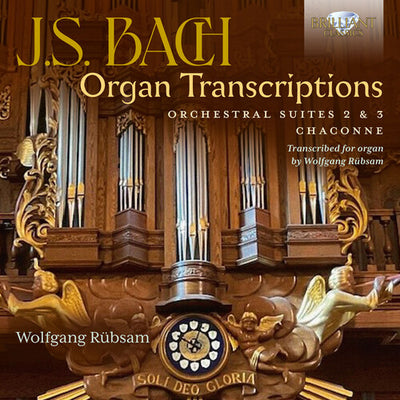
Bach: Orchestral Suites 2 & 3; Chaconne - Transcribed for Organ / Wolfgang Rübsam
Brilliant Classics
CD
$6.99$13.99Save 50%Nov 17, 2023
Over the course of more than half a century, Wolfgang Rübsam has consistently brought new insights to bear on the keyboard music of Bach, firstly in sets of the canonic organ music for Philips, then the same for Naxos. In the last few years, his musicianship and understanding of Bach enriched by those decades of experience, he has turned to the harpsichord/piano repertoire for Brilliant Classics. A series of critically acclaimed albums has shed new light on The Well-Tempered Clavier, the Goldberg Variations, the Partitas and Toccatas with Rübsam’s performance of them on a lautenwerk – a ‘lute-harpsichord’ with a distinctive chime and colour which Bach himself would have been familiar with. Rübsam now returns to the organ, with new transcriptions and recordings of two Orchestral Suites and Chaconne from the D minor Partita for solo violin. While the Chaconne has attracted transcribers and arrangers ever since the 19th century, drawn magnetically to its evolving variations on a ground bass which accumulate an emotional power unusual even for Bach, the Orchestral Suites are much less often encountered outside their original garb. Yet we can be sure that Bach himself would have embraced Rübsam’s idea with enthusiasm. The Suites themselves are compilations of dances, probably not all originally designed for their eventual destination as high-class entertainment music for the concert series at Café Zimmermann in Leipzig, and Bach repurposed some of their movements as sinfonias and even choruses for his church cantatas. As in his fairly free transcription of the Chaconne, Rübsam has made full use of the instrument at his disposal, a magnificent Casavant instrument (1998) at the Church of St. Louis, in St. Paul, Minnesota. The booklet includes a full disposition for the organ as well as an essay introducing both the works and Rübsam’s uniquely imaginative approach to them. ‘If the sound of the lute-harpsichord highlights Bach’s debt to French lute music, especially in the First Prelude, the instrument clarifies that homage while Rübsam’s interpretation transcends it.’ (Fanfare, November 2018, The Well-Tempered Clavier, 96750)
Masterpieces of Baroque piano literature, in critically acclaimed recordings by pianists with a fine sensibility for the 18th century. Recordings made between 2005 and 2023; new booklet essay; an ideal budget introduction to the world of the Baroque keyboard, full of elegant dances and virtuoso playing. This survey of Baroque composers ranges from the high-point of 18th-century keyboard writing, the Goldberg Variations of Bach, to little known gems such as the sonatas by Espona, Galuppi and Giustini. It places the three great masters of the Baroque - Bach, Handel and Rameau - in the context of their influential predecessor, Sweelinck, and then those composers such as Galuppi and Espona who write in a new, galant style which overlaps with the Classicism of Mozart. Some of the artists on these recordings are still in their 20s, having grown up with a culture of historically informed performance practice which they then bring to their handling of a modern piano. Others, such as Yuan Sheng and Wolfram-Schmitt Leonardy, have been playing these pieces for many decades, and bring to them a career's worth of experience in teasing out the meaning and rhetoric of 18th-century phrasing and harmony on an instrument which none of the composers ever encountered. Handel is represented not by the familiar Eight 'Great' Suites but by an imaginative collection of earlier suites. Scarlatti's fertile invention is generously celebrated with 35 of his sonatas. Bach predominates, naturally, with the Six Partitas and the Italian Concerto as well as the Goldbergs, thus representing the stylistic range of his output. Keyboard styles from all over mainland Europe make an appearance, in the Dutch/Italian nobility of Sweelinck, the Hispanic-Italian flavour of Scarlatti, the French accents of Bach and Handel, and native French of Rameau, and the exuberantly Italian flourishes and proto-operatic gestures of Galuppi and Giustini. There is something here for everyone.
This 19th volume of Haydn's complete symphonies coincides with the 40th anniversary of Il Giardino Armonico, the ensemble created and conducted by Giovanni Antonini, artistic director of the Haydn 2032 series. Il Giardino has made it's mark on the baroque world with it's revolutionary approach to Vivaldi, but Haydn has long been part of the Italian group's history, and Symphony No. 44, featured in this volume, was the first work by Haydn performed by the ensemble and Antonini. The title of this symphony, known as the "Funeral Symphony", inspired the inclusion in this programme of Scheidt's Paduana Dolorosa, published in 1621 at the beginning of the bloody Thirty Years' War, and Arvo Part's Da pacem Domine, dedicated to the memory of the victims of the 2004 Madrid train bombings: 'It's contemplative fixity and the sad Paduana dolorosa take on an almost cathartic function which, in my opinion, shows a perfect integration between music that is so stylistically and chronologically distant,' says Antonini, who also conducts Symphonies Nos. 108 (1762) and 52 (1771).
For the last four years, IGOR LEVIT’s name has been the first to be mentioned whenever there has been talk of the most exciting of the younger generation of pianists. What is so surprising about Levit is not only the maturity of his interpretations, but his boundless appetite for new repertoire of works as difficult and demanding as possible. Following his landmark recording, Beethoven – The Late Piano Sonatas, for which he has won international acclaim, Levit is again tackling another complex and difficult major work, J.S. Bach’s six partitas. Written between 1726 and 1730, the partitas BWV 825-830 are considered one of Bach’s masterpieces and are among the most difficult and challenging works for piano. Igor has studied Bach’s work extensively and has reached a deep understanding of the partitas allowing him to play them with such emotionality and musical “thirst” that this recording will be a benchmark for all other pianists.
Igor Levit has received international acclaim since he appeared as the youngest artist ever at the Arthur Rubinstein International Piano Master Competition in 2005, where he won four awards. Born in Russia, Levit moved to Germany with his family at the age of eight. He is a graduate of the Hochschule fur Musik in Hannover, where he achieved the highest grades in the academy’s history.
2018 release. Since 1939, the Vienna Philharmonic's New Year's Concert has become a tradition and the world's most famous classical music event. The list of names of leading conductors who have led the Vienna Philharmonic's New Year's Concerts reads like a veritable who's who of great maestros: Herbert von Karajan, Lorin Maazel, Claudio Abbado and Gustavo Dudamel to name a few. For the New Year's Concert 2018 world-renowned conductor Riccardo Muti returns to conduct the New Year's Concert for the fifth time. He has conducted the Vienna Philharmonic for over 500 concerts, has a very close connection to the orchestra and is one of the most engaged New Year's Concert conductors. Italian conductor Muti holds two music directorships: the Chicago Symphony Orchestra and the Orchestra Giovanile Luigi Cherubini. A prolific recording artist, Muti has received dozens of honors, titles, awards and prizes throughout his career. The Vienna Philharmonic's New Year's Concert is unique and has often been imitated, but not equaled, with a live broadcast on television in over 90 countries around the world with over 40 million viewers. The repertoire for the New Year's Concert features works by members of the Strauss Family - Johann Strauss, father and son, as well as Eduard and Josef Strauss. Old favorites from their works are played alongside others that have never been recorded or are rarely heard. All of them programmed around two fixed points in the concert, The Blue Danube Waltz and the Radetzky March.
Bach's Coffeehouse brings together a selection of Apollo's Fire recordings - old and new alike - featuring repertoire that is believed to have been performed at Cafe Zimmerman in Leipzig, the city where Johann Sebastian Bach served as Cantor. Coffee houses were all the rage at the time, centres for socialising and musical soirees. Bach would have found respite from his formal duties as Cantor, by curating informal concerts at the thriving coffee emporium. Bach's Coffeehouse features new recordings of Brandenburg Concerto No. 4 with virtuoso soloists Alan Choo, the Singaporean violinist and Assistant Artistic Director of Apollo's Fire, and recorder player Daphna Mohr; the Double Concerto for Oboe and Violin with Debra Nagy and violinist Johanna Novom; and "Air on a G String" from Orchestral Suite No. 3. Rounding out the album, Apollo's Fire brings back catalogue favourites by two of Bach's contemporaries: Telemann's swaggering Don Quixote Suite, and Vivaldi's fiery "La folia", featuring Alan Choo and Spanish violinist Francisco Fullana.
For the first time with naïve, the counter-tenor Andreas Scholl joins the Accademia Bizantina and Alessandro Tampieri to present a Neapolitan programme, centred on the Virgin Mary.
Andreas Scholl and the Accademia Bizantina have for several decades enjoyed a successful musical partnership, encompassing the whole Baroque repertoire. As usual, this new album together includes both renowned and less well-known vocal and instrumental pieces. The figure of Mary, which has inspired a huge repertoire, both sacred and profane, runs through this Easter programme of exquisite affliction, virtuosic for both voice and orchestra. “Neapolitan music has a unique melodic vein and a great capacity to communicate emotion profoundly," says Alessandro Tampieri.
Thus, Vivaldi’s iconic Stabat Mater, which the German counter-tenor has enjoyed singing for many years, is placed alongside lesser-known airs from oratorios by Nicola Porpora and Leonardo Vinci, which had the character of the Virgin sung by a castrato. “I endeavour to place humanity before gender," says Andreas Scholl, “and I interpret the role of Mary with the greatest sincerity, without the slightest notion of 'travesty’. Love, despair and pain transcend the notion of gender."
We also find a Salve Regina by Pasquale Anfossi, requiring a particularly participative orchestra, a sonata by Angelo Ragazzi and a violin concerto by Pergolesi, both strongly echoing Pergolesi’s famous Stabat Mater. The solo violin parts are played by Alessandro Tampieri, first violin of the Italian ensemble, who conducts here from his instrument in the purest tradition of the Baroque orchestra.
American Orchestral Music / Falletta, NOI Philharmonic
Naxos
CD
$19.99Nov 24, 2023
JoAnn Falletta conducts the National Orchestral Institute Philharmonic in works by four extraordinary mid-20th-century American composers who helped shape the country’s musical destiny: Aaron Copland, Walter Piston, Paul Creston and Ulysses Kay. Includes two world premiere recordings – Paul Creston's Saxophone Concerto and Ulysses Kay’s poignant and elegiac Pietà.
Corelli: Violin Sonatas, Op. 5 / Rachel Barton Pine
Cedille
CD
$19.99Sep 13, 2024
For her 24th recording for Cedille Records, violinist Rachel Barton Pine joins forces with period instrument specialists David Schrader, John Mark Rozendaal, and Brandon Acker to record Arcangelo Corelli's seminal set of 12 Violin Sonatas, Op. 5. "An exciting, boundary-defying performer" (Washington Post), Pine has been described as "a most accomplished Baroque violinist, fully the equal of the foremost specialists" (Gramophone). Known for her versatility across a vast repertoire - from Renaissance to heavy metal - she has studied period performance practice extensively and performs on the viola d'amore, renaissance violin, and medieval rebec. She has appeared as soloist with Apollo's Fire, the Seattle and Indianapolis Baroque Orchestras, Baroque Band, and Ars Antigua, and has performed concertos with Nicholas McGegan, Jeannette Sorrell, and Frans Bruggen. Published in 1700, Corelli's Twelve Violin Sonatas are foundational in the evolution of both the sonata and concerto forms. This recording explores these compositions through a historically informed approach, utilizing an array of period instruments, each chosen to enhance the expressive nuances of Corelli's music. Reflecting the era's experimental spirit, the ensemble embraces the interpretative freedom suggested by Corelli's original scores. Schrader alternates between organ and harpsichord, Rozendaal between violoncello and viola da gamba, and Acker performs on theorbo, archlute, and baroque guitar. Pine, inspired by the versatility of her colleagues, performs the famous "Follia" variations (Sonata No. 12) on an original-condition Gagliano viola d'amore, exploring this rarely used instrument in an authentic historical context. Corelli: Violin Sonatas, Op. 5, was produced and engineered by the Grammy-winning team of James Ginsburg and Bill Maylone. It was recorded on February 21, 23, and 25, 2024 and April 29-May 2, 2024, at Nichols Concert Hall in Evanston, IL.
Johann Kuhnau-Bach's immediate predecessor as Thomaskantor-in an 8-CD box that offers more than a mere collection of works: the individually issued recordings from 2013 to 2022 by Opella Musica, Camerata Lipsiensis, and Gregor Meyer are brought together as a complete sacred corpus with editorial coherence, making audible how Leipzig's church music takes shape at the threshold of the eighteenth century and beyond. From intimate, chamber-scaled pieces to representative festive compositions, one can trace how compositional technique, the relationship between voices and instruments, and the overall sonic architecture gain definition in the early decades of the eighteenth century-a sounding point of reference for what Bach would later adopt and develop in Leipzig.
Peace I Leave With You - Music for the Evening Hour
Coro
CD
$20.99Apr 05, 2024
CORO Welcomes The Choir of Magdalen College, Oxford, to the label.
In their first recording for CORO, The Choir of Magdalen College, Oxford, under the direction of Mark Williams, explore the repertoire that has provided the bedrock of the college’s musical life for the last 500 years, all of which was written for the end of the day.
Much music associated with evening time is naturally calm and soothing, satisfying those seeking transcendental beauty in the form of unchallenging ‘sound baths’. However, this collection also seeks to challenge, contrasting contemporary settings with music from the 16th century. We hope, through this range of works, to capture something of that liminal space between day and night characterized by Evensong and to lead the listener into that ‘peace that passes all understanding’.
The album showcases works by composers from John Sheppard to Joanna Marsh and features much-loved pieces such as Hubert Parry’s Lord, let me know mine end and John Tavener’s The Lord’s Prayer, as well as new additions to the Evensong repertoire such as Grayston Ives’ In pace and Piers Connor Kennedy’s O nata lux.
Following their critically acclaimed albums of Schubert (BIS-2597), Mozart and Birchall (BIS-2647), works for clarinet trio (BIS-2535) and, more recently, Beethoven and Berwald (BIS-2707), the Wigmore Soloists now turn their attention to twentieth-century English chamber works which, while eschewing some of the continent’s modernist tendencies, are both deeply personal and supremely written, highlighting the specific colors of each of the instruments.
Howard Ferguson’s Octet, a direct and engaging work, was the first of his works to attract attention. Ferguson’s skill is brilliantly demonstrated in this tonally ambiguous work, which takes its instrumentation from Schubert’s famous Octet.
The main characteristic of Sir Arthur Bliss’s Clarinet Quintet, like those of Mozart and Brahms with the same instrumental line-up, is its intense, overtly emotional lyricism, but the sunny, extrovert aspects of Bliss’s character ultimately prevail in the brilliantly energetic finale.
Robin Holloway’s Serenade in C for octet is the most recent work on this disc, and also features the instrumentation of Schubert’s Octet, which the composer acknowledges as a model. Few contemporary composers display as keen a sense of humor as Holloway who wished here to give “an affectionate twist to tonal common practice and light-music clichés all the way from Biedermeier Vienna to Southend Pier”.
Antonio Salieri, Complete Works for Harpsichord & Piano
Dynamic
CD
$16.99Jun 20, 2025
Antonio Salieri was influential as an opera composer and later in life as a teacher to the likes of Beethoven, Schubert and Liszt - quite unlike the sinister and entirely fictional portrayal he received in the film Amadeus. Both of his keyboard concertos were composed during his early years in Vienna and reflect influences from Haydn and the galant style of Johann Christian Bach. The Harpsichord Concerto in B flat major is broader and more elaborate but lighter in mood when compared with the stormy first movement of the Harpsichord Concerto in C major. Heard here in it's world premiere recording, the Keyboard Sonata in C major presents as a suite of short independent pieces, while the short March in D major has only recently been discovered in a Berlin archive.
Clyne: Abstractions; Within Her Arms; Abstractions; Restless
Naxos
CD
$19.99Sep 26, 2025
Anna Clyne, described as a 'composer of uncommon gifts and unusual methods' by The New York Times, is one of the most in-demand composers today, working with orchestras, choreographers, filmmakers and visual artists around the world. Clyne's unique voice combines tradition with postmodern techniques, giving her listeners a sense of musical adventure that is grounded in the past. From the beautiful elegy Within Her Arms to the defiant power of Restless Oceans, Anna Clyne's music strikes a positive and resilient tone.
This first recording of the Eule Organ of Magdalen College, Oxford (opened in January 2023) features a wide range of music performed by Alexander Pott. From Wagner to Delius, the repertoire showcases the instrument's German Romantic heritage as well as it's suitability for English 20th-Century transcription, thanks to it's distinctive voice, colour, breadth and sensitivity.
Wonderland is full of magic and myth. Containing exclusively works commissioned by The King’s Singers across their 55 years, the album celebrates their trademark musical storytelling, with no shortage of comedy. György Ligeti’s six Nonsense Madrigals, each setting playful children’s poetry or extracts from Lewis Carroll’s Alice’s Adventures in Wonderland,provide a musical spine to the album, commemorating 100 years since the composer’s birth in 1923. From just over 50 years ago, the fairytale The Musicians of Bremen (1972) – set to music by the Australian composer and Master of the Queen’s Music Malcolm Williamson – sits alongside Time Piece (1972) by Paul Patterson, which tells an eccentric alternative creation story. These myth-based works have recent companions such as Judith Bingham’s extended work Tricksters (2019), which unearths what could happen if miscreants from different world mythologies could come together for the first time, and Ola Gjeilo’s A Dream within a Dream which questions the very nature of perception and reality. The album also features the legendary Japanese film and game composer Joe Hisaishi’s first ever choral work, I was there (2022),focussing on the cultural memory of tragic events such as 9/11 and the 2011 Japan Earthquake. Themes of hope and positivity,centred on the natural world,emerge in Makiko Kinoshita’s Ashita no uta (Song for tomorrow) (2020) and Francesca Amewudah-Rivers’ Alive (2022).
Arcadian Dreams: the title conjures pastoral perfection, an idyllic vision rooted in Greek mythology. Equally, it references the Arcadian Academy established in Rome in 1690, a vibrant hub of intellectual and artistic creativity whose influence quickly spread across Europe.
Arcadian Dreams assembles an exquisite group of composers-both esteemed and inspired-including the French luminaries Thomas-Louis Bourgeois, Louis Antoine Lefebvre, and Jean-Philippe Rameau; the Neapolitan maestro Domenico Scarlatti, who lived his last 35 years in Spain; and the German-born George Frideric Handel, whose early Italian career left an indelible mark on his masterpieces.
The enchanting realm of Arcadian Dreams abounds with gods and goddesses, shepherds and nymphs, and bucolic dreamscapes, creating an aural tapestry of pictorial, secular cantatas intertwined with entrancing instrumental numbers. The fearless young soprano Hannah de Priest, making her recording debut, vividly captures the essence of these beguiling works, alongside the entrepreneurial early music ensemble Les Délices, whose members bring long-forgotten music alive for contemporary audiences.
"[De Priest] sings with radiant tonal beauty ... always with compelling expressiveness. Her coloratura is both fluent and effortlessly produced... her colleagues in Les Délices ... help create vocal chamber music of the highest order. Together, their embrace of a variety of colors and subtle flexibility of phrasing add immeasurably to the quality of this recital... A most welcome release.” --Early Music America (Ken Meltzer)
"I’m thrilled that more audiences will learn what we already know in Chicago: Hannah De Priest is a star... on an upward trajectory as a leading interpreter of 17th and 18th century repertoire, [she] caps a breakout season... with her debut solo album. Referencing both Greek mythology and the Arcadian Academy in 17th century Rome, Arcadian Dreams features secular Baroque cantatas by Rameau, Handel, Thomas Louis Bourgeois, and Louis Lefebvre with Les Délices, an early music ensemble founded by baroque oboist Debra Nagy. De Priest’s rise as a Baroque specialist is linked with Les Délices and their breakout debut at the 2023 Boston Early Music Festival... The album also includes Albinoni’s Oboe Sonata in C major and a keyboard sonata by Domenico Scarlatti, showcasing Nagy and harpsichordist Mark Edwards." --WFMT Classical (Oliver Camacho)
Miho Hazama, J.S. Bach, John Zorn, & Claude Debussy: Crossin
Avie Records
CD
$19.99Feb 06, 2026
This thoughtfully conceived, beautifully executed, and boldly multi-idiomatic new album is a state-of-the-art insight into the unique soundworld of the contemporary marimba. It is also a portrait of the imaginative virtuosity of one of the instrument's finest practitioners engaging in the worlds of both contemporary classical music and jazz with equal devotion and insight. Her choices on this project display the creative boldness that has defi ned her entire career.
The Lost Generation - Apostel, Busch & Kauder / Botstein, The Orchestra Now
Avie Records
CD
$19.99May 24, 2024
If you’ve seen the Leonard Bernstein biopic “Maestro”, you’ve seen and heard The Orchestra Now, the exceptional ensemble that appears in the movie’s Tanglewood Music Festival scene. The Orchestra Now (TON), a New York-based graduate-level training orchestra comprised of the most vibrant young musicians from around the globe, was founded by conductor, educator and music historian Leon Botstein, whose insatiable curiosity has resulted in rescuing countless musical works from oblivion. Their first recording for AVIE, “The Lost Generation”, brings together three German-speaking composers who were contemporaries of Arnold Schoenberg and Alban Berg, but whose music became supressed by historical events of the 20th century.
In November 2022, TON gave the US premiere of Hugo Kauder’s Symphony No. 1, a “splendid” work that “made a splash” (New York Classical Review). The largely self-taught Moravian-born composer had a distinguished career in Vienna until he was forced to flee the Nazis and arrived in New York in 1938. The first of Kauder’s five symphonies was dedicated to Alma Mahler. Whilst his musical language is rooted in the tradition of Johannes Brahms and Gustav Mahler, he forged an individual voice with his ease and flexibility of harmonic and metrical shifts.
German-born, Austrian composer Hans Erich Apostel studied with Schoenberg and Berg. His works incorporated his mentors’ expressionism and 12-tone methods in equal measure. The Nazis deemed Apostel’s music “degenerate”, but he lived out his life in Vienna until his death in 1972. His Variations on a theme by Haydn, performed frequently in the mid-20th century, is an homage to the second movement of Haydn’s Symphony No. 103, the “Drum Roll, which itself comprises variations on a theme.
Adolf Busch, one of the most celebrated violinists and chamber musicians of the 20th century, was also a prolific composer. A staunch opponent of Nazism, he left his native Germany, arriving first in Switzerland and eventually the United States in 1939. A late Romantic compositional style imbues his Variations on an Original Theme, originally for piano four hands and presented to his wife as a Christmas present in 1944. Busch’s longtime chamber music partner and son-in-law, the pianist Rudolf Serkin, frequently performed the work with his son Peter, who made this orchestration of his grandfather’s composition, in a familial labor of love.
The acclaimed Schubert symphonies recordings by B'Rock Orchestra and Rene Jacobs now appear in a complete boxset. Finally recording Schubert offered Jacobs the opportunity to return to his first great musical love. His interpretation is rooted in profound research into early nineteenth-century developments and ideas, as well as a thorough exploration of Schubert's music and persona. Jacobs perceives this cycle as a series of multiple contrasting tandems of symphonies, oscillating between Italianate lightness and darker currents of Romanticism, between elegant forms and expansive endeavours, all in line with Schubert's dynamic, multi-faceted personality. Schubert's symphonies never acquired the paradigmatic status of his contemporary Beethoven, but with these recordings, Jacobs makes a compelling case to value and understand them on their own terms. He performs these works together with B'Rock Orchestra, one of the most adventurous period instrument ensembles of our times, with whom he has built up a congenial working relationship. In addition to his Schubert symphonies, multi-award-winning conductor Rene Jacobs released Haydn's Stabat Mater (2023) on PENTATONE, together with the Kammerorchester Basel and Zurcher Sing-Akademie. B'Rock Orchestra returned to the label with Antwerp Requiem (2022) and Handel: Water & Fire (2023).