Classical CDs

    Solo Musica

    Eberl: Rediscovered - 3 String quartets, Op.13 / casalQuartett

    CD · 1 disc

    $10.49 $20.99 Save 50%
    Composer
    Eberl, Anton
    Artist
    Casal Quartett
    Released
    Apr 15, 2022
    In the course of their research for the five-part recording production "Beethoven's World 1799-1851" (2020), the casalQuartett came across not only Carl Czerny, one of Beethoven's two pupils, represented by his 28th String Quartet in A flat major, but also the Viennese composer Anton Eberl (1765-1807), who was Mozart's friend and pupil. As an outstanding pianist and composer, he achieved great popularity and, after returning to Vienna from St. Petersburg, had even more prominent supporters than Beethoven. His life ended unexpectedly at the zenith of his success in 1807. His music, as can be seen in the excellent recordings of the symphonies by Concerto Köln and the piano sonatas by Luca Quintavalle, is often surprisingly modern for its time. Like Mozart's late works and those of the new Beethoven, they augur the revolutionary dawn of Romanticism. The casalQuartett has received numerous awards, including the ECHO KLASSIK 2010, 2015, 2017, the Pizzicato Award Luxembourg, the DIAPASON Decouverte, the DIAPASON d'Or, the German Record Critics' Award and has been nominated three times for the ICMA Award and the American Grammy.
    View full page
  • Eberl: Rediscovered - 3 String quartets, Op.13 / casalQuartett
    Sale

    Eberl: Rediscovered - 3 String quartets, Op.13 / casalQuartett

    Solo Musica Apr 2022
    1 disc
    CD
    $20.99 $10.49Save 50%
    Chandos

    Coates: Orchestral Works, Vol. 4 / Wilson, BBC Philhamonic

    CD · 1 disc

    $10.99 $21.99 Save 50%
    Composer
    Eric Coates
    Artist
    BBC Philharmonic
    Released
    Jul 26, 2024
    John Wilson's fourth volume devoted to music by Eric Coates opens with Music Everywhere, a rousing march that was commissioned by Britain's first independent TV and radio service, Rediffusion, for use as it's signature tune. The concert waltz Footlights is a life-affirming evocation of the glamour of the inter-war West End, created just weeks before the start of the Second World War. In wartime, as it turned out, the demand for refreshing, morale-boosting music would be higher than ever. Coates's 'Souvenir' I Sing to You was premiered on 14 March 1940 - the week in which wartime meat rationing was introduced in the UK. Composed for his young son Austin, The Three Bears Phantasy transports the Goldilocks fairytale firmly into the 1920s. From Meadow to Mayfair reflects Coates's own journey from rural Nottinghamshire to life in London. Under the Stars, composed in 1928, marks the first inclusion by Coates of an alto saxophone in his orchestration. The Four Centuries Suite is one of Coates's most substantial compositions - not only in length, but also in the size of the orchestra. It's four movements evoke the musical styles of the seventeenth, eighteenth, nineteenth, and twentieth centuries. Dedicated to his wife, Phyllis, the work is also a celebration of the couple's lifelong love of dancing.
    View full page
  • Coates: Orchestral Works, Vol. 4 / Wilson, BBC Philhamonic
    Sale

    Coates: Orchestral Works, Vol. 4 / Wilson, BBC Philhamonic

    Chandos Jul 2024
    1 disc
    CD
    $21.99 $10.99Save 50%
    Naxos

    Alfano: Suite romantica; Una danza / Grazioli, Milan Symphony

    CD · 1 disc

    $9.99 $19.99 Save 50%
    Composer
    Franco Alfano
    Artist
    Vittorio Rabagliati, Davide Vendramin, Giuseppe Grazioli
    Released
    Apr 12, 2024

    Franco Alfano possessed an innate melodic facility combined with a talent for unexpected timbres. From the neo-Classical Divertimento to the noirish post-war Nenia, the lightness of touch of Amour… Amour… to the impressionistic Una danza and luxuriously orchestrated Suite romantica, each work reveals a different aspect of this multifaceted composer. This release of world premiere recordings features the Orchestra Sinfonica di Milano conducted by Giuseppe Grazioli who makes his Naxos début.

    REVIEW:

    Franco Alfano (1875–1954) remains a marginal figure in musical life despite a fair degree of coverage in record catalogs. Yet he is a thoroughly original composer, one who possessed an innate melodic gift combined with a talent for unexpected timbres, as can be heard in the lavishly orchestrated Suite romantica. The half-hour work is heard on this album in a very colorful and expressive, excellently performed interpretation.

    With Una danza, completely different colors are expressed and one may hear an influence of Debussy. This is followed by Nenia, a somewhat melancholy solo piece for accordion, sensitively played by Davide Vendramin, which finds its counterpart in the Aria of the Divertimento, even if the outer movements are very lively and playful.

    The program, pleasing and excellently played, ends with the Waltz Amour… Amour…, originally composed for piano in 1901 and orchestrated in 1928.

    -- Pizzicato

    View full page
  • Alfano: Suite romantica; Una danza / Grazioli, Milan Symphony
    Sale

    Alfano: Suite romantica; Una danza / Grazioli, Milan Symphony

    Naxos Apr 2024
    1 disc
    CD
    $19.99 $9.99Save 50%
    Chandos

    J. Mendelson & Bacewicz: Chamber Works / Silesian Quartet

    CD · 1 disc

    $10.99 $21.99 Save 50%
    Composer
    Joachim Mendelson, Grazyna Bacewicz
    Artist
    Karolina Stalmachowska, Piotr Salajczyk
    Released
    Jul 07, 2023

    The award-winning Silesian quartet present a new album featuring two composers from Warsaw – Joachim Mendelson and Graznya Bacewicz. After completing his music studies in Warsaw and Berlin, Joachim Mendelson moved to Paris in 1929, where he joined the Association des Jeunes Musiciens Polonais, a society founded in 1926 to facilitate the study, publication, and promotion of the works of young Polish composers. Bacewicz also received support from the Association, and from Paderewski, and studied in Paris with Nadia Boulanger. The associations’ aims included re-establishing a national musical life at the highest level back in Poland (after more than a century of joint occupation by Russia, Prussia, and Austria), and both composers returned to Warsaw and worked there until 1939. Mendelson taught at the Institute of Music, and Bacewicz became leader of the Polish Radio Symphony Orchestra and continued her career and a composer and soloist. Mendelson was imprisoned in the Warsaw ghetto until 1943 when he was murdered by the Gestapo. Five of his works survive, thanks to the French publisher Max Eschig, including the quartet and quintet recorded here. Both Bacewicz works on this recording were rejected by the composer, and never included in her catalogue of works. It is extremely lucky that the manuscripts have survived, preserved at the National Library in Warsaw. Half a century after her death the Royal String Quartet prepared performing scores and gave the first performances.

    View full page
  • J. Mendelson & Bacewicz: Chamber Works / Silesian Quartet
    Sale

    J. Mendelson & Bacewicz: Chamber Works / Silesian Quartet

    Chandos Jul 2023
    1 disc
    CD
    $21.99 $10.99Save 50%
    Naxos

    Fairouz: Native Informant / Pine, Imani Winds

    CD · 1 disc

    $9.99 $19.99 Save 50%
    Composer
    FAIROUZ, MOHAMMED
    Artist
    Steven Spo, Christopher Thompson, Rachel Barton Pine, Mellissa Hughes, David Kravitz, David Krakauer
    Released
    Mar 26, 2013


    FAIROUZ Tahwidah. 4 Chorale Fantasy. 2 Native Informant: Sonata for Solo Violin 3. Posh. 4 For Victims. 2,5 Jebel Lebnan 6 • 1 Mellissa Hughes (sop); 1 David Krakauer (cl); 2 Borromeo Str Qrt; 3 Rachel Barton Pine (vn); 4 Christopher Thompson (baritenor); 4 Steven Spooner (pn); 5 David Kravitz (bar); 6 Imani Winds • NAXOS 8.559744 (78:22 Text and Translation)


    This exceptionally varied and complex album features five first recordings of works by young American-Arabic composer Mohammed Fairouz (b. 1985), whose Piano Sonata impressed me when I reviewed the DVD by pianist Steven Spooner. I bristled, as I always do, to read the dreaded and hackneyed words on the CD insert that Fairouz “is one of the most frequently performed, commissioned, and recorded composers of his generation ” (italics mine). Well, what the heck generation could he possibly be part of but his own? Did you expect him to be the most frequently performed and recorded composers of his father’s generation?


    But promotional semantics aside, Fairouz is a remarkably talented and highly original composer—no more so than some others nowadays who, living in America, combine the music of their ethnic cultures with European and/or American classical structures, but certainly one of the most interesting and communicative of such composers, which I suppose is what moves him to the top of his profession. Certainly, any CD that displays the combined talents of such well-known and/or outstanding talents as the Borromeo Quartet, Rachel Barton Pine, Steven Spooner, and the Imani Winds—all of whom, incidentally, are on my short list of favorite performers whose recordings I try to seek out for review—is testimony enough to the high quality of Fairouz’s music.


    We begin this journey with Tahwidah, the setting of a poem by Mahmoud Darwish for soprano and clarinet. The text—which, surprisingly, is actually included in the booklet (along with all the other sung texts on this disc)—concerns the lullaby of a mother to her son, only to discover at the end that she is singing this at his funeral. The music is thus lyrical but strangely dissonant, beginning with exotic and difficult runs and trills on the clarinet, into which the soprano voice intermixes in a surprising and interesting fashion. Thank heavens, Mellissa Hughes has a pure, radiant voice, devoid of unsteadiness or wobble, and her singing is extraordinarily well phrased and emotionally moving. As in the case of so many modern-day sopranos, however, her English diction is exceedingly poor. Without the text to follow, you won’t be able to make out a single word. A small but important criticism, not meant in a mean-spirited way, but Mellissa, please work on your diction!


    This is followed by Chorale Fantasy, which the composer describes as a song that combines the Arabic mode maqam “with gentle counterpoint,” leading from a songlike melody to a whirling dance. It was commissioned by the Borromeo Quartet, which plays it here. Perhaps not so curiously, the Solo Violin Sonata—commissioned by and played by Rachel Barton Pine—almost sounds, in its first movement, like an extension of the quartet, so lyrical and songlike is its melodic structure.


    I was stunned here by the extraordinary range of colors that Pine extracts from her instrument, ranging from bright, sharply pointed passages reminiscent of Heifetz to warm, rich playing in the mid and lower ranges that sounded like Oistrakh. The second movement, “Rounds,” is a vigorous Arabic round dance (as per the composer’s notes), played with tremendous passion and energy, following which is a lament for the civilian victims of the Egyptian Revolution. This movement, which begins and ends very high up in the violin’s range, moves down to mid-range chordal passages which later incorporate microtonal slides (probably Arabic influenced) and, as in so much of Fairouz’s music, an exceptional singing quality that I feel is related to the song tradition of such composers as Ned Rorem. The composer describes the fourth movement as “just plain fun,” based on “the retro spirit of New York’s cabaret music,” supposedly emulating Gershwin and Porter, but I heard this music as oddly related to Eastern European folk-dance music and Eastern European-American forms, yet with an Arabic accent. At one point, Pine is required to play pizzicato counterpoint to her own top line on the violin. The final movement, which combines the feeling of both a lullaby and a lament, is titled “Lullaby of the ex-Soldat.” Fairouz says that he also conceived this movement as a tribute to Pine’s baby daughter Sylvia Michelle as a “celebration of birth and renewal.” With the possible exception of the first movement, I’d say that Fairouz has accomplished a Herculean task here, writing a sonata for unaccompanied violin that doesn’t owe much to the solo violin sonatas and partitas of Bach. I can only hope that it becomes a staple of the violin repertoire. This is, by the way, also the longest work on this disc.


    Following this is Posh, a short song cycle (three pieces totaling 8:22) based on poems by Wayne Koestenbaum. These poems are not intended to “tell a story,” but merely to give an indication of a life: one song (poem) of a baby and his inability to cope with life without help, of “deadbeat dads” and dreams of the future; the second of a hapless adolescent searching for Ned Rorem songs; and third of an adult whose father “brings to mind the self-slaughtered Walter Benjamin.” This cycle is sung by “baritenor” Christopher Thompson, who has an unusual velvety timbre and, yes, qualities of both baritone and tenor. His diction is also superb, in sharp contrast to Hughes, and in the second song he makes one smile with his unusual way of bringing humor out when he sings. As usual, Spooner’s playing is also excellent, albeit subdued in this particular role as accompanist. Fairouz’s scoring for the piano here is primarily that of gently rocking notes and/or soft chime chords.


    For Victims is described as “a dramatic scene for baritone and string quartet” based on two poems of David Shapiro, but although there are two movements only the second includes the sung poems. Here the Borromeo Quartet plays with a sense of sadness combined with drama, the music in the first movement vacillating between Eastern and Western modes, occasionally juxtaposing themes rather than engaging in actual development. As it turns out Shapiro’s poems, like many similar works, are about the Holocaust, the first a memorial to its victims and the second a personal memory of his grandfather emerging “in a synagogue” with his “sweet tenor coloratura” while he wonders if the dead are “permitted to sing.” Here the quartet’s role is more subdued and subservient to the vocal line. Baritone David Kravitz, unfortunately, has a woofy and tremulous voice, and his diction is only occasionally clear, which is very unfortunate as the music is exceptionally interesting and well written.


    The last work, Jebel Lebnan, translates as Mount Lebanon, and is a lament for the lives lost at the massacres at the Sabra and Shatilla Refugee Camps caused by Phalange Party chief Bashir Gemayel. An interlude for flute is followed by a funeral march entitled “Ariel’s Song,” then a “reawakening” musically described by a celebratory dance to the resilience of the Lebanese people. The final movement, “Mar Charbel’s Dabkeh,” is yet another Arabic round dance. Since I am a huge fan of the Imani Winds, perhaps I am prejudiced in favor of nearly all their performances, which I always find to be rhythmically incisive, colorful in their manipulation of timbre and accent, and emotionally involved in every respect, thus I was immediately rapt by their extraordinary treatment of the opening passage, described by the composer as “a wild scream” for clarinet and piccolo. The music here, punctuated by interjections from the horn and clarinet, is continually underscored by a staccato ostinato figure played by the bassoon. The solo flute interlude is lyrical, yet with telling pauses in the musical line possibly indicating thought or meditation on the part of the flutist. It has a particularly forlorn sound that, to me, indicates such emotions. Interestingly, the solo bassoon line which opens “Ariel’s Song” sounds like a continuation of the flute lament. The other instruments of the quintet enter and exit, either singly or in pairs, but the bassoon generally dominates this lament. (I would also like to point out, for the benefit of those who don’t know, that the Imani Winds are four-fifths women musicians, which I believe is somewhat unique in the classical world.) The dance movement, surprisingly, also starts out slowly, only gradually increasing the tempo within the first dozen or so bars. It’s a cheerful little piece but not terribly uptempo—more of a relaxed dance than a frenetic one. After a short pause in the middle, Fairouz switches gears to his “little song,” which is more meditative and reflective than celebratory. This, in turn, leads into the “Dabkeh” or round dance, which begins with meditative passages played by the flute but then moves into a very sprightly dance rhythm. An Arabic round dance this may indeed be, but to my ears it has a great similarity to a horah!


    Despite my small reservations on the diction of two of the singers and the singing voice of a third, I consider this one of the most interesting, varied, and engaging classical albums of the year so far, and one I shall undoubtedly be putting on my Want List.


    FANFARE: Lynn René Bayley
    View full page
  • Fairouz: Native Informant / Pine, Imani Winds
    Sale

    Fairouz: Native Informant / Pine, Imani Winds

    Naxos Mar 2013
    1 disc
    CD
    $19.99 $9.99Save 50%
    Naxos

    Guerra-Peixe: Symphonic Suites Nos. 1-2 / Thomson, Goiás Philharmonic Orchestra

    CD · 1 disc

    $9.99 $19.99 Save 50%
    Composer
    Cesar Guerra-Peixe
    Artist
    Neil Thomson
    Released
    Jul 08, 2022

    César Guerra-Peixe was one of the most versatile Brazilian musicians of the 20th century, gaining a particular mastery of orchestration and creating his own inimitable sound through extensive work in radio, television and cinema. The toe-tapping dance rhythms and lyrical expressiveness in his two Symphonic Suites were inspired by research into Brazilian folk traditions, further enhanced by a broad range of vibrantly eloquent global influences. The light-hearted Roda de Amigos mischievously caricatures Guerra-Peixe’s musical circle of friends and their various woodwind instruments.

    REVIEW:

    This may be the finest release to date in Naxos’ ongoing Brazilian music series. César Guerra-Peixe (pronounce it “Gweha-Peysh,” more or less) had a relatively long and productive life–1914-93. He was a violinist, teacher, arranger, creator of music for radio, television and film, and an ethnomusicologist, among other things. In his early years, he dabbled in serial (twelve-tone) composition, and it served him well in these two colorful symphonic suites. Both works date from the 1950s, and celebrate the rhythms and percussive sonorities of Brazilian dance music–from the states of São Paulo and Pernambuco respectively–but with a combination of harmonic sophistication and crystal-clear orchestration that makes them models of their kind. Guerra-Peixe’s folk inspirations come out sounding thoroughly modern, more like Bartók, for example, than the early romantic nationalists, and so the result, with its ample use of ostinatos and repetitive gestures, gives the impression of simplicity without ever turning simplistic. They are fresh, vital, and wholly winning.

    Roda de Amigos (“Circle of Friends”) is a witty suite in four movements capturing the characters of some of Guerra-Peixe’s musician colleagues: grumpy, stubborn, melancholic, and mischievous respectively. Scored for small ensemble, each movement features a difficult and brilliant woodwind solo, starting with the bassoon and working through the section with clarinet next, then oboe, then flute. The music is genuinely witty, and admirably suited to the emotional character that each movement describes. Kudos to the woodwind soloists of the Goiás Philharmonic, who sound absolutely world-class in each of their turns in the spotlight. Indeed, conductor Neil Thomson galvanizes his forces to deliver performances of all of this music that, in their clarity, vitality and drive, present this splendid music in the best possible light, and the sonics are really vivid too. If you’re looking for a new discovery that you’ll play and enjoy often, then you’ll definitely want to get this terrific disc forthwith.

    --ClassicsToday.com (10/10, David Hurwitz)

    Another exceptionally interesting and valuable release as part of Naxos’ “The Music of Brazil” series. 

    Apart from the specific quality of these individual scores, a significant part of the value of this disc is to add another name to the lengthening list of Latin American/Brazilian composers of real worth and talent. For too many years Villa-Lobos alone represented his country’s music to the wider world. Certainly César Guerra-Peixe deserves to be placed alongside his compatriots such as Camargo Guarnieri, Claudio Santoro, Antonio Carlos Jobim, Edino Krieger, Alexandre Levy, Oscar Lorenzo Fernandez, Francisco Mignone, Alberto Nepomuceno, and, of course Heitor Villa-Lobos.

    A genuinely important and enjoyable disc.

    --MusicWeb International (Nick Barnard)

    View full page
    Naxos

    Delius: A Mass of Life, Idyll / Opie, Hill

    CD · 2 discs

    $14.99 $29.99 Save 50%
    Composer
    DELIUS, FREDERICK
    Artist
    Hill, Watson, Opie, Wyn-Rogers, Kennedy, Bournemouth So, David
    Released
    Jun 26, 2012


    To witness a performance of Delius’s A Mass of Life, arguably his supreme creative achievement, is to look into the heart of the composer and his Nietzsche-inspired world. Moreover, this ravishing music, written between 1898 and 1905, represents Delius at the height of his powers, when musical ideas seemed to pour out of him at a time when he had finally learned to assimilate, in an entirely individual, not to say maverick manner, a confluence of modernist styles embracing Grieg, Wagner, Strauss, Charpentier and Debussy.

    There is no doubt from the vivid opening choruses of Parts 1 and 2 of this recording (and what openings!) that the message of the work is a life-affirming one. There is a dynamic momentum to the tempi which perfectly evokes Zarathustra’s ruling passion, the Will of Man, and there is a richness to the orchestral sound which adds to the sense of muscularity. The chorus negotiate Delius’s often awkward vocal intervals with great skill and the intonation is virtually flawless. Just occasionally the sheer weight of the orchestral sound, which is quite forward on this recording (more so than Hickox), is apt to overwhelm the voices but this is a minor distraction.

    Hill brings energy and élan to the third section, ‘In deine Auge’ (for me perhaps the most exhilarating section of Part 1), where the parallel with the end of Act 2 of Die Meistersinger is almost palpable and where the most unusual example of a Delius fugue (!) is given life, vigour and meaning.

    Alan Opie, who has the lion’s share of the solo music in the work, is almost Wotan-like in his performances. From his first Nietzschean dance he is majestic and brings out of the score that vibrant, heady, Teutonic contemporaneity with which Delius had clearly become enthralled at this point in his career. Opie’s singing of what is effectively the role of Zarathustra has immense authority and his impressive range (up to high G) is ideal for Delius’s onerous vocal demands.

    Andrew Kennedy, Catherine Wyn-Rogers and Janice Watson also offer fine lyrical interpretations of their solo parts and the choral accompaniments are allowed to intermingle subtly as an extension of the orchestra. The BSO are on fine form too, and special mention needs to be made of the haunting horn-playing in the introduction to Part 2 (‘On the Mountains’), a sound which sums up so much of Delius’s nature music.

    This is a must for any Delius Liebhaber and, with the added bonus of the late Prelude and Idyll, a marvellous starting point for anyone new to Delius’s unique but compelling art.

    -- Jeremy Dibble, Gramophone
    3622320.az_DELIUS_Mass_Life_Prelude.html

    DELIUS A Mass of Life. Prelude and Idyll1 • David Hill, Cond; 1Janice Watson (sop); Catherine Wyn-Rogers (mez); Andrew Kennedy (ten); 1Alan Opie (bar); Bach Ch; 1Bournemouth SO • NAXOS 8.572861-62 (2 CDs: 118:19 Text and Translation)

    A Mass of Life is quintessential Delius, musically and existentially, composed over 1904–05 in the first great rush of his maturity. From the bounding affirmative choruses to the breathtakingly sustained nature contemplations, from the melancholy to the ecstatic, the Mass of Life traces and forecasts the gamut of Delian affect with a concision, fullness, and abundance he might rival but never achieve so comprehensively again. Unless I’ve missed something, this is but the fourth recording of the work since Beecham’s nonpareil 1952 account. Though its musical demands are daunting—if nowhere near as challenging as those of Mahler’s “Symphony of a Thousand,” with which it invites comparison—the primary bar to frequent performance is its text, drawn by Delius’s friend Ernst Cassirier largely from the Dance Songs of Nietzsche’s Also sprach Zarathustra. For those coming in late, one recalls the oft-quoted passage in Eric Fenby’s Delius as I Knew Him: “When, one wet day … he was looking for something to read in the library of a Norwegian friend … and had taken down a book, Thus Spake Zarathustra—a book for all and none—by one Friedrich Nietzsche, he was ripe for it. The book, he told me, never left his hands until he had devoured it from cover to cover. It was the very book he had been seeking all along, and finding that book he declared to be one of the most important events of his life. Nor did he rest content until he had read every work of Nietzsche that he could lay his hands on”—to which Fenby, a devout Catholic, adds—“and the poison entered his soul.” For listeners and performers today it may still be something of a jolt to find, in place of the supplicating Kyrie that the unfortunate term “Mass” leads one to expect, a glowingly charged hymn to the Will, “dispeller of need, my own necessity,” followed by Zarathustra’s brief praise of laughter (“My own laughter I pronounced holy”), succeeded by Zarathustra’s love duet with Life in a meadow filled with dancing girls, an archetypal encounter transpiring in a mythical dimension “beyond good and evil,” beyond place and time, crowned by the first, murmured, utterance of the Bell Song, the work’s central mystery. A Mass of Life may, of course, be enjoyed for its power and sensuous magic without reference to its text, but only to those nurtured on Nietzsche will it reveal its full import. Shrugging incomprehension of the text renders Benjamin Luxon’s Zarathustra, for Charles Groves (with the London Philharmonic Chorus and Orchestra), merely mellifluous, while Peter Coleman-Wright’s deadpan delivery for the late Richard Hickox—with the Waynflete Singers directed by today’s conductor, David Hill, and the Bournemouth Symphony Chorus and Orchestra—proves anesthetically workmanlike. When it appeared in 1997, I rated that reading, on Chandos, the best since Beecham’s (Fanfare 20:6). That honor goes now to the present offering. While Alan Opie does not efface memories of Bruce Boyce, for Beecham—whose delivery resonated from the nexus of Delius’s realization of Nietzsche—he teases the text gingerly, making a credible Zarathustra. In some numbers, Delius asks the soloists to share parts, with some of Zarathustra’s lines persuasively taken by Andrew Kennedy, and a portion of Life’s happily rendered by Janice Watson, though Catherine Wyn-Rogers’s beguiling, seductive Life recalls Monica Sinclair’s divinatory geste for Beecham. The choral work is beyond praise, though in Hill’s brisk approach the melting lyricism heard chez Beecham tautens and leaps.

    Idyll is a late reworking of music from Margot la Rouge, composed in 1902 for the new opera competition offered by the music publisher Sanzogno. Though it failed to score and was not heard in Delius’s lifetime, it comes from the composer’s ripest years and contains gorgeous swaths of his richest utterance, which he salvaged in 1932, recomposing it to words by Whitman and making an extended love duet of it. Idyll has not lacked for vocally lustrous, persuasive performances submerging Whitman’s quaintness (“Behold me when I pass, hear my voice, approach, draw close, but speak not. Be not afraid of me”) in absolute conviction. Of major interest, the lovingly lingering 1981 account led by Eric Fenby—who took down the score from dictation by the blind, paralyzed Delius—features Felicity Lott and Thomas Allen (deleted Unicorn-Kanchana UKCD 2073). Meredith Davies’s still-available 1968 tilt at Idyll, with the Royal Philharmonic Orchestra, is made memorable by the divinatory partnership of Heather Harper and John Shirley-Quirk. In keeping with his go at the Mass of Life, Hill pushes the work a bit, spurring the impassioned moments to escalate from the pervasive tone of wistful elegy. Opie, as the anonymous man, is authoritatively resonant, in response to Janice Watson’s brightly edged soprano (touched by a bit of vibrato), with its gloriously amber lower register, buxomly filling the part of the nameless woman.

    One caveat: In the headnote the title of the work is given per the album, but you will search the catalog of Delius’s works in vain for an orchestral Prelude. The work so designated is simply the first three minutes—an orchestral prelude, to be sure—of Idyll and has never, until now, been listed separately. The fake title generates a phantom work to bedevil buyers, scholars, and connoisseurs, and detracts from—rather than adding to—the program’s generosity.

    Sound packs an immediate wallop making for occasional congestion. In the opening chorus, for instance, the leaping underlining of trombones and tubas becomes indistinct, overwhelmed by choral mass, and while one can pick out the glockenspiel, its function of festive accentuation is lost. In quieter passages, and in the capture of the vocalists, on the other hand, this upfront take is gratifyingly welcome. In German, Zarathustra’s pronouncements recall and parody the Lutheran Bible, in light of which the ostensibly stilted thee-ing and thou-ing of William Wallace’s singing translation—made for Beecham and used by him for all of his public performances (according to notes by Delius aficionado Lyndon Jenkins)—fall into place, if not quite into King James English. Whitman’s text is included.

    In sum, a superb production and the grandest addition to the Delius discography in many years. Highest recommendation.

    FANFARE: Adrian Corleonis
    View full page
  • Delius: A Mass of Life, Idyll / Opie, Hill
    Sale

    Delius: A Mass of Life, Idyll / Opie, Hill

    Naxos Jun 2012
    2 discs
    CD
    $29.99 $14.99Save 50%
  • Dvorak: Stabat Mater; Serenade for Strings
    Sale

    Dvorak: Stabat Mater; Serenade for Strings

    Brilliant Classics Aug 2011
    2 discs
    CD
    $13.99 $6.99Save 50%
  • Un Siecle de Musique Francaise: Pierre Boulez
    Sony Masterworks

    Un Siecle de Musique Francaise: Pierre Boulez

    CD · 1 disc

    $3.49 $6.98 Save 50%
    Composer
    BOULEZ, PIERRE
    Artist
    Various
    Released
    May 13, 2016
    This album is part of the 25-disc box set Un siècle de musique fracaise, which explores French music from the mid-19th to the mid-20th century. This disc profiles French composer Pierre Boulez, and includes his famous Le Marteau sans Maitre.
    View full page
  • Un Siecle de Musique Francaise: Pierre Boulez
    Sale

    Un Siecle de Musique Francaise: Pierre Boulez

    Sony Masterworks May 2016
    1 disc
    CD
    $6.98 $3.49Save 50%
    SWR

    Dietrich Fischer-Dieskau sings Baroque Arias (1952-1954)

    CD · 1 disc

    $6.99 $13.99 Save 50%
    Composer
    STOLZEL TUNDER BUXTEHUDE BR
    Artist
    Dietrich Fischer-Dieskau
    Released
    Aug 28, 2012
    The great bass-baritone Dietrich Fischer-Dieskau has been involved with the music of Bach throughout his career. Even as a student, he studied the cantatas and in his first Post-War concert in 1947, he was a soloist in the "St. Matthew Passion." As the singer's career progressed, performances of the music of Bach and his contemporaries became increasingly rare. However, in the 1950s, while at the beginning of his career, Fischer-Dieskau produced a series of radio recordings featuring not only the music of Bach but other Baroque composers such as Schutz, Tunder and St. Elzel.
    View full page
  • Dietrich Fischer-Dieskau sings Baroque Arias (1952-1954)
    Sale

    Dietrich Fischer-Dieskau sings Baroque Arias (1952-1954)

    SWR Aug 2012
    1 disc
    CD
    $13.99 $6.99Save 50%
    Naxos

    Poulenc: Mass in G Major… / Elora Festival Singers

    CD · 1 disc

    $9.99 $19.99 Save 50%
    Composer
    POULENC, FRANCIS
    Artist
    Elora Festival Singers, Noel Edison
    Released
    Mar 10, 2015

    One thing choirs who’ve sung Francis Poulenc’s choral works know is that he wasn’t concerned about making it easy for singers. Yet, unlike some other composers of the last (and current) century, neither was he creating difficult music just because he could. Instead, there is no similar choral repertoire by any other composer that more satisfyingly rewards the effort it takes–including a commitment of a certain level of vocal/technical skill and artistic savvy–to perform it accurately and stylishly–the rewards to the singer realized in the sheer sensual pleasure and excitement of being “inside” Poulenc’s incredible sound-world; and for the listener, you could say the same, just that the perspective is different.

    There is no choir, nor will you find a recording, that does such full justice to these great a cappella works, each chanson, motet, or Mass movement a miniature yet significant and unique masterpiece. It’s difficult to choose specific performance highlights–there are so many moments perfectly demonstrative of some or other virtuosic technical feat or lovely, breathtaking, or otherwise moving expressive musical effect, that the list would amount to citations of nearly every part of every piece. However, for sheer virtuosity, you won’t be disappointed if you begin with the Mass–the Sanctus and Benedictus are perfect examples of how these singers manage ensemble balances even in the widest-spaced textures or thorniest harmonic passages.

    Although these characteristics are consistent throughout all the performances, in Tenebrae factae sunt and Tristis est anima mea (from the Quatre motets pour le temps de pénitence) we experience the choir’s extraordinary command of ensemble balance, dynamic control, nuances of phrasing, rhythmic precision, spot-on intonation, ideal resonance in harmonies–everything combines to create the resplendent choral sound that defines these works.

    Where there is word-painting–and there are numerous instances–we “get it”; where all-important soft singing is required, the choir delivers while always maintaining intonation and ensemble balance; where the texts are in French (the Sept Chansons), we hear beautifully enunciated, expertly sung French; the bell-like sounds at the end of Par une nuit nouvelle are exquisitely executed, as are the vibrant jazz harmonies of Tous les droits, the scurrying opening lines of Marie, and those treacherous wide-open voicings at the beginning and end of Luire (sung perfectly tuned, producing a hair-raising resonance). Not to take anything away from the rest of the choir, it’s important to give special mention to those sublime sopranos, who have so many passages and individual notes that are high and very exposed, and who sing them with extraordinary confidence, clarity, and accuracy, while always mindful of the lower voices.

    Most popular among Poulenc’s choral works are surely the Christmas motets, especially the oft recorded O magnum–and here the Elora singers deliver it with a completely natural, easy flow from phrase to phrase; repeated statements (iacentem) are given emphasis without dynamic exaggeration; overall, there is a gentleness of expression coupled with an exceptional sense of devotion to the music. And devotion to the music is the key to the success of this entire program, whether conveying the joy, the sadness, or more reflective, prayerful moods and moments. Noel Edison and his singers have made perhaps their finest recording to date, a reference for choirs who follow and for listeners who want an important and enduring addition to their choral music library.

    The production and sound, overseen by Bonnie Silver and Norbert Kraft in the choir’s home venue–St John’s Church, Elora, Ontario–capitalizes on the church’s excellent choral acoustics (which somehow, in different ways, are excellent no matter whether the church is empty or full of people). Thoughtful, informative notes by Dominic Wells cap this essential release.

    -- David Vernier, ClassicsToday.com
    View full page
  • Poulenc: Mass in G Major… / Elora Festival Singers
    Sale

    Poulenc: Mass in G Major… / Elora Festival Singers

    Naxos Mar 2015
    1 disc
    CD
    $19.99 $9.99Save 50%
    SDG

    Bach: St. Matthew Passion / Gardiner, Monteverdi Choir

    CD · 2 discs

    $18.99 $37.99 Save 50%
    Composer
    BACH, J.S.
    Artist
    Gardiner, English Baroque Soloists, Gilchrist, Loges
    Released
    Mar 10, 2017


    This stunning new live recording of Bach’s St. Matthew Passion (Matthauspassion BWV 244) was recorded in Pisa Cathedral during the Anima Mundi Festival as part of the Monteverdi Choir and Orchestra’s 2016 tour. Conducted by Sir John Eliot Gardiner, the brilliant cast includes James Gilchrist as the Evangelist and Stephan Loges as Jesus. The Trinity Boys Choir adds an exciting color to this recording as well. The Monteverdi Choir was founded by Sir John Eliot Gardner in 1964. The ensemble’s first performance was the Monteverdi Vespers in King’s College Chapel, Cambridge. The group has become known worldwide for their stylistic conviction and their ability to perform an extensive repertoire, from Renaissance motets to Classical music of the Twentieth Century.

    -----

    REVIEW:

    Musically this is a very fine performance. The choir are excellent, of course, with a solid but clear and intimate sound even in the larger choruses, no end of expressive means in the chorales, and a thrilling quickness in the crowd choruses. Gardiner asks for a lot of quiet singing from them and they execute it with a superbly controlled beauty.

    The orchestra is as skilled and musical as you like in their obbligatos, and exquisitely responsive in Gardiner's subtle shapings.

    The experienced Evangelist of James Gilchrist and Christus of Stephan Loges are not to be faulted, and none of the nine young aria soloists is a weak link; each one lives up to their moment in the drama.

    All of these things you will find in many other Matthews, but you will rarely find the same careful relishing of the German text. What really makes this one special, however, is its emotional integrity, coming not from affected theatricality but from a pervading sense of profound sadness. This recording is one of Gardiner's finest achievements.

    – Gramophone
    View full page
  • Bach: St. Matthew Passion / Gardiner, Monteverdi Choir
    Sale

    Bach: St. Matthew Passion / Gardiner, Monteverdi Choir

    SDG Mar 2017
    2 discs
    CD
    $37.99 $18.99Save 50%
    Avie Records

    Messiaen: Quartet for the End of Time - Rohde: one wing / Left Coast Chamber Ensemble

    CD · 1 disc

    $9.99 $19.99 Save 50%
    Composer
    MESSIAEN ROHDE
    Artist
    LEFT COAST CHAMBER ENSEMBLE
    Released
    Mar 19, 2021

    The provocative and beguiling Left Coast Chamber Ensemble (LCCE) comprises the crème de la crème of the San Francisco Bay Area’s musicians. Their motto: nothing is out of bounds, and anything is possible. Presenters of all types of music including small ensemble, vocal, orchestral, multi-media and operatic, a select group comes together for this recording of Olivier Messiaen’s seminal chamber work, Quartet for the End of Time. Written during the composer’s confinement in World War II, he maintained hope, expressing, “The abyss is Time with its sadness, its weariness. The birds are the opposite … our desire for light, for stars, for rainbows, and for jubilant songs.” LCCE co-founder and prize-winning composer Kurt Rohde echoes this sentiment in his Messiaen-inspired one wing for violin and piano, heard here in its world-premiere recording.

    REVIEW:

    I’ve gone from having two or three recordings of this eerie but emotionally powerful work, one of them being Tashi’s, to just having one, and that is the EMI recording made under the composer’s own supervision and featuring his wife, Yvonne Loriod, as the pianist. (Interestingly, Dietrich Fischer-Dieskau’s son Manuel is the cellist in this performance.) But after listening to the Left Coast Ensemble’s new recording, I’m tempted to add it to my collection.

    Their performance is a bit brisker and tauter than either Tashi’s or Messiaen’s but not lacking in emotional intensity. Although I felt that the Left Coast Ensemble’s more linear approach gave a more “streamlined” profile to the music, this is sometimes to its favor as it brings out the structure of the work better. And as I say, the individual members of this quartet clearly get the music’s message. Indeed, I found clarinetist Jerome Simas’ long solo in the third section (“The Abyss of the Birds”) to be as forlorn as that of Wolfgang Meyer on the Messiaen-Loriod recording, and better than that of Stoltzman with Tashi.

    – Art Music Lounge

    View full page
    Naxos

    R. Strauss: Ariadne auf Naxos / Falletta, Buffalo Philharmonic

    CD · 1 disc

    $9.99 $19.99 Save 50%
    Composer
    STRAUSS, RICHARD
    Artist
    Falletta
    Released
    Feb 10, 2017
    Listen to the Naxos Podcast to learn more about this release

    I sure hope the folks in Buffalo know what a prize they have in JoAnn Falletta. Her Naxos discography has few peers in terms of imaginative programming and quality of results. The city couldn’t ask for a more positive or alluring cultural calling card, and the present release offers a case in point. There have been many fine recordings of Le Bourgeois Gentilhomme, but this one stands with the best: for clarity, elegance, distinguished solo work (superb oboe, William Preucil’s solo violin), you name it. Although scored for a chamber orchestra, it’s amazing how congested and fussy so many performances sound. Not here. Just listen to the opening processional of “The Dinner,” with its bold horns and transparent textures. Great stuff.

    However, the real item of interest is the “Symphony-Suite” arranged by D. Wilson Ochoa from Ariadne auf Naxos, the original companion work to Le Bourgeois Gentilhomme. Arranging suites from Strauss’ operas is a trend that can only be encouraged. Strauss did it himself, of course, but mostly without much enthusiasm or imagination. So here’s a case where the intervention of more caring hands is clearly called for.

    This suite, forty minutes in all, contains three chunks from the prologue and four from the opera itself. It is gorgeous. Even those who know the opera well may be surprised at how much lovely material slips by without notice in stage performances, such as the “Intermezzo” music on the second to last track here (sound clip). You do get some of the more famous bits (“Es gibt ein Reich,” for example, and the closing scene), but it really is astonishing how much care Strauss lavished on sections that flit by as mere accompaniment–never mind the thematic interest that they contain. Here, thanks to Falletta and the folks in Buffalo, in this luminously played and recorded performance, we can savor them afresh. So what are you waiting for? Go for it.

    - ClassicsToday
    View full page
  • R. Strauss: Ariadne auf Naxos / Falletta, Buffalo Philharmonic
    Sale

    R. Strauss: Ariadne auf Naxos / Falletta, Buffalo Philharmonic

    Naxos Feb 2017
    1 disc
    CD
    $19.99 $9.99Save 50%
    Signum Classics

    The London Cello Sound

    CD · 1 disc

    $5.49 $10.99 Save 50%
    Composer
    BALCOMBE BERNSTEIN CASALS R
    Artist
    The London Cello Sound, Simon
    Released
    Sep 20, 2019
    An iconic release that launched a celebrated series of 'London Sound' recordings, this album assembles an unparalleled ensemble of 40 cellos from The London Philharmonic Orchestra, Philharmonia Orchestra, BBC Symphony Orchestra and Royal Philharmonic Orchestra. David Vernier writes: "Who knows where the idea for this incredible recording came from, but be assured, you've never heard anything quite like it before. The sound of 40 topnotch cellists from four London orchestras performing Saint-Saëns's The Swan or Rachmaninoff's Vocalise is indescribable-but when you hear the rich, warm, reedy resonance, you won't forget it."
    View full page
  • The London Cello Sound
    Sale

    The London Cello Sound

    Signum Classics Sep 2019
    1 disc
    CD
    $10.99 $5.49Save 50%
    Signum Classics

    The Library, Vol. 3 / The King's Singers

    CD · 1 disc

    $5.49 $10.99 Save 50%
    Composer
    VARIOUS
    Artist
    The King'S Singers
    Released
    Jul 02, 2021
    This is the third volume in the EP series ‘The Library’ – a series that explores both the history, and the new horizons, of The King’s Singers close-harmony repertoire. Close-harmony is the part of their work for which they are best known, and their library of thousands of arrangements is one they’re determined to explore, maintain and develop. The track-listing is designed to celebrate some old favorites from the library alongside brand new arrangements and adaptations, created especially for these recordings, which may perhaps become ‘old favorites’ of the future. The King’s Singers were founded on 1 May 1968 by six choral scholars who had recently graduated from King’s College Cambridge. Their vocal line-up was (by chance) two countertenors, a tenor, two baritones and a bass, and the group has never wavered from this formation since.
    View full page
  • The Library, Vol. 3 / The King's Singers
    Sale

    The Library, Vol. 3 / The King's Singers

    Signum Classics Jul 2021
    1 disc
    CD
    $10.99 $5.49Save 50%
  • ZAL
    Sony Masterworks

    ZAL

    CD · 1 disc

    $5.99 $11.98 Save 50%
    Composer
    MAGIN, MILOSZ
    Artist
    Debargue, Kremerata Baltica, Kremer
    Released
    Oct 01, 2021
    After acclaimed recordings of music by the great masters, Lucas Debargue shines much-needed light on a composer he is determined must be heard: Milosz Magin (1929 – 1999). ‘Magin’s style is capable of both enchanting and surprising us,’ the French pianist says. ‘Few composers of his time were so open to cultivating the art of writing beautiful melodies.’ Born in Poland in 1929, Magin settled in Paris in 1960. After a car accident in 1963 he traded a career as one of Poland’s greatest pianists for that of an imaginative composer who would never forget the traditions of his homeland. Magin’s greatest inspiration was Chopin, another Pole who made Paris his home and whose piano works Magin recorded for Decca. The two composers are buried next to one another in Paris. Magin’s music shares much of the same lucid, distilled quality as that of his forbear, as well as a pianistic elegance that speaks of France and Poland in equal measure. ‘His music has been resonating in my mind’s ear for the last twenty years,’ says Debargue, whose first piano teacher was a student of Magin and ‘admired him not only as an inspired composer but also as a pianist and as a teacher whose advice on interpretative matters had often proved invaluable to her. His music has played a crucial role in my life. I grew up with it’, continues the French pianist. The pieces written for children, especially Magin’s Miniature Polonaises of which he presents Nostalgie du pays, were one of the first works he learnt with his first piano teacher.  When Debargue included Magin’s Nostalgie du pays at a recital in Paris, the composer’s granddaughter Alexandra contacted him. A correspondence began and a world of unpublished music saw the light of day.TRACKLIST1.           Andante pour violon et piano    Concerto No. 3 pour piano, cordes et percussions    2.           I. Allegro con fuoco - Allegro Appassionato    3.           II. Allegro    4.           III. Presto    5.           IV. Adagio    6.           V. Allegro con fuoco    7.           Vocalise No. 2 - Andantino    8.           Vocalise No. 3 - Vivace    9.           Nostalgie du pays, extrait des Miniatures Polonaises    Concerto Rustico pour violon, cordes et percussions    10.         I. Allegro    11.         II. Andantino    12.         III. Presto    13.         Vocalise No. 1 - Andante    14.         Vocalise No. 4 - Andantino    ​​​​​​​15.         Stabat Mater pour cordes et timbales
    View full page
  • ZAL
    Sale

    ZAL

    Sony Masterworks Oct 2021
    1 disc
    CD
    $11.98 $5.99Save 50%
    Chandos

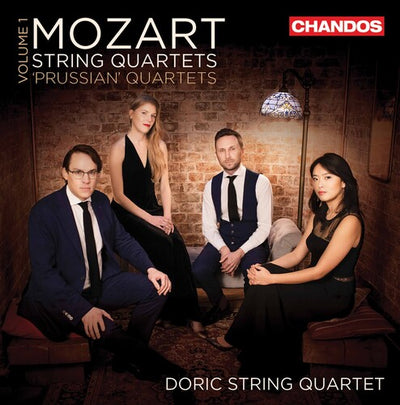
    Mozart: String Quartets, Vol. 1 - The Prussian Quartets / Doric String Quartet

    CD · 2 discs

    $10.99 $21.99 Save 50%
    Composer
    MOZART, W.A.
    Artist
    DORIC STRING QUARTET
    Released
    Jul 02, 2021

    Towards the end of his life, short of money and heavily in debt, Mozart had the opportunity to visit King Friedrich Wilhelm II of Prussia – a famous patron of the arts and a keen and above-average musician. Mozart performed for the King and left with some cash and a commission for a set of six string quartets, of which these are the only three he completed. They are ground-breaking in the way in which Mozart utilised the voicing of the instruments. King Friedrich was a viola da gamba player turned cellist, and these works feature extensive melodies for the cello, usually in a high register, thus emancipating the cello from the bass line and introducing a more evenly blended texture. Firmly established as one of the leading quartets of their generation, the Doric String Quartet enjoys a worldwide reputation and has performed at festivals and concert halls around the globe. Exclusive Chandos artists, the Quartet has drawn widespread critical acclaim for its recordings and won a number of prestigious awards.

    REVIEW:

    Their collective tone is both sweet and sinewy, with vibrato used for expressive effect rather than as a default setting. Contrapuntal textures are ideally lucid.

    – Gramophone (Editor's Choice, Sept. 2021)

    View full page
  • Mozart: String Quartets, Vol. 1 - The Prussian Quartets / Doric String Quartet
    Sale

    Mozart: String Quartets, Vol. 1 - The Prussian Quartets / Doric String Quartet

    Chandos Jul 2021
    2 discs
    CD
    $21.99 $10.99Save 50%
    Naxos

    Dyck, Sternberg, Youferov: History of the Russian Piano Trio, Vol. 5 / The Brahms Trio

    CD · 1 disc

    $9.99 $19.99 Save 50%
    Composer
    DYCK STERNBERG YOUFEROV
    Artist
    THE BRAHMS TRIO
    Released
    Jul 09, 2021

    This album concludes The Brahms Trio’s five-volume survey of the piano trio in Russia with remarkable works by composers whose names have all but disappeared from the musical world’s collective memory. Vladimir Dyck, a student of Widor at the Paris Conservatoire, took French nationality in 1910 but his life came to a tragic end when he and his family were arrested in 1943 and sent to Auschwitz. His Piano Trio, Op. 25 contrasts Russian soulfulness with the lightness and deft scoring he brought to his film compositions. Constantin von Sternberg’s genial Op.104 reflects his career as a virtuoso pianist, while Sergey Youferov’s expansive and nostalgic Op.52 is a farewell to the Russian ‘Silver Age’, a world about to be destroyed by revolution.

    View full page
    Naxos

    Danielpour: Songs of Solitude & War Songs / Hampson, Guerrero, Nashville Symphony

    CD · 1 disc

    $9.99 $19.99 Save 50%
    Composer
    DANIELPOUR, RICHARD
    Artist
    Hampson, Guerrero
    Released
    Oct 14, 2016
    Listen to the Naxos Podcast to learn more about this release

    A 60th Annual Grammy Award Nominee

    Acclaimed as one of America’s leading contemporary composers, Richard Danielpour wrote Songs of Solitude as a response to the events of 9/11. Drawing on the poems of W.B. Yeats, the work enshrines a sense of economy and sparseness, formed of a set of six powerful orchestral songs. The motivating force for War Songs was a series of photographs of the young men and women killed in the Iraq War. The song cycle, with its texts by Walt Whitman, was written for the Nashville Symphony to commemorate the 150th anniversary of the end of the Civil War. Toward the Splendid City is a portrait of New York City driven by Danielpour’s love-hate relationship with his hometown. This is vivid music, subtle tonal-modern tour de force expressions, the main works heartfelt reactions to two of the most difficult historical periods in the USA.

    ------

    REVIEWS:

    Performances are exceptionally well-wrought, detailed and strong. The sound is excellent. The music unforgettable. Very much recommended.

    – Gapplegate Classical-Modern Music Review

    Thomas Hampson…performs the music with just the right blend of evenness and emotional intensity, and the effect of the final and longest song, Come Up from the Fields Father, which lasts half the length of the whole cycle, is especially affecting here. The accompaniment by the Nashville Symphony under Giancarlo Guerrero is nuanced and subtle throughout, fitting the music very well indeed. Hampson and Guerrero are also well-teamed for Songs of Solitude.

    – Infodad.com (October 2016)
    View full page